
Fishing in Palestine Before the Nakba: Abundant Seas and Good Times
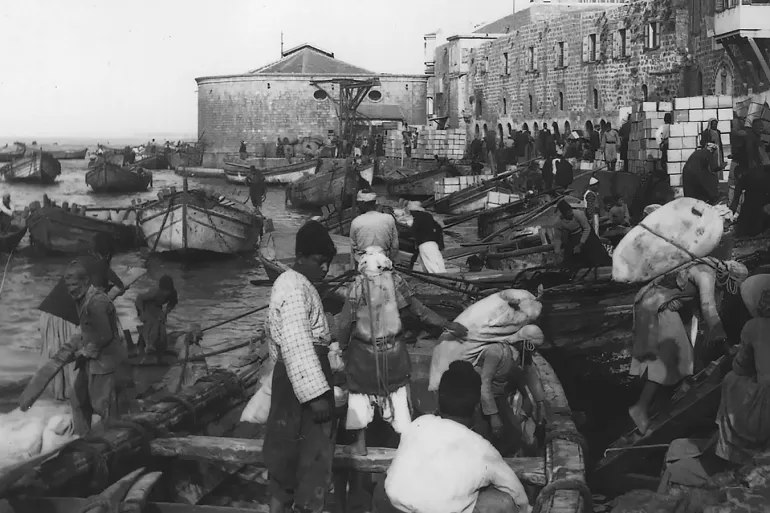
Before the 1948 Nakba, fishing sustained many Palestinian families along a coast stretching from Ras al-Naqoura to Rafah, and on the shores of Lake Tiberias and Lake Hula. The people of Jaffa, Acre, Haifa, Tantura, al-Jura, Gaza and Tiberias fished from sail- and oar-powered boats with nets they knotted by hand, in a sea that those who lived through that time remember as rich and varied. Then the Nakba uprooted the fishermen's towns and villages, turning the sea from an open source of livelihood into a closed frontier.
This article gathers what Palestinian memory and Arab and archival sources preserve about fishing before the Nakba: where people fished, with what tools, which fish they knew and when, how the catch was sold and cooked, and what changed after 1948.
Fishing Centers in Palestine Before 1948: Summary Table
| Center | Waters | Known for | Fate in 1948 |
|---|---|---|---|
| Jaffa | Mediterranean | Main port of central Palestine; flouka boats used for fishing and transport | Most of its people expelled in May 1948 |
| Acre | Mediterranean | An old fishing city where the trade passed from father to son | Occupied in May 1948; some fishermen remained |
| Tantura | Mediterranean | A coastal village living from farming and fishing | Occupied and a massacre committed in May 1948 |
| al-Jura | Mediterranean | One of Palestine's main fishing centers; also bird hunting | Occupied in November 1948; its people fled to Gaza |
| Gaza | Mediterranean | Coastal fishing and the halaqa fish auction | Received the coast's refugee fishermen |
| Tiberias | Lake Tiberias | Musht fish, sardines and a rich fish cuisine | Its Arab population uprooted in April 1948 |
| Hula villages | Lake Hula | A lake and marshes home to the Ghawarna | Villages depopulated; the lake later drained |
The Sea in Palestinian Life Before the Nakba
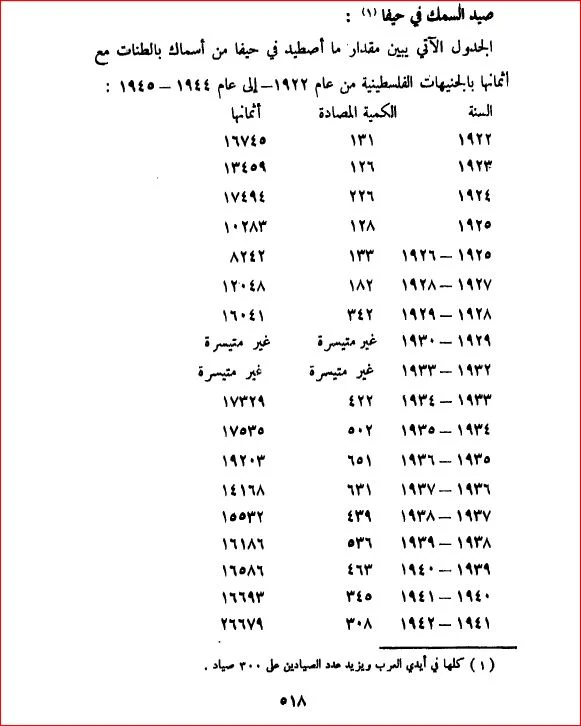
For the people of the Palestinian coast, the sea was far more than a view. It was a livelihood, a source of food, a trade route and a place of celebration. Fishermen who lived through that era describe a sea so rich that fish came close enough to shore to be caught by hand, and prices low enough for everyone. [1]
Hajj Ataallah Saadu Zeinab, born in Jaffa in 1934, recalls working as a fisherman in Jaffa, Acre and Haifa. Hajj Farid Abdel Rahim al-Najjar, born in Khan Younis in 1952, says fishermen had no need to go far, rarely venturing more than about a kilometer from shore. [1]
Fishing Centers on the Palestinian Coast
Jaffa: Bride of the Sea and Its Floukas
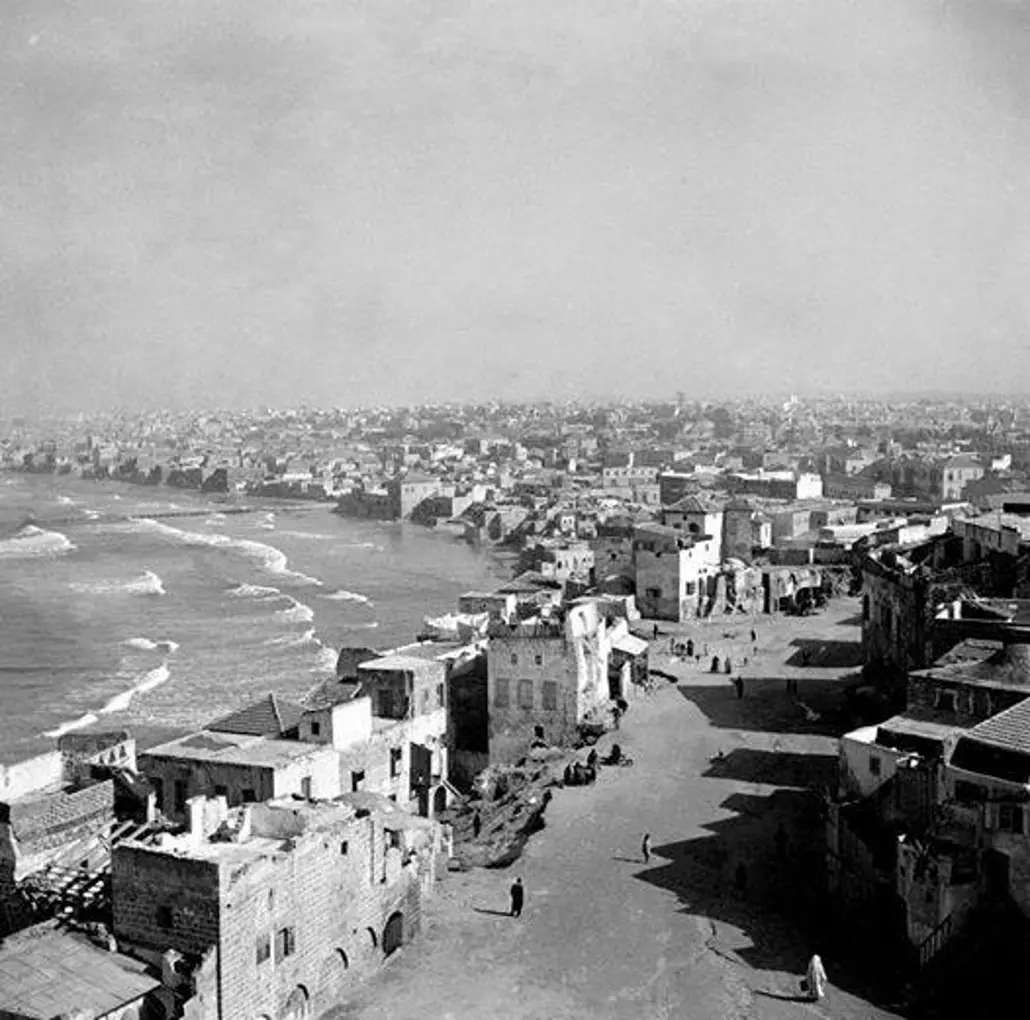
Jaffa was the main sea gateway to central and southern Palestine. Its port was known for fleets of floukas, small boats that carried goods, passengers and crates of oranges between the quay and the large ships anchored in deeper water. [2] Beyond transport, the flouka was the best-known fishing boat on this coast. [1]

Acre and Haifa: Cities That Inherited the Sea
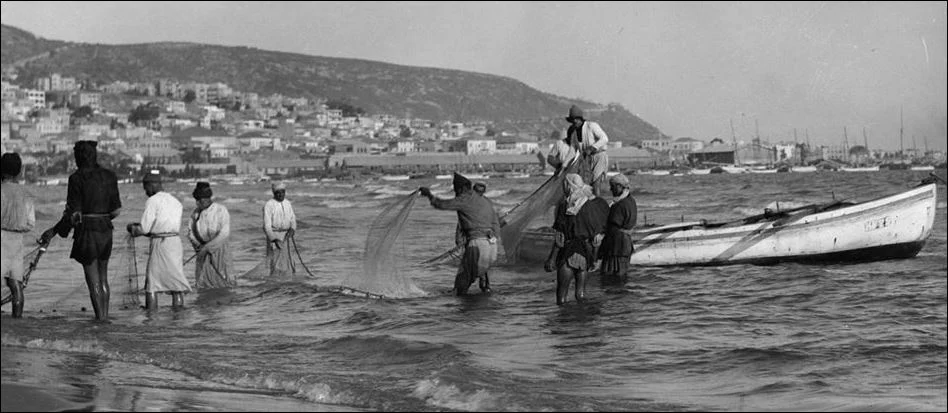
Acre is known to its people as "the fishing city," where the trade is handed down from fathers and grandfathers. As late as the early 1970s, two decades after the Nakba, about half of Acre's Arab families still made their living from fishing. [3] That alone shows how deeply rooted the trade was in the city before 1948. Haifa was among the cities where coastal fishermen worked, as the Jaffa fisherman Ataallah Zeinab recalls. [1]
Tantura: A Village on the Sand
Tantura, south of Haifa, was a coastal village of about 1,720 people before the Nakba, whose residents relied mainly on farming and fishing. [4]
al-Jura: The Fishermen's Village Near Majdal
The Interactive Encyclopedia of the Palestine Question describes al-Jura, near Majdal and Askalan, as one of the main fishing centers in Palestine. Fishing and bird hunting were its people's chief occupations, and they sold their catch in nearby towns and villages; farming came second. Some villagers also made baskets and woven nets. The village had about 2,420 residents in 1944–1945. [5]
Gaza: The Sea and the Halaqa
Gaza had fished its coast for centuries. Its fish auction system, known as the halaqa, dates back to an Ottoman civil code of 1870 and was later amended by the British Mandate's Gaza Municipality Law of 1934. [6] Fishermen from Khan Younis and Gaza sailed as far as El Arish and Sheikh Zuweid in Sinai. [1]
The Fishermen of Lake Tiberias
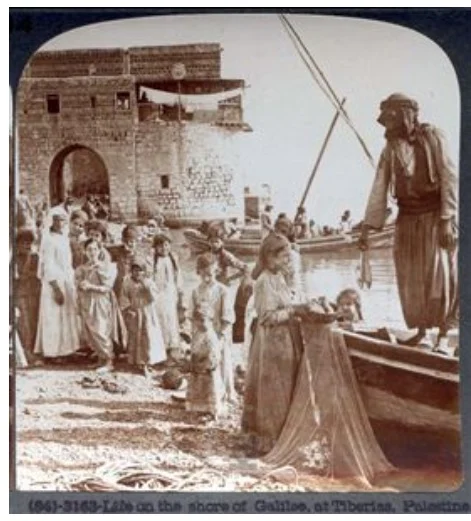
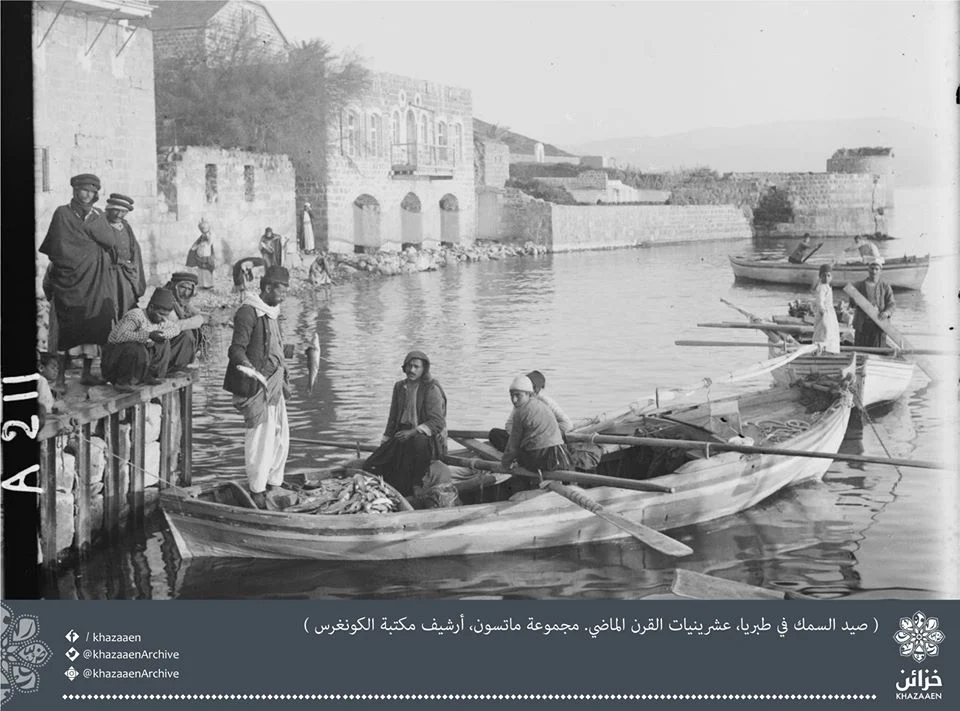
Palestinian fishing was not limited to the Mediterranean. On Lake Tiberias lived Arab fishermen from the city, known as the Tabarneh, as well as farmers and Bedouin from the surrounding villages. Much of what we know about this world comes from oral testimonies that the Palestinian outlet Metras collected from the city's displaced residents. [7]

The testimonies show that before the Mandate, fishing on the lake was more a way of life than a trade. Farmers and Bedouin fished for their households or for pleasure, while the city's fishermen specialized in night fishing from boats on behalf of the big fish merchants. [7]
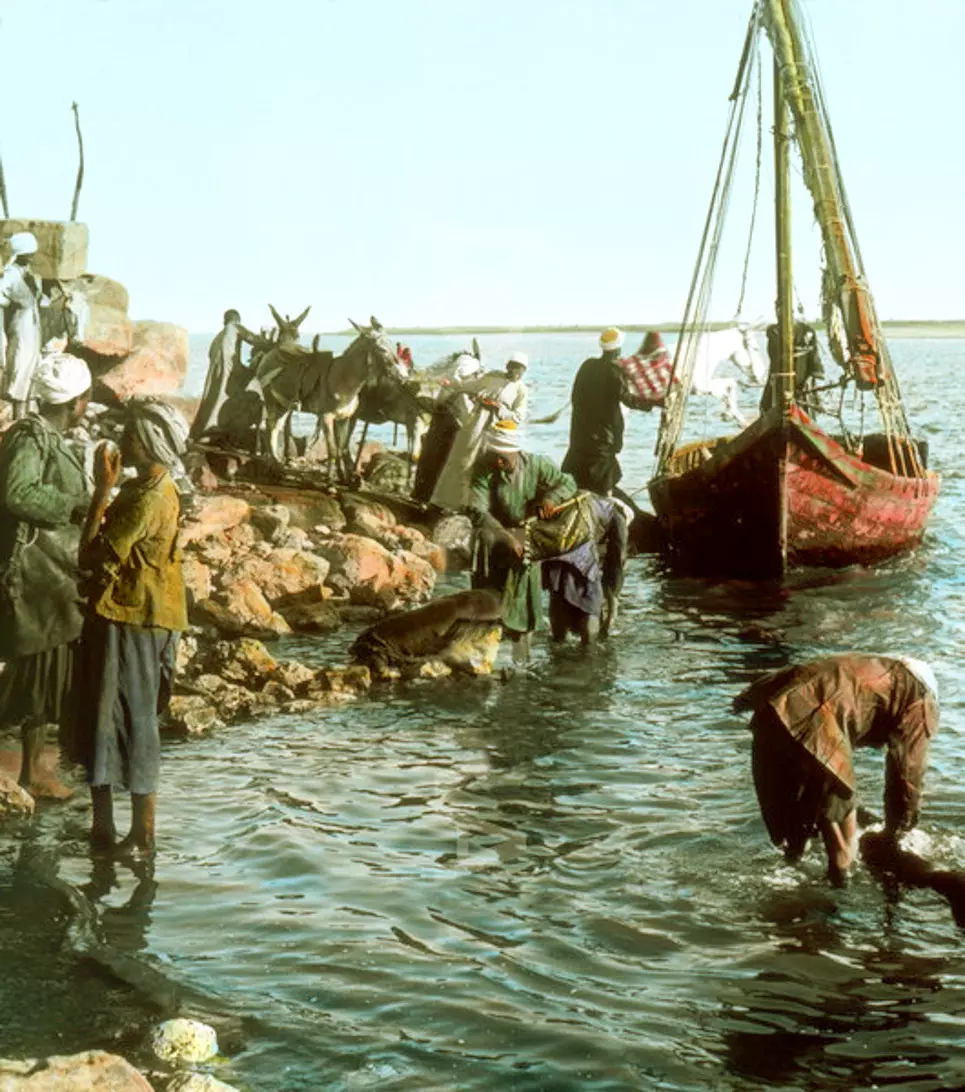
Among the villages near the lake was Tal Hum, whose people were known as Arab al-Samakiyya. They combined livestock herding, farming and fishing in Lake Tiberias. [8]
Lake Hula: The Lake of the Ghawarna
North of Tiberias lay Lake Hula and its marshes, home to the people of the area known as the Ghawarna. The Encyclopedia of Palestinian Camps notes that the lake was known for the abundance and variety of its fish. [9] After the Nakba the lake was drained, and an entire world of fishing, papyrus and marshland vanished along with its displaced people. [7]
Fishing Boats Before the Nakba
Palestinian fishing boats had no engines before the Nakba; they relied on sail and oar. [1] The best known were:
| Boat | Where used | Description |
|---|---|---|
| Shinshoula | Palestinian coast | Held seven or more fishermen; powered by sail and oars [1] |
| Flouka | Jaffa and the coast | A small, deep boat for about three fishermen; sometimes sank under the weight of the catch [1] |
| Shakhatir al-jarf | Lake Tiberias | Boats that hauled drag nets in night fishing [7] |
Fishing Gear and Methods
Handmade Nets
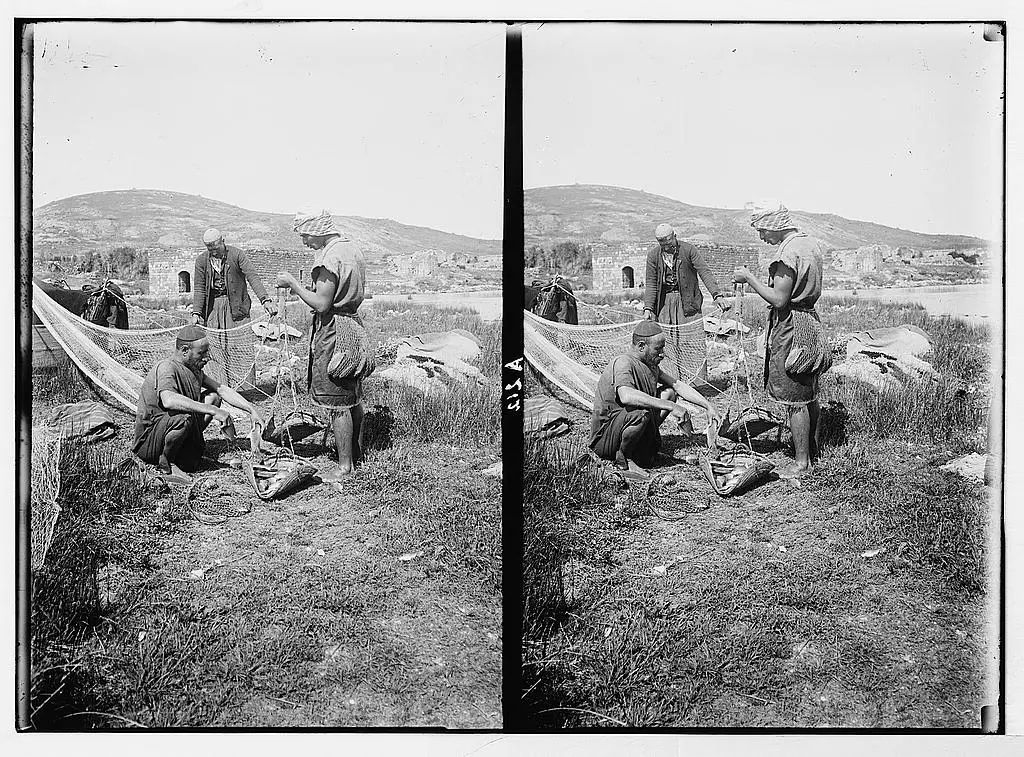
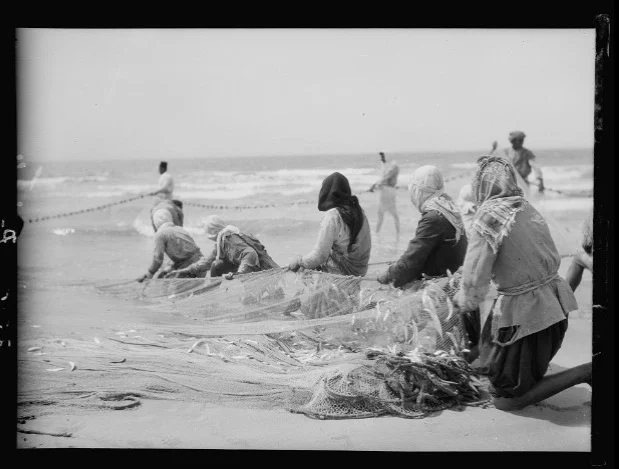
Fishermen knotted their own nets by hand. A single net took about three months to make and could cover roughly 100 square meters. [1] Women took part in knitting and sewing nets, in Tiberias as on the coast. [7] [12]
The Tarraha (Cast Net)
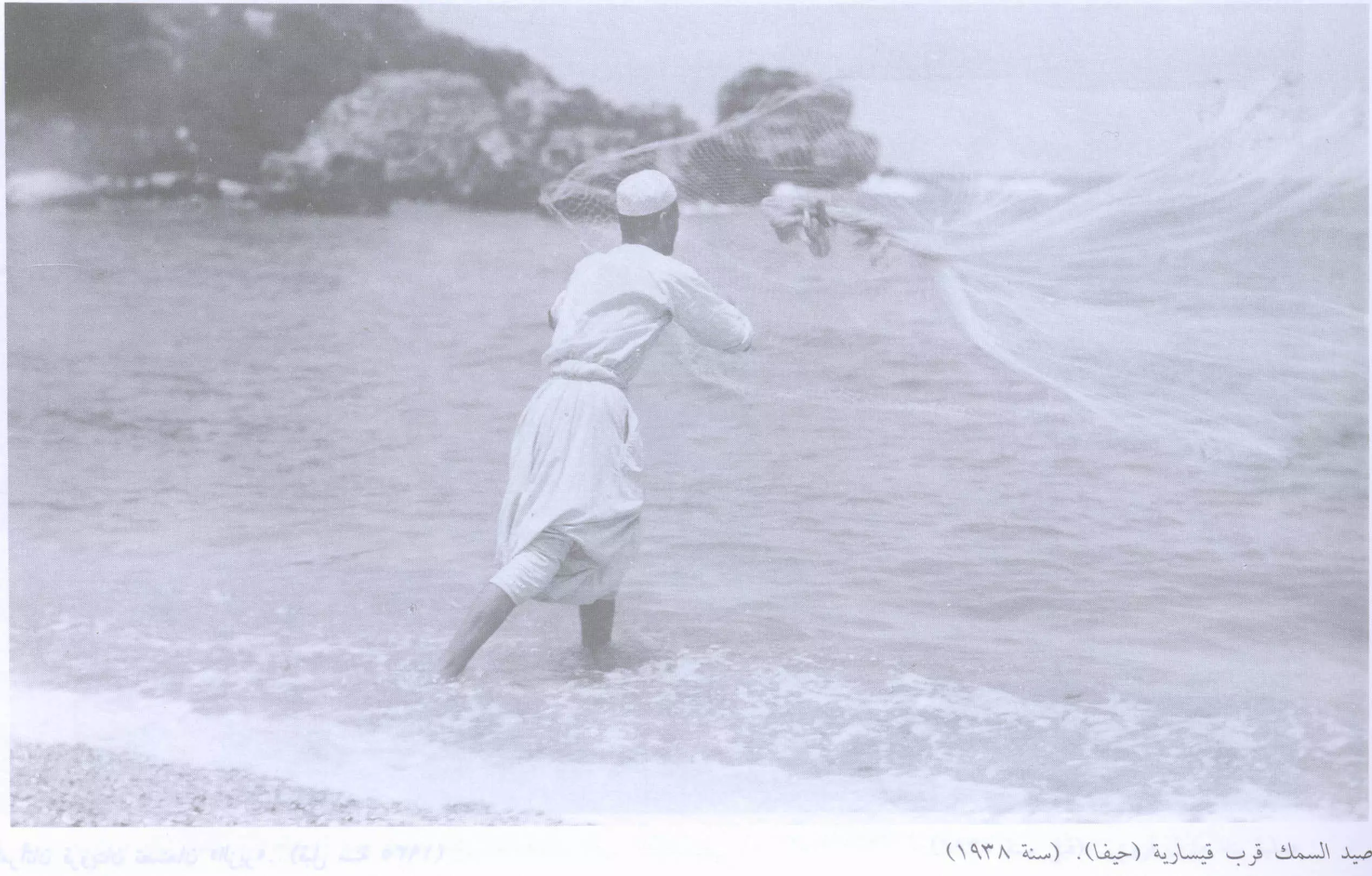
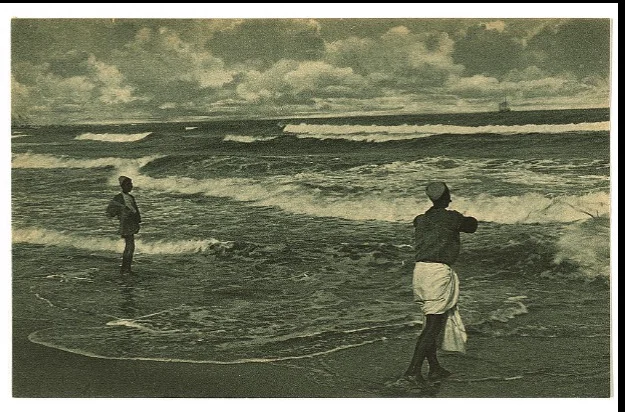
Fishermen often threw a net called the tarraha close to shore and returned a short while later with a good catch. [1]
The Jarf (Drag Net)
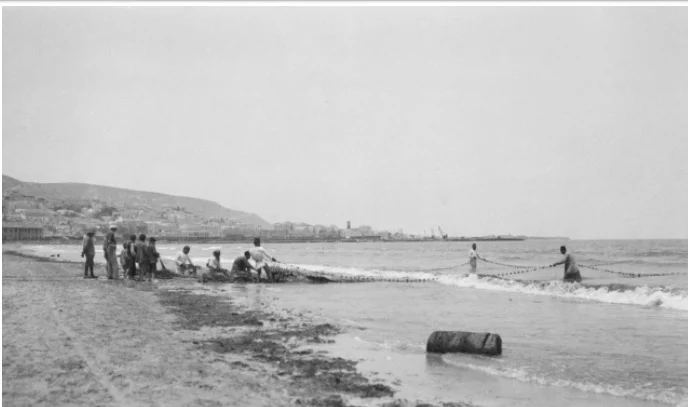
On Lake Tiberias, fishermen used drag nets (jarf), including a fine-meshed net for sardines, hauled by boats at night. [7]
._Fishing_with_drag_net._Loading_drag_net_on_boat_LOC_matpc.20778.jpg?width=800)
Hook and Line
The people of Tiberias also fished with hook and line, using lines braided from horsetail hair. [7]
Fish and Their Seasons
Fishermen who lived through that era say their sea held more than a hundred kinds of fish, and that many have since disappeared or grown scarce. [1] Among the fish that Palestinian coastal fishermen still know are sardines, mullet (bouri), ghazlan, shrimp and crabs. [11]
Lake Tiberias had more than twenty species. The best known were: [7]
- Tiberias musht: the lake's most famous fish, called "Saint Peter's fish" by Christians and bulti by Muslims. The white variety was found near al-Tabigha and the black near al-Butayha, and all of Galilee awaited its season every autumn.
- Sardines: the season began in November and lasted until late winter.
- Hafaf: a single fish could grow as long as a forearm.
- Barbut, bizri, qishra and sarkis: other species known to the lake's fishermen.
Fishermen's Customs and the Ethics of the Sea
Fishing was governed by customs that fishermen passed down. In Tiberias, they widened the mesh of their nets so small fish could escape, grow and breed. When dynamite fishing appeared, the city's boatmen rejected it, seeing it as killing the lake rather than fishing it. [7]
On the coast, fishermen remember a time of cooperation, when a fisherman would share his catch with his guests and neighbors. [1]
Fish Markets and Trade
In Tiberias, sardines were heaped on papyrus mats at the bunt, the landing place where boats docked and cafés gathered. The surplus went to Tawfiq al-Khoury's stall, the city's only wholesale fish market. The Mandate authorities required fishermen to carry a license they called the "sea passport." [7]
In Gaza, fish were sold through the halaqa auction dating back to Ottoman times. [6] In al-Jura, villagers sold their fish and game birds in the surrounding towns and villages. [5]
The Palestinian Seafood Kitchen
Fishing gave rise to a rich cuisine that is still remembered with longing. Dishes from Tiberias preserved in the testimonies include: [7]
- Sayyadiyya: musht fish with rice and onions.
- Mutabbaq: a winter dish of sardines pressed together and fried.
- Sardine kofta.
- Stuffed hafaf: fried and served with tahini.
- Barbut kibbeh: made with fish and bulgur.
The Sea as a Place of Joy: Festivals and Summer Retreats
The sea was a place of both work and celebration. Al-Jura served as a summer retreat for the people of Majdal thanks to its mild air, and it hosted an annual spring festival. [5]
On the beach south of Jaffa, the Nabi Rubin festival was held every summer. Thousands of tents went up on the sand, and between 30,000 and 50,000 people attended. [2]
How the Nakba Destroyed the Fishermen's World
In the 1948 Nakba, more than 800,000 Palestinians were displaced and Zionist militias seized hundreds of towns and villages. [1] The fishermen's towns and villages were at the heart of this uprooting:
- Tantura: occupied in May 1948. Israeli forces committed a massacre there, with testimonies estimating 200 to 250 killed, and most of its people were driven into refugee camps. [4]
- al-Jura: among the first places bombed in Operation Yoav, it was occupied along with Majdal on 4–5 November 1948, and its people fled to the Gaza Strip. Only one house remains. [5]
- Tal Hum (Arab al-Samakiyya): the village was destroyed and its people expelled, most of them to Syria. [8]
- Tiberias: its Arab population was uprooted, and some Tabarneh refugees still live on the east bank of the Jordan River, facing their lake. [7]
- Lake Hula: its villages were depopulated, and the lake itself was later drained. [7]
The fishermen of Jaffa, al-Jura, Majdal and Askalan fled south to the Gaza Strip, where many continued their trade. [6] With them traveled the craft of net-making, the names of boats and the customs of the sea. [10]
The Sea After the Nakba: From Abundance to Siege
Fishermen who have known both eras contrast a sea that was open and plentiful with one that has become narrow and meager, with fewer fish and fewer fishermen. [1]
In Gaza, fishing has been confined to a zone of 6 nautical miles in the north to 12 in the south, instead of the 20 miles set by the Oslo Accords. [12] The craft of hand-knotting nets has almost disappeared from the Strip, replaced by imported nets. [12] Since the war that began in October 2023, about 90% of the fishing assets at Gaza's port have been destroyed, and the catch has fallen from about 4,000 tons a year to under 500 tons. [11]
In Jaffa, Palestinian fishermen, estimated at about 200 in 2019, have been resisting port redevelopment plans they see as a continuation of their displacement. [13] In Acre, according to one of its last fishermen, only three fishing boats remain. [3]
Conclusion
Before the Nakba, fishing was part of the identity of the Palestinian coast and its lakes: boats driven by sail and oar, nets knotted by families, customs that protected the sea, and seasons, dishes and markets. What remains of that world lives on in the memory of refugee fishermen and their children, and in their determination to return to the sea despite the siege.
Frequently Asked Questions About Fishing in Palestine Before the Nakba
Where did Palestinians fish before 1948?
Palestinians fished along the Mediterranean coast, especially in Jaffa, Acre, Haifa, Tantura, al-Jura and Gaza, and on Lake Tiberias and Lake Hula. Al-Jura, near Majdal, was one of the main fishing centers, while Tiberias was known for its musht fish and sardines.
What kinds of fishing boats did Palestinians use before the Nakba?
The best known were the shinshoula, a large boat holding seven or more fishermen, and the flouka, a small boat for about three. On Lake Tiberias, shakhatir al-jarf boats were used for night fishing. All of them ran on sail and oars, without engines.
What was the most famous fish of Lake Tiberias?
The Tiberias musht, called "Saint Peter's fish" by Christians and bulti by Muslims. The lake also had sardines, hafaf, barbut, bizri, qishra and sarkis. The sardine season began in November and lasted until late winter.
How did fishermen make their nets?
Fishermen knotted their nets by hand, and women helped knit and sew them. A single net took about three months and could cover around 100 square meters. The best-known nets were the tarraha on the coast and the jarf in Tiberias.
What happened to Palestinian fishermen in the Nakba?
Fishing towns and villages such as Tantura, al-Jura, Tal Hum and Tiberias were depopulated, and a massacre was committed in Tantura. The fishermen of Jaffa, al-Jura, Majdal and Askalan fled to the Gaza Strip, where many continued fishing.
Why do people say the sea was richer before the Nakba?
Fishermen who lived through that era say there were more than a hundred kinds of fish, that fish came close to shore, and that they sold cheaply. Today they describe scarcity and lost species, alongside the restrictions imposed on where they can fish.
Sources and References
Arabic-language sources are listed with translated titles.
- Ahmed Saqr, "Fishing Before the Nakba: Abundant Fish and Good Times Without Siege or Occupation," Arabi21, May 16, 2023 (Arabic).
- Mahmoud Yazbak, "Jaffa Before the Nakba: A City Bursting With Life," Journal of Palestine Studies (Arabic edition), no. 93, 2013.
- Mona al-Omari, "'The Fishing City': The Occupation Fights It by Every Means," Al Jazeera Net, January 20, 2019 (Arabic).
- Nahed Dirbas, "Return to Tantura: Remembering the Palestinian Massacre," The New Arab, March 15, 2022.
- Interactive Encyclopedia of the Palestine Question: al-Jura (Gaza district).
- Izzat Feidi, "Gaza Strip Fisheries," SAMUDRA, December 2000.
- "Tiberias: The Lake's Seasons and Its Seafood Kitchen," Metras, November 8, 2020 (Arabic).
- Ali Badwan, "Tal Hum, or Arab al-Samakiyya," Diwan al-Arab, October 17, 2019 (Arabic).
- Encyclopedia of Palestinian Camps: "Al-Hula: The Lake of the Ghawarna" (Arabic).
- Nawa Network: "Messengers of the Net: Fishermen Weaving a Livelihood and Stories," testimony on net-making and a fishing family from Jaffa (Arabic).
- Amira Nassar, "'Our Souls in Our Hands': Diaries of Fishermen in Gaza's Destroyed Port," Noon Post, December 11, 2025 (Arabic).
- Sherine Khalifa, "'Your Sea, Gaza': Stories of Fishing and the Fishermen's Hardship," Nawa Network, July 16, 2023 (Arabic).
- Mohammed Mohsen Wattad, "On the 71st Anniversary of the Nakba, Jaffa's Fishermen Resist Judaization and Displacement," Al Jazeera Net, May 11, 2019 (Arabic).
Photo gallery
More from the archive
 Download Our Palestine App
The whole archive in the palm of your hand: depopulated villages, the Nakba, the massacres and Al-Aqsa — free, with no ads to erase the story.
Download Our Palestine App
The whole archive in the palm of your hand: depopulated villages, the Nakba, the massacres and Al-Aqsa — free, with no ads to erase the story.



Comments
No comments yet — be the first to write one.
Add your comment
Name and email are optional. Comments appear after review.