The Battles of Ein Mahil and Kafr Kanna 1948: When Galilee Villages Repelled the Haganah
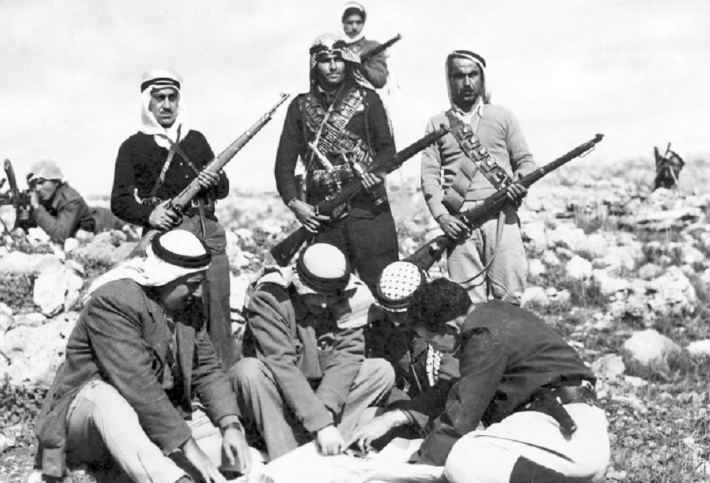
In early 1948 the villages of Lower Galilee around Nazareth became a single line of defence. When the men of Arab al-Subeih clashed with a Haganah force, fighters rushed to their aid from Kafr Kanna and Ein Mahil and inflicted heavy losses on the militias. The militias sought revenge by storming the fighters’ camps in Kafr Kanna and then Ein Mahil, and failed in both attacks, their soldiers falling one after another at the entrances of the two villages. [1]
Ein Mahil and Kafr Kanna remained witnesses to this brotherhood between villages, even when Arab al-Subeih’s turn came in May 1948 and the militias committed a massacre against them, and reinforcements from Ein Mahil and Kafr Kanna rushed to gather their martyrs. [2][3]
Contents
- At a glance
- The clash at Arab al-Subeih
- The Battle of Kafr Kanna
- The Battle of Ein Mahil
- The ambush on the Ein Mahil road
- The massacre of Arab al-Subeih
- Between the accounts
- Timeline
- Frequently asked questions about the battles of Ein Mahil and Kafr Kanna
At a glance
| Item | Details |
|---|---|
| Date | 13 and 15 January 1948 (Arab al-Subeih and Kafr Kanna), then the attack on Ein Mahil; 3 March and 6 May 1948 (Arab al-Subeih) |
| Place | Kafr Kanna, north-east of Nazareth, Ein Mahil, and the lands of Arab al-Subeih in the Nazareth district |
| Defenders | Fighters of Kafr Kanna, Ein Mahil and Arab al-Subeih under Ali al-Nimr |
| Attackers | Haganah forces, then Palmach units in May |
| Outcome of the attacks on Kafr Kanna and Ein Mahil | The militias failed and fell back |
| Ambush of 3 March | 7 settlers from Beit Keshet killed on the Ein Mahil road |
| Arab al-Subeih massacre | 6 May 1948, some 30 martyrs buried in a cave |
The clash at Arab al-Subeih
On 13 January 1948 a battle took place between the men of Arab al-Subeih and a Haganah force. Fighters rushed to the aid of al-Subeih and inflicted heavy losses on the Zionist force; this rallying to their aid was the spark that drew the militias to attack the villages from which the reinforcements had come. [1]
The Battle of Kafr Kanna
The militias learned that the fighters who had come to al-Subeih’s aid were stationed in Kafr Kanna, north-east of Nazareth, and decided to seize the village. On 15 January 1948 they advanced on it in two groups: the first headed straight for the village, its soldiers creeping up to the entrance of the fighters’ camp, while the second was tasked with encircling the village. [1]
But the first group got no further: the fighters spotted it and engaged it fiercely, quickly forcing it to retreat, and the second group halted before anyone had even engaged it. [1]
The Battle of Ein Mahil
After the failure at Kafr Kanna, the Zionist command decided to wipe out the Arab camp at Ein Mahil, and a Haganah platoon attacked the village. No sooner had its soldiers charged towards the village than they began to fall one after another under the fighters’ fire, and the attack on Ein Mahil failed just as the one on Kafr Kanna had. [1]
The failure of the two attacks showed that the villages of Lower Galilee, for all their lack of arms, could hold out when they stood together, and that the fighters’ camps in the villages were a barrier against the militias’ advance in the first months of the war.
The ambush on the Ein Mahil road
On 3 March 1948 the “First Battle of al-Subeih” was fought on the Ein Mahil road, when fighters under Ali al-Nimr ambushed a Zionist force from the settlement of Beit Keshet and killed seven of its settlers. The fighters had originally set out to help the neighbouring villages of Kafr Kanna and Ein Mahil. The Zionists afterwards resorted to British and International Red Cross mediation to recover their dead. [2]
The massacre of Arab al-Subeih
At dawn on 6 May 1948 a Haganah force of some 500 soldiers, armed with every kind of weapon, surrounded Arab al-Subeih while many of its fighters were away helping Lubya and al-Shajara. Those who remained resisted until their ammunition ran out; Ali al-Nimr was wounded and his son Hussein covered his withdrawal, after which the militias blew up his house with mines. [3][2]
The militias then went from house to house, killing women, children and the elderly in cold blood. Hajj Ismail Salama Hussein, then six, recalls hiding behind a door with his four-year-old brother Hassan and seeing two soldiers shoot his mother, Ghazala al-Nimr, as she held her infant, and his brothers Hussein, Khaled, Ghanem and the baby Husni. “I will never forget or forgive the killing of my mother and my four brothers,” he says. [2]
When the fighters returned from Lubya and al-Shajara, they met reinforcements that had come from Ein Mahil and Kafr Kanna on hearing of the massacre, and together they gathered some thirty bodies and buried them without a funeral in a cave on the north-western edge of the village, sealing its entrance. Among the fighters martyred were Hamid Ajil, Mahmoud al-Eid, Ibrahim al-Hamad, Yasin al-Sari, Ali al-Dhiyab, Muhammad Asad al-Qasim, Suleiman al-Shamsi and Muhammad Aqab al-Bayadi; among the women, children and elderly were Ghazala al-Nimr and her four sons, Aliya al-Nimr and her son, Adla al-Said and her three children, Amsha Sa’oub, Sheikh Raja al-Faris, Sheikh Ayed al-Musa and Ali al-Kharoub. [2][3]
After the massacre the people of al-Subeih realised their village was no longer safe and left by night across rough ground under cover of thick fog, while the Palmach looted and demolished the houses and seized the livestock. [3]
Between the accounts
Date of the first al-Subeih clash: WAFA’s text dates it to 13 January 1948 in its section on Kafr Kanna and Ein Mahil, and to 3 January elsewhere. [1]
Date of the Battle of Ein Mahil: WAFA does not give a date for the attack on Ein Mahil, saying only that it followed the attack on Kafr Kanna of 15 January. [1]
Martyrs of the al-Subeih massacre: an initial toll of 19, after which some thirty bodies were gathered. [3]
Timeline
| Date | Event |
|---|---|
| 13 January 1948 | Arab al-Subeih clash with the Haganah; fighters rush to their aid [1] |
| 15 January 1948 | Zionist attack on the fighters’ camp at Kafr Kanna fails [1] |
| After 15 January 1948 | A Haganah platoon’s attack on Ein Mahil fails [1] |
| 3 March 1948 | Ali al-Nimr’s ambush on the Ein Mahil road kills 7 settlers [2] |
| 6 May 1948 | Arab al-Subeih massacre; reinforcements from Ein Mahil and Kafr Kanna gather the martyrs [3] |
Frequently asked questions about the battles of Ein Mahil and Kafr Kanna
Why were Kafr Kanna and Ein Mahil attacked?
Because their fighters rushed to the aid of Arab al-Subeih on 13 January 1948 and inflicted heavy losses on the Haganah, and the militias wanted to destroy their camps. [1]
What was the outcome of the Battle of Ein Mahil?
The Haganah platoon’s attack failed, its soldiers falling one after another under the fighters’ fire. [1]
Who was Ali al-Nimr?
The leader of Arab al-Subeih’s fighters, who led the ambush on the Ein Mahil road on 3 March 1948 and was wounded defending his village on the day of the massacre, when his house was blown up. [2]
When was the Arab al-Subeih massacre?
At dawn on 6 May 1948; some thirty of its people were martyred, including women, children and the elderly. [3][2]
Read also on Palestinuna
Sources and references
- WAFA – Palestinian National Information Centre, “Battles of the Nakba”: “The Battle of Kafr Kanna” and “The Battle of Ein Mahil” (in Arabic).
- WAFA – Palestinian National Information Centre, “Hajj Ismail Salama Hussein: an eyewitness to the al-Subeih massacre,” after the Right of Return Coalition (Wajib), 6 July 2011 (in Arabic).
- Palestinian Villages Encyclopedia, “The massacre of Arab al-Subeih in 1948” (in Arabic).
More from the archive
 Download Our Palestine App
The whole archive in the palm of your hand: depopulated villages, the Nakba, the massacres and Al-Aqsa — free, with no ads to erase the story.
Comments
No comments yet — be the first to write one.
Add your comment
Name and email are optional. Comments appear after review.