The Siege of al-Faluja 1948: The "Black Hyena," the Townspeople and a Broken Agreement
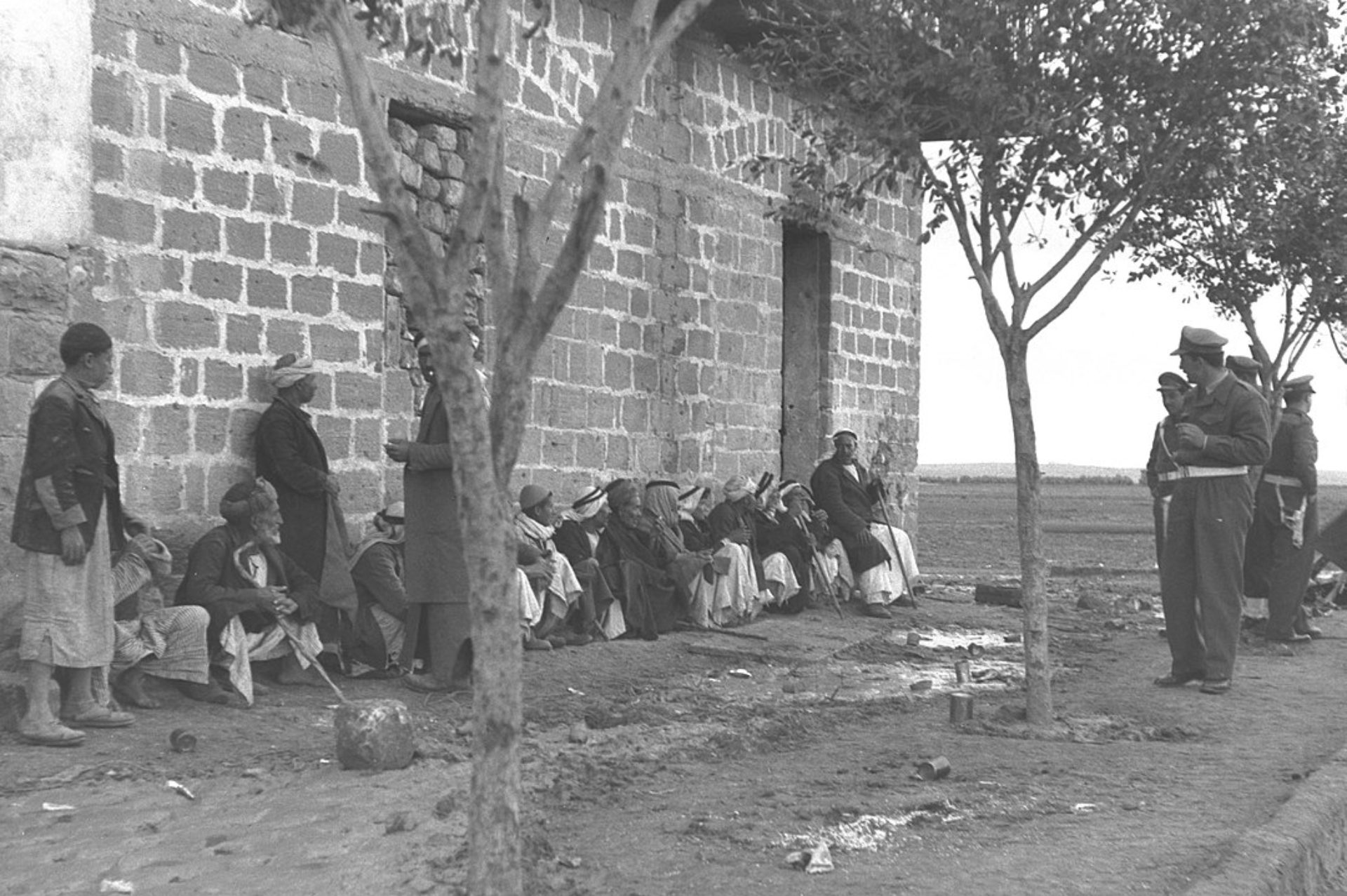
Al-Faluja was a Palestinian town in the Gaza district, some 30 kilometres north-east of the city on the road linking Gaza and Hebron. In the autumn of 1948 it became, together with its neighbour Iraq al-Manshiyya, the last Arab pocket in the occupied south, when occupation forces encircled some four thousand Egyptian soldiers and about six thousand Palestinians – its people and the refugees who had fled to it. The pocket held out for months under bombardment and hunger, refusing every offer of surrender, under Brigadier Sayed Mohammed Taha, known as “the Black Hyena”; among the besieged was the officer Gamal Abdel Nasser. [1][2]
The siege ended with the Egyptian army’s withdrawal in February 1949 under an agreement guaranteeing that civilians could stay in their homes – but the occupation forces broke it the very next day, storming the two towns and expelling their people, then demolishing the houses and building the settlement of Kiryat Gat on their lands. [3]
Contents
- At a glance
- The town
- Before the siege
- The siege
- Refusing to surrender
- The end of the siege and the broken agreement
- Between the accounts
- Timeline
- Frequently asked questions about the siege of al-Faluja
At a glance
| Item | Details |
|---|---|
| Date | Autumn 1948 – 26 February 1949 |
| Place | Al-Faluja and Iraq al-Manshiyya, Gaza district |
| Besieged | About 4,000 Egyptian soldiers of the 1st, 2nd and 6th Battalions of the Fourth Brigade, about 6,000 Palestinians, a Sudanese unit and volunteers |
| Commander | Brigadier Sayed Mohammed Taha, “the Black Hyena” |
| Notable among the besieged | Gamal Abdel Nasser, chief of staff of the 6th Battalion |
| Duration | More than six months according to Al Jazeera Net, about seven according to Arabi Post |
| End | Egyptian withdrawal to Gaza around 25 February 1949; expulsion of the inhabitants from 26 February |
| Area | 38,000 dunums |
| Settlement on the land | Kiryat Gat |
The town
Al-Faluja was known in the past as Zureik al-Khandaq, and later took the name of Sheikh Shihab al-Din al-Faluji, an Iraqi Sufi who came to Palestine in the fourteenth century and was buried there. Standing about a hundred metres above sea level and linking southern Palestine with the north, it had a large market frequented by traders from across Palestine, organised by goods and by region. [1][2]
Before the siege
Skirmishes in the area began in late March 1948 between local volunteers and Egyptian and Sudanese forces on one side and the Zionist militias on the other. After the Egyptian army entered Palestine on 15 May 1948 it reached al-Faluja, which became a base for its forces in the central sector. [3][1]
In the summer fighting Gamal Abdel Nasser was hit by a bullet that nearly struck his heart, according to his memoirs; he recovered by September and returned to his battalion. [2]
The siege
With the broad offensive the occupation forces launched on the southern front in October 1948, while the truce was in force, they seized most of the Naqab and cut the supply lines, and the three Egyptian battalions in al-Faluja and Iraq al-Manshiyya were encircled. The aggression did not stop despite the ceasefire resolution: Egypt complained to the Security Council of a new attack on its positions at al-Faluja on 20 November 1948 with aircraft, heavy artillery and mortars, calling it a further breach of the truce that undermined the Council’s decision of 4 November. [2][4]
The shelling continued throughout the siege, aimed at driving the inhabitants out. Mohammed Mustafa al-Najjar, “Abu Bassam,” then seven years old, recalls three aircraft bombing the town; his two sisters were killed and the family home, which the Egyptians had made an observation post, was destroyed. [1][2]
The inhabitants shared what food remained with the soldiers, who bought wheat, sheep and cattle from them with receipts payable at Egyptian headquarters in Bethlehem, until everything ran out. Convoys from the West Bank and Gaza tried to reach al-Faluja, but the occupation forces cut their routes time after time. [1][2]
Refusing to surrender
On 11 November 1948 UN observers arranged a meeting between Sayed Taha and the occupation army’s southern front commander, Yigal Allon, who offered him an “honourable surrender” on terms that, according to Mohamed Hassanein Heikal, required the entire Egyptian army to leave Palestine and Egypt to accept a peace agreement. Sayed Taha refused, and the pocket went on rejecting every surrender offer until the end of the siege. [2][1]
Mohammed al-Najjar recalls that after that meeting Sayed Taha ordered fire on a Zionist force massing to attack, inflicting hundreds of casualties; the bodies lay for a week before they were handed over. [1]
In Cairo, the besieged soldiers asked for a song, and Umm Kulthum sang for them at her monthly concert, later hosting them after their return. [2]
The end of the siege and the broken agreement
After the Rhodes negotiations, the Egyptian army withdrew from al-Faluja to Gaza around 25 February 1949, under an agreement allowing civilians to remain in their homes. But the occupation forces broke the agreement on 26 February, entering the two towns and beginning to force the inhabitants out. [3]
The report of the UN mediator Ralph Bunche documented the beatings, looting and attempted rapes the inhabitants suffered. Many were moved to al-Arroub camp near Hebron; by 22 April 1949 all had been driven out, and the demolition of the houses began on 27 April. [3]
The settlement of Kiryat Gat was built on the lands of the two towns, spreading over most of al-Faluja’s farmland; part of it became forest, and its Arab features were erased. Its sons and daughters live today in the camps of the West Bank and Gaza, among them Abu Bassam in al-Fawwar camp south of Hebron. [3][1]
Between the accounts
Length and start of the siege: Al Jazeera Net says it lasted more than six months and Arabi Post about seven, the latter dating its start once to May 1948 and once to the end of the year, while the course of events points to full encirclement coming with the October offensive on the southern front. [1][2]
Numbers besieged: about 4,000 Egyptian soldiers and 6,000 Palestinians according to Al Jazeera Net and Arabi Post (2023), and about 1,300 soldiers and 3,000 residents according to Arabi Post (2020); the difference may be between al-Faluja alone and the pocket as a whole. [1][2][3]
The Iraq al-Manshiyya “trap”: Nasser said in a 1962 speech that about 400 Israeli soldiers were killed on 28 December 1948 in an ambush, against 150 Egyptian martyrs, while in a 1955 speech he dated the battle to 16 October 1948; no independent account confirms the figures. [3]
Timeline
| Date | Event |
|---|---|
| Late March 1948 | Skirmishes begin around al-Faluja and Iraq al-Manshiyya [3] |
| 15 May 1948 | The Egyptian army enters Palestine and reaches al-Faluja [1] |
| October 1948 | Offensive on the southern front; Egyptian battalions encircled [2] |
| 11 November 1948 | Sayed Taha rejects Allon’s surrender offer [2] |
| 20 November 1948 | Air and artillery attack on al-Faluja; Egyptian complaint to the Security Council [4] |
| 28 December 1948 | Battle of Iraq al-Manshiyya, according to Nasser’s 1962 speech [3] |
| Around 25 February 1949 | Egyptian army withdraws to Gaza [3] |
| 26 February 1949 | Agreement broken; the towns stormed and expulsions begin [3] |
| 22–27 April 1949 | Last inhabitants expelled; demolition begins [3] |
Frequently asked questions about the siege of al-Faluja
Who was besieged at al-Faluja?
About four thousand Egyptian soldiers of the Fourth Brigade and about six thousand Palestinians, under Brigadier Sayed Mohammed Taha; Gamal Abdel Nasser was among them. [1][2]
Who was “the Black Hyena”?
It is the nickname by which the commander of the besieged pocket was known; he refused every surrender offer until the siege ended. [1]
How did the siege end?
With the Egyptian army’s withdrawal to Gaza around 25 February 1949 after the Rhodes talks, under an agreement guaranteeing civilians could stay. [3]
What happened to al-Faluja’s people after the withdrawal?
The occupation forces broke the agreement on 26 February 1949 and expelled them with beatings and looting; all were out by 22 April, and the houses were then demolished. [3]
What was built on al-Faluja’s land?
The settlement of Kiryat Gat, which spread over most of its farmland. [1]
Read also on Palestinuna
Sources and references
- Awad al-Rujoub, “The siege of al-Faluja: when the Egyptian army and the Palestinian people stood as one,” Al Jazeera Net, 13 May 2019 (in Arabic).
- Arabi Post, “Where Gamal Abdel Nasser was besieged with the Egyptian forces and wounded: the story of the Palestinian town of al-Faluja,” 2 November 2023 (in Arabic).
- Arabi Post, “Nasser’s trap that killed 400 Israeli soldiers: on Kiryat Gat, or Iraq al-Manshiyya,” 2 September 2020 (in Arabic).
- Letter from the Representative of Egypt, M. Fawzi, to the UN Secretary-General, UN document S/1088, 22 November 1948.
More from the archive
 Download Our Palestine App
The whole archive in the palm of your hand: depopulated villages, the Nakba, the massacres and Al-Aqsa — free, with no ads to erase the story.
Comments
No comments yet — be the first to write one.
Add your comment
Name and email are optional. Comments appear after review.