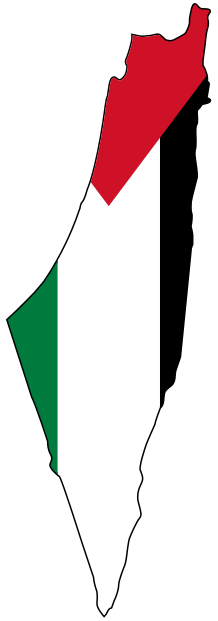
The depopulated village of Subhiyin / al-Azazmeh / District of Bir-a-Saba (Beer Sheva)
About the depopulated village of Subhiyin / al-Azazmeh
- District
- Bir-a-Saba (Beer Sheva)
Hover a dot to read the village name, or click to open its card.
Subhiyin / al-Azazmeh – Palestinian Bedouin Clan of the Beersheba Subdistrict
The Subhiyin, also rendered Subhiyyeen, were one of the largest Palestinian Bedouin clans belonging to the al-Azazmeh tribal grouping of the Beersheba Subdistrict. They did not constitute a single nucleated village, but occupied a broad network of encampments and dwelling areas across the central and southern Beersheba region.
The Subhiyin must be distinguished from the similarly named Subayhat. The two appear as separate al-Azazmeh groups in the official Mandate censuses and had distinct population totals, leadership, and historical subdivisions.
- District
- Beersheba
- Tribe
- al-Azazmeh
- Type of Community
- Dispersed Bedouin and semi-settled clan rather than one nucleated village
- Historic Dwelling Areas
- al-Ruhayba, al-Nahiya, Wadi al-Abyad, Birayn, Subeita, al-Mushrifa, Maqrah Hadaj, al-Dab'i, al-Khalasa, and Burayj al-Saba'
- Population in 1922
- 1,650 – official Mandate estimate in the Census of Palestine
- Population in 1931
- 1,594 – official Census of Palestine
- Population in 1944/1945
- Approximately 2,672 in late-Mandate data reproduced in Salman Abu Sitta's Atlas
- Estimated Population in 1948
- 3,243 according to Salman Abu Sitta's updated Register – a later estimate, not an official census
- Displacement Period
- No single documented date; Abu Sitta's Register indicates 1949–1954 and notes that some returned
- Recorded Destination
- Egypt, represented by the EG code in Abu Sitta's Register, with some members later returning
- Military Operation
- No single Subhiyin-specific operation is documented; Operation Yoav and the occupation of Beersheba form part of the preceding regional context
- Military Unit
- No brigade or battalion is independently documented at clan level
- Land Area
- No independently documented clan-specific total; multi-million-dunum figures concern al-Azazmeh as a whole
- Settlements on Clan Land
- No specific post-1948 settlement can be reliably assigned without clan-level cadastral boundaries
The Subhiyin within al-Azazmeh
The Subhiyin were one of the ten principal al-Azazmeh clans recorded in historical Palestinian sources.
The traditional list includes the Muhammadiyin, Subhiyin, Subayhat, Zaraba, Farahin, Mas'udiyin, 'Usiyat, Sawakhneh, Mri'at, and Sarahin.
A tribal genealogy recorded by 'Arif al-'Arif associates the Subhiyin with the descendants of Ishtiyya, one of the sons of 'Azzam in the traditional al-Azazmeh genealogy.
This is treated as recorded tribal tradition rather than formal documentary genealogy.
Subhiyin versus Subayhat
The similarity between the names Subhiyin and Subayhat has produced confusion in some modern family lists.
The official 1931 census, however, separates the two clearly:
| Clan | Population in 1931 |
|---|---|
| Subhiyin | 1,594 |
| Subayhat | 226 |
Population, subdivisions, and other information belonging to one clan should therefore not be transferred to the other.
Clan Leadership
Khalid 'Awad's documentation of the Beersheba tribes identifies the Subhiyin shaykh as:
Salam bin 'Id bin Sulayman bin Krayishan.
Later tribal documentation indicates that the shaykhship continued within the Krayishan family, although the individual officeholder changed over time.
Subdivisions of the Subhiyin
'Umar Rida Kahhala, citing 'Arif al-'Arif, records the following subdivisions:
- Ghurayban / al-Ghuraybat.
- al-Tabayi'a.
- al-'Uqlan.
- al-Tawaqin.
- al-'Anayqa.
- al-Qatafin.
- al-'Uran.
- al-Lawafiya.
- al-Ghuraba.
Some later sources assign several of these names to the Subayhat instead and give alternative lists for the Subhiyin, such as al-Ruqaybat, al-Masaqiya, and al-Sumran.
Because of this conflict, the present article follows the earlier al-'Arif/Kahhala list while acknowledging that later internal family classifications may differ.
Historic Dwelling Areas
'Arif al-'Arif locates Subhiyin dwellings at:
- al-Ruhayba.
- al-Nahiya.
- Wadi al-Abyad.
- Birayn.
- Subeita.
- al-Mushrifa.
- Maqrah Hadaj.
- al-Dab'i.
- al-Khalasa.
- Burayj al-Saba'.
The number and spread of these locations demonstrate that the Subhiyin were not a conventional single village.
No one coordinate, elevation, or distance from Beersheba can accurately represent the entire clan.
Population in 1922
The 1922 Census of Palestine recorded Subhiyin as follows:
| Total | 1,650 |
|---|---|
| Category | Number |
| Males | 839 |
| Females | 811 |
As with other Beersheba Bedouin groups, the 1922 total requires a methodological qualification: the Mandate administration relied substantially on official estimates, tax records, and information from tribal shaykhs rather than a conventional complete individual enumeration.
Population in 1931
The official 1931 Census of Palestine listed the Subhiyin under El Azazma:
| Total | 1,594 |
|---|---|
| Category | Number |
| Males | 836 |
| Females | 758 |
All were recorded as Muslims.
The official occupied-houses field is blank for the Subhiyin.
Household Estimate
'Arif al-'Arif estimated the Subhiyin at approximately 328 “houses”.
This is not the official occupied-house figure from the 1931 census but a separate tribal estimate.
In Bedouin usage, “house” may refer to a household or tent unit rather than a permanent masonry dwelling.
Population in 1944/1945
Salman Abu Sitta's Atlas of Palestine reproduces a late-Mandate figure of approximately 2,672 people for the Subhiyin.
This should be distinguished from the formal 1931 census and treated as later pre-Nakba population data rather than an equivalent new census.
Estimated Population in 1948
Salman Abu Sitta's updated Register gives an estimated 3,243 people for Subhiyeyn / Azzema in 1948.
Some older or secondary tables display 3,234, but the updated Palestine Land Society Register gives 3,243.
This is a retrospective estimate and not an official census conducted in 1948.
- 19221,650Official Mandate estimate
- 19311,594Official Census of Palestine
- 1944/19452,672Late-Mandate population data reproduced by Abu Sitta
- 19483,243Later estimate in Abu Sitta's updated Register
Refugees and Descendants
Abu Sitta's Register gives an estimated 19,916 refugees and descendants in 1998 for the Subhiyin.
This is a later demographic projection rather than a comprehensive official census of all members of the clan.
Land and Property
The 1945 Village Statistics do not provide an independent cadastral Subhiyin unit comparable to the land tables for settled Palestinian villages.
Historical mapping records localities such as:
- Arab es Subhiyin & Mas'udiyin.
- Arab es Subhiyin & Zeraba.
This reflects overlap or adjacency among al-Azazmeh tribal settlement zones.
Abu Sitta's approximately 5.7 million dunums applies to al-Azazmeh as a whole and cannot be reassigned to the Subhiyin alone.
No Palestinian / Transferred to Zionists / Communal-Public ownership table is therefore supplied without independent clan-level cadastral evidence.
Economic Life
The Subhiyin depended largely on pastoralism and the raising of sheep, goats, and camels, as did other al-Azazmeh communities.
Mobility between their numerous dwelling areas was closely connected with rainfall, grazing conditions, and water availability.
Seasonal cereal cultivation was also practiced where conditions allowed, but no independent crop-area table survives for the Subhiyin alone.
Water, Education, and Services
The broad distribution of Subhiyin encampments—from al-Ruhayba and Birayn to al-Khalasa, Subeita, and Wadi al-Abyad—reflects the importance of wells and water routes in their settlement pattern.
The sources reviewed do not provide a comprehensive clan-specific inventory of wells.
Nor is there sufficient evidence for one school serving the entire dispersed clan, so institutions in al-Khalasa or other nearby localities are not automatically described as Subhiyin facilities.
The Subhiyin and the Nakba
The traditional al-Azazmeh territorial system was progressively disrupted during 1948 as military control of the Naqab changed.
Operation Yoav and the occupation of Beersheba in October 1948 were among the most important regional military developments.
Abu Sitta's Register, however, does not assign the Subhiyin a 1948 depopulation date or an Operation Yoav code.
No Operation Yoav date should therefore be presented as the clan's definitive displacement date.
Expulsion toward Egypt, 1949–1954
Abu Sitta's Register places a note of 1949–1954, with some returning on the Subhiyin entry and records EG as the destination/refuge code.
This places their documented dispersal within the broader postwar displacement of al-Azazmeh communities toward Egypt and Sinai.
The evidence therefore points to a process lasting several years rather than one single departure event in 1948.
Occupation and Displacement Chronology
| Stage | Period | Details |
|---|---|---|
| Pre-Nakba Encampments | Until 1948 | The Subhiyin occupied a wide network of areas including al-Ruhayba, al-Nahiya, Wadi al-Abyad, Birayn, Subeita, al-Mushrifa, Maqrah Hadaj, al-Dab'i, al-Khalasa, and Burayj al-Saba'. |
| Operation Yoav | 15 October – 4 November 1948 | The operation transformed military control of the Naqab but is not recorded as a Subhiyin-specific displacement operation. |
| Occupation of Beersheba | 21 October 1948 | The loss of the district center profoundly affected Bedouin mobility and access to markets, wells, and land. |
| Expulsion and Movement toward Egypt | 1949–1954 | Abu Sitta's Register associates this period with the Subhiyin and notes that some returned. |
| Military Rule and Bedouin Concentration | 1950s | Bedouins who remained or returned faced restrictions on movement, loss of land access, and spatial concentration. |
Military Operation and Unit
Military Operation: No single military operation is independently documented as the operation that displaced the Subhiyin.
Operation Yoav and the October 1948 occupation of Beersheba constitute important regional background, but the principal register places the Subhiyin displacement process in the 1949–1954 period instead.
Military Unit: No particular brigade or battalion is independently documented at clan level.
Cause of Displacement
The dispersal of the Subhiyin was connected to the military conquest and political restructuring of the Naqab, the loss of access to traditional grazing lands, wells, and encampments, and subsequent expulsions and relocations affecting Beersheba Bedouins.
Abu Sitta records Egypt as a principal destination and notes that some Subhiyin later returned.
The most supportable description is therefore a multi-stage displacement and expulsion toward Egypt and Sinai between 1949 and 1954, following the military transformation of the Naqab in 1948.
Destruction of Encampments
There was no single masonry village called Subhiyin for which a reliable destruction percentage can be calculated.
The clan occupied at least ten major dwelling areas, in addition to locations mapped jointly with the Mas'udiyin and Zaraba.
The sources reviewed do not provide a comprehensive inventory of houses, tents, wells, or other structures destroyed at each site, so no unsupported destruction percentage is supplied.
Settlements on Subhiyin Land
No independent cadastral map has been identified that separates Subhiyin property from the territories of other al-Azazmeh branches in sufficient detail to assign a particular Israeli settlement exclusively to their land.
The existence of settlements and installations in the wider historical al-Azazmeh domain is therefore not enough to identify a specific settlement as standing on Subhiyin land.
Such attribution requires site-by-site comparison of historic locations including al-Ruhayba, al-Nahiya, Wadi al-Abyad, Subeita, al-Khalasa, and the other documented dwelling areas.
Subhiyin / al-Azazmeh Today
The Subhiyin did not disappear as a clan after the Nakba. Abu Sitta's Register indicates movement toward Egypt between 1949 and 1954 with some later returning, while Palestinian accounts of the post-1948 Naqab identify the Subhiyin among al-Azazmeh branches of which some members remained in the region.
The Subhiyin / al-Azazmeh name also continues outside Palestine, including in Jordan, although the principal historical sources used here do not provide one contemporary census covering the entire clan.
There is no single former “Subhiyin village site” to describe today because the clan was historically dispersed across numerous encampments.
A precise assessment of each historic site would require separate cadastral and field investigation. This section is therefore not a comprehensive 2026 demographic or field survey.
Sources
- Government of Palestine – Census of Palestine, 1922: Subhiyin
- Government of Palestine – Census of Palestine, 1931: Subhiyin / El Azazma
- 'Arif al-'Arif – Tarikh Bir al-Saba' wa-Qaba'iliha
- 'Umar Rida Kahhala – Mu'jam Qaba'il al-'Arab: Subhiyin, Dwelling Areas and Subdivisions
- Salman Abu Sitta – Atlas of Palestine 1917–1966: Subhiyeen / Azazema
- Salman Abu Sitta – Register of Depopulated Palestinian Localities: Subhiyeyn / Azzema
- Palestine Land Society – The Return Journey: Arab es Subhiyin and Jointly Named Subhiyin Sites
- Encyclopedia of Palestinian Villages – Subhiyin / al-Azazmeh, citing Khalid 'Awad
- PalQuest – Operation Yoav, for the wider regional military context
Photos from the village's people
Photos sent in by visitors and published after review.
Add a photo of this village
Log in to add photos of this village.
Other villages from Bir-a-Saba (Beer Sheva)
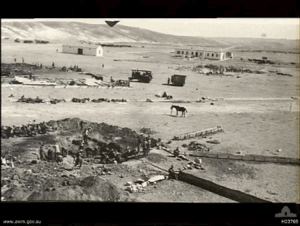
More from the archive
The depopulated village of Dhulam Abu Juwayid / Tayaha / District of Bir-a-Saba (Beer Sheva)
Bir-a-Saba (Beer Sheva)The depopulated village of Sawakhneh / al-Azazmeh / District of Bir-a-Saba (Beer Sheva)
Bir-a-Saba (Beer Sheva)The depopulated village of Nuseirat / Hanajira / District of Bir-a-Saba (Beer Sheva)
 Download Our Palestine App
The whole archive in the palm of your hand: depopulated villages, the Nakba, the massacres and Al-Aqsa — free, with no ads to erase the story.
Download Our Palestine App
The whole archive in the palm of your hand: depopulated villages, the Nakba, the massacres and Al-Aqsa — free, with no ads to erase the story.
Comments
No comments yet — be the first to write one.
Add your comment
Name and email are optional. Comments appear after review.