
The Ibrahimi Mosque

The Ibrahimi Mosque
The Ibrahimi Mosque in Hebron: History, Architecture, the 1994 Massacre and the Struggle Over the Sanctuary
The Ibrahimi Mosque (al-Haram al-Ibrahimi), in the Old City of Hebron (al-Khalil), stands over the Cave of Machpelah, where tradition holds that the prophet Abraham, his son Isaac, his grandson Jacob and their wives are buried. Its massive walls date back some 2,000 years to the era of Herod, and it has been a church, a mosque, a Crusader cathedral and a mosque again. After the 1994 massacre, in which a settler killed 29 worshippers at dawn prayer, Israel divided it, giving 63% to a synagogue. In 2026 Israel seized planning powers over the site, began roofing its open courtyard and banned the call to prayer for months. This guide covers its history, landmarks, religious significance and situation today.
Quick Facts About the Ibrahimi Mosque
| Arabic name | الحرم الإبراهيمي الشريف / المسجد الإبراهيمي |
|---|---|
| Location | Old City of Hebron (al-Khalil), southern West Bank, about 30 km south of Jerusalem |
| Type | Mosque and holy sanctuary over the Cave of Machpelah |
| Oldest structure | The enclosure wall (al-Hayr), Herodian period, 1st century BCE |
| Area | About 2,040 m² |
| Tombs | Cenotaphs of Abraham, Sarah, Isaac, Rebecca, Jacob, Leah and Joseph |
| Minarets | Two surviving |
| Division since 1994 | About 63% under Israeli control as a synagogue; about 37% left to Muslims |
| UNESCO | Part of "Hebron/Al-Khalil Old Town", World Heritage in Danger since 2017 |
| Current status | Under Israeli military control, with checkpoints, closures and call-to-prayer bans |
Origin of the Name
The mosque is named after the prophet Abraham (Ibrahim), known in Arabic as Khalil al-Rahman, "the Friend of the Merciful". The city itself took its Arabic name, al-Khalil, from him. Because it encloses a sacred burial place, it is called a haram, a sanctuary, and is widely regarded as the fourth holiest site in Islam after the mosques of Mecca, Medina and Jerusalem. In Jewish tradition the site is known as the Cave of the Patriarchs, or Machpelah.
Location
The mosque stands in the heart of the Old City of Hebron, in the southern West Bank, about 30 km south of Jerusalem. Since the 1997 Hebron Protocol the Old City and the mosque have been in the H2 zone, about 20% of the city, under Israeli security control. Nearby is Ramat al-Khalil, where tradition says Abraham stayed more than once.
History Through the Ages
According to tradition, Abraham bought the Cave of Machpelah from Ephron son of Zohar the Hittite as a burial place for his family. There he buried his wife Sarah and was later buried himself, followed by his son Isaac and Isaac's wife Rebecca, and his grandson Jacob and Jacob's wife Leah.
- Herodian period: Herod the Great, who ruled from 37 to 4 BCE, built the great rectangular enclosure over the cave, of huge dressed stones, some about 7 metres long.
- Byzantine period: A church was built within the enclosure, and it was destroyed by the Persians in 614 CE.
- Early Islamic period: After the Muslim conquest of Palestine in the 630s, the building became a mosque, and successive Islamic states cared for it.
- Crusader period (1100–1187): The Crusaders turned it into a cathedral and barred Muslims from it, and built a fortress beside it known as the Castle of Saint Abraham.
- Ayyubid period: After liberating Palestine in 1187, Saladin restored it as a mosque, added minarets and brought it the carved wooden minbar originally made in the Fatimid era for the shrine of al-Husayn's head in Ascalon.
- Mamluk period: The Mamluks added the al-Jawliyya prayer hall, new entrances and the cenotaphs of the prophets, and built the Joseph shrine.
- Ottoman period: The Ottomans restored the tombs and the building and kept up its endowments.
Architecture and Landmarks
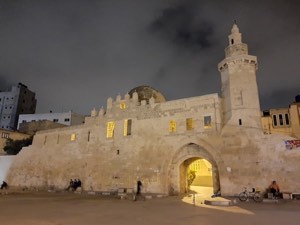
The sanctuary is a large rectangular building of about 2,040 m², enclosed by massive walls of large dressed stones. It has two minarets and several entrances, the best known being the northern entrance. Inside are a congregational mosque, an open courtyard, arcades, rooms, passages, domes and an underground vault known as "the Cave".
Al-Hayr (the Solomonic Wall)
The great enclosure wall, called al-Hayr or the Solomonic Wall, dates back to the Herodian period. It is rectangular, measuring 53.7 m long and 29 m wide inside, with walls 2.65 m thick. It rises 9.5 m above the interior floor and, outside, up to 16 m above the ground on the south-western side near the Citadel Gate.
The Ishaqiyya Hall
Also called the Ishaqiyya chamber, this is the mosque's main prayer hall, in its southern half. It houses the cenotaphs of Isaac and Rebecca, Saladin's minbar, and two of the entrances to the Cave.
The Ibrahimiyya Hall
Named after Abraham and also called al-Hadra al-Ibrahimiyya, it lies at the centre of the building and contains two chambers with the cenotaphs of Abraham and Sarah.
The Yaqubiyya Hall
Named after Jacob and also called al-Hadra al-Yaqubiyya, it lies in the northern part and contains two chambers with the cenotaphs of Jacob and Leah.
The Malikiyya Hall
In the north-western corner, it is a rectangular arcade with a mihrab decorated with glazed tiles and five doors: to the courtyard, to the Ishaqiyya, to the former citadel and Sultan Hasan school, to the muezzin's room and minaret, and to the Joseph shrine. It holds a stone footprint attributed to the Prophet Muhammad, where visitors place perfume as a blessing.
The Jawliyya Hall
Named after Emir Alam al-Din Sanjar al-Jawli, overseer of the two holy sanctuaries of Jerusalem and Hebron, who paid for it himself. It was completed in 1320 under the Mamluk sultan al-Nasir Muhammad ibn Qalawun; sources date the start of work to between 1312 and 1318.
The Noble Cave
The mosque was built over the Cave of Machpelah. The cave has three entrances today: one in the enclosure outside, on the south-western side near the Joseph shrine, which is fully sealed and where Jewish worshippers pray; and two inside the Ishaqiyya Hall.
Other Landmarks
- Two water sources, the springs of Ain al-Tawashi and al-Ain al-Hamra.
- The Joseph shrine, in a structure adjoining the western side of the enclosure.
- The Citadel Tower, the remains of the Crusader Castle of Saint Abraham.
Religious Significance
For Muslims the sanctuary holds the tombs of prophets revered in the Qur'an and is one of the holiest places in Islam. For Jews it is the burial place of the patriarchs and matriarchs, and Christians also honour Abraham as the father of faith. This shared sanctity has, under occupation, made it one of the most contested places in Palestine.
Under Occupation Since 1967
After Israel occupied the West Bank in 1967, settlers began settling around Hebron in 1968 and then inside the Old City. Today there are five settlement sites around the mosque: Tel Rumeida, al-Dabboya, the Osama bin Munqidh school, the vegetable market and the tourist rest-house near the mosque. Israeli forces and settlers have repeatedly attacked the mosque, with the aim, Palestinians say, of turning it into a synagogue.
The 1994 Massacre and the Division of the Mosque
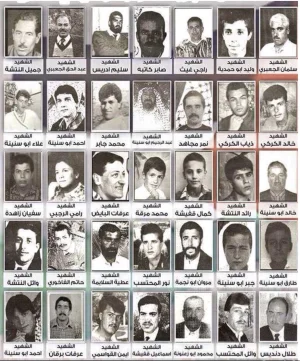
At dawn on Friday , the 15th of Ramadan, the Israeli soldiers guarding the mosque allowed Baruch Goldstein, a settler from Kiryat Arba known for his extremism, to enter carrying an automatic rifle and loaded magazines. As the worshippers bowed in prostration during the dawn prayer, he opened fire. 29 worshippers were killed inside the mosque and about 125 were wounded before survivors overpowered and killed him. In the protests and funerals that followed, Israeli forces killed dozens more Palestinians, bringing the total death toll to about 50–60, according to Palestinian sources.
Israel closed the mosque for more than nine months. An Israeli commission of inquiry then recommended dividing it: about 63% became a synagogue under Israeli control, and about 37% was left to Muslims, including the Ishaqiyya Hall. The mosque is closed entirely to Muslims on about ten Jewish holidays a year, and to Jews on about ten Muslim occasions. It was an unprecedented step in the history of Islamic mosques. Read more in our article on the Ibrahimi Mosque massacre of 1994.
The Situation in 2026
In 2026 Israel took the most far-reaching steps at the site since 1994:
- Seizure of planning powers: In January 2026 Israel's Civil Administration moved planning powers over the mosque from Hebron municipality, and in February the security cabinet approved transferring building-permit powers in Hebron. On the Israeli Finance Minister announced that Israel's Higher Planning Council had taken over planning and construction in the H2 zone, including the mosque, powers the 1997 Hebron Protocol had left with the Palestinian municipality. The Office of the Palestinian President called it a violation of international law.
- Roofing the courtyard: On 23 June 2026 Israeli machinery removed the historic canopy over the mosque's open courtyard, its only open space, and work began on an iron-and-glass roof. Engineers warn that closing the courtyard will trap moisture, erode the stone and threaten the walls with cracks.
- Banning the call to prayer: From 21 June 2026 Israel banned the call to prayer entirely; by 6 September it had been silenced for 75 days in a row, more than 380 prayer times. The Ministry of Awqaf recorded more than 770 banned calls to prayer in 2025 and 760 in 2024.
- Closures and incursions: The mosque was closed repeatedly, including at Eid al-Adha in May 2026 and for Jewish holidays in September. Israeli authorities took over keys held by the Awqaf, changed locks, opened new areas such as the Jawliyya Hall to settlers, and barred the mosque's director and staff from entering for periods.
Worshippers must pass through three military checkpoints and more than 100 barriers in the Old City to reach the mosque, and nearby schools are disrupted whenever it is closed.
Legal Protection and UNESCO
In July 2017 UNESCO inscribed "Hebron/Al-Khalil Old Town", including the Ibrahimi Mosque, on the World Heritage List as a Palestinian site, and on the List of World Heritage in Danger. As an occupied territory, Hebron is covered by the Fourth Geneva Convention and the 1954 Hague Convention for the Protection of Cultural Property in the Event of Armed Conflict, which bar an occupying power from altering the character of cultural and religious property. UN bodies and most countries consider Israeli settlements in the West Bank illegal.
The Ibrahimi Takiyya
Near the mosque stands the Takiyya of Abraham, a charitable kitchen that serves free food to the poor and needy all year, especially in Ramadan, earning Hebron its reputation as "the city that never knows hunger". Its endowment dates to 1279, under the Mamluk sultan Qalawun, though Hebron's people trace its spirit back to Abraham himself, known as "the father of guests", who would not eat without a guest and fed travellers on the very spot where the takiyya serves food today.
Frequently Asked Questions About the Ibrahimi Mosque
Where is the Ibrahimi Mosque?
In the Old City of Hebron (al-Khalil) in the southern West Bank, about 30 km south of Jerusalem.
Who is buried in the Ibrahimi Mosque?
By tradition, the prophet Abraham and his wife Sarah, Isaac and Rebecca, and Jacob and Leah, in the Cave of Machpelah beneath the mosque. A shrine of Joseph adjoins the building.
What happened in the Ibrahimi Mosque massacre?
At dawn on 25 February 1994, during Ramadan, a settler from Kiryat Arba opened fire on worshippers in prostration, killing 29 and wounding about 125. Dozens more Palestinians were killed by Israeli forces in the days that followed.
Why is the Ibrahimi Mosque divided?
After the 1994 massacre an Israeli commission divided it, giving about 63% to a synagogue under Israeli control and leaving about 37% to Muslims.
What is happening at the Ibrahimi Mosque in 2026?
Israel seized planning powers over the site from Hebron municipality, began roofing its open courtyard, and banned the call to prayer for months, alongside repeated closures.
Conclusion
For two thousand years the Ibrahimi Mosque has stood over the tomb of Abraham, passing from Herod to the Byzantines, from the Crusaders to Saladin, from the Mamluks to the Ottomans. Since 1967, and above all since the dawn of 25 February 1994, it has become a symbol of Hebron's suffering under occupation: divided, closed and silenced. Its call to prayer, its worshippers and its stones remain witnesses that the sanctuary of al-Khalil belongs to its people.
Photo gallery


More from the archive
 Download Our Palestine App
The whole archive in the palm of your hand: depopulated villages, the Nakba, the massacres and Al-Aqsa — free, with no ads to erase the story.
Download Our Palestine App
The whole archive in the palm of your hand: depopulated villages, the Nakba, the massacres and Al-Aqsa — free, with no ads to erase the story.



Comments
No comments yet — be the first to write one.
Add your comment
Name and email are optional. Comments appear after review.