The Dome of the Rock
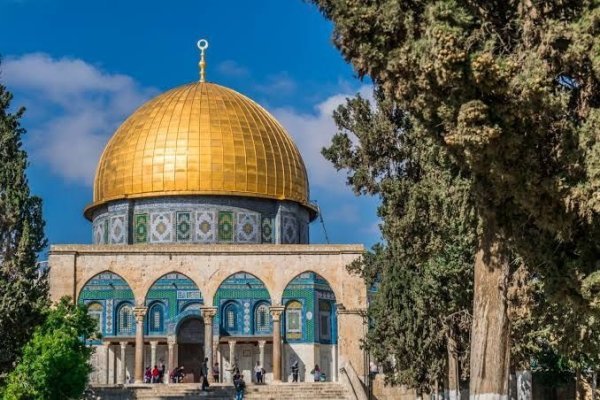
The Dome of the Rock in Jerusalem: History, Architecture, the Sacred Rock and the Threats It Faces
The Dome of the Rock (Qubbat al-Sakhra) rises at the heart of al-Aqsa Mosque in Jerusalem, its golden dome the best-known landmark of the city. Built by the Umayyad caliph Abd al-Malik ibn Marwan and completed in 72 AH (691–692 CE), it is the oldest surviving monument of Islamic architecture. Its octagon shelters the Rock from which, in Islamic tradition, the Prophet Muhammad ascended to heaven on the Night Journey. Since 1967 it has stood under Israeli occupation, and in 2026 it was closed for 40 days while settler groups held rituals opposite it and circulated a video simulating its destruction. This guide covers its history, architecture, religious significance and situation today.
Quick Facts About the Dome of the Rock
| Arabic name | قبة الصخرة المشرفة |
|---|---|
| Location | Centre of al-Aqsa Mosque compound, Old City of Jerusalem |
| Built by | Umayyad caliph Abd al-Malik ibn Marwan |
| Completed | |
| Supervisors | Raja ibn Haywa and Yazid ibn Sallam |
| Plan | Octagon with a central dome over the Rock |
| Dome diameter | About 20 m |
| Height | About 40 m to the top of the crescent |
| Custodian | Jordanian Ministry of Awqaf, through the Jerusalem Islamic Waqf |
| UNESCO | Part of "Old City of Jerusalem and its Walls", World Heritage in Danger since 1982 |
Origin of the Name
The building takes its name from the Rock (al-Sakhra) it covers, the summit of the hill on which al-Aqsa stands. Muslims call it Qubbat al-Sakhra al-Musharrafa, "the Dome of the Honoured Rock". Although it is often mistakenly called the "Mosque of Omar" or confused with al-Aqsa's Qibli Mosque, the Dome of the Rock is a distinct building within the compound.
Location Within al-Aqsa Mosque
The Dome stands on a raised platform near the centre of the al-Aqsa Mosque compound, about 144 dunums in area, in the south-eastern corner of the Old City of Jerusalem. Stairways topped by arcades known as mawazin ("scales") lead up to the platform, and the Qibli Mosque lies to its south. The whole compound, including the Dome of the Rock, is al-Aqsa Mosque; read more in our section on al-Aqsa Mosque.
History Through the Ages
- Umayyad period: Caliph Abd al-Malik ibn Marwan ordered the building, and work began around 685–688 CE. The dedication inscription dates its completion to 72 AH (691–692 CE). He set aside Egypt's tax revenue for seven years to fund it, according to some Arab historians, and entrusted the work to Raja ibn Haywa and Yazid ibn Sallam.
- Abbasid and Fatimid periods: Caliph al-Ma'mun restored the building in 831 CE, and workers tried to replace Abd al-Malik's name in the inscription with his, but kept the original date. Earthquakes damaged it in the 9th century, and the dome collapsed in 1015–1016; the Fatimid caliph al-Zahir rebuilt it in 1022–1023.
- Crusader period (1099–1187): After the Crusaders took Jerusalem in 1099, they turned the Dome into a church called the Templum Domini, placed a cross on its summit, covered the Rock with marble and built an altar on it.
- Ayyubid period: Saladin liberated Jerusalem on 2 October 1187, restored the Dome as a mosque, replaced the cross with a crescent, removed the Crusader additions and gilded the dome. His restoration added a band of verses from Surat Ta-Ha.
- Mamluk period: Sultan Baybars restored its exterior decoration, and al-Nasir Muhammad ibn Qalawun re-gilded the dome and renewed its ceilings.
- Ottoman period: Sultan Suleiman the Magnificent replaced the exterior Umayyad mosaics with glazed Ottoman tiles between 1545 and 1552, and the work was completed under Murad III. In the 1870s the dome was covered in lead sheets.
- Modern period: Between 1959 and 1964 Jordan, with Arab and Turkish funding, replaced the lead covering with gold-coloured aluminium-bronze plates. In the 1990s the dome was re-covered with gold-plated sheets funded by the late King Hussein of Jordan; sources give the amount of gold as between 24 and 80 kg.
Architecture and Decoration
The Dome of the Rock is an octagonal building with four doors, one facing each cardinal direction. Inside, two concentric arcades surround the Rock: an outer octagonal arcade of 8 large piers and 16 columns, and an inner circular arcade of 4 piers and 12 columns, carrying a drum and the dome above. The dome, about 20 m across, is in fact two domes, an inner and an outer shell about a metre apart. The building has 52 windows, and its height to the top of the crescent is about 40 m.
The interior preserves some of the finest early Islamic mosaics, with gold backgrounds, vines, trees and jewels, and a long band of Kufic inscriptions in mosaic carrying Qur'anic verses and the dedication of 72 AH. Outside, the walls are faced with marble below and Ottoman tiles above, with Surat Ya-Sin written in tile around the top of the walls.
The Sacred Rock and the Cave of Spirits
At the centre of the building lies the Rock, an irregular mass of bedrock between 13 and 18 metres across, rising about one and a half metres above the floor. Beneath it is a cave known as the Cave of Spirits (Maghārat al-Arwāḥ), reached by steps, with room for about 40 people. A hole 40 to 50 cm wide pierces the Rock above the cave.
Religious Significance
In Islamic tradition the Rock is the place from which the Prophet Muhammad ascended to heaven (al-Mi'raj) after his Night Journey (al-Isra) from Mecca to Jerusalem, as referred to in the Qur'an (17:1). Al-Aqsa was the first qibla, the direction of prayer, for Muslims and is the third holiest mosque in Islam, after the mosques of Mecca and Medina. The Dome of the Rock is its most recognisable symbol and an icon of Palestine and of Jerusalem's Arab and Islamic identity.
Under Occupation Since 1967
When Israel occupied East Jerusalem in June 1967, Israeli forces entered the compound and raised the Israeli flag over the Dome of the Rock before it was taken down. Under the "status quo" that followed, the Islamic Waqf administers al-Aqsa while Israeli police control its gates. Since then, settler groups seeking to build a "Temple" in place of al-Aqsa have repeatedly called for the Dome of the Rock to be demolished, Israeli incursions into the compound have grown, and Israeli excavations around and beneath the Old City have raised fears for the foundations.
The Situation in 2026
- A 40-day closure: With the start of the war on Iran on 28 February 2026, Israeli authorities closed al-Aqsa, including the Dome of the Rock, for 40 days. Worshippers were barred for most of Ramadan and from the Eid al-Fitr prayer, an unprecedented step in centuries. The mosque reopened on 9 April 2026, when about 3,000 people prayed the dawn prayer, and women returned to their Qur'an circles in the Dome of the Rock.
- Incitement: In March 2026 settler-affiliated online platforms circulated an AI-generated video simulating the bombing of the Dome of the Rock.
- Rituals opposite the Dome: According to a report by Al-Quds International Institution, Israeli police in 2026 enabled settlers to hold collective rituals in the western courtyard opposite the Dome of the Rock, with Israeli ministers, rabbis and Knesset members taking part. On 23 July 2026 about 4,300 settlers stormed the compound, the highest number ever recorded for that occasion.
- Continuing incursions: The Palestinian Ministry of Awqaf recorded 26 incursions in September 2026, including prayers for Israeli soldiers opposite the Dome of the Rock and raids around it during Friday prayers.
Custodianship and Legal Protection
The Hashemite Kingdom of Jordan holds custodianship of Jerusalem's Islamic holy sites, and its Ministry of Awqaf maintains the Dome of the Rock through the Jerusalem Islamic Waqf. In 1981 UNESCO inscribed the "Old City of Jerusalem and its Walls" on the World Heritage List, and added it to the List of World Heritage in Danger in 1982. The UN considers East Jerusalem occupied territory, and the Fourth Geneva Convention and the 1954 Hague Convention for the Protection of Cultural Property bar the occupying power from altering the character of its holy sites. UN Security Council Resolution 478 (1980) rejected Israel's annexation of Jerusalem.
Frequently Asked Questions About the Dome of the Rock
Who built the Dome of the Rock?
The Umayyad caliph Abd al-Malik ibn Marwan, with the work supervised by Raja ibn Haywa and Yazid ibn Sallam. It was completed in 72 AH (691–692 CE).
Is the Dome of the Rock the same as al-Aqsa Mosque?
Al-Aqsa Mosque is the whole compound of about 144 dunums. The Dome of the Rock and the Qibli Mosque are both buildings within it.
Why is the Rock sacred to Muslims?
In Islamic tradition it is the place from which the Prophet Muhammad ascended to heaven after the Night Journey from Mecca to Jerusalem.
Is the dome made of gold?
The dome is covered with gold-plated sheets installed in the 1990s with funding from King Hussein of Jordan, over an earlier aluminium-bronze covering.
What happened to the Dome of the Rock in 2026?
Israel closed al-Aqsa, including the Dome, for 40 days from 28 February to 9 April 2026. Settlers held rituals opposite the Dome and circulated a video simulating its destruction.
Conclusion
For more than thirteen centuries the golden Dome of the Rock has crowned Jerusalem, surviving earthquakes, Crusader occupation and modern conflict. Built by an Umayyad caliph, restored by Saladin, the Mamluks, the Ottomans and Jordan, it remains the symbol of al-Aqsa and of Palestine itself. Today, closed, threatened and surrounded by incursions, it still draws its worshippers back each dawn.
More from the archive

 Download Our Palestine App
The whole archive in the palm of your hand: depopulated villages, the Nakba, the massacres and Al-Aqsa — free, with no ads to erase the story.

Comments
No comments yet — be the first to write one.
Add your comment
Name and email are optional. Comments appear after review.