
Khan Younis Refugee Camp

Khan Younis Refugee Camp
Khan Younis Refugee Camp: History, Population, the Genocide in Gaza and the Right of Return
Khan Younis Camp is one of the largest Palestine refugee camps in the Gaza Strip, lying west of the city of Khan Younis in the south of the Strip, about 2 km from the Mediterranean coast. It was established in for about 35,000 refugees, most of them from the Beersheba region, driven out during the occupation of Palestine. Before October 2023, 95,550 refugees were registered in the camp. Khan Younis has endured repeated massacres, from the killings of November 1956 to the genocide in Gaza, when a four-month ground offensive left the city and camp in ruins. This guide covers its history, origins, population, living conditions and current situation.
Quick Facts About Khan Younis Camp
| Arabic name | مخيم خان يونس |
|---|---|
| Country / Region | Palestine, southern Gaza Strip |
| Governorate | Khan Younis |
| Year established | |
| Area | About 1.27 km² |
| Registered refugees | 95,550 (UNRWA, ) |
| Original population | About 35,000 refugees |
| UNRWA installations (before October 2023) | 25, including 20 schools in 16 buildings, 3 health centres, 2 food distribution centres and 2 relief and social services offices |
| Origin of residents | Mainly the Beersheba region |
| Known for | The massacre of November 1956 |
| Current status | Heavily destroyed since 2023; the "Yellow Line" runs east of the city as of 2026 |
Note: UNRWA counts refer to refugees registered in the camp, not necessarily the number of people living there at any given time.
The Nakba: Why Khan Younis Camp Exists
Khan Younis Camp was born from the Nakba (Arabic for "catastrophe"): the mass expulsion of Palestinians during the occupation of Palestine in . Roughly 750,000 Palestinians were driven from their homes, and more than 200,000 of them poured into the narrow Gaza Strip.
Many of the refugees who reached the south of the Strip were Bedouin and villagers from the Beersheba region and the Naqab. About 35,000 of them sheltered on the sandy land west of the old market town of Khan Younis, forming one of the largest camps in Gaza.
The Right of Return
The right of return is the central demand of Khan Younis's refugees. It rests on several foundations in international law:
- UN General Assembly Resolution 194 (), paragraph 11, resolved that refugees wishing to return to their homes and live at peace with their neighbours should be permitted to do so at the earliest practicable date, and that compensation should be paid to those choosing not to return and for loss of or damage to property.
- The Universal Declaration of Human Rights (Article 13) affirms everyone's right to leave any country, including their own, and to return to it.
- UN General Assembly Resolution 3236 () reaffirmed the "inalienable right" of Palestinians to return to their homes and property.
The lands of the Beersheba region lie only a short distance east of Khan Younis, beyond the armistice line. For three generations, the camp's families have held onto the right to return to them.
History of the Camp
Founding (1948–1950s)
The camp was set up in 1948 west of the town of Khan Younis. Refugees first lived in tents, which UNRWA later replaced with simple shelters. Over the decades, families expanded their homes upward as the population grew, and the camp merged with the surrounding city.
Egyptian administration, 1956 and occupation (1948–1993)
From 1948 to 1967 the Gaza Strip was under Egyptian administration. During the Suez war of 1956, Israeli forces occupied Khan Younis for several months and carried out the massacre described below. With the occupation of the West Bank and Gaza Strip in , the camp came under Israeli military rule, and its people took part in the First and Second Intifadas.
Siege and wars (2007–2023)
After the blockade imposed on Gaza in 2007, unemployment and poverty rose dramatically, and a large share of the population came to depend on UNRWA food and cash assistance. The camp was struck repeatedly in the wars of 2008–2009, 2012, 2014 and 2021.
The Khan Younis Massacre of 1956
On 3 November 1956, during the Suez war, Israeli forces occupied Khan Younis and its refugee camp. In the hours and days that followed, men were rounded up and killed in the streets and in the camp. The killings, known as the Khan Younis massacre, were reported to the UN General Assembly on 15 December 1956 by the Director of UNRWA, whose report recorded about 275 people killed in Khan Younis. Israeli authorities claimed the deaths resulted from resistance by residents. The massacre remains one of the most painful memories in the history of the camp and the city.
Khan Younis and the Genocide in Gaza (2023 onward)
Since October 2023, Khan Younis has been one of the areas most devastated in the genocide in Gaza. In September 2025, the UN Independent International Commission of Inquiry concluded that Israel has committed genocide against Palestinians in Gaza, finding that four of the five acts defined in the 1948 Genocide Convention had been committed. A genocide case brought by South Africa against Israel is also before the International Court of Justice. Israel rejects these findings. By mid-2026, Gaza's health ministry reported more than 72,000 Palestinians killed since October 2023.
A refuge turned into a battlefield (2023–2024)
In the first weeks, hundreds of thousands of people from northern Gaza were ordered to flee south, and many crowded into Khan Younis. In December 2023, Israeli ground forces invaded the city and camp, beginning a four-month offensive. UNRWA facilities sheltering displaced families were struck, Nasser Hospital, the main hospital of southern Gaza, was besieged and forced out of service, and residents were displaced once again, many to Rafah.
An "unrecognisable" city (April 2024)
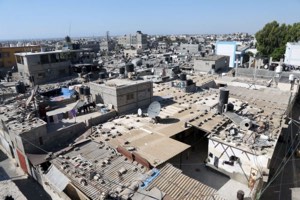
When Israeli troops withdrew on 7 April 2024, residents returned to find their city unrecognisable. According to satellite analysis, about 55% of buildings in the Khan Younis area, around 45,000 buildings, had been destroyed or damaged. A UN assessment mission found that every building it visited had been damaged, paved roads had been reduced to dirt tracks, streets were littered with unexploded ordnance, and Nasser and Al-Amal hospitals had been put out of service. Mass graves were later uncovered in the grounds of Nasser Hospital.
Renewed attacks and the "Yellow Line" (2024–2026)
Khan Younis was invaded and bombed again in later operations, while the coastal area of al-Mawasi to its west, designated as a "humanitarian zone", filled with tents and was itself repeatedly struck. After the ceasefire agreement of October 2025, Israeli forces withdrew to the "Yellow Line", which runs through the east of Khan Younis. Israel's army chief later described the line as a "new border", while Palestinian officials see it as a tool for permanent displacement. Strikes continued into 2026: tents of displaced families were bombed in the centre of Khan Younis in March 2026 and in al-Mawasi in June 2026, and families in the camp have depended on charity kitchens for hot meals.
Origin of the Name
The camp takes its name from the city of Khan Younis. "Khan" means caravanserai, an inn for travellers and traders, and the city grew around a fortified caravanserai built in the 14th century on the ancient trade route between Syria and Egypt, named after the Mamluk official who built it. The name is also spelled Khan Yunis or Khan Yunus.
Location and Geography
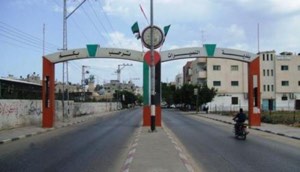
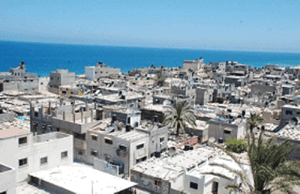
Khan Younis Camp lies in the Khan Younis Governorate in the south of the Gaza Strip, just west of the city of Khan Younis, about 2 km from the Mediterranean coast and north of Rafah. To its west lies the coastal area of al-Mawasi. The city of Khan Younis has long been a major market centre and a stopping point on the ancient trade route to Egypt.
Area and Land
UNRWA gives the camp's area as about 1.27 square kilometres. With nearly 100,000 registered refugees before the war, it was extremely crowded, with shelters built close together and a general lack of recreational and social space.
Places of Origin
According to UNRWA, most of the camp's refugees came from the Beersheba area and the Naqab, with others from villages of the Gaza district and elsewhere in southern Palestine. You can explore the depopulated villages of Palestine in the Our Palestine village archive.
Population and Demographics
| Year | Population | Source |
|---|---|---|
| 1948–1950 | About 35,000 refugees | Historical sources |
| 2010 | About 72,000 registered refugees | UNRWA |
| 2017 | 41,182 residents inside the camp | Palestinian Central Bureau of Statistics (PCBS) |
| 2023 | 95,550 registered refugees | UNRWA |
| 2023–2026 | Residents repeatedly displaced; the area also shelters very large numbers of displaced people | UN agencies |
The difference between UNRWA and PCBS figures reflects different methods: UNRWA counts refugees registered to the camp, many of whom live in the surrounding city, while the PCBS counts people resident inside the camp's boundaries.
Housing and Infrastructure
Before October 2023, overcrowding and housing shortages defined the camp. Families added floors to their shelters, often without proper design, and many lived in substandard conditions. About 90% of the water was unfit for drinking, and electricity was inadequate. UNRWA and the community carried out some improvements, including paving roads and creating small open spaces.
Since 2023, much of the camp and city has been destroyed, roads have been torn up, and unexploded ordnance has made many areas dangerous. Families live in damaged buildings, tents and shelters made from rubble.
Health Situation
Before the war, three UNRWA health centres provided primary care, including reproductive health and child care, and Nasser Hospital was the main hospital of southern Gaza. Since 2023:
- Nasser and Al-Amal hospitals were besieged and put out of service during the 2024 offensive, and many medical supplies were destroyed.
- Famine and malnutrition have spread among residents and displaced families.
- Contaminated water, destroyed sewage systems and overcrowded tents have led to the spread of disease.
- Children and families suffer severe psychological trauma.
Economic Situation
Khan Younis was historically a market town and farming centre. Under the blockade, unemployment and poverty rose sharply, and far fewer families could provide for themselves. Since 2023, the economy has been almost entirely destroyed, much of the farmland east of the city lies behind the "Yellow Line", and nearly all families depend on humanitarian aid, which has itself been severely restricted.
Education
Before October 2023, UNRWA ran 20 schools in 16 buildings in the camp. Since 2023, schools have been turned into shelters, most of those inspected by the UN in April 2024 had been damaged, and the camp's children have lost years of education.
Frequently Asked Questions About Khan Younis Camp
Where is Khan Younis refugee camp located?
It lies west of the city of Khan Younis in the southern Gaza Strip, about 2 km from the Mediterranean coast and north of Rafah.
How many refugees live in Khan Younis camp?
UNRWA reported 95,550 registered refugees in 2023, on an area of about 1.27 square kilometres.
When was Khan Younis camp established?
It was established in 1948, after the Nakba, for about 35,000 refugees, most of them from the Beersheba region.
What was the Khan Younis massacre of 1956?
After Israeli forces occupied Khan Younis on 3 November 1956, men were rounded up and killed in the city and camp. UNRWA's director reported about 275 people killed.
What happened to Khan Younis since October 2023?
Khan Younis endured a four-month ground offensive in the genocide in Gaza. By April 2024, about 55% of buildings in the area had been destroyed or damaged and its main hospitals were out of service. As of 2026, the "Yellow Line" runs through the east of the city, and strikes have continued.
Conclusion
Khan Younis Camp was built by refugees from the Beersheba region beside one of Gaza's oldest market towns. It has lived through the massacre of 1956, decades of occupation and siege, and the destruction of the genocide in Gaza. Its people have been displaced again and again, yet they continue to return to the ruins and to hold onto the right to return to the lands their families lost in 1948.
More from the archive
 Download Our Palestine App
The whole archive in the palm of your hand: depopulated villages, the Nakba, the massacres and Al-Aqsa — free, with no ads to erase the story.
Download Our Palestine App
The whole archive in the palm of your hand: depopulated villages, the Nakba, the massacres and Al-Aqsa — free, with no ads to erase the story.



Comments
No comments yet — be the first to write one.
Add your comment
Name and email are optional. Comments appear after review.
Social Situation
Khan Younis Camp is a large, crowded community with strong family and tribal ties, many of them rooted in the Bedouin traditions of the Beersheba region. The genocide has torn this social fabric apart: families have lost many members, homes have been destroyed, and residents have been displaced again and again, while the area has also had to absorb large numbers of people displaced from the rest of Gaza.