
Palestinian Industries Before the Nakba: Soap, Olive Oil & More
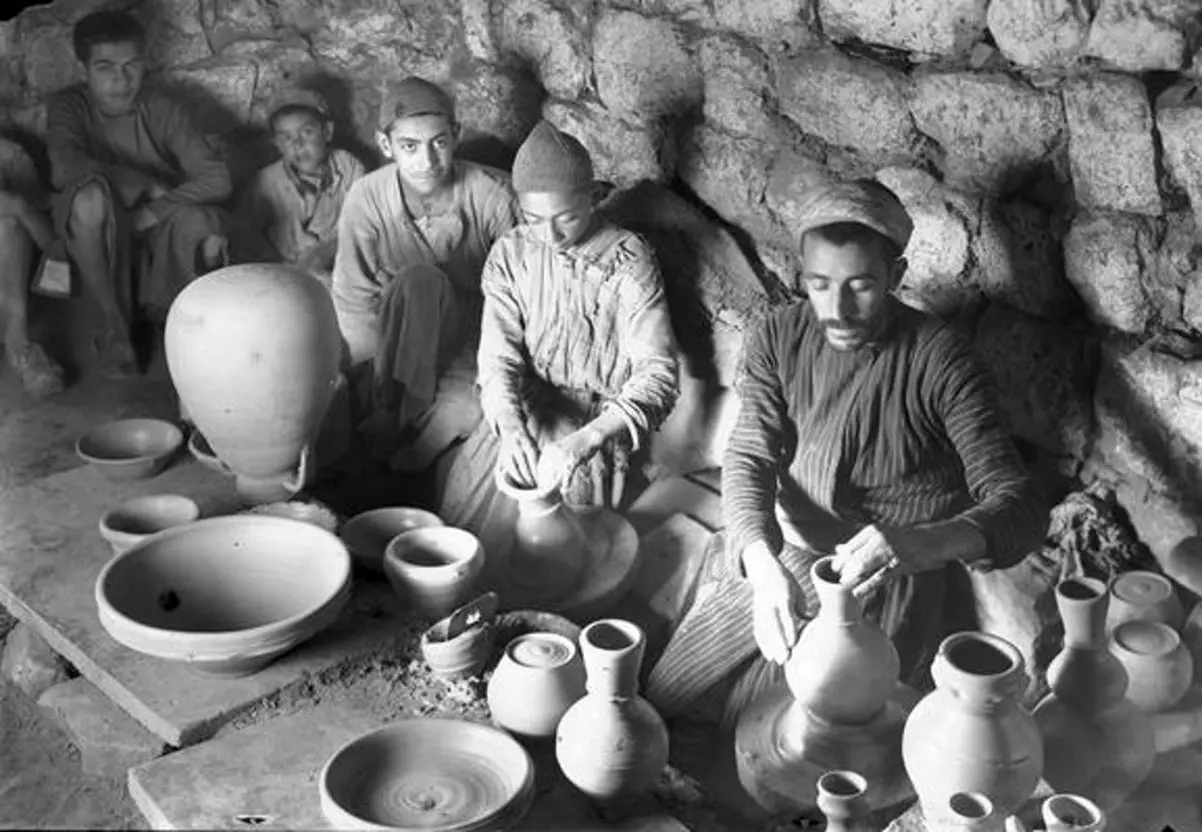
Before the 1948 Nakba, Palestine had a diverse range of industries and crafts rooted in agriculture, the sea and trade. The best known were Nablus soap making and olive oil pressing, the packing and export of Jaffa oranges, Majdal weaving, Hebron glass and Gaza pottery. Alongside them, the British Mandate period saw factories for cigarettes, matches and cardboard, as well as workshops for copper, leather and Bethlehem mother-of-pearl.
When Palestine's economy before the Nakba is remembered, olive groves and orange orchards come to mind first. Yet the picture is incomplete without the soap factories, oil presses, looms, copper and pottery workshops, and food-processing plants. Industry was part of daily life: olives were pressed, and some of the oil became soap; clay was shaped into jars, nets were knotted for fishermen, and surplus milk was preserved as cheese. [1]
Summary Table: Main Palestinian Industries Before 1948
| Industry | Main centers | Dominant form of production |
|---|---|---|
| Nablus soap | Nablus | Large family-owned soap factories |
| Olive and sesame oil | Nablus and its villages, Galilee | Traditional and modern presses |
| Citrus packing and export | Jaffa and the coastal plain | Orchards and packing houses |
| Hand weaving | Majdal and Gaza | Hand looms in workshops |
| Embroidery | Villages and towns throughout | Women's home-based work |
| Pottery | Gaza and Hebron | Small workshops |
| Glass | Hebron | Hand-blowing workshops |
| Mother-of-pearl and olive wood | Bethlehem and Jerusalem | Craft workshops |
| Copper | Jerusalem, Jaffa, Nablus, Nazareth, Acre | Craft workshops |
| Cigarettes | Major towns | Companies and mechanized factories |
| Matches | Nablus and Nazareth | Factories |
| Fishing nets | Jaffa, Gaza, Acre | Family handwork |
How to Read the History of Palestinian Industry
This article distinguishes between Palestinian Arab industries and all industries operating in Palestine, which also included Jewish and foreign enterprises. A factory's presence in the country does not mean it was owned by Palestinian Arabs, so ownership is stated wherever it is known.
"Industry" did not always mean a mechanized factory. It included the family workshop, home-based work, the oil press and the soap factory, alongside modern plants. Figures are given with their year and scope, and statistics from different years are not combined as if they formed a single series.
What Do the Numbers Say?
The available statistics show that the Arab industrial sector was made up of small units spread widely across the country:
- 1926: about 3,000 Arab workers were employed in small industrial workshops, many in food, tobacco, soap, shoes, textiles and furniture. [16]
- 1928: only 3% of craft and industrial establishments employed more than 10 workers, and nearly a third of their workforce were owners and their families. [16]
- World War II: falling imports led to new Arab industries in textiles, clothing, footwear, timber, food, tobacco and metals, while British wartime facilities employed about 28,000 Arab workers. [16]
- 1947: 57.8% of Arab industrial establishments employed fewer than 10 workers, and women made up no more than 5% of their workforce. [16]
Olive Oil and Olive Presses in Palestine
Olive pressing was a core link in rural Palestinian production. Presses followed the harvest season and turned the fruit into oil for cooking, trade and soap making. In traditional presses, the olives were crushed under a millstone and then pressed to extract the oil.

Oil linked farmers to press owners, merchants and manufacturers. The clearest example is the relationship between the villages around Nablus and the city's soap factories, which depended on their oil. [2] A Survey of Palestine records traditional presses operating alongside modern ones, and notes that local olives and sesame were processed mainly in Arab establishments. [3, p. 517]
Nablus Soap: History and How It Was Made
Nablus became synonymous with olive oil soap, and the industry peaked in the nineteenth century. In 1907, the city had about 30 soap factories producing roughly half of the soap consumed in Palestine. [17] Owning a soap factory was tied to wealth and status among the city's families. [2]
.jpg?width=800)
How Was Nabulsi Soap Made?
Production relied on three ingredients: olive oil, water and an alkali. Qili, made from the ash of wild plants, arrived through trade with the Bedouin and was later replaced by industrial soda. [4] Production followed these steps:
- Cooking the oil with the alkaline solution in large copper vats for several days.
- Spreading the liquid soap across the factory floor to set.
- Cutting it into cubes and stamping each with the factory's mark.
- Stacking the cubes in conical towers to dry for weeks.
- Wrapping and selling them.
Markets and Challenges
Nablus soap reached well beyond the local market, and Egypt was among its most important buyers. New customs barriers and competition from cheaper products created mounting difficulties, and the 1927 earthquake damaged soap factories in the Old City. Even so, the craft survived. [2]
In 2024, UNESCO inscribed the tradition of Nabulsi soap making on the Representative List of the Intangible Cultural Heritage of Humanity. [5]
Sesame, Tahini and Halva
Sesame pressing was a food industry that complemented olive oil. A Survey of Palestine grouped it with olives as a local raw material processed mainly in Arab establishments. [3, p. 517] Sesame yielded sirij oil and tahini, which in turn were used to make the tahini halva for which Nablus became known.
Jaffa Oranges: Citrus Packing and Export
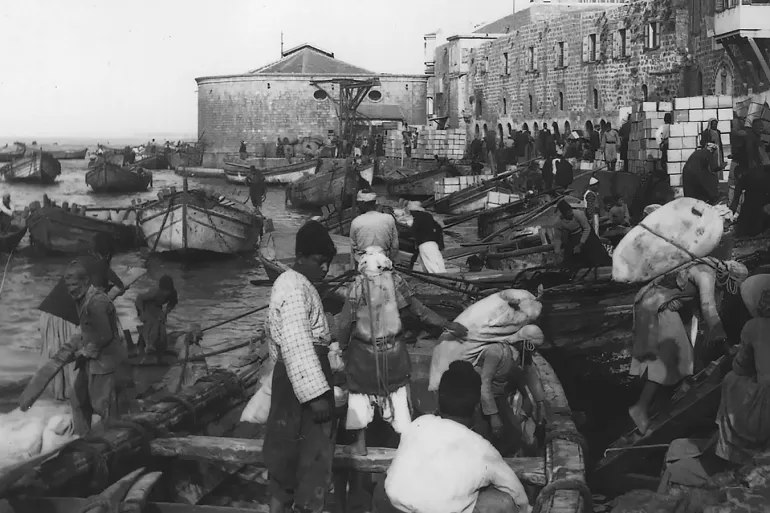
Citrus was Palestine's largest export before the Nakba. In 1935–1937, citrus accounted for about 79% of the value of all agricultural and industrial exports, and most orchards lay within roughly 48 kilometers (30 miles) of Jaffa. [18] In the 1938–1939 season, Arab and Jewish orchards together exported 15.2 million boxes. [19]

Citrus was more than farming. Around it grew sorting, paper wrapping, packing into wooden crates and transport to the port of Jaffa. The picking and packing season, from January to April, employed thousands of workers. [19] Packing houses were therefore part of the industrial landscape tied to agriculture.
Grain Mills
Mills for grinding wheat and barley were common in towns and villages, and were among the country's oldest craft workshops, alongside soap factories and potteries. [16] Some evolved from water- and animal-powered mills into engine-driven ones.
Dairy and Cheese
Turning seasonal surplus milk into cheese was a way to preserve it beyond the season of plenty. A Survey of Palestine records that Arabs made hard white cheese preserved in brine, and notes that large-scale modern dairy manufacturing was limited. [3, p. 517] Production was mostly domestic and artisanal rather than pasteurized-milk lines.

Tobacco and Cigarettes
Cigarettes were one of the few mechanized industries in the Arab sector, combining tobacco processing, manufacturing, packaging and advertising. One piece of evidence is an advertisement for the Grand National Tobacco and Cigarette Company, "Karaman, Dik & Salti Ltd.," held in the Khazaaen archive among documents from 1930–1939. [9] A Survey of Palestine notes the use of both local and imported tobacco in cigarette making. [3, p. 518]
The industry was linked to printing and paper packaging, showing how sectors depended on one another.
Matches and Sulfur Mining
A Survey of Palestine records Arab match factories in Nablus and Nazareth. [3, ch. 13, para. 50] Mining sulfur was a separate extractive activity, and the report notes that concessions to exploit it were granted from 1930. [10]
Palestinian Weaving and Embroidery
Majdal Weaving
Al-Majdal, near Ashkelon, was the best-known center of hand weaving in southern Palestine. The Matson Collection at the Library of Congress holds photographs of its workshops and looms. [11] Weaving involves stretching the lengthwise warp threads and passing the crosswise weft threads between them, a process that demands skill in tension, color harmony and density.

Palestinian Embroidery
Embroidery (tatreez) added motifs and colors to fabric that were tied to regions and occasions, and it was passed down among women within the family. Weaving and embroidery are related crafts, but each has its own tools and skills. UNESCO inscribed the art of embroidery in Palestine on its intangible heritage list in 2021. [12]
Clothing was among the most important Arab industries during the Mandate, alongside food and soap. [1]
Palestinian Pottery: Gaza and Hebron
Pottery was directly tied to household and farm life: jars and jugs stored water and food. Gaza and Hebron had well-established pottery traditions. [6] The craft involved preparing the clay, shaping it by hand or on a potter's wheel, then drying and firing it in kilns.
Copper and Metal Crafts
Copperwork included making, shaping, decorating and repairing vessels. The Palestinian Encyclopedia mentions craftsmen in Jaffa, Jerusalem, Nablus, Nazareth and Acre, and the role of Armenian artisans in Jerusalem. [6] This refers to working and manufacturing copper, not mining the ore locally.
Hebron Glass
Hebron glass is an inherited craft based on hand-blowing, producing colored pieces in many shapes. Institutional sources show the craft continuing across generations. [15]

Bethlehem Mother-of-Pearl and Olive Wood
Bethlehem and Jerusalem were known for mother-of-pearl and olive wood work: rosaries, crosses, religious models and ornaments. These crafts served pilgrims and visitors, tying them to religious tourism. [6]

Leather, Shoes, Candles and Baskets
Palestine had leather tanning and shoemaking, and Hebron was known for its tanneries. Candle making, basketry, mat weaving and straw work were also widespread. [6] Shoemaking was among the sectors employing workers in small workshops from the 1920s onward. [16]

Fishing Nets and Coastal Crafts
Knotting and mending nets was part of fishermen's lives in Jaffa, Gaza and Acre. Accounts of fishing before the Nakba describe small boats and handmade nets. [7] The testimony of a fisherman from a Jaffa family that took refuge in Gaza shows how net-making skills traveled with their owners, and how the whole family took part in the work. [8]
Paper, Cardboard and Printing
Paper-related activity included packaging, cardboard, stationery and printing. A Survey of Palestine records that cardboard manufacturing from waste paper began in 1940, and that the sector employed both Arab and Jewish workers. [13] Packaging and cigarette wrappers were a direct link between this sector and other industries.
Jaffa, Jerusalem and Haifa had Arab printing presses serving the press and publishing, a subject that deserves its own study for its ties to the cultural Nahda.

Cement and Building Industries
The Nesher factory near Haifa was the sole cement producer in Palestine during the Mandate, turning out its first bag of cement in December 1925. [20] A Survey of Palestine describes it as a Jewish enterprise. [3, p. 455] Its existence shows that cement was manufactured in Palestine before the Nakba, not that there was an Arab cement industry.
Arab participation in construction lay in quarrying and dressing stone, making floor tiles, traditional lime kilns and building work itself. Construction was one of the largest employers of Arab workers, with about 17,000 Arab workers in 1926. [16] As cement and concrete spread through the towns during the Mandate, traditional building materials and methods changed.
Water Works and Infrastructure
Sources document facilities for pumping and conveying water, such as the supply from Ras al-Ain to Jerusalem in the 1930s. [3, p. 421] This was infrastructure serving towns and workshops, not a manufacturing industry like soap or textiles.
Craftsmen, Markets and the Arab Exhibitions
Craft knowledge passed through practice in workshops and families, and trade linked workshops to villages, markets and ports. During the Mandate, traditional crafts continued alongside the rise of companies and mechanized plants. Growth was uneven between Arab and Jewish enterprises, however, given differences in capital, institutional support and market policies. [1] [14]
One of the most notable efforts to organize national industry was the Arab Exhibition, held at the Palace Hotel in Jerusalem in 1933 and again in 1934. [21] It brought together industries and crafts from Palestine and the Arab world, but was not held again after 1934 for lack of official British support, unlike the Levant Fair in Tel Aviv, which enjoyed broad backing. [22]
These industries reveal an interconnected economy: the oil press supplied the soap factory, pottery provided storage vessels, nets served fishing, and paper packaging served cigarettes and citrus.
How Did the Nakba Affect Palestinian Industry?
The 1948 Nakba dealt a deep blow to Arab centers of production. Displacement cut craftsmen, workers and merchants off from their workshops, tools and customers. Entire centers vanished from the Palestinian landscape, such as the workshops of Majdal and the orchards and packing houses of Jaffa.
The testimony of a Jaffa fishing family that took refuge in Gaza illustrates how skills traveled with their owners. [8] In Nablus, soap making continued but was hurt by the loss of markets and a changed economic environment. [2] The survival of a skill or a workshop did not mean the sector remained as it was.
Conclusion
Before the Nakba, Palestine was a productive society where agriculture, crafts and factories existed side by side. Recovering that picture does not require exaggerating the size of each sector, but documenting its diversity, its people, its tools and its markets.
Frequently Asked Questions About Palestinian Industries Before the Nakba
What industries existed in Palestine before 1948?
Before 1948, Palestine had Nablus soap making, olive and sesame pressing, citrus packing in Jaffa, weaving in Majdal and Gaza, embroidery, pottery, Hebron glass, Bethlehem mother-of-pearl, copperwork, leather and fishing nets. There were also factories for cigarettes, matches and cardboard.
What was Nablus best known for before the Nakba?
Above all, olive oil soap: in 1907, Nablus had about 30 soap factories producing roughly half of Palestine's soap. The city was also known for olive and sesame pressing and tahini halva, and had Arab match factories.
When was Nabulsi soap added to UNESCO's list?
In 2024, UNESCO inscribed the tradition of Nabulsi soap making in Palestine on the Representative List of the Intangible Cultural Heritage of Humanity, recognizing the knowledge and skills involved, from cooking the oil with alkali to spreading, cutting, stamping and drying.
What industries was Jaffa known for?
Jaffa was known for packing and exporting oranges through its port, Palestine's largest export in the 1930s. It also had coastal crafts such as net making, as well as printing and copper workshops. Most of these activities ended with the displacement of its inhabitants in 1948.
Was the Nesher cement factory Arab-owned?
No. Nesher, near Haifa, was a Jewish enterprise and the sole cement producer in Mandate Palestine from 1925. Arab participation in construction lay in stone quarrying, tile making, lime kilns and building work itself.
How did the Nakba affect Palestinian industry?
The Nakba separated craftsmen and workers from their workshops, tools and markets, and wiped out entire centers such as the workshops of Majdal and the orchards of Jaffa. Some crafts continued with their owners in exile or in cities like Nablus, but with different markets and resources.
Sources and References
Page numbers refer to the printed editions and may differ from PDF page numbering. Arabic-language sources are listed with translated titles.
- WAFA (Palestinian News & Info Agency): The History of Industry in Palestine (Arabic).
- Interactive Encyclopedia of the Palestine Question: Nabulsi Soap Production.
- Government of Palestine, A Survey of Palestine, 1946, Vol. I.
- Heinrich Böll Foundation: Muath al-Nabulsi "Al-Badr" Soap Factory; and UNESCO's nomination file for the tradition of Nabulsi soap making.
- UNESCO: Decision 19.COM 7.b.8, inscription of the tradition of Nabulsi soap making, 2024.
- The Palestinian Encyclopedia: Handicrafts (Arabic).
- Arabi21: Fishing Before the Nakba (Arabic).
- Nawa Network: "Messengers of the Net" — Fishermen Weaving a Livelihood and Stories (Arabic).
- Khazaaen Archive: Grand National Tobacco and Cigarette Company, Karaman, Dik & Salti Ltd., 1930–1939.
- Government of Palestine, A Survey of Palestine, Vol. II, p. 980.
- Matson Collection, Library of Congress: weaving workshop in Majdal.
- UNESCO: The art of embroidery in Palestine, practices, skills, knowledge and rituals, 2021.
- Government of Palestine, A Survey of Palestine, Vol. I, p. 531.
- WAFA: The Palestinian Economy Under the British Mandate (Arabic).
- Heinrich Böll Foundation: Hebron Glass Factory; and the Virtual Museum of the Palestinian Ministry of Tourism and Antiquities: Traditional Glassmaking.
- Interactive Encyclopedia of the Palestine Question: Arab Labor in Mandate Palestine.
- Wikipedia: Nabulsi soap.
- U.S. Department of Agriculture: The Citrus Industry of Palestine, 1938.
- United Nations Conciliation Commission for Palestine: Summary record of a General Committee meeting.
- Nesher: About / company history.
- Khalil Sakakini Cultural Centre: Al-Ma'rad.
- Institute for Palestine Studies: Fair Competition? The Arab Fair in Mid-1930s Palestine.
More from the archive
 Download Our Palestine App
The whole archive in the palm of your hand: depopulated villages, the Nakba, the massacres and Al-Aqsa — free, with no ads to erase the story.
Download Our Palestine App
The whole archive in the palm of your hand: depopulated villages, the Nakba, the massacres and Al-Aqsa — free, with no ads to erase the story.



Comments
No comments yet — be the first to write one.
Add your comment
Name and email are optional. Comments appear after review.