
The First Al-Aqsa Mosque Massacre | 1990
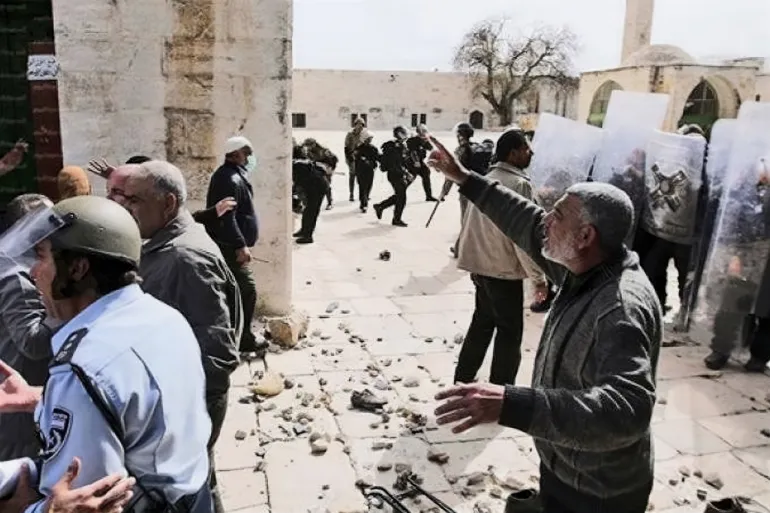
The First Al-Aqsa Massacre (October 8, 1990)
The first Al-Aqsa massacre took place on the morning of Monday, October 8, 1990, at Al-Aqsa Mosque in Jerusalem, shortly before the noon prayer. That day, Israeli occupation forces opened fire on thousands of worshippers who had gathered in the mosque to stop the extremist group known as the "Temple Mount Faithful" from storming it and laying the cornerstone of what it calls the "Third Temple." The massacre left 21 Palestinians dead, around 150 wounded, and some 270 people arrested.
Who Are the "Temple Mount Faithful"?
This extremist Jewish group was founded in 1967 with one primary goal: to build the "Third Temple" on the site of Al-Aqsa Mosque. Its members believe that remains of the Temple lie beneath the mosque, and that the Temple was destroyed twice in history. They therefore call the temple they seek to build the "third."
Members of the group had entered the Al-Aqsa compound several times during certain Jewish holidays, under the protection of Israeli police, who brought them in small groups.
Before the Massacre
A few days before the massacre, the group distributed a statement to the media marking the Feast of Tabernacles (Sukkot). In it, the group announced plans to march to what it calls the "Temple Mount," urged Jews to take part, and declared that it would "decisively" lay the cornerstone of the Third Temple. The statement was accompanied by remarks from the group's founder, Gershon Salomon, who said that the "Arab Islamic occupation" of the Temple area must come to an end, and that Jews must renew their deep connection to the site.
The group had formally requested permission to lay the cornerstone that day. Police prohibited the laying of the stone but allowed group members to enter between 8:00 and 11:00 a.m. The group petitioned the Israeli High Court of Justice against the ban, but later withdrew its petition.
All of this angered Jerusalem's residents. The imam of Al-Aqsa Mosque and the Islamic Movement called on people to remain in the mosque to protect it from the planned incursion.
The Day of the Massacre
Worshippers began arriving at Al-Aqsa at dawn, and their numbers grew through the morning to around 4,000. At 7:30 a.m., a Border Police patrol of ten soldiers entered the compound and took up position near the Mughrabi Gate, where some of its members began issuing threats to the worshippers.
The men gathered inside the Qibli Mosque, while the women went into the Dome of the Rock. Preachers urged worshippers to defend their mosque, while calling on them to exercise restraint and not respond to police provocations. About half an hour before the violence broke out, occupation forces set up military checkpoints on the roads leading to Jerusalem and Al-Aqsa, and closed the mosque's gates to prevent more worshippers from reaching it.
The massacre began at around 10:30 a.m., when Israeli police fired tear gas canisters at the women gathered in the Dome of the Rock. The crowd rose up. Some worshippers headed toward the Dome of the Rock, while others advanced toward the Border Police stationed at the Mughrabi Gate. The soldiers opened fire, and worshippers responded by throwing stones.
The Border Police withdrew behind the Mughrabi Gate and continued firing live ammunition and tear gas at worshippers from there, as well as from the windows of the nearby court building.
An ambulance arrived ten minutes after the violence began, and police targeted it, wounding a doctor, a nurse, and a second male nurse. The occupation authorities then called in reinforcements: around fifty officers entered through the Mughrabi Gate and opened fire. More reinforcements followed until the number of police and Border Police reached about one hundred. A military helicopter flew over the mosque and opened fire, damaging the western side of the Dome of the Rock. Several worshippers were wounded while trying to carry the injured to safety.
Worshippers took shelter inside the Qibli Mosque, where the dead and wounded already lay. The shooting lasted about 35 minutes, and the police post at the Mughrabi Gate was set on fire during the events. Officials from the Islamic Waqf, representatives of the International Committee of the Red Cross, and the United Nations Relief and Works Agency for Palestine Refugees (UNRWA) intervened to evacuate worshippers from the mosque. By 5:00 p.m., everyone had left.
The Toll and the Aftermath
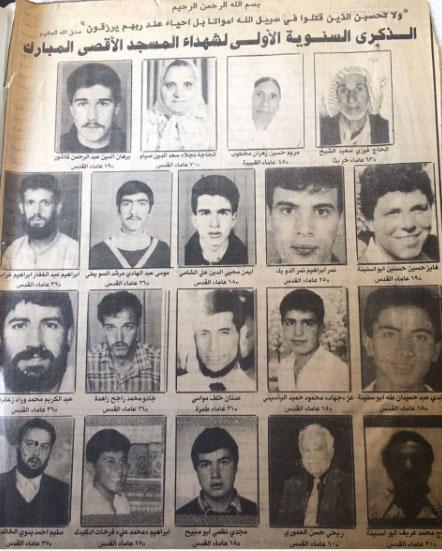
The massacre killed 21 Palestinians, including two women and several elderly people, who were buried in the Bab al-Rahma Cemetery. Around 150 people were wounded, and about 270 were arrested: 150 from inside the Qibli Mosque and 120 from outside it. On the other side, 11 members of the Temple Mount Faithful and 8 Israeli police officers were injured.
Occupation forces obstructed ambulances heading to the wounded, and several doctors and nurses were injured while carrying out their duties. Palestinians were unable to evacuate the dead and wounded until six hours after the massacre began.
Names of the Martyrs
| # | Name | Age |
|---|---|---|
| 1 | Burhan al-Din Abd al-Rahman Kashour | 19 |
| 2 | Ayman Muhyi al-Din Ali al-Shami | 18 |
| 3 | Ibrahim Muhammad Ali Farhat Dkeidek | 16 |
| 4 | Ibrahim Abd al-Qader Ibrahim Ghurab | 31 |
| 5 | Izz al-Din Jihad al-Yasini | 15 |
| 6 | Majdi Abd Abu Snaineh | 17 |
| 7 | Maryam Hussein Zahran Makhtoub | 52 |
| 8 | Fawzi Saeed Ismail al-Sheikh | 63 |
| 9 | Nimer Ibrahim al-Dweik | 24 |
| 10 | Rebhi Hussein al-Amouri al-Rajabi | 61 |
| 11 | Muhammad Aref Yasin Abu Snaineh | 30 |
| 12 | Fayez Hussein Husni Abu Snaineh | 18 |
| 13 | Majdi Nazmi Misbah Abu Sbeih | 17 |
| 14 | Abd al-Karim Muhammad Warrad Zaatreh | 40 |
| 15 | Jado Muhammad Rajeh Zahdeh | 24 |
| 16 | Musa Abd al-Hadi Murshid al-Suweiti | 27 |
| 17 | Salim Ahmad Badri al-Khalidi | 24 |
| 18 | Adnan Khalaf Shtewi Junaidi | 28 |
| 19 | Najla Saad al-Din Siam | 70 |
| 20 | Yousef Abu Snaineh (preacher at Al-Aqsa Mosque) | — |
| 21 | Abd Muhammad Miqdad | — |
Photo gallery
More from the archive
 Download Our Palestine App
The whole archive in the palm of your hand: depopulated villages, the Nakba, the massacres and Al-Aqsa — free, with no ads to erase the story.
Download Our Palestine App
The whole archive in the palm of your hand: depopulated villages, the Nakba, the massacres and Al-Aqsa — free, with no ads to erase the story.



Comments
No comments yet — be the first to write one.
Add your comment
Name and email are optional. Comments appear after review.