Wadie Haddad “Abu Hani”: PFLP External Operations Chief, d. 1978
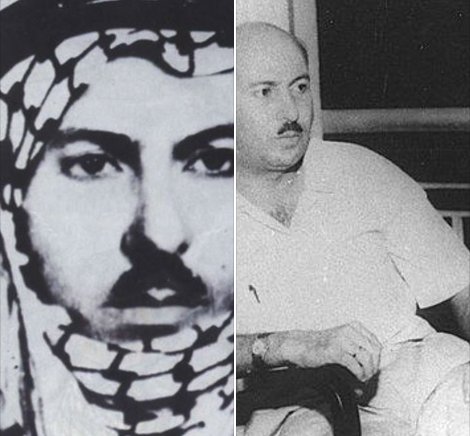
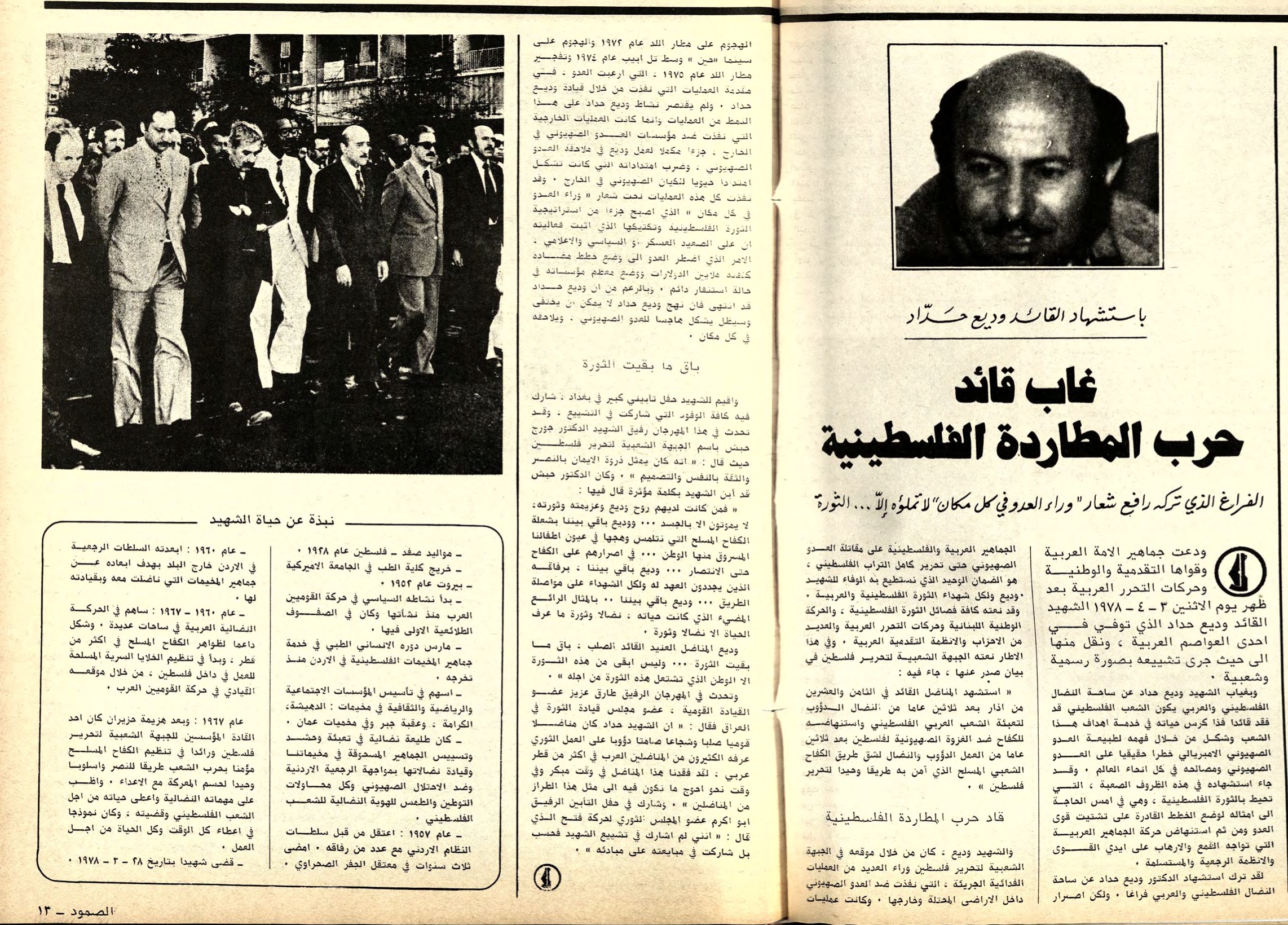
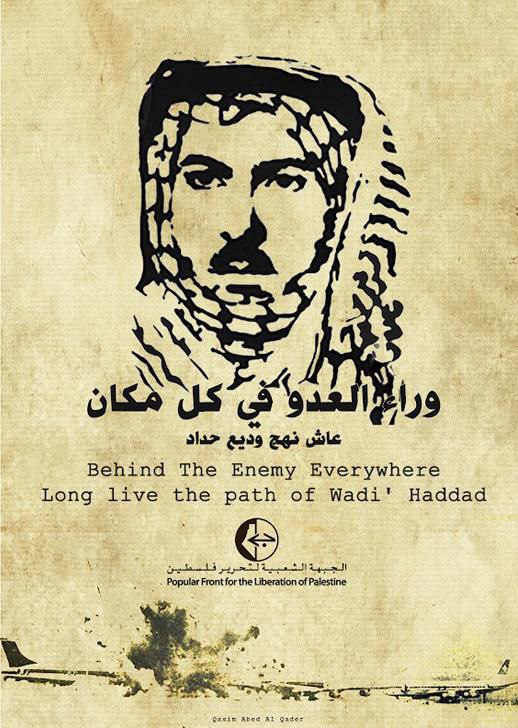
Wadie Haddad, “Abu Hani” (1928–1978), was a Palestinian doctor from Safad who, with his comrade George Habash, founded the Arab Nationalists’ Movement and then the Popular Front for the Liberation of Palestine (PFLP), and led its “external sphere,” which carried the confrontation with the occupation beyond Palestine’s borders under the slogan of pursuing the enemy everywhere. He died in East Berlin on 28 March 1978 after a mysterious illness and was buried in Baghdad; accounts of his poisoning by the Mossad remain disputed. [1] [2] [3]
This article is part of the series “Assassinated leaders of the Palestinian revolution,” alongside the articles on Ghassan Kanafani, Abu Ali Mustafa and Abu Jihad.
Who was Wadie Haddad?
Wadie Haddad was a Palestinian leader and founder known as the secretive, elusive man of the Palestinian revolution [4]. From the PFLP’s founding he was responsible for its external operations, and his name became linked to the hijackings meant to draw the world’s attention to the suffering of the Palestinian people [3] [1]. Writer Saqr Abu Fakhr calls him the “teacher of special operations” to a whole generation of fighters, with contacts stretching from Japan to Latin America [1] [2].
Wadie Haddad at a glance
| Item | Details |
|---|---|
| Name | Wadie Haddad, “Abu Hani,” known as “al-Khal” (the Uncle) [1] [2] |
| Born | Safad, 21 July 1928 according to writer Saqr Abu Fakhr [2] |
| Education | Medicine at the American University of Beirut (enrolled 1946) [1] [5] |
| Organisation | Co-founder of the Arab Nationalists’ Movement, then of the Popular Front for the Liberation of Palestine [1] [2] |
| Role | Head of the PFLP’s “external sphere” (external operations) [1] [3] |
| Family | Wife Samia Nimat Allah Haddad (Umm Hani) and son Hani [1] |
| Died | 28 March 1978, East Berlin, amid conflicting accounts of poisoning [1] [6] [3] |
| Buried | Baghdad, 1 April 1978 [1] [2] |
Timeline
| Year | Event |
|---|---|
| 1928 | Born in Safad, according to Saqr Abu Fakhr [2] |
| 1946 | Enrols in medicine at the American University of Beirut and meets George Habash [1] [5] |
| 1950s | Runs a clinic for refugees with Habash in Jordan and works in the Arab Nationalists’ Movement [1] [7] |
| 1957 | Arrested after the coup against Suleiman al-Nabulsi’s government; three years in al-Jafr prison [1] [2] |
| 1961 | Escapes to Syria [1] |
| 1968 | Founds the PFLP’s “external sphere”; El Al hijacking from Rome to Algiers; Habash freed from Sheikh Hassan prison in Damascus (5 November) [1] [2] |
| 1969 | Flight 840 hijacked by Leila Khaled and Salim al-Issawi on 29 August [8] |
| 1970 | Israeli shelling of his Beirut apartment; September hijackings to Dawson’s Field in Jordan [9] [10] [1] |
| 1976 | Reconciliation meeting with George Habash in Baghdad [1] [2] |
| 1977 | Symptoms of a blood disease appear late in the year [1] |
| 1978 | Moved to East Germany on 1 March, dies on 28 March, buried in Baghdad on 1 April [1] [2] |
From Safad to Beirut: the revolutionary doctor
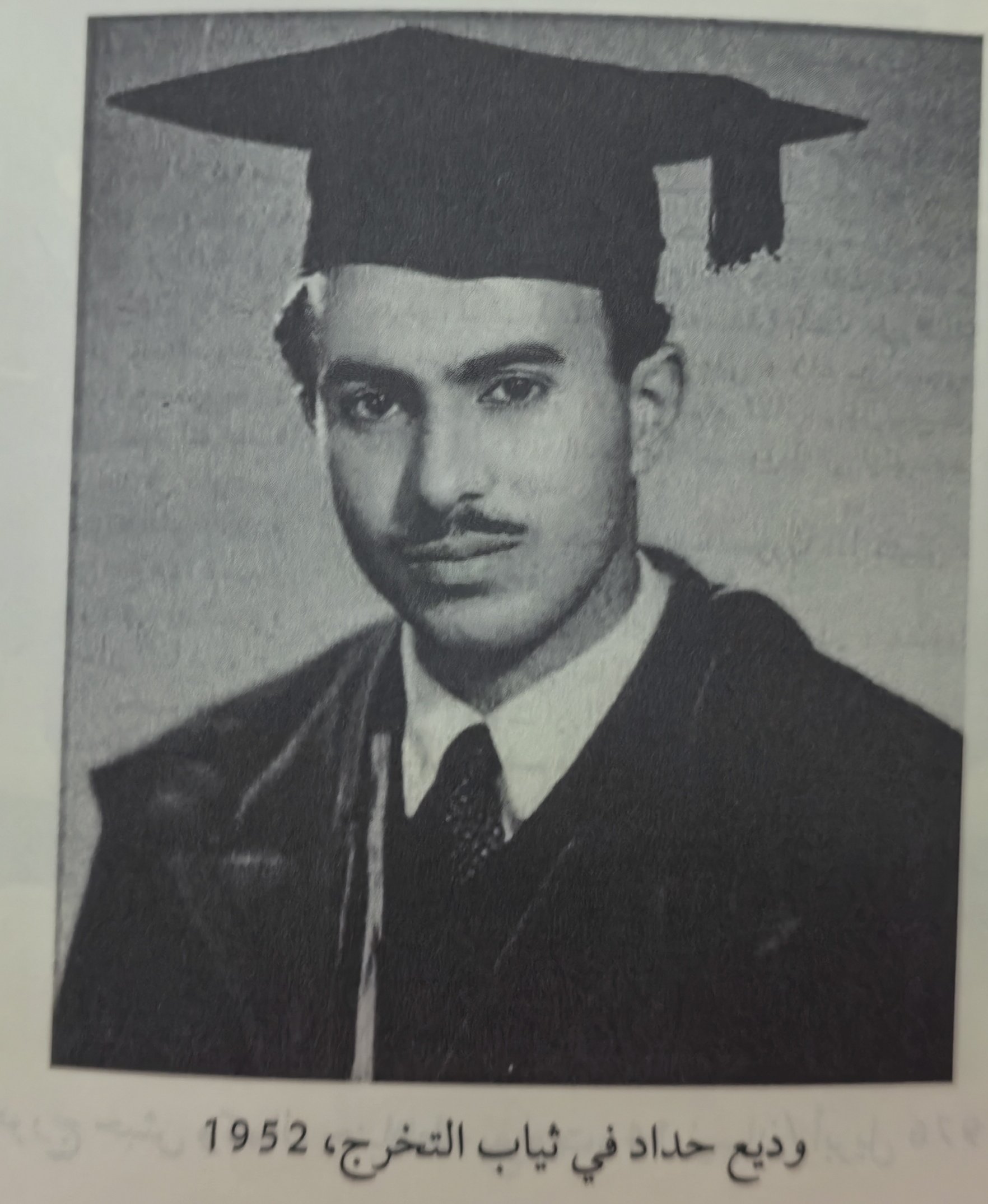
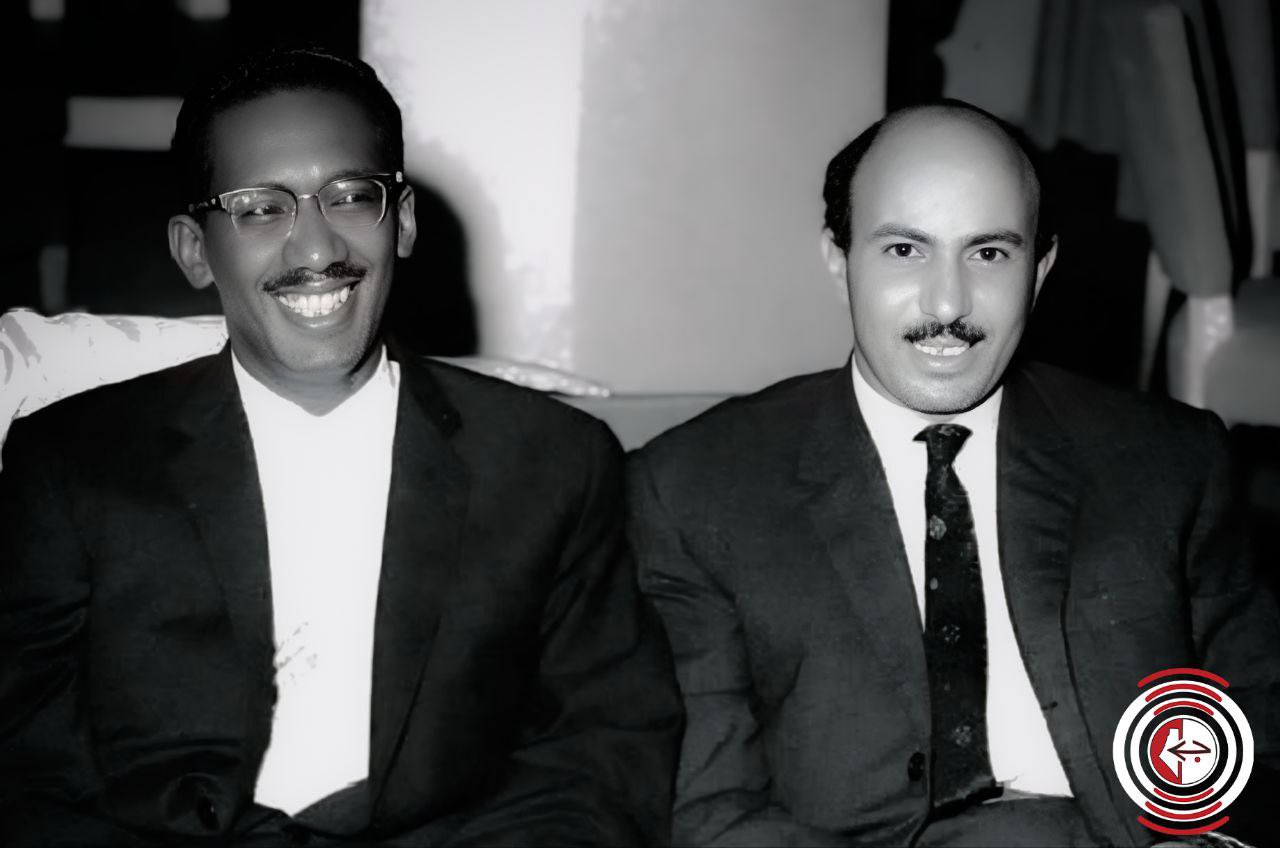
Wadie Haddad was born in Safad; Saqr Abu Fakhr dates his birth to 21 July 1928 [2]. He went to primary school in Safad and secondary school in Haifa, and in 1946 enrolled in medicine at the American University of Beirut, where he met George Habash, who had come from Lydda, beginning a lifelong comradeship [1] [5].
At university the two students were influenced by the nationalist thinkers Constantine Zurayk and Sati’ al-Husri [1] [2]. Then the Nakba of 1948 uprooted his family from Palestine, as it uprooted hundreds of thousands of Palestinians whom Zionist militias drove from their towns and villages, Safad among them.
Amman and al-Jafr: the doctor in prison
After graduating, Wadie Haddad and George Habash moved to Jordan and opened a clinic to treat refugees [1] [7]. Haddad was in the founding group of the Arab Nationalists’ Movement with Habash, Salih Shibl, Hani al-Hindi, Ahmad al-Khatib, Hamid al-Jubouri and Hamad al-Farhan [1] [2], and later led the movement’s “special apparatus” for Palestine, which became the nucleus of the PFLP’s external work [1].
In April 1957, after the coup against Suleiman al-Nabulsi’s government, Wadie Haddad was arrested and spent three years in the desert prison of al-Jafr, before escaping to Syria in 1961 [1] [2]. In Syria he married his relative Samia Nimat Allah Haddad and had a son, Hani, hence the name “Abu Hani” [1].
“Behind the enemy everywhere”: the external sphere
After the 1967 defeat Wadie Haddad was among the founders of the Popular Front for the Liberation of Palestine and took charge of the “external sphere,” formed in 1968 under the slogan of pursuing the enemy everywhere [1] [3]. Oman Daily sums up his strategy as “behind the enemy everywhere”: widening the front and carrying armed struggle from local geography to what he called the “external arena” [4]. The work ran on strict secrecy: no one knew more than their role required, according to Leila Khaled [9].
Among the operations Saqr Abu Fakhr lists are the escape of George Habash from Sheikh Hassan prison in Damascus on 5 November 1968, planned by Haddad, and a 1971 plan to strike the Israeli oil tanker “Coral Sea” near Bab al-Mandab [1] [2]. He also links Haddad’s name to the 1972 Lod Airport operation and the 1975 raid on the OPEC meeting in Vienna, and to ties with the Japanese Red Army and Nicaragua’s Sandinistas [1] [2]. Israel accused him of involvement in the June 1976 hijacking of an Air France plane diverted to Libya and then Uganda [6].
Israel was never far from him: in 1970 his Beirut apartment was hit by Israeli shelling while Leila Khaled was there, according to Asharq News [9].
The hijackings: Palestine in the world’s headlines
In 1968 the PFLP hijacked an Israeli El Al plane flying from Rome to Tel Aviv and diverted it to Algiers [1] [2]. On 29 August 1969 Leila Khaled and Salim al-Issawi hijacked the US Flight 840 bound for Tel Aviv, flew it over Haifa and landed in Damascus, where its 116 passengers disembarked before the plane was blown up; Khaled radioed the control tower: “This is the Popular Front flight… Palestine free and Arab” [8].
On 6 September 1970 the PFLP hijacked several planes, forcing some to land at the abandoned Dawson’s Field in the Jordanian desert to demand the release of Palestinian prisoners held by the occupation and in Europe; the planes were later blown up [10]. Wadie Haddad himself was at Dawson’s Field directing the operation [1] [2]. The operation turned the dispute with the Jordanian regime into an international crisis that escalated on 17 September into the “Black September” fighting [10].
Oman Daily says Haddad and his comrades changed airport security worldwide, and that historians still disagree on how to describe him [4]. What is certain is that these operations put the cause of a people uprooted from its land at the top of the world’s news, at a time when the world ignored Palestinian refugees [8] [3].
The rift with Habash and reconciliation
Wadie Haddad and George Habash disagreed over the hijackings, and Haddad drew his apparatus away from the Front’s leadership [1] [2]. But the two comrades met in Baghdad in 1976, a meeting Saqr Abu Fakhr describes as full of tears and affection [1] [2].
The death of Wadie Haddad: East Berlin, 28 March 1978
In late 1977 Wadie Haddad developed symptoms of a blood disease; on 1 March 1978 he was taken to East Germany for treatment, where he died on 28 March 1978, and he was buried in Baghdad on 1 April 1978 [1] [2]. It was announced at the time that he had died of leukaemia [6] [3].
The poisoning accounts: what do we know?
Years after his death, Israeli accounts began attributing it to the Mossad:
- The chocolate account: in 2006 the book Open Account by Israeli journalist Aharon Klein claimed the Mossad slipped him a biological poison in Belgian chocolate, that Israeli Prime Minister Menachem Begin approved the decision to kill him, and that the 1976 Air France hijacking was the final trigger [11].
- The toothpaste account: later, another Israeli journalist offered a different version, claiming the poison was put in his toothpaste [6] [3].
- The coffee account: Bassam Abu Sharif is credited with speaking of poisoned coffee [3].
Al Jazeera’s Mysterious Endings examined these accounts: it said Wadie Haddad did not even like chocolate, found no medical file or record in his name at the German hospital where he was said to have been treated, quoted a former Israeli intelligence officer saying the Mossad often invents stories to mislead about its operations, and concluded that leukaemia caused his death [3]. Saqr Abu Fakhr considers his death still a mystery [1].
Whether or not the poisoning account is true, the Israeli accounts’ boast that the occupation’s prime minister personally approved his killing [11] exposes the occupation’s policy of assassinating the leaders of the Palestinian people, from Ghassan Kanafani in Beirut in 1972 to the Mossad assassinations in Europe.
Testimonies
Leila Khaled: weeks before the Flight 840 operation, Wadie Haddad briefed her on her mission and tested her endurance by leaving her in an apartment for two days without water or food [8]. She says the rule in the “external sector” was that no one knew more than they needed for their role [9].
The password: Saqr Abu Fakhr recounts that on 8 September 1970 a Palestinian hijacked a British plane in Bahrain on his own initiative; Haddad, at Dawson’s Field, suspected a trap and asked for proof of identity, and the hijacker answered “stuffed courgettes and vine leaves,” Haddad’s favourite dish. Haddad laughed and said: “He’s one of ours, let him land” [1] [2].
George Habash: in his long interview with Saqr Abu Fakhr, chapters of which Al-Araby Al-Jadeed published, Habash speaks of his first meeting with Wadie Haddad and of “the shy Wadie Haddad” of the Jordanian period [5] [7].
Legacy
Saqr Abu Fakhr describes Wadie Haddad as ascetic and gentle, living without personal pleasures and devoted to his people’s cause, and fond of the songs of Wadie al-Safi, Nasri Shams al-Din, Sabah and Fairuz [1] [2]. His name, he says, remains a landmark in the history of the Palestinian struggle [1].
Oman Daily holds that Haddad and his comrades changed the face of aviation security worldwide [4]. In April 2026 Maha Abu Khalil, a PFLP member who took part in the 1969 hijacking of an El Al plane to Athens, was killed by an Israeli airstrike on her home in Tyre, a sign that the occupation still pursues Wadie Haddad’s generation half a century later [4].
Video
Watch the episode “Wadie Haddad: Natural Death or Killed by the Mossad?” from Al Jazeera’s Mysterious Endings (in Arabic) [3].
Conclusion
From Safad, from which he was driven out, to the refugee clinic in Amman, the prison of al-Jafr and the distant arenas to which he carried the battle, Wadie Haddad lived a secret life away from the spotlight, until it ended in a hospital in East Berlin. His death remains a mystery whose accounts are contested between the occupation and history.
Also in this series: Ghassan Kanafani, Abu Ali Mustafa, Abu Jihad.
Frequently asked questions about Wadie Haddad
Who was Wadie Haddad?
A Palestinian doctor and leader from Safad, a co-founder of the Arab Nationalists’ Movement and the Popular Front for the Liberation of Palestine, and head of its external operations.
What was Wadie Haddad’s relationship with George Habash?
They met in 1946 at the American University of Beirut’s medical school, opened a clinic for refugees together in Jordan, and founded the Arab Nationalists’ Movement and then the PFLP.
What was the PFLP’s “external sphere”?
The external operations apparatus Wadie Haddad led from 1968, under the slogan of pursuing the enemy everywhere.
When did Wadie Haddad die?
On 28 March 1978 in East Berlin.
Did the Mossad assassinate Wadie Haddad?
Israeli accounts claim the Mossad poisoned him with chocolate or toothpaste, but there is no conclusive evidence, and an Al Jazeera investigation concluded that leukaemia caused his death.
Where is Wadie Haddad buried?
In Baghdad, on 1 April 1978.
What was Wadie Haddad’s nickname?
“Abu Hani,” after his son Hani; he was also known as “al-Khal” (the Uncle).
Sources and references
Arabic-language sources are listed with translated titles.
- Saqr Abu Fakhr, “Dr. Wadie Haddad,” Al-Hadaf News Portal, 10 September 2023.
- Saqr Abu Fakhr, “Wadie Haddad,” PFLP Lebanon branch website.
- “Wadie Haddad: Natural Death or Killed by the Mossad?” Mysterious Endings, Al Jazeera, 14 January 2019.
- Salem al-Rahbi, “Maha Abu Khalil: A Story from the Time of Wadie Haddad,” Oman Daily, 25 April 2026.
- “George Habash: The First Meeting with Wadie Haddad and the Hard Beginnings (1),” Al-Araby Al-Jadeed.
- Sami Moubayed, “Israel Threatened a ‘Second Munich’: Who Were the Most Prominent Figures It Assassinated Before al-Arouri?” Al Majalla, 2023.
- “George Habash: The Shy Wadie Haddad in the Jordanian Period (3),” Al-Araby Al-Jadeed.
- “‘Flight 840’: The First Hijacking to Introduce Palestine,” Al Jazeera Encyclopedia, 29 September 2016.
- “Leila Khaled: Rafik Hariri Moved Wadie Haddad’s Weapons to Europe,” Asharq News, 13 February 2023.
- “Black September 1970: The Memory of a Wound in the Arab Conscience,” Al Jazeera Documentary, 18 September 2019.
- Wadie Awawdeh, “Book Reveals Mossad Poisoned a Palestinian Activist,” Al Jazeera Net, 5 May 2006.
Photo gallery
More from the archive
 Download Our Palestine App
The whole archive in the palm of your hand: depopulated villages, the Nakba, the massacres and Al-Aqsa — free, with no ads to erase the story.
Comments
No comments yet — be the first to write one.
Add your comment
Name and email are optional. Comments appear after review.