
The Church of the Nativity
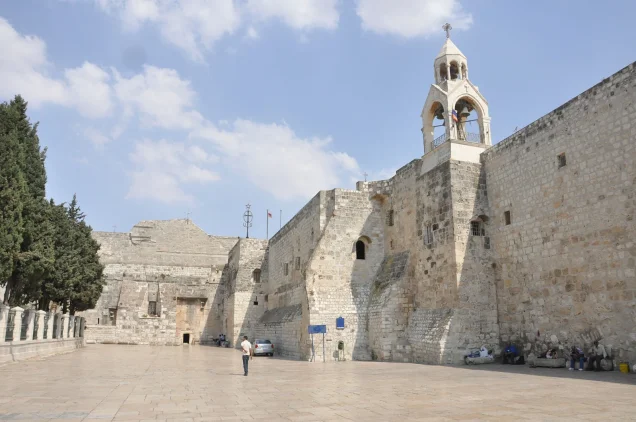
The Church of the Nativity
The Church of the Nativity in Bethlehem: History, the Grotto of the Nativity and the 2002 Siege
The Church of the Nativity, on Manger Square in the heart of Bethlehem, stands over the cave where Christian tradition holds that Jesus was born. First built by Emperor Constantine and his mother Helena in the 4th century and rebuilt by Emperor Justinian in the 6th, it is one of the oldest churches in the world in continuous use, and in 2012 it became the first Palestinian site inscribed on UNESCO's World Heritage List. In 2002, during the Second Intifada, it endured a siege of about 39 days by Israeli forces, as fighters, residents and monks shared hunger and fear inside its walls. This guide covers its history, architecture, religious significance, the siege and its situation today.
Quick Facts About the Church of the Nativity
| Arabic name | كنيسة المهد |
|---|---|
| Location | Manger Square, Bethlehem, southern West Bank, about 10 km south of Jerusalem |
| First church | Begun 326 CE by Constantine and Helena; dedicated 339 CE |
| Present basilica | Rebuilt by Justinian in the 6th century |
| Holiest spot | The Grotto of the Nativity, marked by a 14-pointed silver star |
| Entrance | The low "Door of Humility" |
| Custodians | Greek Orthodox, Catholic (Franciscan) and Armenian churches |
| UNESCO | World Heritage Site since 2012, the first in Palestine |
| 2002 siege | 2 April – 10 May 2002, about 39 days |
| Status | One of the oldest churches in continuous use in the world |
Location
The church stands on Manger Square in the old centre of Bethlehem, in the southern West Bank, about 10 km south of Jerusalem. Facing it across the square is the Mosque of Omar, named after the caliph Umar ibn al-Khattab, who according to tradition prayed near the church during his visit and guaranteed its protection.
History Through the Ages
- Constantine and Helena (4th century): After Empress Helena visited the Holy Land in 325–326, Emperor Constantine ordered a basilica built over the cave of the Nativity. Work began in 326, the church was in use by 333 and it was dedicated on 31 May 339. It was the first of three great churches Constantine built in the Holy Land, alongside the Church of the Holy Sepulchre in Jerusalem and the Eleona Church on the Mount of Olives.
- Justinian (6th century): After the first church was damaged by fire during a Samaritan revolt, Emperor Justinian (527–565) rebuilt it in essentially its present form. Religious services have been held in it regularly ever since, making it one of the oldest churches in continuous use in the world.
- 614: When the Persians invaded Palestine, they spared the church; tradition says their commander saw the Magi depicted on its façade in Persian dress.
- Islamic and Crusader periods: The church was respected under early Islamic rule. The Crusaders, who held Bethlehem from 1099, decorated it with wall paintings and mosaics completed in 1169.
- Ottoman period: The main entrance was walled up and reduced to the low "Door of Humility". The church was damaged by the earthquake of 1834 and a fire in 1869, and its ownership was fixed by the Status Quo of the holy places.
Architecture and the Grotto of the Nativity
Visitors enter the basilica by bending through the Door of Humility, a small opening in the walled-up Justinianic entrance. Inside, the vast nave is lined with rows of red limestone columns painted with images of saints, and beneath its wooden floor lie remains of Constantine's original mosaic pavement. The walls preserve Crusader-era mosaics, restored in recent years.
Steps beside the altar lead down to the Grotto of the Nativity, the cave where, according to tradition, Jesus was born and laid after his birth. Its floor is of white marble, and a 14-pointed silver star marks the place of the birth, with a Latin inscription meaning "Here Jesus Christ was born of the Virgin Mary". Fifteen silver lamps, representing the different Christian communities, hang above it, among many icons and images of saints. Nearby is the Chapel of the Manger.
The Church Complex and Its Communities
The church is a large religious complex: besides the basilica it includes monasteries and churches of the different Christian communities. The Greek Orthodox monastery lies to the south-east, the Armenian monastery to the south-west, and the Franciscan monastery to the north, with the Church of Saint Catherine, built in 1881 for the Latin (Catholic) community, from which the Christmas Midnight Mass is broadcast worldwide. Under the Status Quo, the Greek Orthodox own most of the basilica, while the Catholics and Armenians hold smaller parts, and the Coptic and Syriac churches have minor rights. Manger Square and its surroundings were renovated ahead of the millennium celebrations of 2000.
Religious Significance
The Church of the Nativity holds a special place in the hearts of Christians of every denomination: beyond its historical importance, it stands on the spot where Christian tradition places the birth of Christ. Christmas is celebrated here three times, by the Latin, Orthodox and Armenian churches according to their calendars. For Muslims, the birth of Jesus (Isa), son of Mary, is told in the Qur'an, and Bethlehem's Muslims and Christians have long shared the square and the church's celebrations.
The Siege of the Church of the Nativity (2002)
On , during the Second (al-Aqsa) Intifada, Israeli forces invaded Bethlehem as part of the military operation known as "Defensive Shield". Palestinian fighters took refuge inside the church, where the monks received them and made the difficult decision to shelter and protect them, whatever the cost, along with civilians who had fled there.
For about 39 days, until , fighters, residents and monks shared the siege, hunger and sickness, and the killing, abuse and intimidation spared no one. Israeli snipers surrounded the church, and parts of the complex were damaged by gunfire and fire. Eight Palestinians were killed and 14 wounded during the siege, among them the church's bell-ringer, while two Israeli soldiers were killed. Negotiations involving international organisations, the European Union and the Palestinian Authority ended the siege with an agreement under which 13 Palestinians were deported abroad, mostly to European countries, and 26 were deported to the Gaza Strip.
UNESCO and Restoration
On 29 June 2012 UNESCO inscribed the "Birthplace of Jesus: Church of the Nativity and the Pilgrimage Route, Bethlehem" on the World Heritage List, the first Palestinian site to be inscribed. Because of water leaks and decay it was also placed on the List of World Heritage in Danger. A major restoration began in September 2013, repairing the roof, windows, columns and mosaics, and in July 2019 UNESCO removed the church from the danger list.
The Church Today (2026)
After the genocide war on Gaza began in October 2023, Bethlehem cancelled its public Christmas celebrations for two years. In 2024, instead of the Christmas tree, a nativity scene in the form of a destroyed house surrounded by barbed wire, titled "Christmas under the rubble", stood in Manger Square in solidarity with Gaza. In December 2025 the Christmas tree was lit again for the first time since the war began, as Muslims and Christians gathered in the square. But tourism, on which more than 70% of Bethlehem's people depend directly or indirectly, collapsed almost to zero, the city lost more than 60% of its annual income, and Israeli checkpoints, the separation wall and settlements continue to encircle it.
Legal Protection
As a World Heritage Site in occupied territory, the church is protected by the World Heritage Convention, the Fourth Geneva Convention and the 1954 Hague Convention for the Protection of Cultural Property in the Event of Armed Conflict, while the Status Quo governs the rights of the churches that share it.
Frequently Asked Questions About the Church of the Nativity
Where is the Church of the Nativity?
On Manger Square in the centre of Bethlehem, in the southern West Bank, about 10 km south of Jerusalem.
Who built the Church of the Nativity?
Emperor Constantine and his mother Helena built the first church, begun in 326 and dedicated in 339. Emperor Justinian rebuilt it in its present form in the 6th century.
What is the Grotto of the Nativity?
The cave beneath the church where tradition says Jesus was born, marked by a 14-pointed silver star and lit by fifteen silver lamps representing the Christian communities.
What happened during the 2002 siege of the Church of the Nativity?
From 2 April to 10 May 2002, Israeli forces besieged the church where Palestinian fighters, civilians and monks were sheltering. Eight Palestinians were killed, and the siege ended with 13 Palestinians deported abroad and 26 to Gaza.
Is the Church of the Nativity a UNESCO World Heritage Site?
Yes. It was inscribed in 2012, the first Palestinian site on the World Heritage List, and was removed from the danger list in 2019 after restoration.
Conclusion
For seventeen centuries, the Church of the Nativity has kept watch over the grotto of Bethlehem, outlasting empires, earthquakes and wars. It sheltered the besieged in 2002 as it has sheltered prayer since the age of Constantine, and in the shadow of the genocide war on Gaza it marked Christmas beneath the rubble. It remains the heart of Bethlehem and a symbol of Palestine's place at the cradle of Christianity.
Photo gallery


More from the archive
 Download Our Palestine App
The whole archive in the palm of your hand: depopulated villages, the Nakba, the massacres and Al-Aqsa — free, with no ads to erase the story.
Download Our Palestine App
The whole archive in the palm of your hand: depopulated villages, the Nakba, the massacres and Al-Aqsa — free, with no ads to erase the story.



Comments
No comments yet — be the first to write one.
Add your comment
Name and email are optional. Comments appear after review.