
Hisham's Palace

Hisham's Palace in Jericho: Umayyad Masterpiece, the Tree of Life Mosaic and Khirbat al-Mafjar
Hisham's Palace (Qasr Hisham), known as Khirbat al-Mafjar, lies on the northern bank of Wadi Nuway'ima about 2–3 km north of the centre of Jericho. Attributed to the Umayyad caliph Hisham ibn Abd al-Malik (724–743), with decoration completed under al-Walid II (743–744), it was a winter retreat rather than an official seat. Its great bath hall holds one of the largest mosaic floors in the world, some 825–850 m², including the famous Tree of Life panel with its lion and gazelles. Unveiled under a protective shelter in 2021 and on Palestine's tentative World Heritage list, it is one of the jewels of early Islamic art. This guide covers its history, architecture, mosaics and situation today.
Quick Facts About Hisham's Palace
| Arabic name | قصر هشام / خربة المفجر |
|---|---|
| Location | Northern bank of Wadi Nuway'ima, about 2–3 km north of Jericho |
| Period | Umayyad, first half of the 8th century |
| Attributed to | Caliph Hisham ibn Abd al-Malik (724–743); decoration completed under al-Walid II (743–744) |
| Purpose | Winter palace for rest and leisure, with an agricultural estate |
| Components | Palace, great bath, mosque, fountain, enclosure wall, two gates |
| Bath hall | About 30 × 30 m, with 38 mosaic panels |
| Great mosaic | About 825–850 m², one of the largest in the world |
| Most famous panel | The Tree of Life, with lion and gazelles |
| UNESCO | On Palestine's tentative World Heritage list since 2020 |
The Name: Hisham's Palace and Khirbat al-Mafjar
The site is known locally as Khirbat al-Mafjar, "the ruins of al-Mafjar", from the springs that "burst forth" (tafajjara) in the area. It was attributed to Caliph Hisham ibn Abd al-Malik on the strength of written evidence found there, notably a fragment bearing the name "Hisham". Some scholars, following the excavator Robert Hamilton, argue that it was built by his heir and successor al-Walid ibn Yazid (al-Walid II), who completed its decoration; the exact patronage remains debated.
Location
The palace lies on the northern bank of Wadi Nuway'ima, about 2 to 3 km north of the centre of Jericho, in the Jordan Valley. The springs of Ain Nuway'ima and Ain al-Sultan, linked to the palace by a water system, made this warm, fertile valley an ideal winter retreat, far from the cold of the caliphal capital in Damascus.
History of the Palace
The palace was not the caliph's official residence but a winter palace for rest and recreation, one of the so-called "desert castles" built by the Umayyads across the Levant. A violent earthquake that struck the region around 749 CE is traditionally thought to have destroyed the reception hall and the bath before the work was finished, though a 2013 geological study links the destruction to a later earthquake in 1033. Occupation continued in other parts of the site, including the palace, until the 10th century. The northern area of the site was used as an agricultural estate in the Umayyad and Abbasid periods, from about 730 to 950 CE.
Layout of the Site
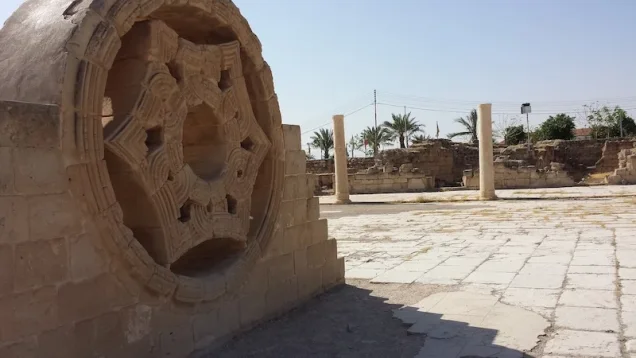
In the Umayyad period the site contained the palace, the great bath, the mosque, a fountain, an outer enclosure wall (al-hayr), two gates, and probably residences for the ruling elite. The three main buildings were arranged along the western side of a shared forecourt, with a pool and fountain at its centre. The two-storey palace was built around a colonnaded courtyard, and its decoration included carved stucco and the famous stone window in the shape of a star, which has become a symbol of Jericho.
The Great Bath Hall
The great bath lies north of the palace. Its main element is the large reception hall known as the cold room, whose finest feature is its mosaic floor. The hall measures about 30 × 30 metres and contains 38 panels of coloured mosaic. It was roofed with a series of arches and domes built of baked brick, resting on sixteen massive stone piers arranged in four rows. The building was decorated with stucco, carved stone and statues, and its upper walls were painted with murals. A pool was added on the south side of the hall.
A statue of the caliph, holding a sword and standing on a pair of lions, was placed above the main entrance, and the caliph probably sat in the apse opposite the entrance. North of the cold hall were the hot rooms: two warm rooms and two hot rooms heated by steam, two furnaces and a latrine.
The Diwan and the Tree of Life Mosaic
The diwan was built in the north-western corner of the bath hall as a small reception chamber, with a semicircular dais at its northern end. Benches lined its eastern and western walls, its walls were covered in carved stucco, and its floor was laid with exceptionally beautiful mosaics in varied geometric patterns, including the famous scene of lions and gazelles beneath a citrus tree, the "Tree of Life". On one side of the fruit-laden tree, two gazelles graze peacefully; on the other, a lion attacks a third. The panel is often read as a symbol of peace and war, or of the power of the ruler, and it is one of the most celebrated masterpieces of early Islamic art.
Discovery and Excavation
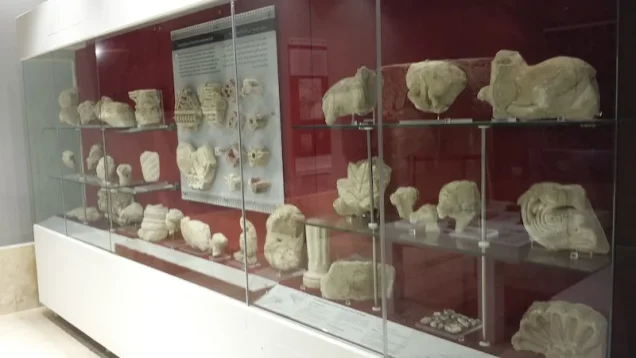
The site was identified in 1873. Systematic excavations were carried out between 1935 and 1948 by the Palestinian archaeologist Dimitri Baramki for the Department of Antiquities of Mandate Palestine, with Robert Hamilton publishing the main study. Further excavations followed under the Jordanian Department of Antiquities from 1957, and from 2006 a joint Palestinian-American project resumed work at the site. Many of the stucco sculptures and finds from the early excavations are displayed at the Rockefeller Museum in Jerusalem, which has been under Israeli control since 1967.
The 2021 Unveiling of the Great Mosaic
For decades the great mosaic was kept covered with sand to protect it, and shown to visitors only rarely. Following a 2015 agreement between the Palestinian Ministry of Tourism and Antiquities and the Japan International Cooperation Agency (JICA), a project worth about 12 million US dollars restored the bath hall and built a large protective shelter over it, designed by a Japanese architectural firm. In 2021 the mosaic was permanently uncovered and opened to the public, one of the largest continuous mosaic floors in the world.
The Palace Today (2026)
Hisham's Palace is one of the most visited heritage sites in Palestine, managed by the Palestinian Ministry of Tourism and Antiquities, with a visitor centre and the restored mosaic hall. But tourism in Jericho has been hit hard since the genocide war on Gaza began in October 2023, by Israeli military checkpoints and gates around the city and restrictions on movement in the West Bank. Palestinian and Israeli heritage organisations have also warned against Israeli decisions in 2025–2026 to extend Israeli archaeological enforcement powers into Areas A and B, which could threaten Palestinian management of sites such as this one.
UNESCO and Legal Protection
In 2020 Palestine added Hisham's Palace to its tentative list for UNESCO World Heritage. Jericho's Tell es-Sultan was inscribed on the World Heritage List in 2023. As part of occupied territory, the site is protected by the Fourth Geneva Convention and the 1954 Hague Convention for the Protection of Cultural Property in the Event of Armed Conflict, and under the Oslo Accords responsibility for heritage sites in Areas A and B was transferred to the Palestinian Authority.
Frequently Asked Questions About Hisham's Palace
Where is Hisham's Palace?
On the northern bank of Wadi Nuway'ima, about 2–3 km north of the centre of Jericho in the Jordan Valley.
Who built Hisham's Palace?
It is attributed to the Umayyad caliph Hisham ibn Abd al-Malik (724–743), with its decoration completed under his successor al-Walid II (743–744). Some scholars attribute it to al-Walid II himself.
What is the Tree of Life mosaic?
A mosaic in the diwan of the bath hall showing a fruit tree with two gazelles grazing on one side and a lion attacking a gazelle on the other, one of the masterpieces of early Islamic art.
How big is the mosaic at Hisham's Palace?
The mosaic floor of the bath hall covers about 825–850 m², making it one of the largest in the world. It was unveiled under a protective shelter in 2021.
Why was Hisham's Palace destroyed?
An earthquake traditionally dated to around 749 CE destroyed the reception hall and the bath, though a 2013 study links the destruction to an earthquake in 1033. Parts of the site remained occupied until the 10th century.
Conclusion
Hisham's Palace was built for a caliph's winters and brought down by an earthquake, but it left behind some of the most beautiful art of the early Islamic world. Its Tree of Life, its star window and its vast mosaic floor tell of the wealth and refinement of the Umayyad age in the Jordan Valley. Restored and opened by Palestinians, it remains a treasure of Jericho, the oldest city in the world, and a symbol of Palestine's place in the history of civilisation.
Photo gallery




More from the archive
 Download Our Palestine App
The whole archive in the palm of your hand: depopulated villages, the Nakba, the massacres and Al-Aqsa — free, with no ads to erase the story.
Download Our Palestine App
The whole archive in the palm of your hand: depopulated villages, the Nakba, the massacres and Al-Aqsa — free, with no ads to erase the story.



Comments
No comments yet — be the first to write one.
Add your comment
Name and email are optional. Comments appear after review.