Wadi Qelt and the Monastery of St George of Choziba

Wadi Qelt and the Monastery of St George of Choziba: A Desert Valley Between Jerusalem and Jericho
Wadi Qelt is a deep desert valley that runs from the hills near Jerusalem down to the Jordan Valley at Jericho, fed by three perennial springs and lined with ancient aqueducts, hermits' caves and monasteries. Clinging to its northern cliff stands the Monastery of St George of Choziba (Deir al-Qelt), a Greek Orthodox monastery whose origins go back to hermits around 420 CE and to John of Thebes around 480. Persians massacred its monks in 614, Crusaders restored it, and it was rebuilt between 1878 and 1901. Today the valley lies almost entirely in Area C under Israeli control, and in 2026 settlers installed an iron gate on the road to the monastery and attacked Palestinians in nearby villages. This guide covers the valley and the monastery, their history and their situation today.
Quick facts
| Arabic names | وادي القلط؛ دير القديس جورجيوس الخوزيبي / دير القلط |
|---|---|
| Course | From near Jerusalem east to the Jordan Valley at Jericho |
| Sections | Wadi Fara (upper), Wadi Fawwar (middle), Wadi Qelt (lower) |
| Springs | Ein Fara, Ein Fawwar and Ein Qelt |
| Hike | About 25 km from Hizma to Jericho, descending about 850 m |
| Monastery founded | Hermits from c. 420; monastery organised by John of Thebes c. 480–530 |
| 614 | Persians destroyed it and killed its 14 monks |
| Restorations | 1179 (Manuel I Komnenos); 1878–1901 (the monk Kallinikos) |
| Church | Greek Orthodox Patriarchate of Jerusalem |
| Status | Mostly in Area C; Important Bird Area |
The valley of Wadi Qelt
Wadi Qelt begins in the hills north-east of Jerusalem and descends eastward through the limestone of the wilderness to the plain of Jericho and the Jordan River, just north of the Dead Sea. Its upper section is called Wadi Fara, its middle Wadi Fawwar and its lower reach Wadi Qelt. Three perennial springs (Ein Fara, the largest, at its head; Ein Fawwar in the middle; and Ein Qelt farther down) keep water flowing through the dry wilderness. The valley, covering about 15,000 hectares, is an Important Bird Area, home to Eurasian eagle-owls, griffon vultures, Bonelli's eagles and lesser kestrels. A popular hiking trail of about 25 km runs from Hizma to Jericho, descending some 850 metres.
Aqueducts, palaces and ancient sites
- Aqueducts: from before the Common Era, aqueducts were built carrying water from the springs to Jericho's gardens and palaces. Sections of these channels still run along the valley walls.
- Tulul Abu al-Alayiq: at the mouth of the valley, where it opens onto the Jericho plain, stand the remains of ancient winter palaces known as Tulul Abu al-Alayiq.
- Ancient road: the old road from Jerusalem to Jericho followed the valley, which Christian tradition associates with the setting of the parable of the Good Samaritan.
- Monasteries: besides St George's, the valley held the lavra of Pharan, founded by St Chariton in the upper valley in the 3rd–4th century, among the first in Palestine.
- Prehistoric remains: large Bronze Age stone structures known as Qubur Bani Isra'in overlook the upper valley.
The Monastery of St George of Choziba
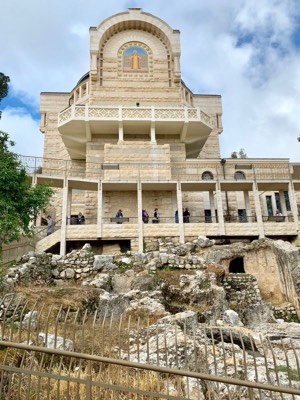
The monastery hangs on the northern cliff face of Wadi Qelt, a few kilometres west of Jericho, its walls and blue domes built into the rock above the stream. It grew from hermits' caves into a monastery with a church dedicated to the Virgin Mary, an ancient chapel of St Stephen, a bell tower, and irrigated gardens and olive groves along the valley floor. A pedestrian bridge crosses the wadi to its gate.
History of the monastery
- c. 420: monastic life began as a lavra, a loose community of hermits living in caves around a cave associated with the Prophet Elijah, who met each week for prayer and a shared meal.
- c. 480–530: John of Thebes (John of Choziba), a monk from Egypt, organised the hermits into a monastery dedicated to the Mother of God.
- 6th–7th centuries: St George of Choziba, a monk from Cyprus who died around 620, became the community's most famous figure, and the monastery later took his name.
- 614: during the Persian invasion of Palestine, Persian forces destroyed the monastery and killed its fourteen monks. It was then largely abandoned.
- Crusader period: the Byzantine emperor Manuel I Komnenos restored it in 1179, and further repairs followed in 1234. After the Crusaders' departure it was abandoned again.
- 1878–1901: the Greek monk Kallinikos resettled the site in 1878 and, with the help of the Greek Orthodox Patriarchate of Jerusalem, completed its rebuilding in 1901.
Traditions and relics
Christian tradition holds that the Prophet Elijah rested in a cave here on his way to Sinai, and that St Joachim, father of the Virgin Mary, wept in the wilderness here until an angel announced the conception of Mary. The skulls and bones of the fourteen monks killed in 614 are kept in a chapel outside the monastery walls. The monastery also holds the relics of St John of Choziba, St George of Choziba and the Romanian monk John Jacob of Choziba, who lived as a hermit in the valley and died in 1960. The Romanian Orthodox Church canonised him in 1992, and the Patriarchate of Jerusalem recognised him in 2016.
Reaching the monastery
The monastery can be reached on foot along the wadi, about a three-hour hike, or by a steep descent of about a kilometre from a car park on the opposite rim. Bedouin and residents of Jericho offer donkey rides along the way, an important source of income for local families. It is usually open daily except Sundays and some holidays, in the morning hours, and visitors are expected to dress modestly.
Under occupation since 1967
Israeli forces occupied Wadi Qelt with the rest of the West Bank in June 1967. Most of the valley was later classified as Area C, under full Israeli control, and its upper part was declared an Israeli nature reserve (Ein Prat). Settlements were built on the hills above the valley. Palestinian Bedouin communities who graze their flocks in the valley face demolitions, restrictions on access to water and grazing land, and growing settler violence. Aqabat Jabr refugee camp lies near the valley's mouth at Jericho.
The valley today (2026)
- 29 April 2026: settlers installed an iron gate on the Wadi Qelt road in the al-Marshahat area west of Jericho, about 300 metres from residents' homes. According to the human rights organisation Al-Bidar, the road links al-Marshahat to the area of the monastery, Ein Qelt spring and the Jericho–Jerusalem road, and residents use it daily.
- 10 October 2026: settlers from a nearby outpost beat a Palestinian man in the village of al-Duyuk al-Tahta near Wadi Qelt, under the protection of Israeli forces.
- Pilgrims: the genocide war on Gaza and the regional war have sharply reduced the number of foreign pilgrims and hikers, cutting the income of Jericho's guides and donkey owners.
Legal protection
As a historic and religious landscape in occupied territory, Wadi Qelt and its monastery are protected by the 1954 Hague Convention for the Protection of Cultural Property and the Fourth Geneva Convention, which prohibit the occupying power from transferring its population into occupied land. UN Security Council Resolution 2334 (2016) confirms that settlements have no legal validity. The Palestinian Ministry of Tourism and Antiquities has placed Palestine's desert monasteries on its tentative list for UNESCO World Heritage.
Frequently asked questions
Where is Wadi Qelt?
In the West Bank, between Jerusalem and Jericho. It runs from the hills near Jerusalem east to the Jordan Valley at Jericho.
Who founded St George's Monastery in Wadi Qelt?
Hermits settled here around 420 CE, and John of Thebes organised them into a monastery around 480. It later took the name of St George of Choziba, who died around 620.
What happened to the monastery in 614?
Persian forces destroyed it and killed its fourteen monks, whose skulls and bones are still kept in a chapel outside the walls.
How do you reach St George's Monastery?
By hiking along Wadi Qelt for about three hours, or by a steep one-kilometre walk down from a car park, with donkey rides available.
What is happening in Wadi Qelt in 2026?
Settlers installed an iron gate on the road to the monastery in April 2026 and attacked Palestinians in nearby villages, under the protection of Israeli forces.
Conclusion
For sixteen centuries the monks of Choziba have kept their prayers alive in the cliffs of Wadi Qelt, above a stream that has watered Jericho for thousands of years. Today the valley that sheltered hermits is closing in on its Palestinian shepherds and villagers, as iron gates and outposts spread across the wilderness between Jerusalem and Jericho.
More from the archive


 Download Our Palestine App
The whole archive in the palm of your hand: depopulated villages, the Nakba, the massacres and Al-Aqsa — free, with no ads to erase the story.
Comments
No comments yet — be the first to write one.
Add your comment
Name and email are optional. Comments appear after review.