The Port of Jaffa
The Port of Jaffa: Palestine's Gateway to the Sea for Four Thousand Years
The Port of Jaffa is the oldest and commercially most important port in Palestine. Its history goes back some four thousand years, and it remained Palestine's gateway to the Mediterranean until the Nakba. Through it the Jaffa orange carried the city's name around the world, pilgrims and merchants arrived, and sailors and boatmen ferried goods and passengers from ships anchored offshore. The port was a stage for the great strike of 1936 and then a witness to the expulsion of Jaffa's people by sea in 1948, until the occupation authorities closed it to commercial shipping in 1965. This guide covers the port's history and its role in the life of Jaffa and Palestine.
Quick facts
| Arabic name | ميناء يافا |
|---|---|
| Location | Below the old city of Jaffa, on the Mediterranean |
| Age | About four thousand years |
| Status | Palestine's oldest and commercially most important port until 1948 |
| Main export | Jaffa oranges and citrus |
| Entrances | Three: al-Dubla, al-Bughaz and al-Awjan |
| Facilities | Lighthouse, quarantine station, agriculture office, Sailors' Committee |
| 1936 strike | 17 April to 13 November 1936 |
| Fall of Jaffa | May 1948 |
| Closed to commercial shipping | 1965 |
Location and anchorage
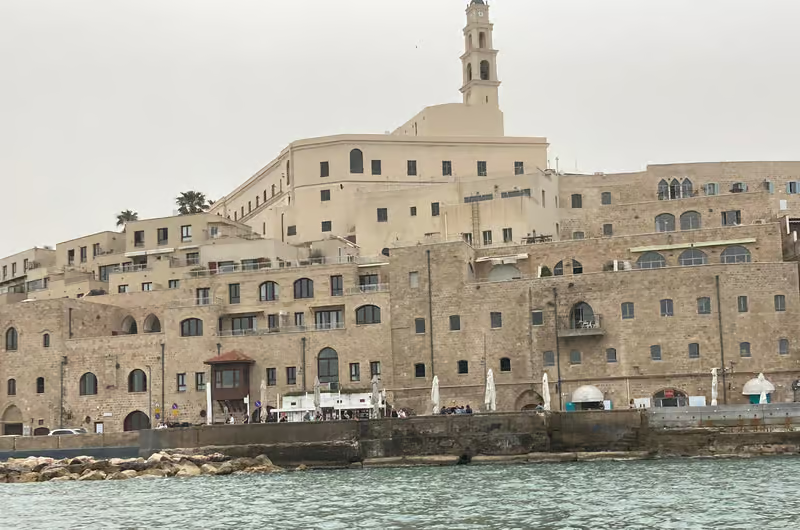
The port lies below the Jaffa hill and the old city of Jaffa, sheltered by a chain of offshore rocks. Its rocky seabed kept large ships from docking, so only small boats could enter, while large vessels anchored offshore. The port had three entrances, al-Dubla to the north, al-Bughaz, the nearest and most dangerous, and al-Awjan to the south, later abandoned, and two gates, north and south, to prevent smuggling and keep out those with no business at the port.
History through the ages
- Canaanite period: Jaffa grew up as a Canaanite city around its natural anchorage, known as "Yapu".
- Antiquity: the port passed through the hands of the Egyptians, Assyrians, Babylonians, Persians, Greeks and Romans.
- Islamic conquest: Jaffa became part of Jund Filastin, and Arab geographers described it as a fortified port and "the treasury of Palestine".
- Ottoman period: in the early 19th century Jaffa's governor Muhammad Agha Abu Nabbut renewed the port and built a breakwater, and the port became the pilgrims' gateway to Jerusalem.
- Early 20th century: a breakwater was built from rock brought from outside the city and large concrete blocks, and the port was widened by dredging.
The port in its golden age
Until 1948 the Port of Jaffa was one of the most important ports on the Mediterranean and the hub of a city whose economy rested on citrus, import and export, banking, land and sea transport companies and tourism. Since large ships could not dock, boat owners with their lighters (mawa'in) and feluccas carried goods and passengers between ships and shore, their work organised by the Sailors' Committee. The port had a lighthouse, a quarantine station, the Iskandarani coffeehouse and an agriculture office that inspected citrus before export. It was cleared with bulldozers after every orange season and cleaned every three months to maintain its depth.
The Jaffa orange
The port's name was bound up with the Jaffa orange (Shamouti), grown by Palestinian farmers in the orchards of Jaffa and its district and exported through the port to Europe and the world, carrying the city's name to distant markets. The port's agriculture office checked the quality of the oranges before shipment, and rejected consignments had to be re-sorted. Citrus farming was one of the three pillars of Jaffa's economy before the Nakba.
The 1936 revolt
Jaffa was the starting point of the great strike that swept Palestine from 17 April to 13 November 1936, the longest strike ever waged by an entire people, with port workers and sailors at its heart, bringing the port to a halt. The British Mandate authorities responded by closing Port Street militarily and blowing up hundreds of houses in the old city to cut military roads through it, while rushing to open an alternative port in Tel Aviv to break the strike, weakening the Port of Jaffa's position.
The Nakba and expulsion by sea
In the spring of 1948, under bombardment and siege, the port became an escape route, as thousands of Jaffa's people boarded boats and ships to flee to Gaza, Beirut and Egypt. In May 1948 the city fell to Zionist militias; of its population of some 120,000 Palestinians, only about 4,000 remained, gathered in the Ajami neighbourhood, fenced in with barbed wire for more than a year and needing permits to move in or out. All 26 Arab villages of the Jaffa district were destroyed.
The port's closure
The port kept receiving ships until 1965, when the occupation authorities closed it to commercial shipping and built the port of Ashdod in its place, after Jaffa had been annexed to the Tel Aviv municipality in 1950. Since then the port that was once Palestine's gateway to the world has become a small harbour for fishing boats.
The port today (2026)
Today Palestinian fishermen from Jaffa work in the port, carrying on a trade handed down from their fathers and grandfathers, alongside restaurants and tourist and commercial projects built on its quays and old warehouses, as part of "development" schemes that Jaffa's people see as part of the Judaisation of the city and the erasure of its character. With its boats and old lighthouse, the port remains a witness to Jaffa, the "Bride of the Sea", once Palestine's gateway to the world, and to its people who left from its quays in 1948 and still dream of return.
Frequently asked questions
How old is the Port of Jaffa?
Its history goes back about four thousand years, making it Palestine's oldest port.
Why couldn't large ships dock at the port?
Because its seabed is rocky and shallow, so ships anchored offshore and boats and lighters carried goods and passengers to shore.
What is the port's connection to the Jaffa orange?
Jaffa oranges from the orchards of Jaffa were exported through it to Europe and the world, carrying the city's name to distant markets.
What happened at the port in 1948?
Thousands of Jaffa's people fled through it by boat to Gaza, Beirut and Egypt under bombardment, before the city fell in May 1948.
When was the Port of Jaffa closed?
The occupation authorities closed it to commercial shipping in 1965 and built the port of Ashdod in its place.
Conclusion
For four thousand years the Port of Jaffa was Palestine's window on the sea: from it the Jaffa orange sailed to the world, in it workers struck against the Mandate, and from its quays Jaffa's people departed under bombardment in 1948. Today, between the boats of Palestinian fishermen and Judaisation projects, the port remains a living memory of the "Bride of the Sea" and its people's right of return.
More from the archive


 Download Our Palestine App
The whole archive in the palm of your hand: depopulated villages, the Nakba, the massacres and Al-Aqsa — free, with no ads to erase the story.

Comments
No comments yet — be the first to write one.
Add your comment
Name and email are optional. Comments appear after review.