The Jaffa Clock Tower

The Jaffa Clock Tower
The Jaffa Clock Tower: Sultan Abdul Hamid's Tower in the Heart of the "Bride of the Sea"
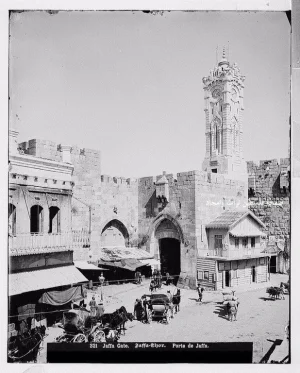
The Jaffa Clock Tower, also known as the Tower of Sultan Abdul Hamid II, is an Ottoman stone tower standing in Clock Square at the entrance to the Old City of Jaffa. It was built in the early 20th century to mark the 25th anniversary of Sultan Abdul Hamid II's accession, one of several clock towers raised in the cities of Palestine, including Jerusalem, Haifa, Acre and Nablus. The tower was the heart of modern Jaffa, surrounded by the Saraya, the markets and the Great Mosque. On 4 January 1948 it witnessed the bombing of the neighbouring Saraya by Zionist militias, months before the city fell and most of its people were expelled. The tower still stands today, a witness to Arab Jaffa. This guide covers the tower's history, its surroundings and the story of its city.
Quick facts
| Arabic name | برج الساعة – يافا |
|---|---|
| Other name | Tower of Sultan Abdul Hamid II |
| Location | Clock Square (Martyrs' Square), entrance to the Old City of Jaffa |
| Period | Ottoman, under Sultan Abdul Hamid II |
| Built | 1903–1904 CE, according to different sources |
| Occasion | 25th anniversary of Sultan Abdul Hamid II's accession |
| Surroundings | The Saraya, the Great (Mahmudiyya) Mosque, the old markets |
| 4 January 1948 | Bombing of the neighbouring Saraya by the Zionist Stern Gang |
| Fall of Jaffa | May 1948 |
| Condition | Still standing |
The name
The tower is known as the Clock Tower for the clock that crowns it, and as the Tower of Sultan Abdul Hamid II after the Ottoman sultan whose accession it commemorated. The square around it took its name from the tower and became known as Clock Square.
Location: Clock Square
The tower stands in the centre of Jaffa, in the square known as Clock Square or Martyrs' Square, at the main entrance to the Old City. It is close to the Saraya, the Great (Mahmudiyya) Mosque and the old markets, a few steps from the port and the Sea Mosque. In the early 20th century the square was the crossroads of the city and the heart of its commercial life.
History and construction
- The occasion: the tower was built to mark the 25th anniversary of Sultan Abdul Hamid II's accession, as part of an Ottoman policy of modernising cities and promoting trade under which dozens of clock towers were raised across the empire.
- Date: sources date its construction to 1903–1904 CE.
- Ottoman Jaffa: the tower came at the height of Jaffa's prosperity as Palestine's main port, the city of oranges and the starting point of the first railway to Jerusalem, and it became a symbol of a modern city open to the world.
Ottoman clock towers in Palestine
According to Al Jazeera, several Palestinian cities received similar clocks, most of them built for the 25th anniversary of Sultan Abdul Hamid's rule, including Jaffa, Haifa and Acre, as well as the clock at Bab al-Saha in Nablus, which still stands. The Jerusalem Clock Tower, raised above Bab al-Khalil in 1907, was removed by the British Mandate authorities in 1922, leaving the Jaffa tower one of the few Ottoman clock towers that survive.
The bombing of the Saraya (January 1948)
Close to the tower stood the Saraya, the former Ottoman governor's palace outside the Old City. Before 1948 it housed Jaffa's municipality, which provided social services there and distributed food to needy children. On 4 January 1948 the Zionist Lehi (Stern Gang) militia, which the British classed as a terrorist organisation, blew up the Saraya with a truck bomb, killing 14 people and wounding 98 according to Noon Post, while other sources give higher figures. It was one of the most prominent attacks in the run-up to the fall of Jaffa.
Jaffa and the Nakba
Before the Nakba some 120,000–130,000 Palestinians lived in Jaffa and its surroundings. The city was besieged and shelled for weeks in the spring of 1948 until it fell in May 1948. Most of its people were expelled, and only 3,000–4,000 remained, gathered in the Ajami neighbourhood and fenced in with barbed wire. In 1950 Jaffa's municipal institutions were merged into the Tel Aviv municipality. Some 20,000–25,000 Palestinians live in the city today, facing Judaisation and evictions.
The tower today (2026)
The Clock Tower still stands in its square and is one of Jaffa's best-known landmarks, a favourite spot for visitors' photographs. Yet it is presented today as a tourist attraction in a city merged into Tel Aviv, while the Arab story of the place is erased: a square that was the heart of Arab Jaffa, a Saraya blown up over the heads of those inside, and a city most of whose people were expelled. For Jaffa's Palestinians and its refugees, the Ottoman tower remains part of their city's identity and a testament that the "Bride of the Sea" is a Palestinian city.
Frequently asked questions
Where is the Jaffa Clock Tower?
In Clock Square (Martyrs' Square) in the centre of Jaffa, at the entrance to the Old City near the Saraya and the Great Mosque.
When was the Jaffa Clock Tower built?
In the early 20th century, in 1903–1904 CE according to different sources.
Why was the Jaffa Clock Tower built?
To mark the 25th anniversary of the Ottoman Sultan Abdul Hamid II's accession, which is why it is also known as the Tower of Sultan Abdul Hamid.
What happened in Clock Square in 1948?
On 4 January 1948 the Zionist Stern Gang blew up the neighbouring Saraya, home of Jaffa's municipality, killing and wounding dozens, months before the city fell in May 1948.
Is the Jaffa Clock Tower still standing?
Yes, it still stands in its square, unlike the Jerusalem Clock Tower, which was removed by the British Mandate in 1922.
Conclusion
For more than a century the clock of the Ottoman tower has chimed at the heart of Jaffa, a witness to the age of oranges, the port and the railway, to the bombing of the Saraya and to the Nakba of 1948. Its hands still turn above a square that was the heart of the "Bride of the Sea", a reminder that Arab Jaffa's time has not stopped.
More from the archive
 Download Our Palestine App
The whole archive in the palm of your hand: depopulated villages, the Nakba, the massacres and Al-Aqsa — free, with no ads to erase the story.
Comments
No comments yet — be the first to write one.
Add your comment
Name and email are optional. Comments appear after review.