The Roman Theatre of Tiberias
The Roman Theatre of Tiberias: A Witness to a Palestinian City Emptied of Its People
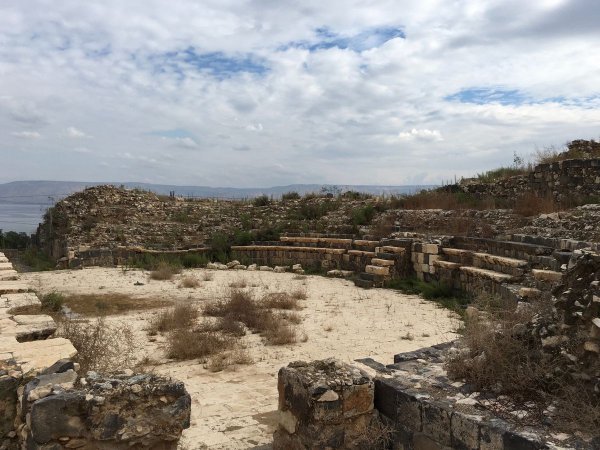
The Roman Theatre of Tiberias is one of the most prominent remains of the ancient city on the western shore of Lake Tiberias. It dates from the Roman period, when the city was founded in the 1st century CE near the Canaanite town of Raqqat. Excavations in the south of the city uncovered its remains along with layers of Byzantine and Islamic history, above all Abbasid residential quarters and gold dinars bearing the name of Harun al-Rashid. Tiberias itself was emptied of its Arab inhabitants on 18 April 1948, the first mixed city whose Palestinian population was expelled, and its old town was demolished. This guide covers the theatre and the history of the city around it.
Quick facts
| Arabic name | المسرح الروماني في طبريا |
|---|---|
| Location | Southern Tiberias, on the western shore of the lake |
| Period | Roman, from the city's founding in the 1st century CE |
| The city | Founded near the Canaanite town of Raqqat; named after Emperor Tiberius |
| Destruction | The earthquake of 749 CE that struck the city |
| Islamic period | Capital of Jund al-Urdunn; rebuilt by the Abbasids; flourished under the Fatimids |
| Finds | Abbasid quarters and gold dinars of Harun al-Rashid |
| Expulsion | 18 April 1948; about 6,160 Arab inhabitants |
| Old town | Arab quarters, walls and most landmarks demolished after the Nakba |
| Run by | The occupation authorities, as part of an archaeological park |
Location
The theatre lies on the southern side of Tiberias, on the western shore of the lake, in the area stretching towards the hot springs of Hammam Tabariyya. Since Roman times these springs and the fertile land around them made the city a winter resort.
Roman Tiberias and the theatre
Tiberias was built in the 1st century CE near the Canaanite town of Raqqat, and the Roman client ruler Herod Antipas named it in honour of Emperor Tiberius Caesar. It stood on a trade route linking Damascus with Egypt and was laid out in Roman style, with a colonnaded main street and gates at either end, while its baths on the hot springs added to its importance. The Roman theatre, with its stone auditorium facing the lake, was part of the city's public life, like other Roman theatres in Palestine at Sebastia, Caesarea and Beisan.
The Islamic golden age
- The conquest (634–635): the Arabs entered Tiberias in 13 AH, and historical sources say the Companion Shurahbil ibn Hasana built a mosque there at the conquest.
- Capital of Jund al-Urdunn: Tiberias became the capital of the military province of al-Urdunn.
- The 749 earthquake: a great earthquake struck the city on 18 January 749, and the Abbasids rebuilt it.
- The Fatimid period: the city reached its peak, with an estimated population of about 30,000.
- Crusaders and Saladin: the Crusaders took it, Saladin recovered it at the Battle of Hattin in 1187, and after changing hands it was finally retaken by the Muslims in 1247.
- Zahir al-Umar: in the 18th century Zahir al-Umar al-Zaydani made it his capital and built its walls and the Zaydani Mosque.
The excavations and who tells the story
The occupation authorities carried out the excavations in southern Tiberias for tourism development, looking for Roman, Byzantine and Jewish remains. They uncovered the theatre and part of a smaller Byzantine theatre (odeon). But they also uncovered, according to Al Jazeera, Islamic remains that confirm the city's golden age under the Abbasids and Fatimids: residential quarters with courtyards, fountains and pools, millstones, pottery, glassware and oil lamps, basalt drains, and gold dinars bearing the name of Harun al-Rashid. The occupation presents the history of the ancient city from its own perspective, while the Arab and Islamic layers, and the people who were expelled, remain on the margins of that narrative.
Tiberias and the Nakba
In April 1948 the Haganah attacked Tiberias and took control of the city with the help of the British forces stationed there. On 18 April 1948 its Arab inhabitants, about 6,160 people according to the Palestinian National Information Centre, were expelled, making Tiberias the first mixed city whose Arab population was driven out. After the war its northern Arab quarters, its walls and most of its historic landmarks were demolished and replaced with parks, hotels and modern buildings. Al-Jisr Mosque was turned into a museum and the Zaydani Mosque was closed. The refugees of Tiberias and their descendants live today in camps in exile, among them Ain al-Hilweh, denied the right of return, while the people of the 26 villages of the Tiberias district were also expelled.
The theatre today (2026)
The theatre now lies within an archaeological park run by the occupation authorities in southern Tiberias, where restoration work is under way. Together with the Abbasid houses found around it, it remains a witness that the city's history is far broader than the narrative presented there, and that Tiberias was an Arab and Islamic city for more than thirteen centuries before its people were expelled.
Frequently asked questions
Where is the Roman Theatre of Tiberias?
On the southern side of Tiberias, on the western shore of the lake, towards the hot springs of Hammam Tabariyya.
When was the Roman theatre of Tiberias built?
In the Roman period, with the founding of the city in the 1st century CE near the Canaanite town of Raqqat.
What destroyed ancient Tiberias?
A great earthquake struck the city in 749 CE. The Abbasids rebuilt it, and it later flourished under the Fatimids.
What did the excavations uncover?
The remains of the theatre and part of a Byzantine odeon, together with Abbasid and Fatimid quarters and gold dinars bearing the name of Harun al-Rashid.
What happened to Tiberias in 1948?
Its Arab inhabitants, about 6,160 people, were expelled on 18 April 1948, making it the first mixed city emptied of its Arab population, and its old town was then demolished.
Conclusion
The Roman Theatre of Tiberias is one page in the long history of a Palestinian city on the shore of the lake, which was Roman, Byzantine and Arab-Islamic in turn. Beneath and around its stones lie the houses of the Abbasids and the dinars of Harun al-Rashid, and the memory of the people expelled in 1948 who still wait to return.
More from the archive
 Download Our Palestine App
The whole archive in the palm of your hand: depopulated villages, the Nakba, the massacres and Al-Aqsa — free, with no ads to erase the story.
Comments
No comments yet — be the first to write one.
Add your comment
Name and email are optional. Comments appear after review.