
Khan al-Umdan in Acre

Khan al-Umdan in Acre: The City's Largest Khan and a Waqf "Neither Sold nor Bought"
Khan al-Umdan ("the Inn of the Pillars") is the largest and finest of the khans of Acre, standing near the port in the southern part of the old city. Sheikh Zahir al-Umar al-Zaydani began building it in the 1760s, and the governor of Acre, Ahmad Pasha al-Jazzar, completed it in 1784; it is named after the granite columns that carry its arcades. It is a two-storey building of 48 rooms around a large courtyard, where merchants arriving by sea lodged and stored their goods, and above its entrance rises the Ottoman clock tower built in 1901. Al-Jazzar's waqf records describe it as "a waqf that is neither sold nor bought", yet Israeli authorities have sought to sell it to investors and turn it into a hotel, while Acre's people hold on to it as part of their city's identity. This guide covers the khan's history, architecture and the challenges it faces today.
Quick facts
| Arabic name | خان العمدان – عكا |
|---|---|
| Location | Southern part of Acre's old city, near the port |
| Construction began | 1760s, under Zahir al-Umar |
| Completed | 1784, under Ahmad Pasha al-Jazzar |
| Name | After its granite columns |
| Floors and rooms | Two floors and 48 rooms around a large courtyard |
| Original function | Lodging for merchants and storage for their goods |
| Clock tower | Above the entrance, built in 1901 |
| Status | Islamic waqf, registered in the Ottoman land registry as no. 642 |
| World Heritage | Part of the Old City of Acre, on the UNESCO list since 2001 |
The name
The khan is called "al-Umdan", the Palestinian colloquial plural of "column", after the massive granite columns that carry the arches of its ground-floor arcades. They were probably brought from the ruins of ancient coastal cities, in keeping with al-Jazzar's practice of reusing ancient columns in his buildings, as he did in his great mosque.
Location
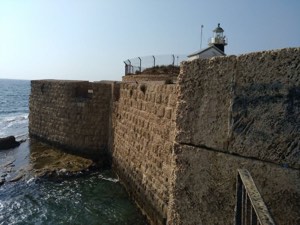
The khan stands in the southern part of the old city of Acre, close to the historic port, with Khan al-Shuna to its west and the Sea Gate tower to its south, and near the churches of St. George and St. John the Baptist and Khan al-Franj. Its position near the port made it the first stop for merchants arriving by sea.
History
- 1760s: Sheikh Zahir al-Umar al-Zaydani, who made Acre his capital, began building the khan as part of his urban and commercial revival of the city.
- 1784: the governor of Acre, Ahmad Pasha al-Jazzar, expanded and completed the khan as part of his great projects, which included the walls, the mosque, the bathhouse and the aqueduct.
- 1862–1912: al-Jazzar's waqf records list the khan as a waqf of two floors and 48 rooms.
- 1901: the clock tower was built above the khan's entrance to mark the 25th anniversary of Sultan Abdul Hamid II's accession.
- 1948: Acre fell and most of its people were expelled.
- 2001: the Old City of Acre, including the khan, was inscribed on UNESCO's World Heritage List.
- 2008 and 2013: Israeli authorities tried to sell the khan to investors to turn it into a hotel.
Architecture
The khan is a rectangular two-storey building of 48 rooms surrounding a large inner courtyard. The ground floor is fronted by an arcade of arches resting on the granite columns; its rooms served as storerooms for goods and stables for caravan animals, while the upper floor was reserved for merchants' lodgings and overlooks the courtyard through an arcade of arches on columns. Above the northern entrance rises the Ottoman clock tower of a ground floor and four storeys, which became a landmark of Acre's skyline from the sea.
Al-Jazzar's waqf
Ahmad Pasha al-Jazzar endowed the khan to the charitable complex that later bore his name, including the al-Jazzar Mosque and its facilities. The waqf records discovered in 2008, covering 1862 to 1912, describe the khan as "a waqf that is neither sold nor bought" and record that it was registered in the Ottoman land registry as no. 642. The khan's revenues were spent on the mosque and the interests of the city's Muslims.
Acre and the Nakba
In the 1946 census Acre had 13,560 inhabitants, most of them Arabs. On 17 May 1948 the city fell to the Haganah, and most of its people were expelled to Lebanon and Syria, while some remained in the old city. Acre's waqfs and its refugees' property were placed under Israeli control, and the khan lost its commercial function; the city's people came to use it as a cultural space for festivals, summer camps and local concerts.
Attempts to sell and Judaise
In 2008 Israeli authorities tried to sell the khan through a commercial tender, but the investor withdrew at the last minute and its main gate was closed. In 2013 the Israeli Ministry of Tourism and the Israel Land Authority planned to sell it to private investors to convert it into a 200-room hotel, and hundreds of Palestinians marched in protest on 18 October 2013. The khan was also among the most prominent historic landmarks the Israeli company Amidar sought to take over, as part of wider pressure on an old city home to some 5,000 Arabs, including hotel and resort projects and eviction orders against Arab families.
The khan today (2026)
The khan still stands with its clock tower and columns, one of the main landmarks of Acre's World Heritage old city, but most of it has remained closed to the city's people, with a single gate open to visitors. Acre's people call for the khan to be restored as an Islamic waqf as al-Jazzar registered it, and for an end to plans to turn it into a hotel serving the Judaisation of the city, as they raise the slogan "My home is not for sale" against the pressure on the old city.
Frequently asked questions
Where is Khan al-Umdan?
In the southern part of Acre's old city, near the historic port.
Who built Khan al-Umdan?
Sheikh Zahir al-Umar began building it in the 1760s, and Ahmad Pasha al-Jazzar completed it in 1784.
Why is it called Khan al-Umdan?
After the massive granite columns that carry the arches of its arcades.
How many rooms does Khan al-Umdan have?
48 rooms on two floors around a large inner courtyard.
Is Khan al-Umdan an Islamic waqf?
Yes. Al-Jazzar endowed it to his charitable complex, and the waqf records describe it as "a waqf that is neither sold nor bought", registered in the Ottoman land registry as no. 642.
Conclusion
Near Acre's port, Khan al-Umdan has stood for more than two centuries as a witness to commercial Acre under Zahir al-Umar and al-Jazzar, when merchants' caravans lodged among its columns. Today, amid attempts to sell it and turn it into a hotel, the khan remains in the conscience of Acre's people a waqf "neither sold nor bought", one they hold on to just as they hold on to their homes and their city.
More from the archive


 Download Our Palestine App
The whole archive in the palm of your hand: depopulated villages, the Nakba, the massacres and Al-Aqsa — free, with no ads to erase the story.
Comments
No comments yet — be the first to write one.
Add your comment
Name and email are optional. Comments appear after review.