
Church of St Peter in Gallicantu
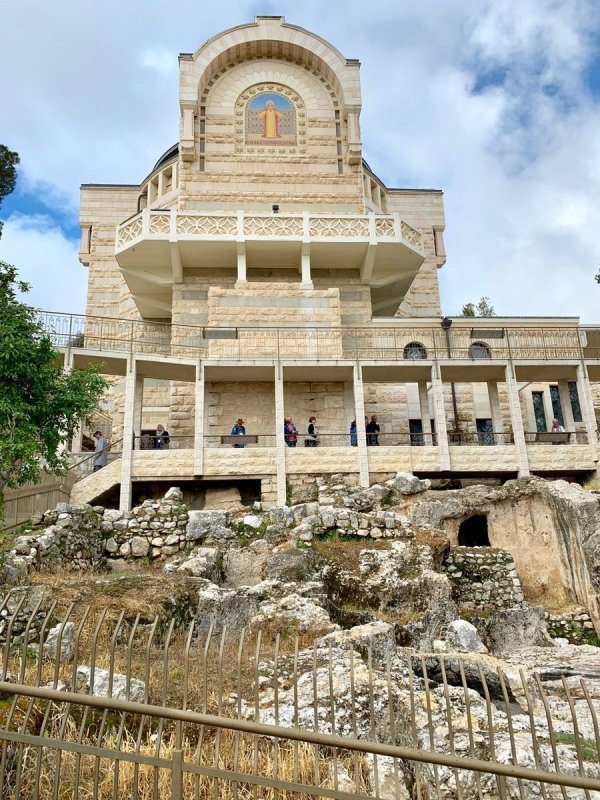
Church of St Peter in Gallicantu, Jerusalem: The Church of the Cock's Crow
The Church of St Peter in Gallicantu, known in Arabic as the Church of the Cock's Crow (كنيسة صياح الديك), stands on the eastern slope of Mount Zion, just outside the walls of Jerusalem's Old City, overlooking the Kidron Valley and Silwan. It marks the traditional site of the palace of the high priest Caiaphas, where, according to the Gospels, Jesus was held and tried and Peter denied him three times before the cock crowed. The present Catholic church, run by the Assumptionist Fathers, was completed in 1931 over the remains of Byzantine and Crusader churches. This guide covers its name, history, architecture, archaeology and its surroundings under occupation.
Quick facts
| Arabic name | كنيسة القديس بطرس في غاليكانتو / كنيسة صياح الديك |
|---|---|
| Meaning of "Gallicantu" | Latin for "at the cock's crow" |
| Location | Eastern slope of Mount Zion, outside the Old City walls, Jerusalem |
| Denomination | Roman Catholic, run by the Assumptionist Fathers |
| First church | Byzantine shrine, 457 CE |
| Destroyed | 1010, under the Fatimid caliph al-Hakim |
| Crusader chapel | Rebuilt in 1102; fell into ruin after 1187 |
| Present church | Built 1924–1931 |
| Tradition | Palace of Caiaphas; Peter's denial; Jesus held overnight |
| Symbol | Golden rooster on the roof |
The name and the story of Peter's denial
"Gallicantu" is Latin for "at the cock's crow", a name introduced by the Crusaders. It recalls the Gospel account in which Jesus told Peter at the Last Supper, "before the cock crows, you will deny me three times." After Jesus was arrested in Gethsemane and taken to the house of the high priest Caiaphas, Peter waited in the courtyard and, when questioned, denied knowing him three times. Then the cock crowed, and Peter "went out and wept bitterly" (Matthew 26:75). In Arabic the church is commonly called كنيسة صياح الديك, the Church of the Cock's Crow.
Location
The church lies on the eastern slope of Mount Zion, south of the Old City walls of Jerusalem and below Zion Gate. From its terraces visitors look down on the Kidron Valley, the Pool of Siloam and the Palestinian town of Silwan, with the Mount of Olives beyond. Nearby are the Dormition Abbey and the Cenacle (Room of the Last Supper).
History through the ages
- Byzantine period: a shrine was built on the site in 457 CE to commemorate Peter's repentance. Crosses carved into the walls of the caves below the church are dated to the fifth century.
- 1010: the shrine was destroyed under the Fatimid caliph al-Hakim bi-Amr Allah, as were many churches of the period.
- Crusader period: the Crusaders rebuilt the chapel in 1102 and gave it the name "Gallicantu". After Saladin took Jerusalem in 1187, the church fell into ruin.
- Assumptionist excavations: the Assumptionist Fathers, a French Catholic order, acquired the land in the late 19th century and excavated it, uncovering Byzantine mosaics, caves, cisterns and a stepped street.
- The present church (1924–1931): a new church was built over the ancient remains and completed in 1931. Some sources give 1932.
- 1948–1967: Mount Zion lay along the armistice line that divided Jerusalem, and Zion Gate stayed closed until 1967.
Architecture and art
The church is built on three levels into the hillside, and visitors enter at the top and descend. Its features include:
- a golden rooster on a cross on the roof, the church's emblem;
- a large cross-shaped window in the ceiling of the upper church;
- colourful mosaics showing Jesus before Caiaphas, the Last Supper and Peter;
- the fourteen Stations of the Cross along the walls;
- wrought-iron doors decorated with reliefs of the denial story;
- two Byzantine-era mosaics found during excavation, displayed near the entrance;
- a middle chapel built into the rock, using stone from the ancient caves.
Archaeology: the crypt, the pit and the ancient steps
Beneath the church lies a network of rock-cut caves, cisterns, storerooms and olive presses from the Roman period. Christian tradition holds that one deep pit served as the cell where Jesus was held on the night of his arrest, and visitors can descend into it. Archaeologists note that such cellars and cisterns were common in Second Temple-era houses, so the identification remains a matter of tradition rather than established fact.
On the north side of the church an ancient stone staircase runs down towards the Kidron Valley. Its dating is debated, but Christian tradition holds that Jesus walked these steps on the way to Gethsemane after the Last Supper and was brought back up them under arrest.
Religious significance
The church is a station on the pilgrims' route through the final days of Jesus' life, between the Cenacle and Gethsemane. Its theme is human weakness and repentance: Peter, who denied Jesus three times, wept and was later forgiven and entrusted with leading the disciples. Pilgrims pray in the crypt and look out over the valley that Jesus is believed to have crossed.
Under occupation since 1967
Israeli forces occupied all of East Jerusalem in June 1967, and Israel later annexed it, a step declared null and void by UN Security Council Resolution 478. Mount Zion and the slopes around the church have since seen repeated pressure on Christian sites:
- On 1 January 2023 two men broke into the nearby Protestant cemetery on Mount Zion and smashed dozens of gravestones, an attack condemned by the churches and by many governments.
- The Dormition Abbey, a few hundred metres away, has been sprayed several times with hostile graffiti, and clergy in Jerusalem report frequent harassment.
- Below the church, in Silwan, the occupation authorities and settler organisations are expanding "national park" and tourism projects.
The church today (2026)
The church continues to receive visitors, though the genocide war on Gaza since October 2023 has drastically reduced pilgrim numbers. The view from its terraces now takes in a neighbourhood under threat: in the al-Bustan quarter of Silwan, the occupation authorities had demolished 54 of its houses by February 2026 to make way for a "biblical garden", and demolished more homes on 30 March 2026, according to Al Jazeera. In January 2026 the municipality also issued notices to seize about 7 dunums of the neighbourhood's land.
Legal protection
The church lies just outside the walls of the Old City of Jerusalem, which UNESCO lists as World Heritage in Danger. As a religious site in occupied territory, it is protected by the Fourth Geneva Convention and the 1954 Hague Convention for the Protection of Cultural Property, and UN Security Council Resolution 478 rejects Israel's annexation of East Jerusalem.
Frequently asked questions
What does "Gallicantu" mean?
It is Latin for "at the cock's crow", recalling the Gospel story in which Peter denied Jesus three times before the cock crowed.
Where is the Church of St Peter in Gallicantu?
On the eastern slope of Mount Zion in Jerusalem, just outside the Old City walls, overlooking the Kidron Valley and Silwan.
When was the church built?
The present church was built between 1924 and 1931 over the remains of a Byzantine shrine from 457 CE and a Crusader chapel from 1102.
Is this where Jesus was imprisoned?
Christian tradition places the house of the high priest Caiaphas here and holds that Jesus was kept overnight in a pit beneath the church, though archaeologists treat this as tradition rather than proven fact.
Who runs the church?
The Assumptionist Fathers, a French Roman Catholic order, own and run the church.
Conclusion
Built into the rock of Mount Zion, the Church of St Peter in Gallicantu keeps the memory of a night of arrest, denial and repentance. Its golden rooster looks out over Silwan, where Palestinian homes are being demolished, a reminder that Jerusalem's holy places and its people share the same fate under occupation.
More from the archive

 Download Our Palestine App
The whole archive in the palm of your hand: depopulated villages, the Nakba, the massacres and Al-Aqsa — free, with no ads to erase the story.
Download Our Palestine App
The whole archive in the palm of your hand: depopulated villages, the Nakba, the massacres and Al-Aqsa — free, with no ads to erase the story.



Comments
No comments yet — be the first to write one.
Add your comment
Name and email are optional. Comments appear after review.