
Beddawi Refugee Camp
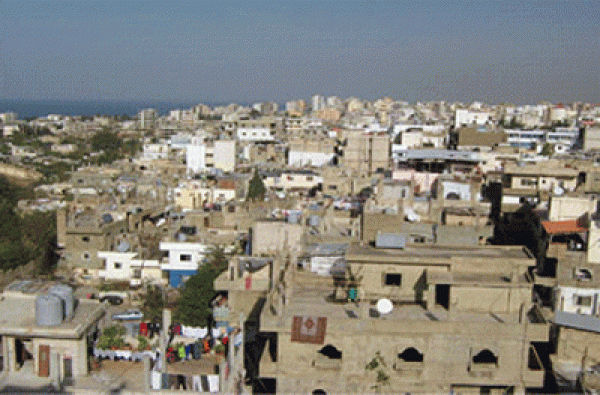
Beddawi Refugee Camp
Beddawi Refugee Camp in Lebanon: History, Galilee Villages, Population and Life Today
Beddawi Camp sits on a hill about 5–7 km north-east of Tripoli in northern Lebanon. Established in for refugees of the 1948 Nakba, most of them from the Galilee, the Hula plain and Jaffa, it later took in families from the destroyed camps of Nabatieh and Tel al-Zaatar, and in 2007 sheltered tens of thousands displaced from Nahr al-Bared. With more than 21,000 registered refugees and thousands of Syrians, it is one of the two main Palestinian camps in northern Lebanon, facing poverty, Israeli strikes and a new security arrangement at its gates. This guide covers its history, origins, population, services and its situation today.
Quick Facts About Beddawi Camp
| Arabic name | مخيم البداوي |
|---|---|
| Country | Lebanon |
| Location | On a hill about 5–7 km north-east of Tripoli, North Governorate |
| Year established | |
| Registered refugees (UNRWA) | 21,252 (June 2018) |
| Residents (2017 census) | 17,995, including 6,193 Syrians |
| Origin of residents | The Galilee, the Hula plain and Jaffa |
| Arrivals from other camps | Nabatieh (1974), Tel al-Zaatar (1976), Nahr al-Bared (2007) |
| Status | Official UNRWA camp |
The Nakba: Why Beddawi Camp Exists
Beddawi was born from the Nakba (Arabic for "catastrophe"): the mass expulsion of Palestinians during the occupation of Palestine in , when roughly 750,000 Palestinians were driven from their homes. The villages of the Galilee and the Hula plain were emptied, some after massacres such as the Safsaf massacre of October 1948, and their people crossed into Lebanon.
In Tripoli, many refugees first sheltered in mosques in Khan al-Askar and in poor neighbourhoods near the port. In 1955 the Abu Ali River flooded and damaged Khan al-Askar, pushing many families to a new camp on a hill outside the city, leased by UNRWA. A second group came from the Bekaa Valley to escape its harsh winters.
The Right of Return
Beddawi's neighbourhoods carry the names of Galilee villages such as al-Jish and Saffuriyya, and residents mark Nakba Day and Land Day and display Palestinian symbols on their homes and walls. The right of return rests on several foundations in international law:
- UN General Assembly Resolution 194 (), paragraph 11, resolved that refugees wishing to return to their homes and live at peace with their neighbours should be permitted to do so at the earliest practicable date, and that compensation should be paid to those choosing not to return and for loss of or damage to property.
- The Universal Declaration of Human Rights (Article 13) affirms everyone's right to leave any country, including their own, and to return to it.
- UN General Assembly Resolution 3236 () reaffirmed the "inalienable right" of Palestinians to return to their homes and property.
History of the Camp (1955–2006)
Families first lived in shacks, then UNRWA registered them and built densely packed houses with shared walls, each of one or two rooms, which later became permanent homes. Early jobs were in construction and agriculture; in the 1970s the presence of the PLO and Palestinian factions created more work.
The camp was repeatedly targeted by Israel: an airborne raid in 1972 and air strikes in 1973, 1976 and 1996 caused casualties. As other camps were destroyed, Beddawi became a refuge: families arrived from Nabatieh camp, destroyed by Israeli air raids in 1974, and from Tel al-Zaatar camp, which fell after a long siege and massacre in 1976. More refugees came during the Israeli invasion of 1982. The camp itself was damaged during the Lebanese civil war and saw several waves of displacement.
A Camp of Refuge: Nahr al-Bared and Syria (2007–2023)
The largest influx came in 2007, when fighting destroyed Nahr al-Bared camp, 12 km to the north. Tens of thousands fled to Beddawi, and UNRWA sources say its population swelled to about 30,000. UNRWA set up metal container shelters around the camp, and two prefabricated schools built outside it in 2007 still teach students from Nahr al-Bared. After 2011, Palestinian and Syrian families fleeing the war in Syria also arrived, and Syrians came to make up more than 30% of residents.
In 2018 a Joint Security Forces Committee, led by the Palestinian factions and coordinating with the Lebanese authorities, was formed to control insecurity inside the camp. Lebanon's economic collapse from late 2019 deepened poverty.
The Current Situation (2024–2026)
The wars of recent years have reached Beddawi directly. In October 2024, an Israeli strike on a home in the camp killed a Hamas commander and members of his family. On , days into Israel's intensified war on Lebanon, an Israeli strike on a residential unit in the camp killed two people and wounded a woman, according to Lebanon's health ministry.
At the same time, the camp's security arrangements are changing. In 2025 the Lebanese army closed several side entrances, eleven by November according to local sources. In January 2026 the army informed the factions that it would take over the checkpoints at the camp's two main entrances, and in July 2026 residents protested a plan for the state to take over a site inside the camp, fearing it would restrict movement and deepen the camp's isolation. In early 2026 the camp also faced a severe water crisis, while UNRWA's funding cuts continue to reduce services.
Origin of the Name
The camp is named after the surrounding Beddawi area north-east of Tripoli. According to one local story, the area itself takes its name from the shrine of a Bedouin (بدوي, badawi) who settled there long ago.
Location and Geography
Beddawi sits on a plateau overlooking Tripoli, about 5–7 km from the city, with the Mediterranean to the west. It lies 12 km from Nahr al-Bared camp. Nearby are the old Iraq Petroleum Company refinery, the Deir Ammar power station, an army barracks, a Lebanese University campus and a government hospital. It is bordered by al-Qubba, Jabal Mohsen, al-Fawwar, al-Airouniyya, Tallet al-Mankubin and Wadi al-Nahla, and has two main entrances, north and south.
Layout and Neighbourhoods
The camp is divided into four sectors (A to D). Its inner streets are wider and its infrastructure better than in many Lebanese camps. Neighbourhoods are named after Galilee villages such as al-Jish and Saffuriyya, after extended families, and after other camps, such as Tel al-Zaatar and Nabatieh, whose displaced families settled there. Main streets include the north–south main road, the market street, al-Quds Street and Popular Committee Street.
Villages of Origin
Beddawi's families come from Jaffa, the Galilee and the Hula plain, including Acre, Safed, Shefa-'Amr, Haifa and the villages around them. According to the Interactive Encyclopedia of the Palestine Question, notable villages include:
- Safed district and the Hula: al-Khalisa, al-Buwayziyya, Jahula, Safsaf, 'Ayn al-Zaytun, al-Na'ima, al-Zahiriyya and al-Jish
- Acre district: al-Birwa, Suhmata and al-Sha'b
- Nazareth district: Saffuriyya
- Cities: Jaffa, Haifa and Acre
Families from the same extended family and village tend to live close together, keeping alive the social map of the Galilee.
Population and Demographics
UNRWA counts registered refugees, which is not the same as the number of people living in the camp: some registered refugees have left, while the 2017 census counted everyone living there, including Syrians and Lebanese. The camp's popular committee says the real population is much higher.
| Year / group | Population | Source |
|---|---|---|
| 2007 | About 30,000 after the influx from Nahr al-Bared | UNRWA, via the Interactive Encyclopedia |
| 2017: Palestinian refugees from Lebanon | 9,740 | 2017 census |
| 2017: Syrians | 6,193 | 2017 census |
| 2017: Palestinian refugees from Syria | 1,367 | 2017 census |
| 2017: Lebanese and others | 695 | 2017 census |
| 2017: total residents | 17,995 | 2017 census |
| June 2018 | 21,252 registered refugees | UNRWA |
Housing and Infrastructure
Homes have grown upward and outward as the population has risen. Eleven wells feed central tanks, but droughts strain supply and residents often buy drinking water; nine small water-purification businesses operate in the camp. Electricity from the Qadisha company cannot meet demand, so residents rely on private generators. UNRWA handles waste collection, sewers, drainage and pumping stations. Cemetery space is running out.
Economic Life
Unemployment is high, especially among graduates, and many families live below the poverty line. Lebanese law bars Palestinians from more than seventy professions, and Palestinians cannot obtain commercial driving licences. The Federation of Palestinian Trade Unions in the North counts about 6,000 workers, mostly in construction in Tripoli and northern Lebanon; others work for UNRWA, the PLO, factions, shops and salons. Remittances from emigrants in Europe and orphan sponsorship programmes help many families, and a cash-for-work programme launched in 2021 offers short-term jobs. Irregular migration by sea has grown, and several young people from the camp have died on the way.
Health Situation
UNRWA's health centre, rehabilitated in 2015, sees an average of 560 patients a day and offers gynaecology, dental and eye care, a laboratory and a pharmacy. Safad Hospital, affiliated with the Palestine Red Crescent Society, provides emergency, surgical and obstetric care, and several faction-run clinics and a dental centre also operate. Diabetes, heart disease, hypertension, kidney disease, cancer and mental illness are common; by the end of 2016, non-communicable diseases affected 11% of the population.
Education and Community
UNRWA runs primary, preparatory and secondary schools in the camp, serving about 3,700 students, and secondary students perform well in Lebanon's official exams. Scholarships come from UNRWA and Palestinian funds, and several kindergartens are run by civil society groups and factions. Many associations work with women, children, orphans and people with disabilities, and scout troops and sports clubs are active. The camp's popular committee, with representatives of each faction and neighbourhood, acts as a kind of municipal council, coordinating with UNRWA, NGOs, Lebanese authorities and neighbouring municipalities.
Frequently Asked Questions About Beddawi Camp
Where is Beddawi camp located?
On a hill about 5–7 km north-east of Tripoli in northern Lebanon, 12 km from Nahr al-Bared camp.
When was Beddawi camp established?
In 1955, after a flood of the Abu Ali River damaged Khan al-Askar in Tripoli, where many refugees had been sheltering.
Where do Beddawi's refugees come from?
Mainly from the Galilee, the Hula plain and Jaffa, including al-Birwa, al-Khalisa, Suhmata, Saffuriyya, Safsaf, 'Ayn al-Zaytun and al-Jish, as well as families displaced from Nabatieh, Tel al-Zaatar and Nahr al-Bared camps.
How many people live in Beddawi camp?
UNRWA counted 21,252 registered refugees in 2018, while the 2017 census counted 17,995 residents, including more than 6,000 Syrians.
What role did Beddawi play in 2007?
It sheltered tens of thousands of people displaced by the destruction of Nahr al-Bared camp, and its population swelled to about 30,000.
Conclusion
Beddawi was built on a hill above Tripoli for refugees washed out of their shelters by a flooded river, and it has been a refuge ever since: for the survivors of Nabatieh and Tel al-Zaatar, for the displaced of Nahr al-Bared, and for families fleeing Syria. Its streets carry the names of al-Jish and Saffuriyya, its people endure poverty, strikes and closures, and they still mark every Nakba Day with the same demand: the right to return to the Galilee.
More from the archive

 Download Our Palestine App
The whole archive in the palm of your hand: depopulated villages, the Nakba, the massacres and Al-Aqsa — free, with no ads to erase the story.
Download Our Palestine App
The whole archive in the palm of your hand: depopulated villages, the Nakba, the massacres and Al-Aqsa — free, with no ads to erase the story.



Comments
No comments yet — be the first to write one.
Add your comment
Name and email are optional. Comments appear after review.