
Qabr Essit (Sayyida Zaynab) Refugee Camp
Qabr Essit (Sayyida Zaynab) Refugee Camp in Syria: History, Hula Villages, Population and the War Years
Qabr Essit Camp, also known as Sayyida Zaynab Camp, lies about 12–14 km south of Damascus, beside the shrine of Sayyida Zaynab. Palestinian refugees first settled there after the 1948 Nakba, but the camp took its shape after 1967, when Palestinians who had found refuge in the Golan Heights were displaced a second time. Most of its families come from the villages and Bedouin clans of the Hula Valley in the Safed and Tiberias districts. Home to about 23,700 refugees before 2011 on one of the smallest areas of any camp, it was hit by fighting in 2013 and by deadly bombings in 2016. This guide covers its history, origins, population, services and its situation today.
Quick Facts About Qabr Essit Camp
| Arabic name | مخيم قبر الست / مخيم السيدة زينب |
|---|---|
| Other names | Sayyida Zaynab Camp, Qabr Es-Sit |
| Country | Syria |
| Location | About 12–14 km south of Damascus, beside the Sayyida Zaynab shrine, Rif Dimashq Governorate |
| Established | Refugees settled from ; the camp took shape after |
| Area | About 0.015–0.027 km² depending on the source |
| Pre-war population | About 23,700 registered refugees (other UNRWA figures: 27,300) |
| Origin of residents | Villages and clans of the Hula Valley (Safed and Tiberias districts), many displaced again from the Golan in 1967 |
| UNRWA status | Official UNRWA camp |
The Nakba: Why Qabr Essit Camp Exists
Qabr Essit was born from the Nakba (Arabic for "catastrophe"): the mass expulsion of Palestinians during the occupation of Palestine in , when roughly 750,000 Palestinians were driven from their homes. In the north, the villages and Bedouin encampments of the Hula Valley, close to the Syrian border, were emptied in the spring of 1948, and their people crossed into Syria. Many stayed nearby in the Golan Heights, within reach of their lands. A few dozen families were housed near the shrine of Sayyida Zaynab south of Damascus, where the camp's first nucleus took shape.
In June , the occupation of the Golan Heights displaced those refugees a second time. Thousands of them came to Sayyida Zaynab, and the small settlement became a crowded camp. The UN Security Council, in Resolution 237 (1967), called for the return of those who had fled since the outbreak of hostilities.
The Right of Return
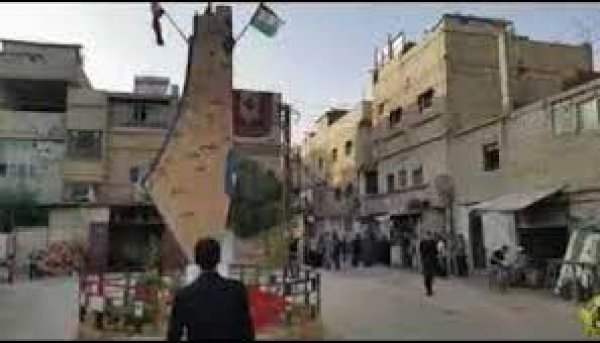
Twice displaced, first from the Hula and then from the Golan, the people of Qabr Essit hold firmly to the right of return. A roundabout in the camp carries a model of the map of Palestine, and its Palestine Square a model of the Dome of the Rock. The right of return rests on several foundations in international law:
- UN General Assembly Resolution 194 (), paragraph 11, resolved that refugees wishing to return to their homes and live at peace with their neighbours should be permitted to do so at the earliest practicable date, and that compensation should be paid to those choosing not to return and for loss of or damage to property.
- The Universal Declaration of Human Rights (Article 13) affirms everyone's right to leave any country, including their own, and to return to it.
- UN General Assembly Resolution 3236 () reaffirmed the "inalienable right" of Palestinians to return to their homes and property.
History of the Camp (1948–2011)
From tents to concrete
The first refugees lived in UNRWA tents for about six months, after which housing units of about 60 m² per family were built. The old camp began with 48 families. After 1967 the population rose to about 4,000, and the camp grew on land leased by UNRWA in the town of Sayyida Zaynab. Over the years the homes were rebuilt in concrete, some reaching three storeys or more.
Work and national life
In the early years, refugees worked on farms in al-Kiswah and Douma, in quarries and road-building, and women also worked in agriculture. Palestinian factions were active in the camp from early on, and its people joined them across generations. In May 2011, on the anniversary of the Nakba, young Palestinians from Syria crossed the armistice line in the occupied Golan; three young men from the camp were killed and others wounded.
The War Years (2012–2018)
The Syrian war reached the camp through the fighting around Sayyida Zaynab. In 2013, fighting near the camp forced many residents to flee, and UNRWA's education, health and other services in the camp were cut off. Up to 40% of the population left, and the number of residents fell from about 27,300 to about 12,800. Faced with the danger, the camp's factions and clans set aside their differences to protect it.
Life began returning gradually from 2014, and UNRWA's services fully resumed by November 2014. But the area around the shrine became the target of repeated bombings. In 2016 alone, UNRWA recorded four deadly attacks in Sayyida Zaynab:
- : three coordinated explosions killed 35 civilians and injured 150.
- February 2016: a series of bombings killed 134 people, including 31 Palestine refugees, according to UNRWA.
- : a bombing killed at least seven civilians and wounded dozens.
- : an explosion about 200 metres from the camp entrance killed at least 14 civilians, including five Palestine refugees aged 5 to 45, and injured more than 100.
The January and February attacks were claimed by the Islamic State group (ISIS). The explosions also damaged the camp's infrastructure, including its main sewage pipes, damage residents still blame for today's sewage crisis. In 2016, the Dallata/Beit Jibrin school, damaged in the war, reopened after reconstruction with funding from Japan.
The Current Situation (2025–2026)
Since the fall of the former regime in December 2024, the camp has faced worsening living conditions. Many Palestinians displaced from Yarmouk, Sbeineh and other areas have settled in and around it, adding pressure to its weak infrastructure. A report in January 2026 cited UNRWA figures of nearly 50,000 people in 2022, with projections of about 60,000, and said a new census was under way.
Residents describe services as "very bad, if not almost non-existent". Electricity cuts can last for days. Water is scarce, and a family may spend a fifth of its income on water from tankers. Unemployment is the most pressing problem, especially among young people, and UNRWA food parcels have been cut. The cemetery is full, and the cost of a grave has risen sharply.
Residents have tried to make their voices heard. On 22 January 2025, they held a peaceful sit-in outside the UNRWA office, demanding better health, education, relief and disability services. The same day UNRWA closed its offices in the camp, including its only clinic, without explanation. In March 2026, sewage flooded several streets and homes for days, and residents warned of open electrical cabinets near the Alma and Beit Jibrin schools, a danger that grows with winter rain.
Origin of the Name
"Qabr Essit" (قبر الست) means "the Lady's tomb", the popular name for the shrine of Sayyida Zaynab, granddaughter of the Prophet Muhammad, and for the town that grew around it. The camp takes both its names from its location beside the shrine.
Location and Geography
The camp lies in the town of Sayyida Zaynab in Rif Dimashq Governorate, about 12–14 km south of central Damascus. It is bordered to the north and west by the town of Hujeira, Harat Ghurba and the Hujeira junction gathering; to the east by the Sayyida Zaynab shrine and its markets; and to the south by the lands of al-Dhiyabiyya and Sayyida Zaynab.
Area and Layout
Qabr Essit is one of the smallest Palestinian camps by area: sources give between 15,000 and 27,000 m² (about 0.015–0.027 km²). A main street divides it into northern and southern parts. Its neighbourhoods include al-Dawwara, al-Shamalina, Ghurba and al-Jana'en. Residents distinguish between the old camp and the new camp, which includes Harat al-Jana'en, although UNRWA and GAPAR do not use this division. Some lanes, such as those of al-Shamalina, are very narrow.
Villages of Origin
Most of the camp's families come from the north of Palestine, especially the Safed and Tiberias districts. According to the Interactive Encyclopedia of the Palestine Question:
- Main clans: al-Zanaghra of al-Zanghariyya, al-Shamalina of Arab al-Shamalina, al-Talawiya, and other Bedouin clans
- Villages of the Hula Valley: al-Salihiyya, al-Dawwara, al-Abisiyya, al-Zuq al-Tahtani, al-Zuq al-Fawqani, al-Mansura, Jahula, al-Qudayriyya and al-Mallaha, as well as al-Hib and al-Wuhayb
The camp's families are known for standing together in joy and grief, a custom that has endured despite the hardships of recent years.
Population and Demographics
Figures for Qabr Essit vary widely, partly because many displaced people live in and around the camp. UNRWA counts registered refugees, which is not the same as the number of people actually living in the camp.
Population of Qabr Essit Camp over time
- 194848 families (old camp)Interactive Encyclopedia of the Palestine Question
- 1967About 4,000Interactive Encyclopedia of the Palestine Question
- Before 2011About 23,700 (other UNRWA records: 27,300)UNRWA
- 2013–2014About 12,800Interactive Encyclopedia of the Palestine Question
- 2016About 16,000UNRWA
- 2021About 17,000Interactive Encyclopedia of the Palestine Question
- 2022Nearly 50,000, including displaced people (UNRWA figures cited in a 2026 report)Palestinian Refugees Portal
Housing and Infrastructure
Most of the camp's streets are paved, and its homes are built of concrete, often several storeys high on tiny plots. Water comes from an artesian well and an UNRWA tank, and in recent years solar panels have been added to the wells to allow about two hours of pumping a day. In the summer of 2023 supply collapsed and families relied almost entirely on expensive tanker water. The sewage network is old and damaged, contaminating drinking water and causing poisoning, and in March 2026 it overflowed into streets and homes for days.
Economic Life
The shrine of Sayyida Zaynab once offered seasonal work in religious tourism, serving visitors from Iran, Iraq and elsewhere. Today most working residents hold government jobs or run small shops, and few work in the private sector. A report put unemployment above 50%, concentrated among young people. A relatively better-off group has emerged over the years, mostly UNRWA staff and families with relatives working abroad. During the war, harmful coping mechanisms spread, including early marriage, child labour and drug use.
Health Situation
UNRWA runs a health centre in the camp, which provides child health care and treatment for diabetes and blood disorders, and a disability centre. Nearby hospitals, such as al-Sadr charity hospital, also serve residents. Sickle cell anaemia, high blood pressure, diabetes and kidney failure are widespread. Medicines are in short supply, and poor sanitation has led to a relatively high rate of illnesses linked to environmental health.
Education
Children were taught in a tent until 1969, then in rented houses on the edge of the camp. Today UNRWA runs four schools in two buildings on a double-shift system: two elementary schools, Dallata and Beit Jibrin, and two preparatory schools, Alma and al-Yarmouk. The Dallata/Beit Jibrin school, rebuilt after war damage and reopened in 2016 with funding from Japan, has room for 1,364 pupils, with a computer lab and a science lab. Secondary students attend free Syrian government schools in Sayyida Zaynab, and Palestinian students pay the same nominal university fees as Syrians.
Frequently Asked Questions About Qabr Essit Camp
Where is Qabr Essit camp located?
In the town of Sayyida Zaynab, about 12–14 km south of Damascus, beside the shrine of Sayyida Zaynab.
Why is it called Qabr Essit?
"Qabr Essit" means "the Lady's tomb", the popular name for the shrine of Sayyida Zaynab beside which the camp stands. It is also known as Sayyida Zaynab Camp.
When was Qabr Essit camp established?
A small group of refugee families settled there after the 1948 Nakba, but the camp took shape after 1967, when Palestinians displaced from the Golan Heights arrived.
Where do Qabr Essit's refugees come from?
Mainly from the villages and Bedouin clans of the Hula Valley in the Safed and Tiberias districts, including al-Salihiyya, al-Dawwara, al-Zuq, al-Mansura, Jahula and the al-Zanaghra and al-Shamalina clans.
What happened to Qabr Essit during the Syrian war?
Fighting in 2013 forced up to 40% of residents to flee and cut UNRWA services until November 2014. In 2016, bombings in Sayyida Zaynab killed dozens of Palestine refugees, including five in an explosion near the camp entrance in June.
Conclusion
Qabr Essit is a camp of second displacement: its families fled the Hula in 1948, rebuilt their lives in the Golan, and lost their homes again in 1967. On a few hectares beside the shrine of Sayyida Zaynab, they raised a crowded camp of schools, workshops and narrow lanes, survived the bombings of the war years, and opened their doors to those displaced from Yarmouk and Sbeineh. Today they ask for water, electricity and work, and they keep the map of Palestine at the heart of their camp, and the right to return to it.
More from the archive

 Download Our Palestine App
The whole archive in the palm of your hand: depopulated villages, the Nakba, the massacres and Al-Aqsa — free, with no ads to erase the story.
Download Our Palestine App
The whole archive in the palm of your hand: depopulated villages, the Nakba, the massacres and Al-Aqsa — free, with no ads to erase the story.



Comments
No comments yet — be the first to write one.
Add your comment
Name and email are optional. Comments appear after review.