
Rafah Refugee Camp
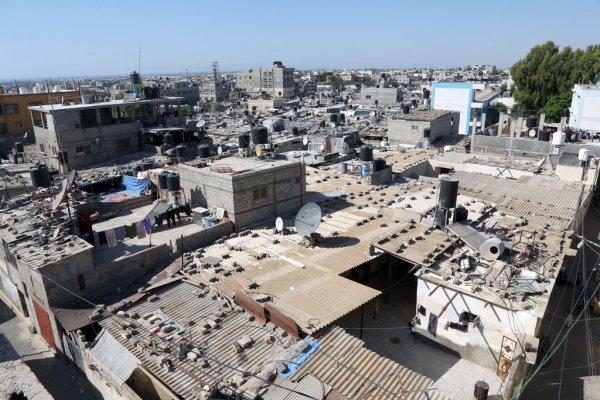
Rafah Refugee Camp
Rafah Refugee Camp: History, Massacres, the Genocide in Gaza and the Right of Return
Rafah Camp was one of the largest Palestine refugee camps in the Gaza Strip, at its southern tip on the border with Egypt. It was established in for about 41,000 refugees driven from their towns and villages during the occupation of Palestine in 1948, and over time merged with the city of Rafah and the Tal al-Sultan neighbourhood. The camp has lived through the massacre of 1956, mass home demolitions in the early 2000s, and finally the genocide in Gaza, in which Rafah became the "last refuge" for more than a million people before being invaded and almost entirely destroyed. As of 2026, most of Rafah lies behind the Israeli-controlled "Yellow Line" and its people cannot return. This guide covers its history, origins, population and current situation.
Quick Facts About Rafah Camp
| Arabic name | مخيم رفح |
|---|---|
| Country / Region | Palestine, southern Gaza Strip, on the border with Egypt |
| Governorate | Rafah |
| Year established | |
| Original population | About 41,000 refugees |
| UNRWA facilities (before October 2023) | 15 schools in 11 buildings, 2 health centres in the camp and 3 in the surrounding area, 2 food distribution centres and 2 relief and social services offices |
| Neighbourhoods | Including al-Shaboura, Yibna, Brazil, al-Salam and Tal al-Sultan |
| Origin of residents | Mainly towns and villages of the Gaza district and southern Palestine |
| Known for | The 1956 massacre; the 2004 demolitions; the "tent massacre" of May 2024 |
| Current status | Almost entirely destroyed; most of Rafah lies behind the "Yellow Line" and residents cannot return as of 2026 |
The Nakba: Why Rafah Camp Exists
Rafah Camp was born from the Nakba (Arabic for "catastrophe"): the mass expulsion of Palestinians during the occupation of Palestine in . Roughly 750,000 Palestinians were driven from their homes, and more than 200,000 of them poured into the narrow Gaza Strip. Many were pursued from town to town until they reached its southern edge.
About 41,000 of them settled at Rafah, on the border with Egypt, making it one of the largest refugee camps in Gaza from the start. Many of its neighbourhoods still carry the names of the places their people came from, such as Yibna, named after the town of Yibna in the Ramla district.
The Right of Return
The right of return is the central demand of Rafah's refugees. It rests on several foundations in international law:
- UN General Assembly Resolution 194 (), paragraph 11, resolved that refugees wishing to return to their homes and live at peace with their neighbours should be permitted to do so at the earliest practicable date, and that compensation should be paid to those choosing not to return and for loss of or damage to property.
- The Universal Declaration of Human Rights (Article 13) affirms everyone's right to leave any country, including their own, and to return to it.
- UN General Assembly Resolution 3236 () reaffirmed the "inalienable right" of Palestinians to return to their homes and property.
Today, Rafah's families face a double exile: they are barred from the villages their grandparents lost in 1948, and also from the ruins of the camp they built in Rafah itself.
History of the Camp
Founding (1949–1950s)
The camp was established in 1949, with relief first provided by the Quakers before UNRWA took over in 1950. Tents were replaced by simple shelters, and the camp grew into blocks and neighbourhoods. Shortly after its creation, thousands of refugees moved to a nearby housing project at Tal al-Sultan, and over time the camp became almost indistinguishable from the city of Rafah.
Egyptian administration and occupation (1949–2005)
From 1948 to 1967 the Gaza Strip was under Egyptian administration, apart from the months of Israeli occupation during the Suez war of 1956, when the massacre described below took place. After the occupation of the West Bank and Gaza Strip in , Rafah came under Israeli military rule. Following the Egypt–Israel peace treaty, the border drawn in 1982 divided the town of Rafah between Egypt and Gaza, separating families on either side.
Siege and the tunnel economy (2007–2023)
After the blockade imposed on Gaza in 2007, Rafah's location on the border made it the centre of a "tunnel economy", with smuggling tunnels used to bring in goods and building materials. Egypt destroyed almost all the tunnels in 2013–2014. Unemployment and poverty then rose sharply, and Rafah's famous carnation exports, once a key part of its economy, were almost completely blocked.
The Rafah Massacre of 1956
On 12 November 1956, during the Israeli occupation of Gaza in the Suez war, Israeli forces rounded up men in Rafah and its refugee camp, and many were shot during the screening operation. The Director of UNRWA's report to the UN General Assembly recorded 111 people killed in Rafah. Coming only days after the massacre in Khan Younis, it remains one of the founding traumas in the memory of the camp.
Home Demolitions (2000–2005)
During the Second Intifada, Rafah Camp was the scene of some of the largest home demolitions in the occupied territories, as Israeli forces widened a buffer zone along the border with Egypt:
- In October 2003, an Israeli operation in the camp completely destroyed 100–120 shelters, leaving about 1,500 people homeless, according to UNRWA.
- In May 2004, in the operation known as "Rainbow", Israeli forces carried out large-scale incursions into the camp and the Brazil, al-Salam and Tal al-Sultan neighbourhoods, demolishing homes, destroying roads, water and sewage networks, and damaging UNRWA schools. When a crowd of demonstrators approached Tal al-Sultan, a tank fired into it.
Rafah and the Genocide in Gaza (2023 onward)
Since October 2023, Rafah has been at the heart of the genocide in Gaza. In September 2025, the UN Independent International Commission of Inquiry concluded that Israel has committed genocide against Palestinians in Gaza, finding that four of the five acts defined in the 1948 Genocide Convention had been committed. A genocide case brought by South Africa against Israel is also before the International Court of Justice. Israel rejects these findings. By mid-2026, Gaza's health ministry reported more than 72,000 Palestinians killed since October 2023.
The "last refuge" (late 2023–May 2024)
As the north and then Khan Younis were invaded, people were ordered to flee south, and more than a million displaced Palestinians crowded into Rafah, in tents covering every open space. Rafah, including its camp, became the last refuge of Gaza's population.
Invasion and the tent massacre (May 2024)
In May 2024, Israeli forces invaded Rafah, and more than a million people were forced to flee again. On 24 May 2024, the International Court of Justice ordered Israel to halt its offensive in Rafah. Two days later, on 26 May 2024, Israeli airstrikes hit a camp for displaced people near UNRWA warehouses in the Tal al-Sultan area, which had been designated as a safe area. Tents caught fire, and at least 45 people were killed, many of them women, children and elderly people burned in the flames. Israel's prime minister called the strike a "tragic mistake". It became known as the "tent massacre".
A city destroyed (2025)
When a ceasefire took effect in January 2025, residents returned to find Rafah destroyed: homes, shops, streets and health facilities in ruins, water and electricity systems wrecked, and unexploded ordnance everywhere. The city's mayor said about 70% of its facilities and infrastructure had been destroyed. After the war resumed in March 2025, the whole of Rafah was ordered evacuated again.
Behind the "Yellow Line" (2025–2026)
After the ceasefire agreement of October 2025, Israeli forces withdrew to the "Yellow Line", but most of Rafah remained inside the area under Israeli control. A city that once had about a quarter of a million inhabitants now stands almost completely destroyed and emptied of its people. Its residents live in tents in al-Mawasi and Khan Younis, waiting to return, while plans for housing near the "Yellow Line" are discussed without them.
For the people of Rafah Camp, this is a second Nakba: the grandchildren of the refugees of 1948 have been killed, starved, displaced and barred once again from their homes.
Origin of the Name
The camp takes its name from the city of Rafah, one of the oldest cities in Palestine, known in ancient times as Raphia, which has stood for millennia at the gateway between Palestine and Egypt.
Location and Geography
Rafah Camp lies in the Rafah Governorate at the southern end of the Gaza Strip, next to the border with Egypt and the Rafah crossing. It merged over time with the city of Rafah and with Tal al-Sultan to the northwest. To its north lies Khan Younis, and to the west the coastal area of al-Mawasi.
Places of Origin
Most of Rafah's refugees came from towns and villages of the Gaza district and southern Palestine, including the Beersheba region. The town of Yibna in the Ramla district gave its name to one of the camp's best-known neighbourhoods. You can explore the depopulated villages of Palestine in the Our Palestine village archive.
Population and Demographics
| Period | Population | Source |
|---|---|---|
| 1949 | About 41,000 refugees | UNRWA |
| Before October 2023 | The camp had merged with the city of Rafah, home to about a quarter of a million people | Various sources |
| Early 2024 | More than a million displaced people crowded into Rafah | UN agencies |
| 2025–2026 | Rafah almost completely emptied of its residents | Various sources |
Note: UNRWA's current camp profile does not publish an updated figure for refugees registered in Rafah Camp, so none is given here.
Housing and Infrastructure
Before 2023, the camp was characterised by overcrowding, housing shortages and extremely narrow streets, with families adding floors to their shelters. About 90% of the water was unfit for drinking. Since 2024, Rafah's homes, streets, water and electricity networks have been almost completely destroyed, and unexploded ordnance lies among the ruins.
Health Situation
Before the war, two UNRWA health centres operated in the camp and three more in the surrounding area. During the genocide, Rafah's hospitals and clinics were overwhelmed by over a million displaced people, then forced to close during the invasion. Today, Rafah's people live in tents elsewhere in Gaza, facing malnutrition, disease and severe psychological trauma.
Economic Situation
Rafah's economy once depended on farming, carnation exports, trade through the border and, for a time, the tunnels. Under the blockade, unemployment and poverty became very high, and much of the population depended on UNRWA food and cash assistance. Since 2024, Rafah's economy has ceased to exist, and its people depend entirely on humanitarian aid.
Education
Before the war, UNRWA ran 15 schools in 11 buildings in the camp. During the genocide, schools became shelters for the displaced and were later destroyed or abandoned, and Rafah's children have lost years of education.
Frequently Asked Questions About Rafah Camp
Where is Rafah refugee camp located?
It lies in the Rafah Governorate at the southern tip of the Gaza Strip, on the border with Egypt, and has merged with the city of Rafah and the Tal al-Sultan neighbourhood.
When was Rafah camp established?
It was established in 1949 for about 41,000 refugees driven from their homes during the occupation of Palestine in 1948.
What was the Rafah massacre of 1956?
On 12 November 1956, during the Israeli occupation of Gaza, men in Rafah and its camp were rounded up and many were shot. UNRWA's director reported 111 people killed.
What was the Rafah tent massacre?
On 26 May 2024, Israeli airstrikes hit a camp for displaced people near UNRWA warehouses in Tal al-Sultan, setting tents on fire and killing at least 45 people, two days after the International Court of Justice ordered Israel to halt its Rafah offensive.
Can Rafah's residents return in 2026?
No. As of 2026, Rafah is almost completely destroyed and most of it lies behind the Israeli-controlled "Yellow Line". Its residents live in tents in al-Mawasi and Khan Younis, waiting to return.
Conclusion
Rafah Camp was built at the southern edge of Palestine by refugees who had been pushed as far as they could go. It survived the massacre of 1956, the demolitions of the 2000s and years of siege, and in the genocide in Gaza it became the last refuge of a whole people before being destroyed. Today its families wait in tents to return, first to Rafah, and ultimately to the villages their grandparents lost in 1948.
More from the archive
 Download Our Palestine App
The whole archive in the palm of your hand: depopulated villages, the Nakba, the massacres and Al-Aqsa — free, with no ads to erase the story.
Download Our Palestine App
The whole archive in the palm of your hand: depopulated villages, the Nakba, the massacres and Al-Aqsa — free, with no ads to erase the story.



Comments
No comments yet — be the first to write one.
Add your comment
Name and email are optional. Comments appear after review.