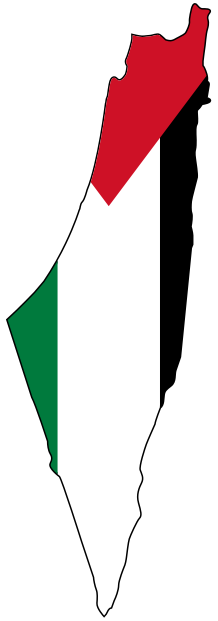
Palestinian Women Before the Nakba: From the Threshing Floor to the Women’s Congress
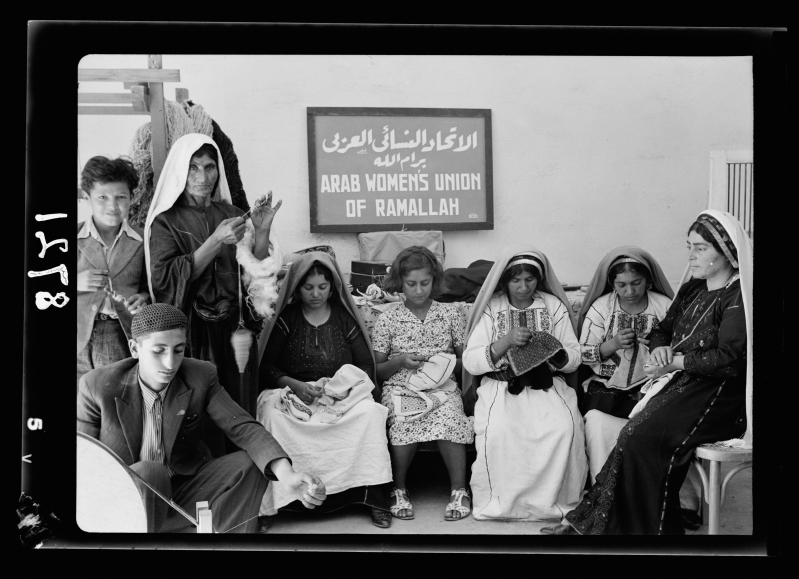
Before the Nakba, Palestinian women were everywhere: in the fields and on the threshing floor, at the spring and the taboun oven, in schools and hospitals, and in the streets demonstrating against the British Mandate. On 26 October 1929, more than two hundred women from across Palestine gathered in Jerusalem for the first Arab Women’s Congress, launching a women’s movement that stood beside the national struggle until the Nakba. [1] [2]
This article tells the story of Palestinian women before the Nakba: rural women and their work, the thobe and embroidery, women’s songs, girls’ education and women teachers, the women’s movement in the cities and its pioneers, and women’s roles in the 1936 revolt and in the year of the Nakba.
Palestinian women before the Nakba at a glance
| Item | Details |
|---|---|
| First Arab Women’s Congress | Jerusalem, 26 October 1929, attended by more than 200 women [1] [2] |
| Branches of the women’s associations | Acre, Gaza, Haifa, Jaffa, Nablus, Nazareth and Ramla [1] |
| Girls in government schools (1945/46) | 16,506 girls vs. 64,536 boys [4] |
| Girls attending school | About 60% of urban girls vs. about 7.5% of village girls [4] |
| First women teachers’ college | Jerusalem, 1919 [4] |
| First Palestinian woman detained by the Mandate for national activity | Sadhij Nassar, 1938 [3] |
| Palestinian delegation to the Cairo women’s congress | 27 members, October 1938 [14] |
| First secret women’s resistance organization | “Zahrat al-Uqhuwan,” Jaffa, 1947 [17] |
Rural women: the field, the spring and the taboun
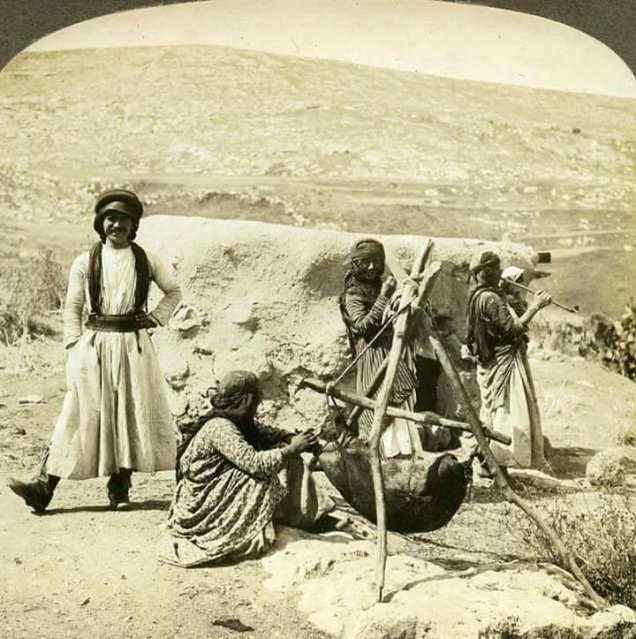
Rural women were partners in the village economy. They worked in the fields, at the harvest and on the threshing floor; they baked bread in the taboun, churned milk into butter, and carried water from the spring on their heads. [9] [10] A study of the Galilee village of al-Birwa shows that the roles of men and women in the village were flexible rather than rigidly divided, and that women’s work gave them relative freedom of movement and a part in political events such as the 1936 revolt, even though it did not give them land ownership or a seat in the diwan. [9]
About three quarters of the population lived in the countryside and depended on farming, so whole families worked in the fields together. [25] Shukriya Othman, who grew up in Lifta, remembers the many crops the village grew: “Before the Nakba, we worked hard, but we were happy.” [25] In al-Birwa, farming was the backbone of the economy: wheat, barley, maize, sesame, watermelon and olives, with three olive presses in the village. [21] Women’s work was not silent; songs accompanied it at harvest and in spring, on the way to fetch water, and at the laundry. [19]
Women’s work also depended on the family’s means: women from well-off families usually did not take part in production, while others worked both on the land and at home. [9] Women also practiced crafts whose products were sold, such as the long “mazawid” rugs for which the women of Barbara were known, and the silk embroidery of Nazareth’s women. [11] [12]
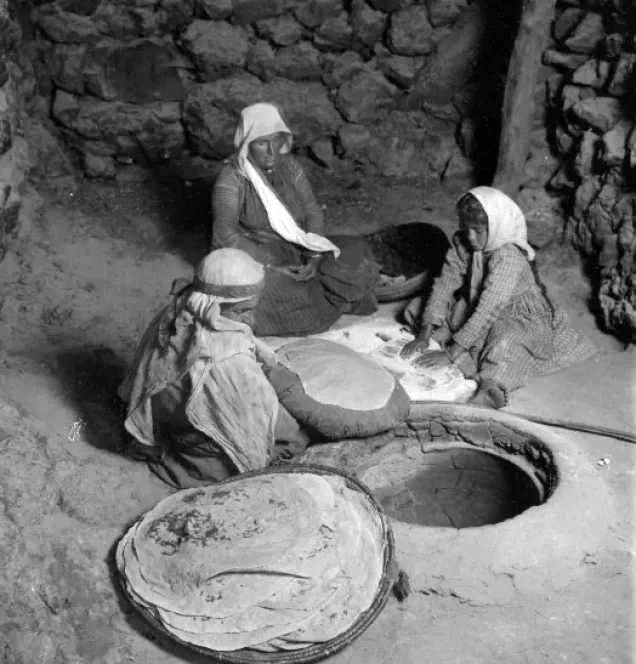

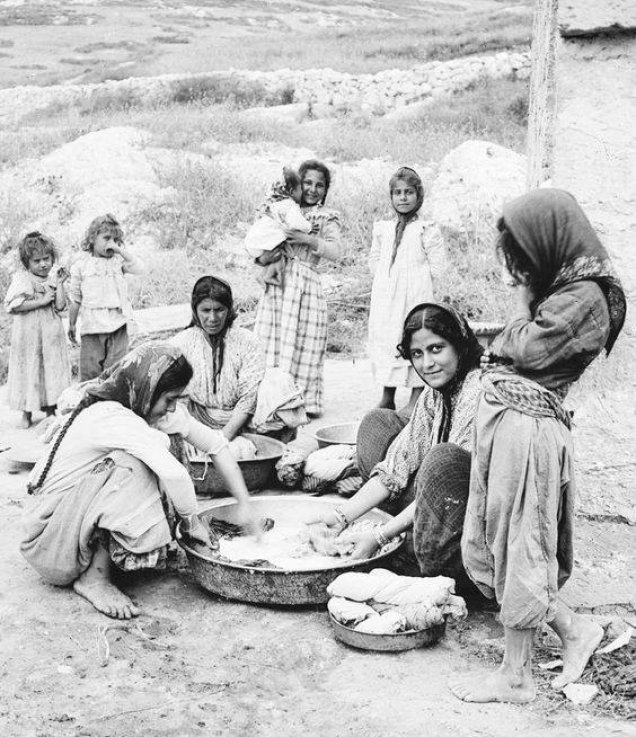
Read more about village life in Safad and Beisan and their villages.
The thobe and embroidery
A village girl learned weaving and embroidery from a young age, and the embroidered thobe became a record of her town and village. [8]
- Colors: Red dominated the Palestinian thobe, in many shades: purple in Gaza, brown in Hebron, bright red or wine red in Bethlehem, Ramallah and Jaffa, and orange-red in Beersheba. [8]
- Everyday and festive dresses: The black, lightly embroidered thobe was for daily work; the white or festive thobe was densely embroidered. [8]
- Regional differences: Dense embroidery in Jerusalem, Ramallah, Hebron and Beersheba; simpler dresses in Majdal, Hamama and Jaffa; orange blossoms and cypress trees on the Jaffa thobe; the “Pasha’s tent” in Hebron; geometric motifs in the Galilee and Safad; and the “Canaanite star” in Bethlehem. [8]
- Parts of the thobe: The thobe is made of a front panel and a back panel, side panels known as banayiq, sleeves, and a square or rectangular chest piece, a form that stayed almost unchanged for centuries. Embroidery skills passed from mother to daughter. [20] [24]
- The coin headdress (smada and shatweh): A bride decorated her headdress with coins, which bore witness to her dowry and then served as savings for her household. [8]
Majdal and Acre were centers for making dresses and their fabrics before the Nakba. [8]
One surviving example is a bridal thobe from Bayt Dajan in the Jaffa district, dating to about 1940–1950 and held in the collection of the Palestinian Museum. It is beige linen embroidered with red silk thread in the fallahi cross stitch; its chest piece carries stars and geometric and plant motifs, and its sleeves and side panels carry cypress, mountain, feather and star motifs. [20]
Women’s songs and occasions
Women preserved a large part of Palestinian folk heritage through song and storytelling. They sang in their own gatherings at weddings, during the harvest and in spring, on the way to fetch water and at the laundry, at births and celebrations, and when the men went away. [19]
- Al-mahahat: A wedding song that congratulates the couple and praises their beauty and families. It shows off women’s skill at improvised verse and ends with a zaghrouda. [19]
- The zaghrouda: The ululation of joy and of victory, still heard at weddings and at the funerals of martyrs. [19]
- The tarwida: A colloquial word for song. Among the best known are mournful farewell songs tied to the conscription of men into the Ottoman army, which the historian Abd al-Latif al-Barghouti described as “sad songs full of tears and mourning.” [19]
- Farewell to the bride: A sad song with which women bid farewell to the bride as she leaves her parents’ home. [19]
- Coded speech (al-malulah): Swapping letters and repeating the “l” sound to hide the meaning of words, used to send messages to prisoners. [19]
Girls’ education
Under the Mandate, girls’ education made clear progress in the cities but lagged badly in the villages. In the 1945/46 school year, Arab government schools had 16,506 girls against 64,536 boys; about 60% of urban girls were in school, against only about 7.5% of village girls. [4] The villages had only 55 girls’ schools against 377 boys’ schools. [4]
The share of girls in school varied from city to city [4]:
| City | Girls in school | Boys in school |
|---|---|---|
| Jerusalem (1942/43) | 85% | 100% |
| Ramallah and al-Bireh (1942/43) | 80% | 100% |
| Nazareth (1942/43) | 79% | 100% |
| Acre (1942/43) | 70% | 100% |
| Jaffa (1944/45) | 57% | 77% |
| Haifa (1942/43) | 45% | 60% |
| Safad (1942/43) | 31% | 67% |
| Majdal (1944/45) | 29% | 63% |
| Hebron (1942/43) | 25% | 60% |
| Gaza (1944/45) | 21% | 51% |
Among the pioneers of girls’ education was Nabiha Nasir, who founded a girls’ primary school in Birzeit in 1924; it became a coeducational secondary school in 1930 and a college in 1942. [4] In the villages, girls’ education faced obstacles, including parents’ fear of losing control over educated daughters and the lack of advanced classes in the village. [9]
In Jerusalem, Zlikha al-Shihabi founded al-Dawha School in the 1930s and worked with Melia Sakakini on a volunteer literacy campaign for girls. [14] Girls’ schools reached some villages in the last years before the Nakba: in Lifta, a girls’ primary school opened in 1945. [22]
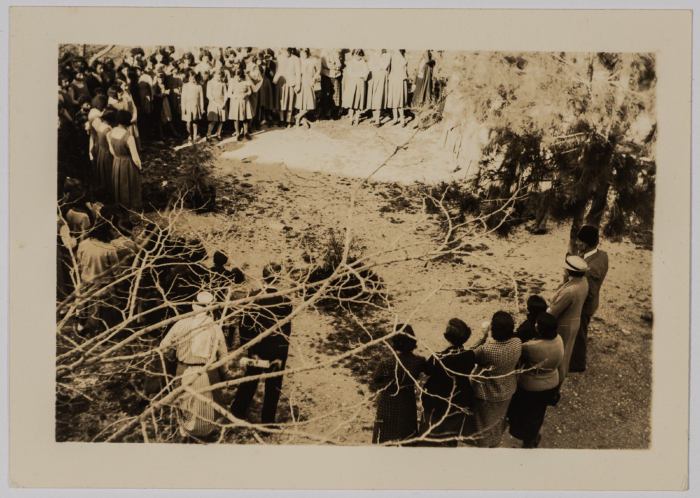
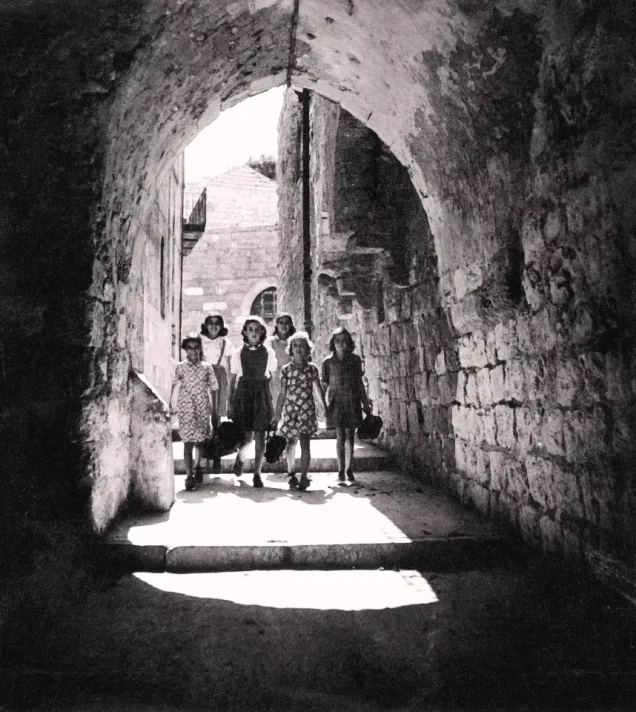
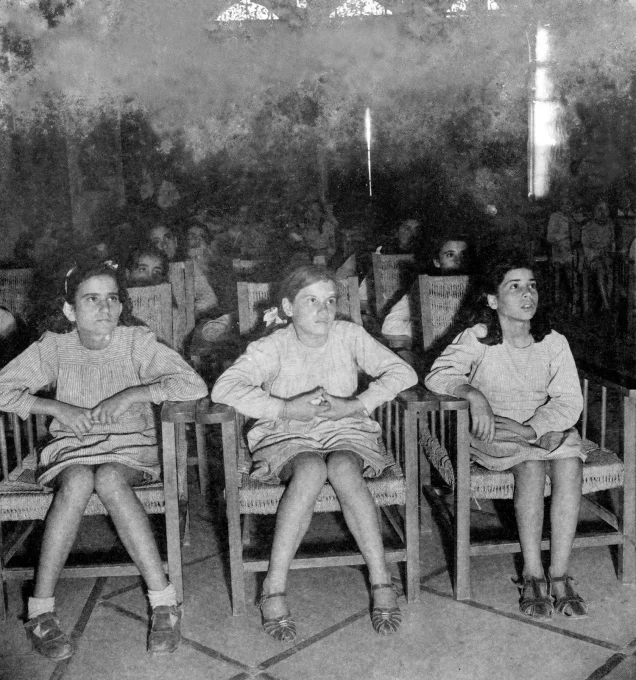
Read: Education in Palestine before the Nakba.
Teachers and nurses
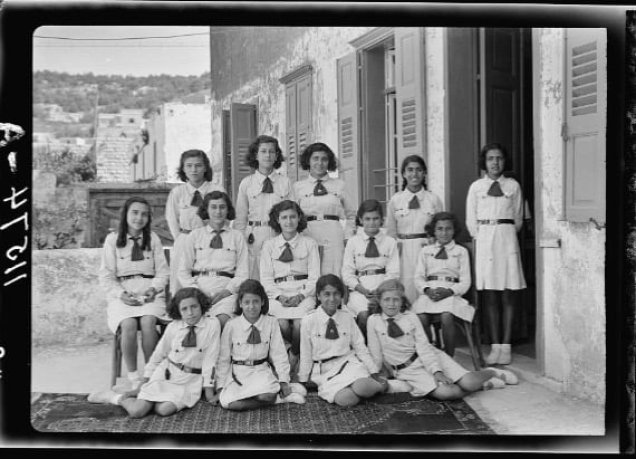
Education opened the door to work outside the home for women, especially in teaching and nursing:
- The Women’s Training College in Jerusalem: Founded in 1919, it had 23 students in 1920 and 104 in 1945/46. [4]
- The Rural Women’s Training College in Ramallah: Founded in November 1935 to prepare teachers for village girls’ schools, it had 34 students in 1945/46. [4]
- Teachers: Such as Hind al-Husseini, who graduated in 1937 and taught at a girls’ school in Jerusalem until the end of the 1945/46 school year. [16]
- Nursing: Nurses worked in hospitals and health centers, including the health center in Majdal, which employed nurses from Beit Jala. [13]
The 1929 Arab Women’s Congress
After the al-Buraq revolt of 1929, the first Arab Women’s Congress met in Jerusalem on 26 October 1929, attended by more than 200 women from across Palestine; other sources put the number at more than 300. [1] [7]
The congress adopted three resolutions [2]:
- That Arab women in Palestine launch a national women’s renaissance, following the example of neighboring Arab countries.
- To endorse the resolutions of the Arab national movement adopted at its earlier congresses.
- To promote national trade and industry by every means and strengthen economic ties with Syria and the Arab countries.
A delegation carried the resolutions to the High Commissioner at Government House, after which the participants drove in a motorcade through the streets of Jerusalem, calling on the foreign consuls. [1] The congress elected the Arab Women’s Executive Committee, which ran the Arab Women’s Association; its members included Tarab Abd al-Hadi, Shahinda Duzdar, Zlikha al-Shihabi, Melia Sakakini, Matiel Mogannam, Zahiyya Nashashibi, and its president, Wahida al-Khalidi. [1]
Zlikha al-Shihabi was part of the delegation that presented the congress’s memorandum to the High Commissioner [14], and the memorandum demanded an end to Jewish immigration and the repeal of the Balfour Declaration. [15]
Women’s associations and unions
- Branches: The Arab Women’s Association spread with branches in Acre, Gaza, Haifa, Jaffa, Nablus, Nazareth and Ramla. In Nablus, the women decided to keep their association independent and closed to men after some men tried to take control of its funds. [1]
- The 1933 demonstrations: In April 1933, the women of Jerusalem boycotted Allenby’s visit, and Matiel Mogannam and Tarab Abd al-Hadi addressed the crowds. In October 1933, women in Jerusalem and Jaffa joined the demonstrations, and the High Commissioner described their participation as “new and disquieting.” [1]
- The Haifa union: The Arab Women’s Union in Haifa, led by Sadhij Nassar, was known for its national militancy and held its own Balfour Day demonstration in 1933 after others had called theirs off. [1]
- The 1938 Cairo congress: In October 1938, Palestinian women sent a 27-member delegation to the Eastern Women’s Conference for the Defense of Palestine in Cairo, at the invitation of Huda Sha’rawi. Sadhij Nassar was elected secretary of the conference bureau, and Zlikha al-Shihabi one of the deputies of the Palestinian delegation. [3] [14]
- The Arab Women’s Union: In late 1938, the Jerusalem association split into the Arab Women’s Association and the Arab Women’s Union, which became the more politically active of the two and was led by Zlikha al-Shihabi after her return from Cairo. [1] [14]
- The Second World War: After the revolt was crushed in 1939, women’s work turned to clinics, schools, and sports and literary clubs. [1] The union in Jerusalem ran first-aid, health, welfare and orphan-care programs, opened a winter convalescent home in Jericho and a sports club, and held a conference on 16 July 1946 attended by women from Arab capitals. [14]
- The Women’s Social Solidarity Society: Founded in Jerusalem in 1945, it counted Hind al-Husseini among its activists and grew to 22 branches. [18]
Pioneers of the women’s movement
Among the hundreds of women who carried women’s work before the Nakba, some names stood out in the congresses, the press and education:
Sadhij Nassar: the journalist detainee
Sadhij Nassar was born in Haifa in 1900 and married Najib Nassar, founder of the newspaper al-Karmel. She began writing for it in 1923, founded its “Women’s Section” in 1926, and later edited and ran the paper with her husband. [3] She founded the Arab Women’s Union in Haifa. The British arrested her in late 1938 on charges of supplying the rebels with weapons, and she spent eleven months in the Bethlehem detention camp, the first Palestinian woman detained by the Mandate authorities for her national activity. [3] [6] After the Nakba she took refuge in Lebanon and then Syria, and died in Damascus. [3]
Zlikha al-Shihabi: from the 1929 congress to the General Union
Born in Jerusalem in 1903, she had a father who was one of the few to send his daughters to school. She took part in the 1929 congress, founded al-Dawha School, and led the Arab Women’s Union in Jerusalem. She continued her work after the Nakba and chaired the preparatory committee for the founding conference of the General Union of Palestinian Women in 1965. The occupation deported her to Jordan in 1967; she later returned, and died in Jerusalem in 1992. [14]
Matiel Mogannam: author of “The Arab Woman and the Palestine Problem”
Born in 1899 to a Palestinian family that emigrated with her to New York, she returned to Palestine with her husband Mogannam Mogannam in the mid-1920s. She took part in preparing the 1929 congress, addressed the women’s march in Jerusalem on 15 April 1933, and in 1937 published her English-language book The Arab Woman and the Palestine Problem in London. [15]
Nabiha Nasir and Hind al-Husseini: education and care
Nabiha Nasir founded the Birzeit girls’ school in 1924, which grew into a college. [4] Hind al-Husseini, born in Jerusalem in 1916, worked as a teacher until 1946 and then devoted her life to the orphans of the Nakba. [16]
Read also: Libraries, newspapers and printing in Palestine before the Nakba.
Women in the 1936 revolt
With the great strike of 1936, the newspapers Filastin and al-Difa’ published more than fifty articles on women’s participation in the first month alone. [1] Women played many roles in the revolt:
- Demonstrations: The women of Jaffa more than once led demonstrations of about 5,000 people, and women were arrested for breaking the curfew. On 29 July 1936, police attacked women demonstrators in Acre and wounded young girls. [1]
- Enforcing the strike: Women in Haifa were arrested for smashing the windows of shops that broke the strike. [1]
- Supporting detainees: Women from Acre, Haifa, Jaffa and Ramla supplied the detainees in the Acre camp with food and clothing, demanded their release, and protested death sentences. [1]
- Supporting the fighters: Women brought food and water to the fighters, treated the wounded, and sold their jewelry to arm their husbands, sons and brothers. [6]
- In the courts: Zlikha al-Shihabi organized crowds of women to attend the trials of rebels to raise their morale. [14]
- In the village: Rural women took part in the events of the revolt, as in the village of al-Birwa. [9]
Women martyrs of the revolt
The lists of martyrs of the 1936–1939 revolt record the names of women killed by British forces, among them [5]:
- Hamida, wife of Hamad al-Eid: from Lubya in the Tiberias district, killed in 1936.
- Dhiba Dhiyab Salem: killed in Hittin in 1937.
- An unnamed Bedouin girl: killed in Safad on 25 May 1938.
- Sa’da bint Abd al-Rahman: of Arab al-Turkman, killed in Kafr Qara.
Zahrat al-Uqhuwan: a secret women’s organization in Jaffa
In Jaffa, the sisters Moheeba and Nariman Khorsheed founded “Zahrat al-Uqhuwan” (the Anemone Flower), considered the first secret women’s organization active in resisting the occupation; its members swore their oath of membership on 20 February 1947. [17] According to Moheeba’s own account, the organization began with twelve women. It worked in nursing and in helping the poor and students, then moved to armed action, and continued until the Nakba. [17] Moheeba was in charge of operations, intelligence, fundraising and buying weapons. [18]
Moheeba Khorsheed was born in Jaffa in 1925 and worked as a mathematics teacher. She corresponded with the commander Abd al-Qadir al-Husseini, who was killed at al-Qastal in April 1948, and she died in Cairo in 1999. [17]
Women in the year of the Nakba
In 1948, Palestinian women paid a double price: they were killed in massacres, driven out with their children, and carried their homes on their heads along the roads of exile. In Deir Yassin, Halwa Zeidan took up her son’s rifle after he was killed, and fought until she too was killed. [6] Women, children and elderly people were among the victims of the massacre of 9 April 1948. [23]
Women urged families to stay in their homes and refuse to leave, guided fighters along safe routes, and helped displaced women find shelter. [18] In al-Birwa, after the village was occupied in June 1948, armed men returned together with a similar number of unarmed men and women to harvest their crops. [21]
In Jerusalem in April 1948, Hind al-Husseini found children who had survived the Deir Yassin massacre, the oldest of them nine years old. She took them into her home and then founded “Dar al-Tifl al-Arabi” (the Home of the Arab Child) for them. [16] Some sources say there were 55 children. [18] After the Nakba, women in the camps provided health and education services and taught sewing and embroidery. [18]
Read about Deir Yassin and the Zionist massacres on our site.

Depopulated villages in this article
- Lifta: About 5 km west of Jerusalem on the Jerusalem–Jaffa road, with 2,550 inhabitants in 1945 and a girls’ school opened in 1945. Its people were driven out in early 1948 after attacks that destroyed most of its houses.
- Deir Yassin: About 5 km west of Jerusalem, with 610 inhabitants. The Irgun and Stern gangs committed a massacre there on 9 April 1948.
- al-Birwa: About 10.5 km east of Acre, with 1,460 inhabitants, and the birthplace of the poet Mahmoud Darwish. It was occupied on 11 June 1948.
- Bayt Dajan: About 9 km east of Jaffa, with 3,840 inhabitants. The expulsion of its people began on 25 April 1948.
- Barbara: About 17 km northeast of Gaza, with 2,410 inhabitants, known for its grapes and for the “mazawid” rugs woven by its women. It was occupied on the night of 4–5 November 1948.
- Lubya: About 10 km west of Tiberias and the largest village in the district, with 2,350 inhabitants; the martyr Hamida, wife of Hamad al-Eid, came from there. Most of its people left on the night of 16 July 1948.
- Hittin: About 8 km northwest of Tiberias, with 1,190 inhabitants; the martyr Dhiba Dhiyab Salem came from there. Most of its people left on the night of 16–17 July 1948.
Conclusion
Before the Nakba, Palestinian women were a pillar of every side of the country’s life: on the threshing floor and at the taboun, in the embroidered thobe that carried the name of her village, in the school and the teachers’ college, in the street demonstrating and speaking out, in the revolt carrying food and weapons, and in Jaffa founding a secret resistance organization. From the Women’s Congress of 1929 to Deir Yassin in 1948, Palestinian women wrote their own chapter in the story of the homeland, and they are still writing it.
Frequently asked questions about Palestinian women before the Nakba
When was the first Arab Women’s Congress held in Palestine?
It was held in Jerusalem on 26 October 1929, attended by more than 200 women from across Palestine, and it elected the Arab Women’s Executive Committee.
What were the resolutions of the 1929 Women’s Congress?
It called for a national women’s renaissance on the model of the Arab countries, endorsed the resolutions of the national movement, and called for promoting national trade and industry and strengthening economic ties with the Arab countries.
Who was Sadhij Nassar?
A journalist and activist from Haifa who founded the Women’s Section of al-Karmel in 1926 and the Arab Women’s Union in Haifa, and who in 1938 became the first Palestinian woman detained by the Mandate authorities for her national activity.
What share of girls went to school before the Nakba?
About 60% of urban girls were in school, against about 7.5% of village girls; Arab government schools had 16,506 girls in 1945/46.
What role did women play in the 1936 revolt?
They led demonstrations, enforced the strike, supported detainees, brought food and water to the fighters, treated the wounded, and sold their jewelry to buy weapons; several women were killed by British forces.
What was Zahrat al-Uqhuwan?
A secret women’s organization founded by the sisters Moheeba and Nariman Khorsheed in Jaffa in 1947. It worked in nursing and helping the poor, then in armed resistance until the Nakba.
Who was Zlikha al-Shihabi?
A women’s movement pioneer from Jerusalem (1903–1992) who took part in the 1929 congress, led the Arab Women’s Union in Jerusalem, and helped found the General Union of Palestinian Women in 1965.
What is al-mahahat?
A women’s song at Palestinian weddings that congratulates and praises the couple in improvised verse and ends with a zaghrouda.
What did the embroidered thobe mean?
The thobe was a record of a woman’s region and village, with colors and motifs that differed from one area to another; girls learned embroidery from a young age.
Sources and references
Arabic-language sources are listed with translated titles.
- Ellen Fleischmann, “The Emergence of the Palestinian Women’s Movement, 1929–39,” Journal of Palestine Studies, vol. 29, no. 3, Spring 2000.
- “Resolutions of the Women’s Congress, 26 October 1929,” from Abd al-Wahhab al-Kayyali, Documents of the Palestinian Arab Resistance against the British Occupation and Zionism, 1918–1939, Institute for Palestine Studies, 1968.
- “Sadhij Nassar,” Interactive Encyclopedia of the Palestine Question, Institute for Palestine Studies.
- “Education in Palestine before the Nakba,” Palestinina.
- “Martyrs of the 1936–1939 Revolt,” Palestinian National Information Center – WAFA.
- Tuqa al-Ani, “Immortal Names: Palestinian Women and the Struggle against Occupation,” Noon Post, 23 July 2021.
- Rawaa Murshid, “Palestinian Women’s Unions: Achievements and Challenges,” Noon Post, 8 March 2021.
- Nour Olwan, “The Thobe of the Homeland: Palestinian Dress Tells the History of the Land and Its People,” Noon Post, 28 February 2018.
- Lina Mohammad Mi’ari, “The Roles of Rural Palestinian Women in Their Economic and Cultural Dimensions, 1930–1960: The Village of al-Birwa as a Model,” MA thesis, Institute of Women’s Studies, Birzeit University, 2005.
- “Nazareth” (photo gallery), Palestinina.
- “Barbara,” Depopulated Villages section, Palestinina.
- “The City of Nazareth,” Nedaa al-Watan, 24 April 2022.
- Ali Habib Allah, “Majdal Asqalan: Originally a Story of Return,” Arab48, 13 May 2024.
- “Zulaykha al-Shihabi,” Interactive Encyclopedia of the Palestine Question, Institute for Palestine Studies.
- “Matiel Mogannam,” Interactive Encyclopedia of the Palestine Question, Institute for Palestine Studies.
- “Hind al-Husseini,” Interactive Encyclopedia of the Palestine Question, Institute for Palestine Studies.
- Mirvat Sadiq, “Palestine’s Zahrat al-Uqhuwan: A Secret Women’s Organization on the Eve of the Nakba,” Al Jazeera Net, 15 May 2021.
- Maha Shahwan, “How Did Palestinian Women Fighters Face the Horrors of the Nakba?” Noon Post, 5 May 2023.
- Christina Hazboun, “Palestinian Folk Songs: A Rich Heritage Preserved by Women,” Noon Post, 24 December 2021.
- “Bayt Dajan Bridal Thobe” (0002.01.0086), Palestinian Museum collection.
- “al-Birwa,” Depopulated Villages section, Palestinina.
- “Lifta,” Depopulated Villages section, Palestinina.
- “Deir Yassin,” Depopulated Villages section, Palestinina.
- Susan Maadi, “Palestinian Dress from Ancient Canaan to the Thobe in Congress,” Noon Post, 16 June 2020.
- Farid Taamallah, “The Lost Land: Nakba Survivors Remember Rural Struggle under the British Mandate,” Noon Post, 15 May 2020.
More from the archive
 Download Our Palestine App
The whole archive in the palm of your hand: depopulated villages, the Nakba, the massacres and Al-Aqsa — free, with no ads to erase the story.
Comments
No comments yet — be the first to write one.
Add your comment
Name and email are optional. Comments appear after review.