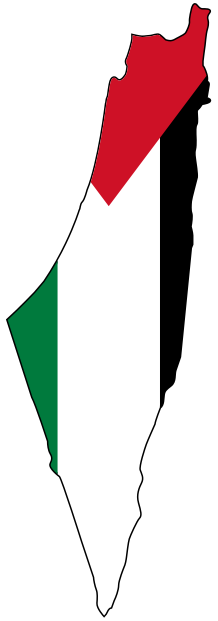
Cafés in Palestine Before the Nakba: From the Vagabonds’ Café to Kawkab al-Sharq
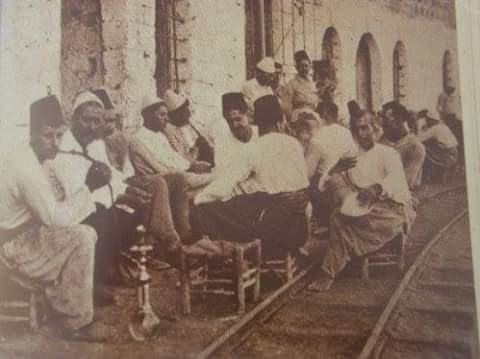
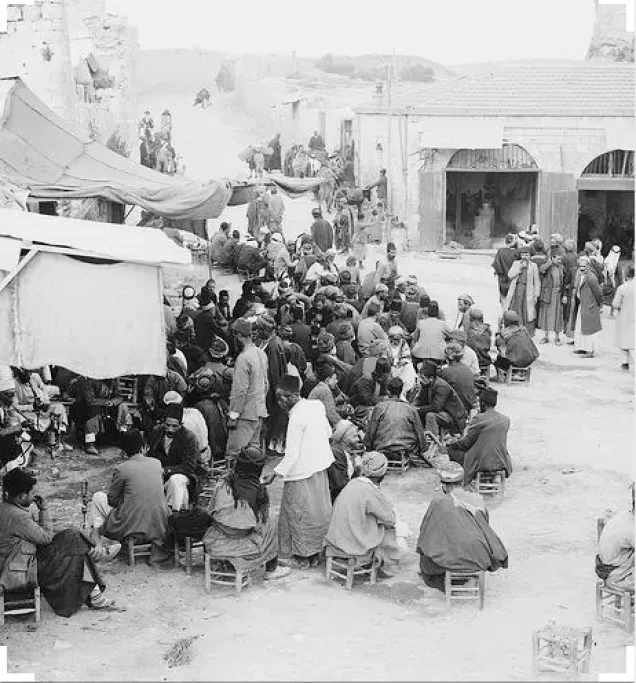
Before the Nakba, the café was the heart of the Palestinian city: there newspapers were read and politics debated, the hakawati told the epics of Antar and al-Zir Salim, people listened to the phonograph and then the radio, and merchants, writers and journalists met. In Jerusalem, Khalil Sakakini and his friends founded the “Vagabonds’ Café”; in Jaffa, one of its sons counted 75 cafés; and in Haifa, Umm Kulthum left a café with the title “Kawkab al-Sharq,” the Star of the East. [1] [2] [4] [5]
This article tells the story of cafés and social life in Palestinian cities before the Nakba: what went on inside them, the best known in Jerusalem, Jaffa, Haifa, Nazareth, Tiberias and Acre, their role in politics, the press and the arts, and what became of them in 1948.
Cafés in Palestine before the Nakba at a glance
| Item | Details |
|---|---|
| Oldest documented café in Jerusalem | In the Qaramy quarter, 1578 [1] |
| Founding of the Vagabonds’ Café and the Jawhariyya Café in Jerusalem | 1918 [1] [2] |
| Manifesto of the “Party of the Vagabonds” | 1925, eighteen articles [2] |
| Number of cafés in Jaffa before the Nakba | 75, according to Ali al-Bawwab’s count [4] |
| Umm Kulthum’s first visit to Palestine | October 1931 [5] |
| Years of operation of Hammam al-Basha in Acre | About 150 years, from the late eighteenth century until 1948 [20] |
| Start of the Palestine Broadcasting Service (“Huna al-Quds”) | Late March 1936 [9] |
The roots of the café in the Palestinian city
Palestinian cities have known the café for centuries: a café is recorded in the Qaramy quarter of Jerusalem in 1578. [1] In the late nineteenth century, cafés spread inside the walls of Jerusalem’s Old City, among them the cafés of Khalil Najm, Siyam, Ali Zahhamin, Arif Za’tara and al-Basatiy, and the Nabulsi café in the Hindiyya building near Damascus Gate. [1]
As cities grew beyond their walls in the late Ottoman and Mandate periods, cafés moved to the new streets, squares and transport hubs: to Jaffa Gate, Jaffa Street and Mamilla in Jerusalem, to Clock Tower Square and the port in Jaffa, and to Hanatir Square near the railway station in Haifa. [1] [3] [15]
What went on in the café?
The café was not just a place to drink coffee; it was the city’s public square:
- The hakawati: The storyteller sat on a raised seat with no curtains or wings and told folk epics such as the Sira of Antar ibn Shaddad, the Taghriba of Bani Hilal and the Sira of al-Zir Salim, sometimes singing and playing the rababa, in evenings the writer Radi Shehadeh called “magical.” Shehadeh considers him the only popular dramatic form that endured in Palestine throughout the Ottoman era. [8]
- Shadow play: The show of Karagöz and Aywaz, which reached the cafés from Ottoman tradition. [1] [8]
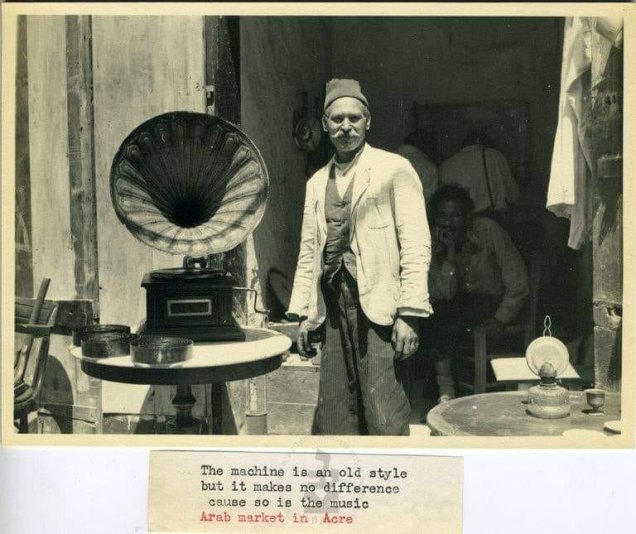
- Music and song: Cafés hosted musical performances and speeches, and later the phonograph and the radio; the Jawhariyya memoirs describe evenings of music that brought singers together in Jerusalem. [1]
- Theatre: Some cafés were also theatres: in Jaffa there were the theatre of the Bannour café and the theatre of the Halwani café. [4]
- Politics: Cafés became platforms for party propaganda and political and intellectual debate. [1]
- Trade: In Jaffa, orange merchants began their day with a cup of coffee at the “Daoud café,” where they negotiated their deals. [3]
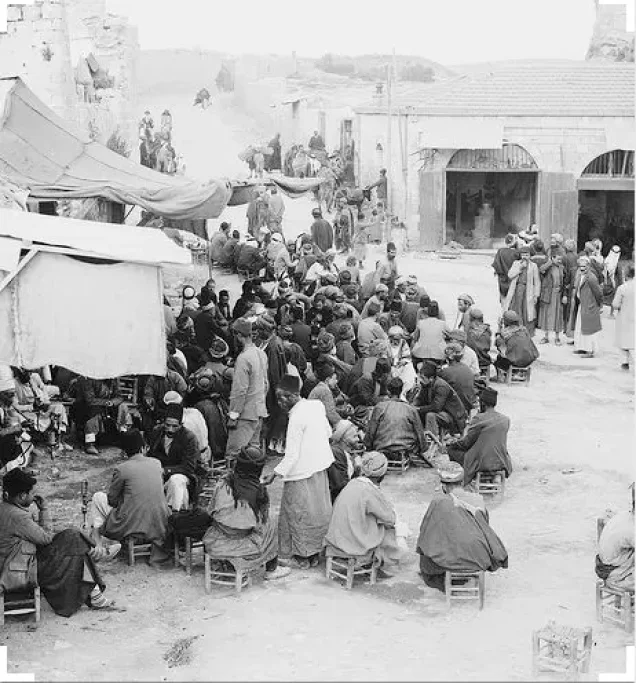
Café customs: backgammon, narghile and radio
The café had its daily rituals: patrons played chess and backgammon (tawlat al-zahr), smoked tobacco and the narghile, and drank coffee and tea. [17] Later, some café owners bought phonographs to play the songs of the great Arab singers, and when the radio arrived they set it up high, so that people gathered around it to hear music, songs and news bulletins. [17]
Almost every trade had its café: in Jaffa, sailors had the “Madfa’ (Cannon) café” near the port, orange merchants the “Daoud café,” fishermen the “Fishermen’s café,” merchants and senior officials the “Halwani café,” and journalists a café on the beach. [3] In the streets, coffee stalls served a cup to those with no time to sit. [22]

Ramadan nights: the hakawati and Karagöz
Ramadan nights were the café’s liveliest. In Haifa, as the historian Johnny Mansour relates, men and boys went out after the iftar meal to the squares and cafés, most staying until midnight or later, while children roamed the neighborhoods collecting sweets and nuts. [17]
- The hakawati: Storytellers spread through the squares and cafés of eastern Haifa after iftar. They were known for their booming voices and for tales that did not end in a single night but continued the next, so the audience came back to hear the rest. [17]
- Karagöz and Aywaz: The two shadow-play characters, well known across the Levant, performed satirical and comic shows for a small fee, or often for a little food and sweets. [17]
- The sea: In Jaffa, people went to the sea during Ramadan to escape the heat, and some carried their iftar to eat on the shore. [19]
Jerusalem’s cafés
The Jaffa Gate area, the main transport hub for Bethlehem and the south, was the heart of Jerusalem’s modern cafés. [1] Among Jerusalem’s cafés before the Nakba:
- The Vagabonds’ Café: Inside Jaffa Gate, founded in 1918, it became a meeting place for writers, poets, journalists and politicians. [1] [2]
- The Jawhariyya Café: Founded in 1918 on Jaffa Street. [1]
- Al-Ma’arif Café: Just outside Jaffa Gate, where concerts and shadow plays were staged. [1] [18]
- Cafés of Omar Square and Jaffa Gate: Such as the Lido in Omar Square, and the Bloor and Bank cafés. [1]
- Cafés of Jaffa Street and Mamilla: Such as the Europe café in the Sansour building, and the Vienna and Piccadilly cafés. [1]
- The Barkarnik café: Opposite the governor’s seat. [1]
- Old City cafés: Such as the cafés of Arif Za’tara and Siyam, and the Nabulsi café near Damascus Gate. [1]
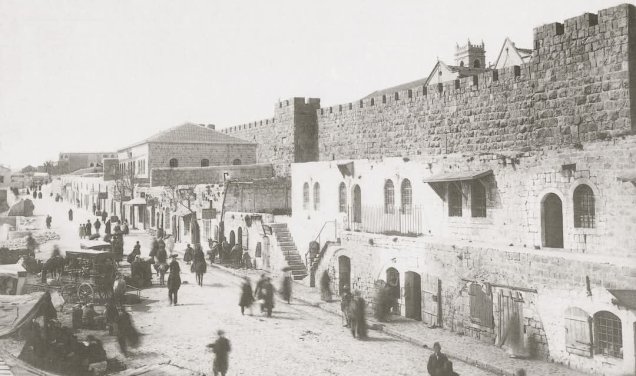
Read about Jerusalem and its depopulated villages.
The Vagabonds’ Café and the Party of Idleness
The café was originally called “Qahwat al-Mukhtar” (the Mukhtar’s Café). It was founded in 1918 inside Jaffa Gate by Issa Michael al-Tubbeh, a mukhtar in the Old City, and Khalil Sakakini and his friends renamed it the “Vagabonds’ Café” (Maqha al-Sa’aleek). [2] Every Wednesday a circle of writers gathered there, among them Adel Jaber, Is’af al-Nashashibi, Issa al-Issa, Ishaq Musa al-Husseini and Khalil Nakhleh, and visitors from abroad included Ahmad Zaki Pasha and Khalil Mutran. [1] [2] Sakakini took his guests there rather than to his home, and they sat by the pool. [1]
From this circle the “Party of the Vagabonds” was born, for which Sakakini wrote a satirical manifesto of eighteen articles, published in 1925. [2] Among its principles:
- Membership is open to all men and women unless they violate the party’s principles. [2]
- The party has no president, treasurer or headquarters, and its members meet in the street. [2]
- No titles: everyone is addressed in the familiar singular, and titles such as “Your Excellency” are rejected. [2]
- Idleness is the party’s motto, the working day is two hours long, and holidays are for eating, drinking and merriment. [2]
- Criticism without flattery, and rejection of the labels of left and right. [2]
The café’s sessions were spent reading, writing, singing and playing, and Sakakini called them “fabulous” in his diary. In 1921 he declined an honor from a club in Bethlehem, citing the party’s rule barring members from accepting decorations. [2] But the café declined after Sakakini returned to his post as inspector of education in 1926, as newspapers moved to Jaffa and Haifa in the 1920s and intellectuals turned to national politics; in a letter, Sakakini mourned the end of his “age of idleness.” [2]
Jaffa’s cafés
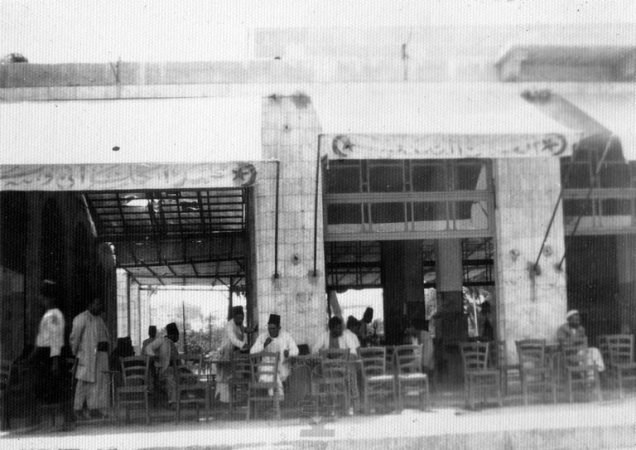
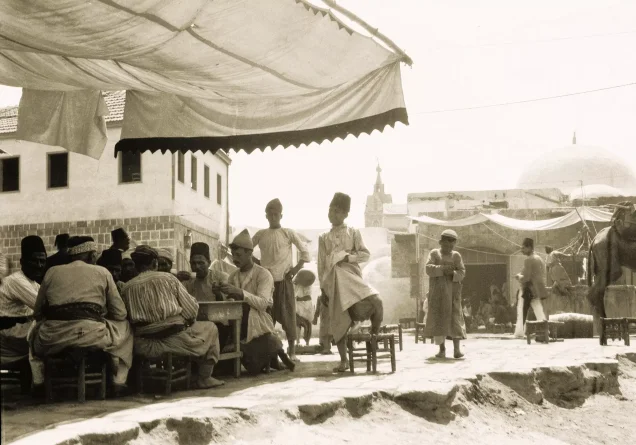
Jaffa was the city of cafés par excellence: Ali al-Bawwab counted 75 cafés there before the Nakba, where newspapers were read, politics debated, and the hakawati and the radio listened to. [4] Among them:
- The Madfa’ (Cannon) café: Near the port, named after an Ottoman cannon fired at sunset during Ramadan; its regulars were “Jaffa’s valiant sailors.” [3]
- The Daoud café: The café of the orange merchants, who began their day there with a cup of coffee and talked business. [3]
- The Inshirah café: Shafiq al-Hout described it as the most cheerful of cafés; bus passengers used to bet on whether one of its regulars would be sitting there. [3]
- The Halwani café: The municipal café, where merchants, senior officials and notables met, and which also had a theatre. [3] [4]
- The Abu Shakoush café: A theatre and café opposite the offices of the newspaper al-Difa’. [3]
- A beach café: Owned by a member of the Sukkar family, where journalists met in the evenings to critique their work and the state of the press. [3]
- The terrace of the Continental Hotel: A meeting place for writers, poets and artists. [3]
Clock Tower Square was the heart of the city’s evenings, home to “al-Dharifiyya,” whose nights were enlivened by performers from Egypt and Lebanon. Jaffa’s stages welcomed Umm Kulthum, Mohammed Abdel Wahab and Farid al-Atrash, and its cinemas included the Hamra, Nabil, Rashid and Farouk; Shafiq al-Hout described the Hamra as “unique in the Middle East in its size and splendor.” [3] The journalist Nasir al-Din al-Nashashibi recalled those days: “We stayed up late a lot, laughed a lot, and wrote a lot.” [3]
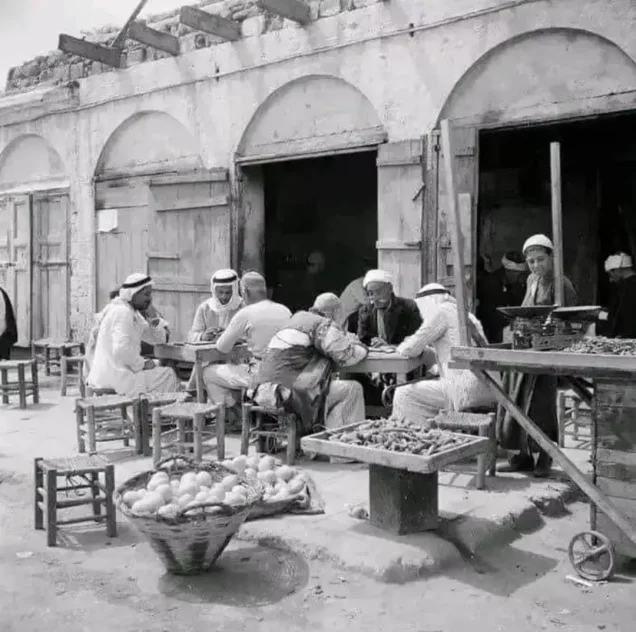
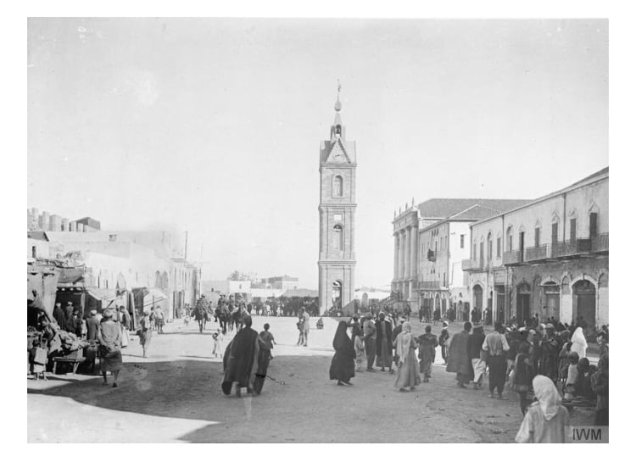
Villages near Jaffa had their cafés too, such as the Abu Arab café in Sheikh Marzouq Square in Bayt Dajan, a village about 9 km east of Jaffa with 3,840 inhabitants, whose people began to be expelled on 25 April 1948. [13]

Read: Jaffa before the Nakba: capital of the press, cinema and cafés.
Haifa: the Kawkab al-Sharq café
Haifa was “a city of summer and late nights,” with its clubs, cafés, newspapers and poets. [7] In October 1931 Umm Kulthum visited Palestine for the first time, singing in Jaffa, Jerusalem and Haifa, and she returned to Haifa in 1935. [5] She arrived in Palestine known as the “Nightingale of the East” and left as the “Star of the East” (Kawkab al-Sharq): the historian Johnny Mansour relates that an audience member called out to her during a performance in a Haifa café, “Umm Kulthum, you are the Star of the East,” and says the café bore that very name. [5] [6]
The memory of the people of Wadi Salib tells another version: that Umm Kulthum sang at the “Bustan al-Inshirah” garden in Haifa, and that her concert there helped earn her the title. [16]
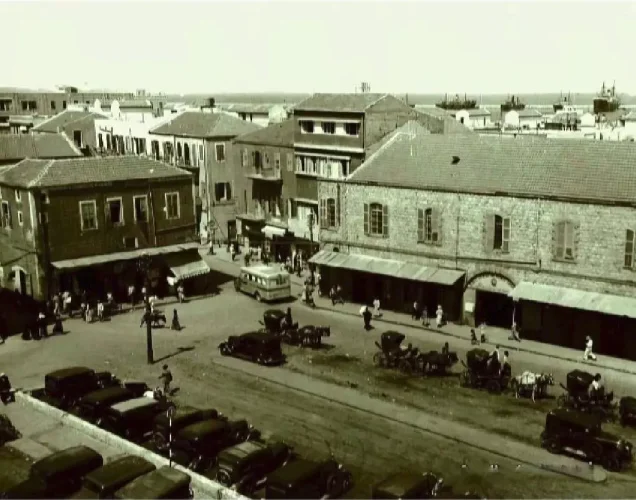
Haifa’s Arab cafés included “Qahwat al-Ajami” beneath the Ajami building, “Qahwat al-Radio” on the ground floor of the Shabib building on al-Muluk Street, and the “Metropole” café. [16] Cafés multiplied in Arab Haifa until they became the place where friends met to play chess and backgammon. [17] The city’s people also went to the al-Amin cinema and to the Abu Nassour and al-Aziziyya beaches. [16]
Haifa was a stop for Egyptian troupes on their way to Lebanon: Yusuf Wahbi and the Ramses troupe performed there, and Farid al-Atrash gave six concerts in the city. [6]
Read about Haifa and its depopulated villages and the arts in Palestine before the Nakba.
Cafés of Nazareth, Tiberias and Acre
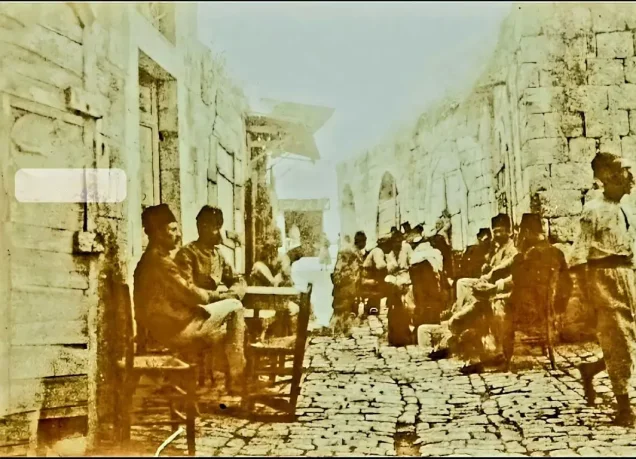
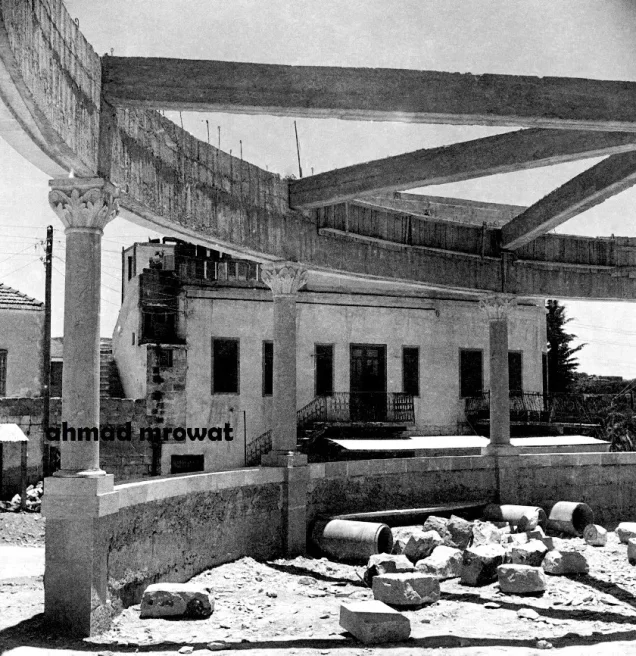
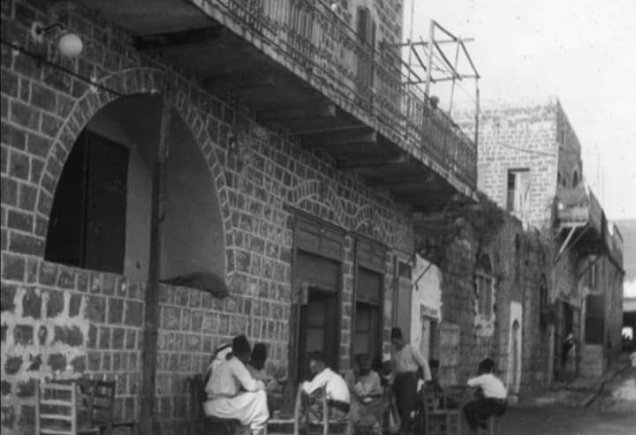
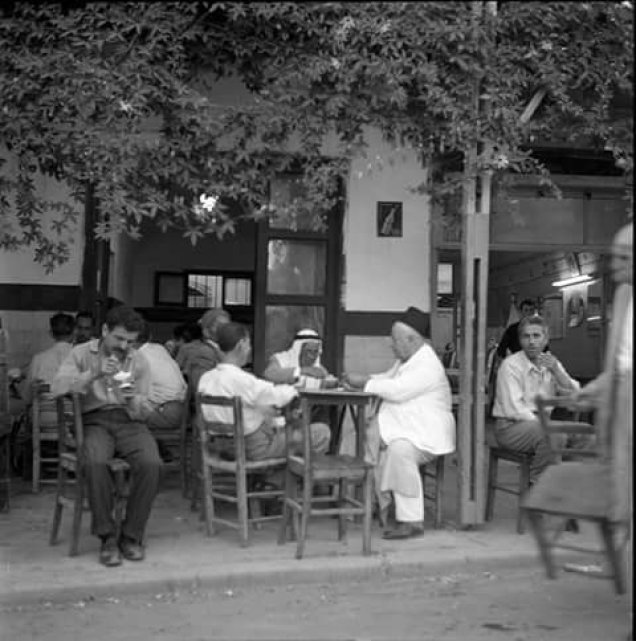
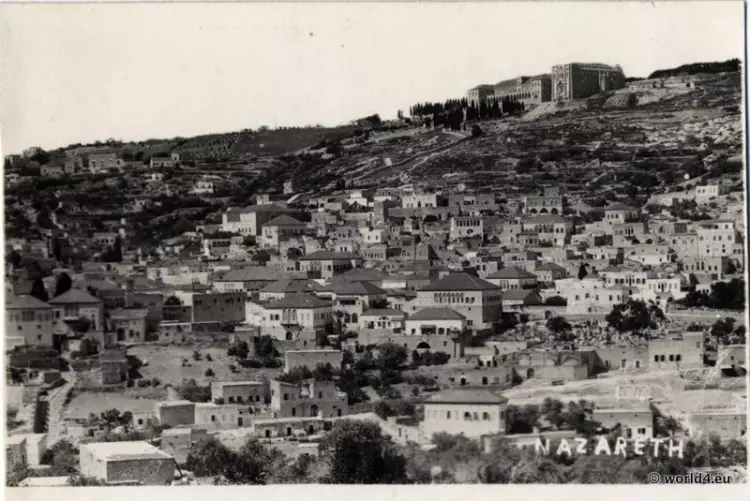
- Nazareth: Its cafés were where its people met, among them a popular café seen in a 1903 photograph, and the Jarjoura café, built in July 1935. [10]
- Tiberias: Its cafés included one in a city neighborhood seen in a 1925 photograph, and the city had the Tiberias Hotel, seen in a 1936 photograph. [11]
- Acre: Among its pre-Nakba photographs is a cafeteria from 1946. [12]
Bathhouses, clubs and the beach
The café was not the only social space in the Palestinian city; alongside it were other places to meet:
- Public bathhouses: In Acre, Ahmad Pasha al-Jazzar built Hammam al-Basha in the late eighteenth century; it operated for about 150 years until 1948, a place for meeting, rest and celebration, where barbers also worked. [20] In Haifa there was the “Small Bath” in the middle of Suq al-Shawam, owned by the Kazbar and Ranno families. [16] In Gaza, Hammam al-Samra, nearly 900 years old, still bears witness to this tradition. [21]
- Clubs and associations: Literary and intellectual clubs, unions and charities spread through the cities, and cafés, cinemas and theatres became places to discuss the community’s issues. [18]
- Cinema and theatre: Cinemas multiplied in Jerusalem, Jaffa and Haifa, reaching five in Jaffa, and Jerusalem had thirty theatre troupes in 1944. [18]
- The beach: The sea was the outlet of the people of Jaffa and Haifa, who went there to swim and stroll. [3] [16] [19]
Read also: Sports in Palestine before the Nakba.
The café, politics, the press and radio
The café was closely tied to the press: in Jerusalem the Vagabonds’ Café was a meeting place for journalists, in Jaffa the Abu Shakoush café stood opposite the offices of al-Difa’, and journalists met in the evenings at a beach café to critique one another’s work. [2] [3] Cafés were platforms for party propaganda and political and intellectual debate. [1]
Then the radio entered the café: in late March 1936 the Palestine Broadcasting Service (“Huna al-Quds,” This Is Jerusalem) began broadcasting from the Palace Hotel in Jerusalem in Arabic, English and Hebrew; its Arabic section was directed by the poet Ibrahim Tuqan until the British authorities dismissed him in 1940. [9] Palestinian radio ranked second in the Arab world after Egyptian radio. [18] In Jaffa, the Near East Arab Broadcasting Station operated and was among the best-known stations of the Second World War. [3] Listening to the news and songs in the café became part of daily life. [1] [4]
Read also: Libraries and the press in Palestine before the Nakba.
The cafés in the year of the Nakba
In 1948 this world came to an end: in Jerusalem, many Arab cafés in the new city, in Mamilla, at Jaffa Gate and on Jaffa Street, were destroyed or their owners displaced, and most Old City cafés were closed and turned into shops. [1] In Jaffa, of some 120,000 people in the city and its villages, only about 4,000 remained after its fall in May 1948, and with the expulsion of its people the life of its cafés ended. [4] [14] After its building was occupied, the Palestine Broadcasting Service moved to Ramallah as “the Jerusalem Arab Broadcasting Station.” [9]
Hammam al-Basha in Acre stopped operating in 1948, after about a century and a half. [20] In Haifa, the people of Wadi Salib, regulars of its cafés and bathhouses, were scattered, and many of them ended up in the Yarmouk camp in Syria. [16]
In Acre, where part of the population remained after the Nakba, a 1950 photograph shows a café with a phonograph. [12]
Conclusion
Before the Nakba, cafés were the mirror of Palestinian cities: in Jerusalem, Sakakini and his friends wrote the manifesto of “idleness” and mocked titles; in Jaffa, orange merchants began their day with a cup of coffee; in Haifa, Umm Kulthum left a café as the “Star of the East.” In every city the hakawati told his tales, the radio broadcast, and people debated the fate of the country. Then the Nakba came, closing the cafés and scattering their patrons, but their memory survives in the memoirs and photographs of their people.
Frequently asked questions about cafés in Palestine before the Nakba
What was the Vagabonds’ Café?
A café inside Jaffa Gate in Jerusalem, founded in 1918, which Khalil Sakakini and his friends made into a meeting place for writers, and where they founded the satirical “Party of the Vagabonds,” whose manifesto was published in 1925.
How many cafés were there in Jaffa before the Nakba?
Ali al-Bawwab counted 75 cafés in Jaffa before the Nakba, among them the Madfa’, Daoud, Inshirah, Halwani and Abu Shakoush cafés.
Where did Umm Kulthum’s title “Star of the East” come from?
The historian Johnny Mansour relates that Umm Kulthum received the title in Haifa, when an audience member called out to her during a performance in a café in the city: “Umm Kulthum, you are the Star of the East.”
What did people do in the cafés?
They drank coffee and tea, played chess and backgammon, smoked the narghile, listened to the hakawati, the phonograph and the radio, read newspapers, and discussed politics and business.
What is Karagöz?
A shadow play starring Karagöz and Aywaz that presented satirical and comic scenes in cafés and squares, especially on Ramadan nights, for a small fee or a few sweets.
What did the hakawati perform in the cafés?
He told folk epics such as the Sira of Antar, the Taghriba of Bani Hilal and the Sira of al-Zir Salim, seated on a raised chair, sometimes singing and playing the rababa.
What happened to Palestinian cafés in 1948?
Many of the cafés of new Jerusalem were destroyed or their owners displaced, most Old City cafés were closed, and Jaffa’s cafés emptied after most of its people were expelled.
Sources and references
Arabic-language sources are listed with translated titles.
- A study of cafés in Jerusalem, Al-Quds University digital repository.
- Salim Tamari, “The Vagabond Café and Jerusalem’s Prince of Idleness,” Jerusalem Quarterly, Institute for Palestine Studies.
- “Jaffa, Jerusalem, Amman and Back: Memories and Accounts,” from the memoirs of Shafiq al-Hout, Tamam al-Akhal and Nasir al-Din al-Nashashibi, Yafa website.
- Mahmoud Yazbak, “Jaffa before the Nakba: A City Pulsing with Life,” Majallat al-Dirasat al-Filastiniyya, no. 93, 2013.
- Wadie Awawdeh, “‘Star of the East’: A Crown Umm Kulthum Brought Back from Haifa,” Al Jazeera Net, 7 February 2015.
- Bisan al-Omari, “Johnny Mansour: Haifa before the Nakba, Pearl of the Levant,” Al Jazeera Net, 10 May 2016.
- Salman Natour, “Haifa’s Memory on a Frozen Lake,” Diwan al-Arab, 9 May 2012.
- Radi Shehadeh, “Theatre in Palestine Before and Shortly After the Nakba,” Diwan al-Arab, 4 January 2026.
- “‘Huna al-Quds’: A Radio Station the Mandate Launched from a Hotel to Counter Arab ‘Hostility’,” Al Jazeera Net Encyclopedia, 16 October 2025.
- “Nazareth” (photo gallery), Palestinina.
- “Tiberias” (photo gallery), Palestinina.
- “Acre” (photo gallery), Palestinina.
- “Bayt Dajan,” Depopulated Villages section, Palestinina.
- Sami Abu Shehadeh and Fadi Abu Shbeita, “Jaffa: From Eminence to Ethnic Cleansing,” Haq al-Awda, BADIL Resource Center.
- “Haifa” (photo gallery), Palestinina.
- Ali Badwan, “Wadi Salib, from Haifa to Yarmouk and Back,” Diwan al-Arab, 2 April 2020.
- Johnny Mansour, “Ramadan in the City,” Diwan al-Arab, 4 August 2012.
- Ahmed Seif al-Nasr, “What Was Life Like in Palestine before the Nakba?” Noon Post, 13 May 2024.
- Abdel Basset Khalaf, “A Memory That Does Not Rust” (episode 14), Diwan al-Arab, 23 July 2013.
- “Hammam al-Basha,” Arabica Encyclopedia.
- “The Only One Left in the City, Nearly 900 Years Old: Hammam al-Samra in Gaza,” Arabi Post, 11 July 2022.
- “Jaffa” (photo gallery), Palestinina.
More from the archive
 Download Our Palestine App
The whole archive in the palm of your hand: depopulated villages, the Nakba, the massacres and Al-Aqsa — free, with no ads to erase the story.
Comments
No comments yet — be the first to write one.
Add your comment
Name and email are optional. Comments appear after review.