Battle of al-Zira'a 1948: The Yarmouk Battalion Storms Tirat Zvi in the Beisan Valley
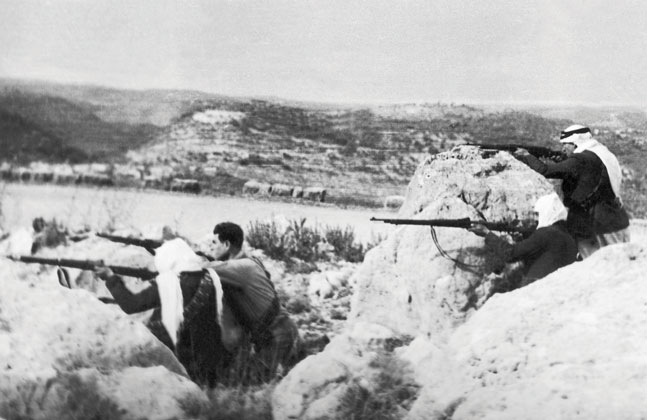
The battle of al-Zira’a was an attack by the First Yarmouk Battalion of the Arab Liberation Army, under Lieutenant Colonel Muhammad Safa, on the night of 16–17 February 1948, against the settlement of “Tirat Zvi,” which Zionist settlers had built south-east of Beisan and which the Arabs called al-Zira’a. The fighters broke through the settlement’s wire and fought in its streets and houses until morning, blocking the reinforcements, and withdrew only when the British army intervened to rescue the settlers. [1][2][3]
It was the Arab Liberation Army’s second battle after Jiddin, and its commander, Fawzi al-Qawuqji, called it “one of the largest and most violent engagements” before the regular Arab armies entered; 37 of the fighters were martyred. [3][1]
Contents
- At a glance
- A settlement in the Beisan valley
- The aims of the attack
- The night of the battle
- British intervention and withdrawal
- Losses and results
- Differences between the accounts
- Timeline
- Frequently asked questions about the Battle of al-Zira’a
At a glance
| Item | Details |
|---|---|
| Date | Night of 16–17 February 1948, from 23:45 until morning |
| Place | The Tirat Zvi settlement (al-Zira’a), south-east of Beisan, in the Beisan valley |
| Arab force | The First Yarmouk Battalion of the Arab Liberation Army |
| Commander | Lieutenant Colonel Muhammad Safa, on Fawzi al-Qawuqji’s orders |
| Enemy | The settlement’s garrison and Zionist reinforcements, then a British force |
| Martyrs | 37, with a greater number wounded according to al-Qawuqji |
| Settlers’ losses | 112 killed according to a British officer cited by al-Qawuqji |
| Outcome | The settlement was stormed and fighting raged inside it, then the force withdrew after British intervention |
A settlement in the Beisan valley
Zionist settlers built the Tirat Zvi settlement south-east of the town of Beisan, in the Beisan valley; the Arabs called it al-Zira’a. It had a power station, water pumps and fish ponds, and the settlers fortified it with barbed wire, watchtowers and trenches. [2]
The aims of the attack
After the First Yarmouk Battalion entered Palestine, al-Qawuqji judged that the Arab formations were tied down in fighting and short of ammunition, and that the situation called for vigorous action to raise Arab morale and “shake” the Zionists’. He ordered Lieutenant Colonel Muhammad Safa to choose a settlement to attack and to inflict “as much damage as possible.” Al-Qawuqji planned the attack while still in Damascus. [1]
WAFA adds that the attack was also meant to cover the crossing of other Arab Liberation Army forces carrying heavy equipment, and that Safa planned feint attacks on two neighbouring settlements to mislead the enemy about the real target. [2]
The night of the battle
Rain and storms delayed the attack through the second week of February, until after a month of continuous rain the Beisan valley was little more than a swamp. When the weather improved on the night of 16–17 February, Safa seized the chance: at 23:45 one company of the First Yarmouk Battalion struck the settlement’s observation posts by surprise, while another company was detailed to block the reinforcements. [1][2]
The garrison fell back into the settlement and fired distress flares; the fighters cut the barbed wire under heavy fire and pursued it inside, and fierce street fighting raged among the houses. The interception company clashed with the Zionist reinforcements, some of whose units, by sheer numbers, managed to reach the settlement, and “a bloody conflict” went on in the streets and houses until morning. [1][3]
At dawn the commandos tried to blow up the watchtower but failed in the rain, which had returned in force. The infantry advanced under artillery cover and destroyed some houses, but the settlers opened the ponds on them, flooding the trenches, and the fighters sank knee-deep in mud, so the advance stalled. The freshly ploughed, rain-soaked ground hampered both the attack and the withdrawal, and at least half the attackers’ weapons jammed. [2][1][3]
British intervention and withdrawal
At dawn, when the battle seemed to be turning the fighters’ way, a British force arrived to rescue the settlers; al-Qawuqji says the British stepped in only when Arab victory was in sight. Lieutenant Colonel Safa then ordered his troops to withdraw, since occupying the settlement “was not an end in itself,” and the Yarmouk Battalion pulled back. [1][2]
Losses and results
Al-Qawuqji puts the fighters’ losses at 37 killed during the night and a greater number wounded. He cites the British Colonel Nelson, who supervised the removal of the bodies to Beisan, as reporting 112 settlers killed, with more wounded. [1]
The battle did not achieve the capture of the settlement, but al-Qawuqji holds that it inflicted heavy losses on it in arms, equipment and men, shook the settlers’ morale and set off a Zionist movement away from the firing line towards the coast, while Palestinian morale rose considerably. At the same time he acknowledges that the defenders “put up a magnificent show.” [1][2]
Arab sources attribute the failure to take the settlement to the rain that flooded the ground and trenches, the ponds opened on the attackers, poor and largely jammed weapons, the strength of the settlement’s defences and the arrival of reinforcements, and finally the British intervention that decided the outcome. [3][2][1]
Differences between the accounts
The Al Jazeera Encyclopedia and al-Qawuqji’s memoirs agree on 37 martyrs, while in WAFA’s “Battles of the Nakba” the figure 37 appears as the number of wounded, with an unclear figure for the dead. The figure of 112 settlers killed appears in WAFA and is attributed by al-Qawuqji to the British Colonel Nelson; no independent source confirms it. WAFA alone mentions the aim of covering the crossing of heavy forces, the feints against two neighbouring settlements and the opening of the ponds on the attackers, while al-Qawuqji stresses the aim of raising morale and the British intervention. [3][1][2]
Timeline
| Date | Event |
|---|---|
| 21–23 January 1948 | The battle of Jiddin, the Arab Liberation Army’s first [3] |
| Second week of February | Rain and storms delay the attack [1] |
| 16 February, 23:45 | A company of the First Yarmouk Battalion attacks the observation posts [1] |
| Night of 16–17 February | The wire breached; street fighting; reinforcements intercepted [1] |
| Dawn, 17 February | Attempt to blow up the watchtower; ponds opened on the attackers [2] |
| Morning, 17 February | A British force rescues the settlers; Safa orders withdrawal [1] |
Frequently asked questions about the Battle of al-Zira’a
When was the Battle of al-Zira’a?
On the night of 16–17 February 1948, from 23:45 until the following morning. [1]
Where was the al-Zira’a settlement?
South-east of Beisan in the Beisan valley; the Zionists call it Tirat Zvi. [2]
Who led the attack?
Lieutenant Colonel Muhammad Safa, commander of the Arab Liberation Army’s First Yarmouk Battalion, on Fawzi al-Qawuqji’s orders. [1][3]
How many were martyred?
37 according to al-Qawuqji and the Al Jazeera Encyclopedia, with a greater number wounded. [1][3]
Why did the fighters withdraw?
After a British force arrived at dawn to rescue the settlers, amid rain, mud and jammed weapons. [1][3]
What were the results?
The settlement was not taken, but al-Qawuqji holds that it inflicted heavy losses on the settlers and raised Palestinian morale. [1]
Read also on Palestinuna
Sources and references
- Fawzi al-Qawuqji, “Memoirs, 1948, Part I,” Journal of Palestine Studies, Institute for Palestine Studies.
- WAFA – Palestinian National Information Centre, “Battles of the Nakba”: “The Battle of al-Zira’a” (in Arabic).
- “The Arab Liberation Army: When the Regimes Failed to Confront the Zionist Gangs in Palestine,” Al Jazeera Encyclopedia, 9 August 2024 (in Arabic).
More from the archive
 Download Our Palestine App
The whole archive in the palm of your hand: depopulated villages, the Nakba, the massacres and Al-Aqsa — free, with no ads to erase the story.
Comments
No comments yet — be the first to write one.
Add your comment
Name and email are optional. Comments appear after review.