The Sea Mosque (Jami' al-Bahr)

The Sea Mosque (Jami' al-Bahr)
The Sea Mosque of Jaffa: The Fishermen's Mosque on the Old Port
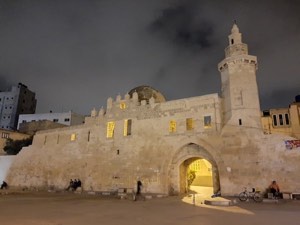
The Sea Mosque (Jami' al-Bahr) stands on the seafront of the Old City of Jaffa, the "Bride of the Sea", overlooking its ancient port. It is one of the city's oldest surviving mosques, dated by Al Jazeera to the 17th century. For centuries it served the fishermen, sailors and people of the port quarter, and it is one of only nine mosques still in use in Jaffa out of the 33 the city had before its occupation in 1948. It was restored and reopened with Turkish support, and in 2014 settlers living in the refugee homes around it went to court to silence its call to prayer. This guide covers its history and architecture and the story of Jaffa around it.
Quick facts
| Arabic name | مسجد البحر |
|---|---|
| Location | Old City of Jaffa, on the seafront by the old port |
| Built | 17th century according to Al Jazeera; heritage sources note an Ottoman-era renovation |
| Congregation | Fishermen, sailors and people of the port quarter |
| Main features | Prayer hall and a slender minaret on the shore |
| Restoration | Supported by the Turkish association Mirasimiz (reopened before 2012) |
| Jaffa's mosques | 33 before the Nakba; 9 still in use, including the Sea Mosque |
| Call-to-prayer case | Lawsuit to silence its adhan, December 2014 |
| Today | An active mosque holding daily prayers |
| City | Jaffa, occupied in May 1948 |
The name
The mosque takes its name from the sea it directly overlooks. Standing beside the port, it was the mosque of Jaffa's fishermen and sailors and the people of the port quarter.
Location
The mosque stands in the port quarter of the Old City of Jaffa, on the street along the seafront, looking straight out over the old port that built the city's prosperity and made it an important centre of domestic and foreign trade. It sits below the hill of old Jaffa, a short distance from the clock tower and the Great (Mahmudiyya) Mosque.
History
- Foundation: Al Jazeera dates the mosque to the 17th century, making it one of Jaffa's oldest surviving mosques, while Palestinian heritage sources note that it was renovated in the Ottoman period.
- Ottoman Jaffa: as Jaffa flourished as Palestine's main port, famous for its oranges, the mosque served the busy harbour and the fishing community.
- 1948: the mosque survived the siege and occupation of Jaffa in May 1948, unlike many of the city's mosques, which were confiscated, closed or demolished.
- Before 2012: it was restored and reopened with support from the Turkish association Mirasimiz ("Our Heritage"), part of efforts by Arab and Islamic organisations to restore Jaffa's surviving mosques.
- 2014: settlers living nearby, in refugee homes, filed a lawsuit to silence its call to prayer.
Architecture
The Sea Mosque is a small stone building in the local Ottoman style, with a prayer hall facing the qibla and a slender minaret that has become a familiar landmark of Jaffa's seafront, visible from the port and the beach. Its position at the water's edge, between the sea on one side and the old stone houses of Jaffa on the other, gives it a character unlike any other mosque in the city.
Jaffa's mosques and the Nakba
Before the Nakba, some 120,000–130,000 Palestinians lived in Jaffa and its surroundings. The city fell to Zionist militias in May 1948 and most of its people were expelled. Only 3,000–4,000 remained, gathered in the Ajami neighbourhood and fenced in with barbed wire. By 2012 their number had reached about 25,000, according to Al Jazeera.
Jaffa had 33 mosques before the Nakba, of which only nine remain in use. The occupation authorities seized holy places under the "Absentee Property" law, some were sold at public auction, and mosques were closed, converted to other uses or demolished. According to the Yafa Lak website, the al-Suksuk Mosque became a plastics factory, the al-Nuzha Mosque was closed until 1985, and the al-Dabbagh Mosque was demolished in 1999. The Mamluk cemetery near the Great Mosque was bulldozed for a housing project and a hotel, and of the 35-dunam Abd al-Nabi cemetery less than two dunams remain. The Sea Mosque is one of the few that kept its function, a rare witness to the city's Arab and Islamic history.
The battle over the call to prayer
In December 2014 a group of Jewish residents who had settled near the Sea Mosque in refugee property filed a suit at the Tel Aviv Central Court against the mosque's imam, seeking an injunction to stop the call to prayer over loudspeakers on grounds of "noise". It was the first case of its kind, brought at a time when a bill to silence the adhan had been frozen. The imam said the lawsuits had "crossed all red lines" and threatened the existence of the remaining mosques, while Jaffa residents described living through "a psychological war". Jaffa's Hassan Bek Mosque has also faced repeated attacks, including one in 2018.
The mosque today (2026)
The Sea Mosque remains an active place of prayer for Jaffa's Muslims, especially on Fridays and in Ramadan. But the battle over the call to prayer has returned in force. On 1 July 2026 the Knesset passed in a preliminary reading, by 50 votes to 36, a "Muezzin Law" banning the adhan over loudspeakers in Jerusalem and Arab towns inside the Green Line without prior permission, allowing police to confiscate sound systems and imposing fines of up to 50,000 shekels. The Palestinian National Council called the bill "legislative terrorism" and a violation of freedom of worship. Around the mosque, Jaffa's Palestinians face urban Judaisation, evictions, and hotel and investment projects on waqf land, and for the people of Jaffa the mosque remains part of holding on to their city's identity.
Frequently asked questions
Where is the Sea Mosque in Jaffa?
On the seafront of Jaffa's Old City, looking directly over the old port, below the hill of old Jaffa.
How old is the Sea Mosque?
Al Jazeera dates it to the 17th century, making it one of Jaffa's oldest surviving mosques.
Why is it called the Sea Mosque?
Because it stands at the water's edge overlooking the Mediterranean, and was the mosque of Jaffa's fishermen and sailors.
How many mosques did Jaffa have before 1948?
33 mosques, of which only nine remain in use, the Sea Mosque among them.
Is the Sea Mosque still used for prayer?
Yes. Daily and Friday prayers are held there, even though settlers nearby tried in 2014 to silence its call to prayer through the courts.
Conclusion
For centuries the Sea Mosque has watched over Jaffa's port, through the age of oranges and sailing ships, the Nakba of 1948, and the decades of confiscation and demolition that claimed most of the city's mosques. Its minaret at the water's edge and its call to prayer remain a daily reminder that Jaffa, the Bride of the Sea, is a Palestinian city.
Photo gallery


More from the archive

 Download Our Palestine App
The whole archive in the palm of your hand: depopulated villages, the Nakba, the massacres and Al-Aqsa — free, with no ads to erase the story.
Comments
No comments yet — be the first to write one.
Add your comment
Name and email are optional. Comments appear after review.