Church of the Holy Sepulchre
Church of the Holy Sepulchre
Church of the Holy Sepulchre, Jerusalem: History, Holy Sites & the 2026 Closure
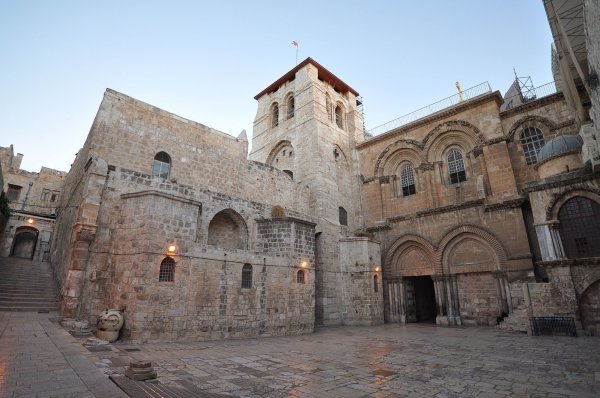
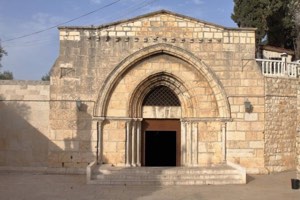
The Church of the Holy Sepulchre, known in Arabic as the Church of the Resurrection (كنيسة القيامة), stands in the Christian Quarter of Jerusalem's Old City over the sites where Christian tradition places the crucifixion, burial and resurrection of Jesus. Emperor Constantine had it built, and it was consecrated in 335. It has since been destroyed, rebuilt and restored many times, and today it is shared by several churches under the centuries-old "Status Quo". Since Saladin's time its keys have been held by Muslim Jerusalem families. In 2026 it was closed for about 40 days during the war on Iran, and worshippers faced heavy restrictions at Easter. This guide covers its history, holy places, custodians and its situation under occupation.
Quick facts
| Arabic name | كنيسة القيامة |
|---|---|
| Location | Christian Quarter, Old City of Jerusalem |
| Founded | By Emperor Constantine, c. 326; consecrated 13 September 335 |
| Destroyed | Damaged by the Persians in 614; destroyed on al-Hakim's orders in 1009 |
| Rebuilt | Byzantine rebuild completed 1048; Crusader church consecrated 1149; rotunda rebuilt 1810 |
| Holy places | Calvary (Golgotha), Stone of Anointing, the Tomb (Edicule) |
| Main churches | Greek Orthodox, Roman Catholic (Franciscans), Armenian |
| Minor rights | Coptic, Syriac and Ethiopian Orthodox |
| Key holders | Muslim families: Joudeh (keys) and Nusseibeh (door-keepers) |
| UNESCO | Part of "Old City of Jerusalem and its Walls" (1981), in danger since 1982 |
The name
Western churches call it the Church of the Holy Sepulchre, after the tomb of Jesus at its heart. Eastern churches and Arabic speakers call it the Church of the Resurrection (كنيسة القيامة, Kanisat al-Qiyama, from the Greek Anastasis), after the resurrection that Christians believe took place there.
Location
The church stands in the Christian Quarter of the Old City of Jerusalem, a few hundred metres west of al-Aqsa Mosque. The Via Dolorosa ends at the church. Facing its courtyard is the Mosque of Omar, built in 1193 by Saladin's son al-Afdal to mark the spot where, according to tradition, Caliph Omar ibn al-Khattab prayed outside the church.
History through the ages
- Roman period: the site lay just outside the city walls at the time of Jesus. Emperor Hadrian later built a pagan temple over it.
- Constantine (4th century): around 326 Constantine ordered the temple demolished and a church built. According to tradition his mother, Empress Helena, found the True Cross there. The church was consecrated on 13 September 335.
- 614: the Persians took Jerusalem, burned the church and carried off the relic of the Cross. Patriarch Modestus restored it soon afterwards.
- 638 – Omar: when Jerusalem surrendered to Caliph Omar ibn al-Khattab, he guaranteed its Christians their lives and churches in the Covenant of Omar. When the patriarch invited him to pray inside, he prayed outside the church so that later Muslims would not claim it as a mosque.
- 1009: the Fatimid caliph al-Hakim bi-Amr Allah ordered the church destroyed, and the tomb was almost completely demolished.
- 1048: after an agreement between the Byzantines and the Fatimids, the rotunda was rebuilt under Emperor Constantine IX Monomachos.
- Crusaders (1099–1187): the Crusaders united the holy places under one roof in a Romanesque church consecrated on 15 July 1149, which is essentially the building seen today.
- Saladin (1187): after liberating Jerusalem, Saladin kept the church open for Christian worship and entrusted its keys to a Muslim family.
- Ottoman period: the Franciscans restored the tomb in 1555. After a fire in 1808 the rotunda's dome collapsed and was rebuilt in 1810. Ottoman decrees of 1757 and 1852 fixed the "Status Quo" governing the churches' rights.
- 20th century: the church was damaged by the 1927 earthquake. In 1947 the British propped up the Edicule with iron girders, which stayed until 2016. From 1948 to 1967 the Old City was under Jordanian administration.
- Restorations: the Edicule was restored between May 2016 and March 2017, and when the marble cladding was removed the original limestone burial bed was found intact. Restoration of the church floor began in 2022.
Architecture and holy places
- Stone of Anointing: just inside the entrance; tradition holds that Jesus' body was prepared for burial here. The present stone dates from the 1810 reconstruction.
- Calvary (Golgotha): up a steep staircase to the right of the entrance, with Greek Orthodox and Catholic chapels over the rock of the crucifixion.
- The Rotunda and the Edicule: under the great western dome stands the Edicule, the small shrine over the tomb of Jesus, with the Chapel of the Angel in front of the burial chamber.
- The Katholikon: the Crusader-era main church, today Greek Orthodox, under a dome 19.8 metres across. The "omphalos" stone in its floor marks what medieval tradition called the centre of the world.
- Chapel of St Helena: down a stairway, called by the Armenians the Chapel of St Gregory the Illuminator, with the grotto where tradition says the Cross was found below it.
- Other chapels: including the Coptic chapel behind the Edicule, the Syriac chapel with an ancient rock-cut tomb, and the Ethiopian monastery on the roof (Deir al-Sultan).
The churches and the Status Quo
The church is shared by three main churches, the Greek Orthodox, the Roman Catholic (represented by the Franciscan Custody of the Holy Land) and the Armenian Apostolic, while the Coptic, Syriac and Ethiopian Orthodox churches hold minor rights. Under the Status Quo set by Ottoman decrees in 1757 and 1852, every space, hour of worship and even repair is fixed, and any change requires the agreement of all. The best-known symbol of this arrangement is the "Immovable Ladder", a wooden ladder resting on a ledge above the entrance since at least 1757, which no one moves without consensus.
The Muslim keepers of the keys
Since Saladin's time the keys of the church have been entrusted to Muslim Jerusalem families. According to their tradition, Saladin gave the key to the Joudeh family in 1187, while the Nusseibeh family, which traces its role back to Omar, opens and closes the great door. Every morning and evening the key is brought from the Joudeh family and the door is opened or closed by a member of the Nusseibeh family, a daily ritual that has become a symbol of Muslim–Christian coexistence in Jerusalem.
Holy Saturday and the Holy Fire
On Holy Saturday of the Orthodox Easter, known in Arabic as سبت النور (the Saturday of Light), the Greek Orthodox patriarch enters the tomb and emerges with a flame that the faithful believe is lit miraculously. The fire is passed from candle to candle through the crowd and flown to Orthodox communities abroad. Palestinian scout troops with drums and bagpipes lead the processions through the Old City.
Under occupation since 1967
Israeli forces occupied the Old City in June 1967, and Israel later annexed East Jerusalem, a step declared null and void by UN Security Council Resolution 478. Since then:
- Every Easter, Israeli police limit the number of worshippers at the Holy Fire, close the roads leading to the church and set up checkpoints in the Christian Quarter, citing safety. Church leaders say these measures restrict freedom of worship.
- Palestinian Christians from the West Bank and Gaza need permits to reach the church, and since October 2023 permits for West Bank Christians have been refused.
- On 25 February 2018 the heads of the churches closed the church for three days in protest at municipal tax demands and a draft law targeting church land. It reopened after the measures were suspended.
The church in 2026
- The 40-day closure: on 28 February 2026, as the US–Israeli war on Iran began, Israeli authorities closed the church, citing a lack of shelters around the holy sites. It stayed closed for about 40 days, the same period during which al-Aqsa Mosque was closed.
- Palm Sunday (29 March 2026): Israeli police stopped the Latin Patriarch of Jerusalem and a group of priests from entering the church to celebrate Palm Sunday, and they prayed at the Latin Patriarchate instead. After protests, the churches reached an agreement to allow clergy to hold the Holy Week liturgies, broadcast live without congregations.
- Holy Saturday (11 April 2026): Israeli forces turned the Old City into what Al Jazeera described as a military barracks, with iron barriers and signs reading "entry for bracelet holders only". For the first time, Jerusalem's Christians received bracelets, but only one per family. The Greek Orthodox patriarch led the ceremony with clergy and a limited number of worshippers.
- Gaza: the genocide war on Gaza has also struck the city's small Christian community, whose churches, including the Church of Saint Porphyrius, have sheltered displaced families and come under bombardment.
Legal protection and UNESCO
The church is part of the "Old City of Jerusalem and its Walls", inscribed on the UNESCO World Heritage List in 1981 at Jordan's request and on the List of World Heritage in Danger since 1982. As a holy site in occupied territory, it is protected by the Fourth Geneva Convention and the 1954 Hague Convention for the Protection of Cultural Property, which require the occupying power to respect freedom of worship and cultural property. UN Security Council Resolution 478 rejects any change to the status of Jerusalem.
Frequently asked questions
Where is the Church of the Holy Sepulchre?
In the Christian Quarter of the Old City of Jerusalem, at the end of the Via Dolorosa, a few hundred metres west of al-Aqsa Mosque.
Who built the Church of the Holy Sepulchre?
Emperor Constantine had the first church built around 326, and it was consecrated in 335. The present building is largely the Crusader church consecrated in 1149, with later restorations.
Why do Muslim families hold the keys?
According to tradition, Saladin entrusted the key to the Joudeh family in 1187, and the Nusseibeh family opens and closes the door, a role that helped keep neutrality between the churches sharing the building.
Which churches share the Church of the Holy Sepulchre?
The Greek Orthodox, Roman Catholic and Armenian churches share it, with minor rights for the Coptic, Syriac and Ethiopian Orthodox, under the Ottoman-era Status Quo.
Was the Church of the Holy Sepulchre closed in 2026?
Yes. Israeli authorities closed it on 28 February 2026, when the war on Iran began, for about 40 days, and imposed heavy restrictions on Palm Sunday and Holy Saturday.
Conclusion
For seventeen centuries the Church of the Holy Sepulchre has drawn pilgrims from every Christian tradition to the heart of Jerusalem, survived destruction and fire, and kept a daily ritual in which Muslim hands open its door. Under occupation, closures and checkpoints now stand between Palestinian Christians and their holiest church, yet it remains, with al-Aqsa, at the heart of the city's identity.
More from the archive
 Download Our Palestine App
The whole archive in the palm of your hand: depopulated villages, the Nakba, the massacres and Al-Aqsa — free, with no ads to erase the story.
Comments
No comments yet — be the first to write one.
Add your comment
Name and email are optional. Comments appear after review.