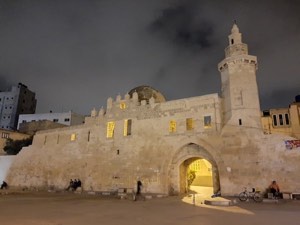
Al-Qaysariyya Market (Gold Market) in Gaza

Al-Qaysariyya Market (Gold Market) in Gaza: A Mamluk Souq by the Omari Mosque Under the Genocide War
Al-Qaysariyya Market, known as the Gold Market (Souq al-Dhahab), is a historic covered market in the old city of Gaza, adjoining the southern side of the Great Omari Mosque in the al-Daraj neighbourhood. It was built in the 14th century CE in the Mamluk period as a complement to the mosque's southern portico, and runs about 60 metres beneath a pointed vault lined with 44 small shops, making it one of the last arcaded longitudinal markets in the region. Just months after its restoration was completed in August 2023, the market was hit at least three times during Israel's genocide war on Gaza, destroying its eastern gate, its central dome and several shops, yet it still works as the main gold-trading centre of the Strip. This guide covers the market's history, architecture and what has befallen it.
Quick facts
| Arabic name | سوق القيسارية (سوق الذهب) – غزة |
|---|---|
| Other names | Gold Market, Souq al-Dhahab |
| Location | South of the Great Omari Mosque, al-Daraj, old city |
| Built | 14th century CE, Mamluk period |
| Dimensions | About 60 m long and 9 m wide |
| Shops | 44 shops, each about 2 × 2 m |
| Roof | Pointed vault with an octagonal dome at the centre |
| Last restoration | 2020–2023, completed in August 2023 |
| War | At least 3 strikes, including a direct strike on 4 July 2024 |
| Today | Partly working; emergency stabilisation of the eastern gate |
The name
The name "al-Qaysariyya" comes from qaysariyyat, commercial structures known since Roman times and still built in the Islamic period, resembling a small khan with workshops and shops. The name "Gold Market" comes from the gold trade and goldsmithing that became its main activity.
Location
The market adjoins the southern side of the Great Omari Mosque in the al-Daraj neighbourhood, at the heart of the old city of Gaza. Its eastern gate was the main entrance to the old city, and its central hall links it to the Omari Mosque and to Souq Khan al-Zeit.
History
- 14th century CE: the market was built in the Mamluk period as a complement to the southern portico of the Great Omari Mosque, renewed under Sultan al-Nasir Muhammad ibn Qalawun.
- Successive uses: it first served as a stable for soldiers' horses, then as a centre for trading and tanning hides and making shoes, and later as a market for gold and money-changing.
- Early 20th century: its western part was demolished before and during the First World War, and the doors of its eastern gate were removed in the middle of the century.
- Until the 1960s: it was still used for selling leather shoes and sandals alongside gold.
- After the Nakba of 1948: the number of gold shops multiplied with the influx of refugees expelled from their villages to Gaza.
- 2020–2023: the market was restored in a project involving Gaza Municipality, the University College of Applied Sciences, the Riwaq centre and the GIRIH foundation, completed in August 2023.
Architecture
The market runs about 60 metres long and about 9 metres wide, with a narrow central passage about 3.2 metres wide lined on both sides by 44 small vaulted shops, each about two metres by two. The passage is roofed by a pointed vault with openings for natural light and ventilation, and at its centre stands an octagonal dome on an axis linking it to the southern entrance of the Omari Mosque. Its eastern gate was built in the Mamluk style with rounded and pointed arches decorated in marble of sugar-white and terracotta tones, and its central hall bears Islamic inscriptions carved in marble. Its walls are of sandstone and limestone.
The market in Gaza's life
Goldsmiths and spice sellers traditionally worked in the market, and over time it became the main gold-trading centre of the Gaza Strip, supporting about 120 families. The market reflects Gaza's shared fabric: about 20% of its shop owners are Christians. With its narrow lanes and constant bustle, it has long been a window on the popular life of old Gaza.
The market in the genocide war
Just two months after its restoration was completed, Israel's genocide war on the Gaza Strip broke out in October 2023, and the market was hit at least three times: two major strikes in the first three months of the war and a direct strike on 4 July 2024. According to the August 2024 report of ICOMOS Palestine:
- The Mamluk eastern gate was completely destroyed.
- The main cross-vault and the central dome were destroyed.
- Between 6 and 8 shops were demolished, many others were badly damaged, and the northern walls were seriously affected.
- The remaining structure was left in very poor condition, in need of urgent intervention.
In June 2024 UNESCO confirmed damage to the market among 50 cultural sites in Gaza. This came amid destruction across the whole old city: the main prayer hall of the neighbouring Great Omari Mosque was completely destroyed, Hammam al-Samra, the last Ottoman bathhouse in the Strip, was destroyed on 30 December 2023, and the occupation destroyed 206 of the 325 registered archaeological and heritage sites in the Strip.
The market today (2026)
Despite the destruction, al-Qaysariyya still works as the main gold-trading centre of Gaza. Craftsmen supervised by the Riwaq centre are carrying out emergency interventions to slow the collapse of the eastern gate: clearing rubble, sorting and storing the old stones, shoring up and stabilising the surviving elements, and documenting architectural components so they can be reused when conditions allow. With its Mamluk vault and small shops, the market remains a witness to a Gaza that rebuilds itself stone by stone after every assault.
Frequently asked questions
Where is al-Qaysariyya Market?
Adjoining the southern side of the Great Omari Mosque in the al-Daraj neighbourhood, in the old city of Gaza.
When was al-Qaysariyya Market built?
In the 14th century CE, in the Mamluk period, as a complement to the southern portico of the Omari Mosque.
Why is it called the Gold Market?
Because the gold trade and goldsmithing became its main activity; today it is the leading gold-trading centre in the Gaza Strip.
What happened to the market in the genocide war?
It was hit at least three times, destroying its eastern gate, its central dome and between 6 and 8 shops, and badly damaging many others.
Is the market still working?
Yes. It still works as a gold-trading centre, while emergency stabilisation of its eastern gate is under way under the supervision of the Riwaq centre.
Conclusion
For seven centuries al-Qaysariyya has stood in the shadow of the Great Omari Mosque, from a stable for horses to a leather market and then a gold market. It was restored to its former splendour, and then the genocide war tore down its gate and dome just months later. But the goldsmiths have returned to their shops and the craftsmen to its stones, so the market remains a witness to a Gaza that does not die.
More from the archive


 Download Our Palestine App
The whole archive in the palm of your hand: depopulated villages, the Nakba, the massacres and Al-Aqsa — free, with no ads to erase the story.
Comments
No comments yet — be the first to write one.
Add your comment
Name and email are optional. Comments appear after review.