
Shatila Refugee Camp
Shatila Refugee Camp
Shatila Refugee Camp in Beirut: History, the 1982 Massacre, the War of the Camps, Villages of Origin and Life Today
Shatila Camp lies in the southern suburbs of Beirut, beside the Sabra neighbourhood and the Sports City. It was founded in by refugees from the villages of the Galilee, above all Majd al-Kroum, joined by families from al-Birwa, Amqa, Saffuriyya, al-Kabri, Balad al-Shaykh, Safsaf and Jaffa. Its name is known around the world because of the Sabra and Shatila massacre of 16–18 September 1982, in which thousands of Palestinian and Lebanese civilians were killed. Besieged and almost entirely destroyed again in the War of the Camps (1985–1988), Shatila was rebuilt upward into one of the most crowded places in Lebanon, home today to about 14,000 people, more than half of them Syrian refugees. This guide covers its history, origins, population, living conditions and its situation in 2025–2026.
Quick Facts About Shatila Camp
| Arabic name | مخيم شاتيلا |
|---|---|
| Country | Lebanon |
| Location | Southern suburbs of Beirut (Ghobeiri municipality), beside Sabra and the Sports City |
| Year established | ; recognised by the Red Cross in 1950 and taken over by UNRWA in 1951 |
| Area | 39,567 m² originally; about 70,000 m² with its extensions (UNRWA, 2018) |
| Registered refugees | About 9,842 (UNRWA) |
| Residents | About 14,010 (2017 survey), 57.6% of them Syrian |
| Origin of residents | Mainly villages of the Galilee in the Acre district, especially Majd al-Kroum |
| Known for | The Sabra and Shatila massacre (16–18 September 1982) |
| Rank | The most densely populated of Lebanon's 12 official Palestinian camps |
The Nakba: Why Shatila Camp Exists
Shatila was born from the Nakba (Arabic for "catastrophe"): the mass expulsion of Palestinians during the occupation of Palestine in . Roughly 750,000 Palestinians were driven from their homes, and more than 500 villages and towns were emptied and most of them destroyed.
In the Galilee, the villages of the Acre district fell in the summer and autumn of 1948. Their people crossed into Lebanon, and some made their way to Beirut, where they rented rooms until their savings ran out. In 1949, a refugee from Majd al-Kroum who had arrived with about twenty relatives pitched a tent in a pine grove south of the city and called his fellow villagers to join him. That cluster of tents became Shatila.
The Right of Return
The right of return is the central demand of Shatila's refugees. It rests on several foundations in international law:
- UN General Assembly Resolution 194 (), paragraph 11, resolved that refugees wishing to return to their homes and live at peace with their neighbours should be permitted to do so at the earliest practicable date, and that compensation should be paid to those choosing not to return and for loss of or damage to property.
- The Universal Declaration of Human Rights (Article 13) affirms everyone's right to leave any country, including their own, and to return to it.
- UN General Assembly Resolution 3236 () reaffirmed the "inalienable right" of Palestinians to return to their homes and property.
Because Lebanon rejects the permanent settlement (tawteen) of Palestinian refugees and denies them basic rights, return remains for Shatila's people the only solution they recognise, and families still keep the keys of their homes in Haifa, Tiberias and the villages of the Galilee.
History of the Camp (1949–1982)
From tents to tin roofs (1949–1960s)
The International Committee of the Red Cross recognised the settlement as a camp in 1950, and UNRWA took over in 1951. In the early 1950s it held only about a hundred refugees, rising to more than 2,000 later in the decade. Lebanese authorities long banned refugees from strengthening their tents, so they improvised with wood, stone and sheets of tin; only from 1955 were they allowed to reinforce their shelters, and in the early 1960s permanent homes with concrete-block walls and corrugated-iron roofs appeared. In the mid-1950s, UNRWA opened the camp's first school, al-Jalil (Galilee).
The years of the revolution (1969–1982)
After the 1969 Cairo Agreement, the PLO took over the camp's management and Shatila became one of the centres of the Palestinian revolution in Beirut. The camp expanded beyond its original boundaries, and with its surroundings it grew to about 20,000 people, rising towards 50,000. The Palestine Red Crescent Society opened its first clinic in Lebanon in Shatila in 1968, and later built Gaza Hospital (1973) and Akka Hospital (1976) on the camp's edges.
The Sabra and Shatila Massacre (1982)
In the summer of 1982, Israel invaded Lebanon and besieged Beirut. After the PLO fighters left the city under an internationally guaranteed agreement, the camps were left without protection. On 15 September, Israeli forces entered West Beirut and surrounded Sabra and Shatila.
From the evening of until the morning of , militiamen of the Lebanese Forces entered the camp and the Sabra neighbourhood and killed civilians in their homes and alleys: men, women, children and the elderly, Palestinians and Lebanese alike. Israeli forces controlled the perimeter, allowed the militia in, and fired flares over the area through the night.
- Victims: there is no single agreed toll. A field documentation study published by the Institute for Palestine Studies recorded 1,390 victims by name, killed and missing; other estimates range from about 3,000 to 3,500.
- UN response: on 19 September 1982, the Security Council unanimously condemned the massacre in Resolution 521, and on 16 December 1982 the General Assembly, in Resolution 37/123 D, described it as an act of genocide.
- The Kahan Commission: an Israeli inquiry, reporting on 7 February 1983, found the Lebanese Forces directly responsible and Israel indirectly responsible, and held the Israeli defence minister personally responsible for ignoring the danger of a massacre. He left the defence ministry, but no one was ever brought to trial.
The victims were buried in a mass grave at the edge of the camp, now the Martyrs of Sabra and Shatila cemetery, where the anniversary is marked every September. For a full account of the massacre, see our article: The Sabra and Shatila Massacre.
The War of the Camps (1985–1988)
Less than three years after the massacre, Shatila was besieged again, this time by the Amal movement, backed by the Syrian regime, in what became known as the War of the Camps:
- 19 May 1985: heavy fighting broke out around Sabra, Shatila and Burj al-Barajneh. Sabra fell on 30 May, and in Shatila the defenders held only the area around the mosque. A ceasefire was signed in Damascus on 17 June, but clashes resumed.
- 19 May 1986: exactly a year later, the siege was tightened with artillery and tanks.
- 26 November 1986: the camp's official electricity was cut off; it would not return until 1995.
- Early 1987: the camps went weeks without fresh food or medicine. On 17 February 1987, Amal's leadership ordered the sieges lifted, and Syrian troops deployed around the camps.
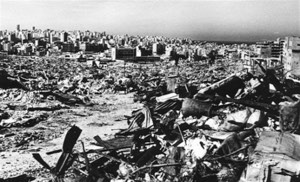
By the end of the war, Shatila had been besieged for most of three years and was almost entirely destroyed; its schools, al-Jalil and Ariha, were in ruins and much of its population was displaced. An official Lebanese report put the toll of the Amal–Palestinian fighting at 3,781 dead and 6,787 wounded across the camps. In 1988, fighting between Palestinian factions left the camp under the control of pro-Syrian groups.
Rebuilding and the Years After (1990–2023)
After the civil war ended, residents rebuilt the camp by the mid-1990s, but with no room to expand they built upward, with buildings of six storeys or more on foundations meant for one. The Ariha school was rebuilt in 1994, and electricity returned in 1995. From 2011, tens of thousands of people fleeing the war in Syria, Syrians and Palestinians from Syria, crowded into Shatila because it was one of the cheapest places to live in Beirut. Since 2005, the camp has had two rival popular committees, and residents have long complained of factional rivalry, armed incidents and a growing drug trade.
The Current Situation (2024–2026)
Weapons, drugs and security
- May 2025: clashes between rival drug gangs in the camp killed two people and wounded two.
- 21 August – 13 September 2025: following the Lebanese government's decision to place all weapons under state control, Palestinian factions began handing their weapons to the Lebanese army, starting in Burj al-Barajneh and extending to the camps of Beirut and the south.
- 5 September 2025: a gunfight between drug traffickers, using machine guns and rocket-propelled grenades, wounded at least three people and set a home on fire.
- September 2025: in an operation described as unprecedented since the 1969 Cairo Agreement, the Lebanese army entered Shatila and arrested 55 people of Lebanese, Syrian and Palestinian nationality, seizing large quantities of drugs, weapons and ammunition.
Crumbling homes
In January 2026, a fifth-floor staircase in a residential building collapsed after salty water seeped into it, injuring a young man; civil defence teams sealed the building and families were forced out, and residents had to pay for the repairs themselves. Residents say many homes, built of weak materials and eaten by humidity and saline water, are no longer safe, and that one collapse in the narrow alleys could bring down neighbouring buildings.
A refuge during the 2026 war
During the war on Lebanon in spring 2026, Palestinian families displaced from the camps of the south sought shelter in Shatila, adding to its overcrowding. On the 78th anniversary of the Nakba in May 2026, refugees in Shatila, displaced once again, spoke of their families' homes in Haifa and Tiberias and of their insistence on returning. Meanwhile, UNRWA's financial crisis has reduced services that the camp's residents depend on.
Origin of the Name
The land on which the camp was built belonged to a Lebanese landowner from Choueifat who had emigrated to Brazil. His agent, Saad al-Din Pasha Shatila, allowed the refugees to settle on it, and UNRWA named the camp after him. Some early residents had proposed calling it "the Mujahideen camp".
Location and Geography
Shatila lies in Beirut's southern suburbs, within the municipality of Ghobeiri in the Baabda district of Mount Lebanon. It borders the Sabra neighbourhood and market to the north, the Sports City to the west and Sabri Hamadeh Street and the pine grove to the south. Gaza Hospital stands on its northern edge and Akka Hospital on its southern edge. The camp lies in a low-lying area, so rainwater and sewage collect in its alleys in winter. Burj al-Barajneh and Mar Elias camps are nearby.
Area and Land
The original camp covered 39,567 m² of hilly land with fig and prickly-pear trees. Its boundaries did not change until 1969, when it expanded to include the western quarter and nearby areas. In 2018, UNRWA counted 452 buildings over an estimated 70,000 m². Part of the land is leased to UNRWA for 99 years, and another part is owned by the PLO.
Villages of Origin
Most of Shatila's first residents came from Majd al-Kroum in the Acre district, many of whose people were driven out in 1948. Others came from about 25 villages of the Galilee and from Jaffa:
- Acre district: Majd al-Kroum, Al-Birwa, Amqa, Al-Kabri, Dayr al-Qasi, Kuwaykat, Al-Manshiyya and Sha'b
- Haifa district: Balad al-Shaykh and Yajur, and families from the city of Haifa
- Nazareth district: Saffuriyya
- Safed district: Safsaf
- Cities: about 25 families from Jaffa, and families from Tiberias
The names of the camp's sports clubs, such as Majd al-Kroum, al-Karmel, Jabalia and Ariha, and of its UNRWA schools, such as al-Jalil, Ramallah and al-Hamma, keep the map of Palestine alive.
Population and Demographics
Population of Shatila Camp over time
- Early 1950sAbout 100Palestine Studies
- Late 1950sMore than 2,000UNRWA
- 1969–1982About 20,000, rising towards 50,000 (camp and surroundings)Palestine Studies
- 200312,116Encyclopedia of Palestinian Camps
- 2016About 8,500 registered refugeesUNRWA
- 2017About 14,010 residents: 57.6% Syrian, 29.7% Palestinians from Lebanon, 8.2% Lebanese, 3.8% Palestinians from SyriaSurvey (Palestine Studies)
- LatestAbout 9,842 registered refugeesUNRWA
Note: Registered refugees are not the same as residents. Since 2011, Syrians have become the majority of Shatila's residents, while many registered Palestinian refugees from Shatila have emigrated to Europe, especially Denmark, Sweden and Germany.
Housing, Water and Electricity
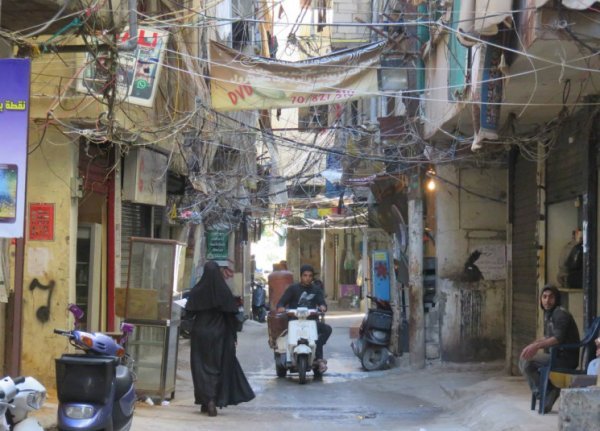
Shatila is a dense maze of buildings up to six storeys high, built without safety standards and separated by alleys so narrow that sunlight rarely reaches the ground. Hundreds of homes are considered at risk of collapse.
- Water: the camp's wells were mostly lost after 1986, and the water that reaches homes is salty and unfit to drink. A Swiss-funded desalination project supplies part of the camp's needs, and residents buy drinking water.
- Electricity: supply is unstable and depends on private generators. Tangled wires hang over the alleys, posing a constant danger.
- Sewage: the camp lies in a low area, and rain and sewage flood alleys and homes. A new network was completed in 2010, but a European-funded drainage project failed because of poor implementation.
There are no green spaces or playgrounds, and rubbish and rodents are common.
Legal Status of Palestinians in Lebanon
Shatila's Palestinians live under the same restrictions as all Palestinian refugees in Lebanon: they have no citizenship, are barred from practising many professions, especially syndicated ones such as medicine, law and engineering, and since 2001 have been barred from owning or registering property. These restrictions confine most residents to casual work and make UNRWA's services essential.
Economic Situation
Most men in Shatila work as day labourers, shopkeepers or street vendors, and many women work as cleaners; some residents work for UNRWA or NGOs. Since 2011, Palestinian workers have faced competition from Syrian refugees for the same jobs. Lebanon's economic collapse since 2019, the war of 2024 and the war of 2026 have deepened poverty, and many families depend on aid.
Health Situation
UNRWA runs one health centre in the camp, which sees more than 100 patients a day and suffers from shortages of medicines and staff. The Palestine Red Crescent Society, whose first clinic in Lebanon opened in Shatila, runs services in and around the camp; Gaza Hospital stopped working after the massacre and now shelters displaced families, while Akka Hospital offers limited services. Serious cases are referred to contracted hospitals in Beirut. Respiratory diseases, asthma, heart disease, diabetes, hypertension and thalassaemia are common, linked to humidity, overcrowding and poor nutrition, as are psychological trauma and disabilities.
Education
UNRWA runs two schools in the camp, named after Palestinian places, including Ramallah elementary school, which now teaches both boys and girls. Al-Jalil secondary school, opened in 1997, lies about a kilometre away. Pass rates in the intermediate (brevet) exam have been low, and dropout estimates range from 4% to 18%. Kindergartens are run by associations such as al-Najdeh, Beit Atfal al-Soumoud and the Children and Youth Centre.
Frequently Asked Questions About Shatila Camp
Where is Shatila refugee camp?
In the southern suburbs of Beirut, Lebanon, within Ghobeiri municipality, beside the Sabra neighbourhood and the Sports City.
What happened in the Sabra and Shatila massacre?
From 16 to 18 September 1982, after Israeli forces surrounded the area, Lebanese Forces militiamen killed civilians in Shatila camp and the Sabra neighbourhood. Estimates range from 1,390 documented victims to about 3,500 killed.
Why is it called Shatila?
After Saad al-Din Pasha Shatila, the agent of the Lebanese landowner who allowed the refugees to settle on the land in 1949.
What was the War of the Camps?
A series of sieges of Beirut's Palestinian camps by the Amal movement, backed by Syria, from 1985 to 1988. Shatila was besieged for most of three years and almost entirely destroyed.
How many people live in Shatila today?
UNRWA counts about 9,842 registered refugees, while a 2017 survey found about 14,010 residents, more than half of them Syrian refugees.
Where do Shatila's refugees come from?
Mainly from Majd al-Kroum and other villages of the Acre district, such as al-Birwa, Amqa, al-Kabri and Dayr al-Qasi, as well as Saffuriyya, Balad al-Shaykh, Safsaf and Jaffa.
Conclusion
Shatila began as a few tents in a pine grove for the people of Majd al-Kroum. It became a centre of the Palestinian revolution, a name forever tied to the massacre of September 1982, and a camp besieged and flattened in the War of the Camps. Rebuilt upward on the same small plot, it now shelters Palestinians, Syrians and Lebanese in some of the hardest conditions in Lebanon. Through all of it, its people have kept the memory of their dead and of their villages, and the demand that justice and return will one day come.
More from the archive


 Download Our Palestine App
The whole archive in the palm of your hand: depopulated villages, the Nakba, the massacres and Al-Aqsa — free, with no ads to erase the story.
Download Our Palestine App
The whole archive in the palm of your hand: depopulated villages, the Nakba, the massacres and Al-Aqsa — free, with no ads to erase the story.



Comments
No comments yet — be the first to write one.
Add your comment
Name and email are optional. Comments appear after review.
Social Life, Memory and Institutions
Despite everything, Shatila has a lively civil society. Beit Atfal al-Soumoud, founded to care for children orphaned by the Tel al-Zaatar massacre, al-Najdeh and the Children and Youth Centre run kindergartens, vocational training and psychosocial programmes; since 2011, organisations such as Basmeh & Zeitooneh have also served Syrian refugees. A small Museum of Memories, opened in 2005, preserves heritage objects that families brought from Palestine. Every September, the camp gathers at the Martyrs of Sabra and Shatila cemetery to mark the anniversary of the massacre, joined by visitors from around the world.