
Jabal al-Hussein Refugee
Jabal al-Hussein Refugee Camp in Amman: History, Origins, Population and Life Today
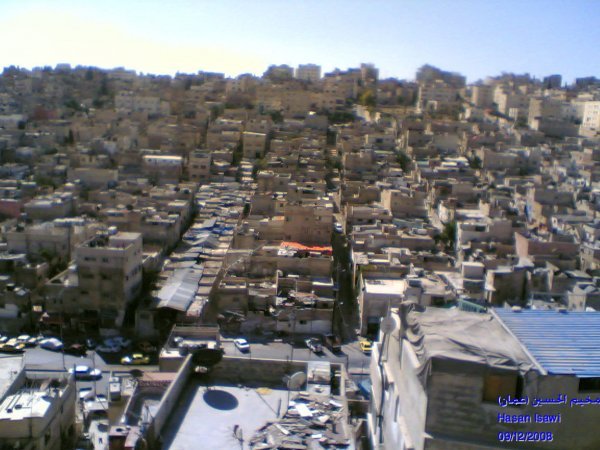
Jabal al-Hussein Camp, also known simply as al-Hussein Camp, lies in the heart of Amman, on the eastern slope of Jabal al-Hussein north of the city centre. Established in as the first refugee camp in Amman, it was one of four camps set up in Jordan for refugees of the 1948 Nakba, most of them from Ramla, Lydda and Jaffa. Built for 8,000 people on about 0.42 km², it is now home to around 30,000 registered refugees and suffers from severe overcrowding. This guide covers the camp's history, origins, population, services and its situation today.
Quick Facts About Jabal al-Hussein Camp
| Arabic name | مخيم جبل الحسين / مخيم الحسين |
|---|---|
| Country | Jordan |
| Location | North-west of central Amman, about 3 km from the city centre, Capital Governorate |
| Year established | |
| Area | About 0.42 km² (445 dunums) |
| Population at founding | About 8,000 |
| Population today | About 29,000–33,000 depending on the source |
| Origin of residents | Mainly Ramla, Lydda and Jaffa |
| Status | Official UNRWA camp; the first refugee camp in Amman |
The Nakba: Why Jabal al-Hussein Camp Exists
Jabal al-Hussein Camp was born from the Nakba (Arabic for "catastrophe"): the mass expulsion of Palestinians during the occupation of Palestine in , when roughly 750,000 Palestinians were driven from their homes. Jaffa and its villages fell in the spring of 1948, and in July the people of Lydda and Ramla were expelled in their tens of thousands, many of them walking east towards the hills.
Many of those who reached Amman first sheltered in caves in areas such as Joufeh and Zuhour. In , a camp was set up for them on the slope of Jabal al-Hussein, one of four camps established in Jordan for the refugees of 1948 and the first in the capital.
The Right of Return
In the mid-1960s some residents called their camp al-Awda, "the return", and slogans calling for the liberation of Palestine still appear on its walls. Residents continue to demand their right of return under Resolution 194. That right rests on several foundations in international law:
- UN General Assembly Resolution 194 (), paragraph 11, resolved that refugees wishing to return to their homes and live at peace with their neighbours should be permitted to do so at the earliest practicable date, and that compensation should be paid to those choosing not to return and for loss of or damage to property.
- The Universal Declaration of Human Rights (Article 13) affirms everyone's right to leave any country, including their own, and to return to it.
- UN General Assembly Resolution 3236 () reaffirmed the "inalienable right" of Palestinians to return to their homes and property.
History of the Camp (1952–1988)
Tents, zinc and water from Ras al-Ain
The camp was laid out on a grid of 10-by-10-metre plots, each called a نمرة (numra), with a tent for every family. Rain leaked into the UNRWA tents, and families soon built rooms with zinc sheets, then with brick and concrete. For the first decade, women carried water from Ras al-Ain, about four kilometres away. About two years after its founding, the camp counted 8,783 people in 1,608 families. The land was later leased from private owners for 99 years.
Plans, politics and change
In 1955 a plan proposed moving the camp south, but it was dropped and the population kept growing; refugees arriving in the 1950s and 1960s settled in neighbouring Safh al-Nuzha and other parts of Jabal al-Hussein. In the mid-1960s the camp became a centre of Palestinian political activity. After the events of 1970–1971, Jordanian government control was restored and Palestinian factions had little presence afterward. In the 1970s many families moved out to better homes nearby, and between 1970 and 1984 only single-storey buildings were permitted.
An Urban Camp (1988–2025)
In 1988 Jordan's Department of Palestinian Affairs (DPA) became the main authority over the camp, sharing responsibilities with UNRWA, and second storeys were later allowed with external staircases. In 1998 camp services committees were created. In the 1990s, Palestinians returning from Kuwait after the Gulf War settled nearby, and the camp's main street became a busy fashion retail area.
In 2005, the construction of Jordan Street (al-Urdon Street) cut through the area, separating the camp from Safh al-Nuzha. Over time the camp became an urban district fully absorbed into Amman, its old lanes swallowed by expanding homes.
The Current Situation (2025–2026)
Jabal al-Hussein's main problem is severe overcrowding: there is no room left for new construction. According to a 2013 survey, about 28% of its refugees live below the national poverty line, 15% suffer from chronic illnesses and 69% have no health insurance. Cheap rents and the central location have attracted Syrians who fled after 2011, migrant domestic workers and other low-income residents, while many original refugee families have rented out or sold their homes and moved elsewhere in Amman. The camp is often stigmatised as a place of poverty, drugs and social problems.
The financial crisis of UNRWA weighs heavily on the camp's families. In 2026, UNRWA announced cuts of about 20% to service hours and school time across its fields, including Jordan, affecting the schools, health centre and relief services on which many households depend.
Origin of the Name
The camp takes its name from Jabal al-Hussein, the hill and neighbourhood of Amman on whose eastern slope it was built. It is commonly shortened to al-Hussein Camp, and in the 1960s some residents also called it al-Awda Camp, "the Camp of Return".
Location and Geography
The camp lies about 3 km from central Amman, on the eastern side of Jabal al-Hussein, a hill north of downtown, in the Capital Governorate. Its main entrance is on the west, and Ein Jalout Street runs through it, crossed by about fifty alleys. It is closely linked to the main market on Khalid bin al-Walid Street, and the neighbourhood of Safh al-Nuzha lies beyond Jordan Street.
Area and Layout
The camp covers about 0.42 km² (445 dunums). The built-up area around it has spread to nearly double that size. The original 10-by-10-metre grid has largely vanished as homes expanded into the lanes, leaving a dense network of narrow alleys off Ein Jalout Street. The camp has about 77,455 m² of paved roads, 16,375 m² of concrete walkways and some 450 electricity poles.
Towns and Villages of Origin
According to the Interactive Encyclopedia of the Palestine Question and the Encyclopedia of Palestinian Camps, most of the camp's early residents came from:
Smaller groups came from the villages of Bayt Dajan in the Jaffa district and al-Walaja in the Jerusalem district. Many of the first families were urban tradespeople and craftsmen.
Population and Demographics
UNRWA counts registered refugees, while the Department of Palestinian Affairs gives estimates of residents. Many registered refugees now live elsewhere in Amman, and the camp also houses non-refugees, so the figures differ.
Population of Jabal al-Hussein Camp over time
- 1952About 8,000UNRWA
- About 19548,783 in 1,608 familiesInteractive Encyclopedia of the Palestine Question
- 200128,062Encyclopedia of Palestinian Camps
- 2012About 30,000Interactive Encyclopedia of the Palestine Question
- 201732,217 (UNRWA records)Encyclopedia of Palestinian Camps
- 2019More than 29,000 registered refugeesEncyclopedia of Palestinian Camps
- RecentAbout 33,057 in 7,793 families (estimate)Department of Palestinian Affairs
Housing and Infrastructure
The camp has about 2,600 housing units, nearly all built of brick or concrete, each of around 100 m². Almost all homes are connected to the water, sewage and electricity networks, except for floors built above the permitted two storeys. Power cuts are frequent, and the public toilets that once served the markets have been removed. Many extensions were built without permits and tolerated by the DPA. Responsibilities are split among the DPA, which handles infrastructure and commercial licences, UNRWA and the Greater Amman Municipality, which collects garbage weekly.
Economic Life
The camp is a busy commercial hub, with about 850 shops, five bakeries and six pharmacies, and commercial strips along its eastern and northern edges. Residents work in restaurants, tailoring shops, garages and the fashion trade. Female unemployment, at about 12%, is the lowest of Jordan's ten camps, yet poverty and youth unemployment remain high. Charities support about 650 families and UNRWA about 400.
Health Situation
UNRWA runs a health centre providing primary care to registered refugees, and residents are also served by a Ministry of Health centre and a medical centre run by the camp's zakat committee. Residents complain that the number of doctors and services falls short of the camp's needs. About 15% of residents suffer from chronic illnesses, the second-highest rate among Jordan's camps.
Education
UNRWA's schools moved over the decades from tents to asbestos barracks to concrete buildings. Today the agency runs double-shift schools at the camp entrance, with more schools serving its children in the neighbouring al-Nuzha area, along with kindergartens. There are no government schools inside the camp; UNRWA teaches the elementary and preparatory grades and offers grants to outstanding secondary students.
Frequently Asked Questions About Jabal al-Hussein Camp
Where is Jabal al-Hussein camp located?
In Amman, Jordan, on the eastern slope of Jabal al-Hussein, about 3 km north-west of the city centre.
When was Jabal al-Hussein camp established?
In 1952, as the first refugee camp in Amman and one of four camps set up in Jordan for refugees of the 1948 Nakba.
How many people live in Jabal al-Hussein camp?
About 29,000 to 33,000 people depending on the source, in a camp originally built for 8,000.
Where do the camp's refugees come from?
Mainly from Ramla, Lydda and Jaffa, with smaller groups from Bayt Dajan and al-Walaja.
What are the main problems in Jabal al-Hussein camp?
Severe overcrowding, poverty, limited health insurance and services, and the effects of UNRWA's funding crisis.
Conclusion
Jabal al-Hussein began as rows of leaking tents on a hillside of Amman, home to families from Ramla, Lydda and Jaffa who had sheltered in caves after the Nakba. In seventy years it has become a dense, busy quarter of the capital, with its markets, its champion volleyball club and its crowded alleys. Today it struggles with overcrowding, poverty and shrinking services, but its people, and many who have moved away, still carry its memory of Palestine and the right to return.
More from the archive



 Download Our Palestine App
The whole archive in the palm of your hand: depopulated villages, the Nakba, the massacres and Al-Aqsa — free, with no ads to erase the story.
Download Our Palestine App
The whole archive in the palm of your hand: depopulated villages, the Nakba, the massacres and Al-Aqsa — free, with no ads to erase the story.



Comments
No comments yet — be the first to write one.
Add your comment
Name and email are optional. Comments appear after review.
Sport, Culture and Community
The camp is home to al-Hussein Youth Club, founded in 1954, whose volleyball team has won the Jordanian league 13 times and represented Jordan in Arab championships, and whose scout troop is among the oldest in the country. UNRWA runs 12 installations serving the camp, including a women's programme centre that serves about 200 refugee women a year. Other organisations include an orphan centre, the Jordanian Women's Union, a special education centre and a club for people with physical disabilities. Former residents remain active in the camp's social and cultural life, sustaining its sense of belonging to Palestine.