The Kafr Qasim Massacre, 1956
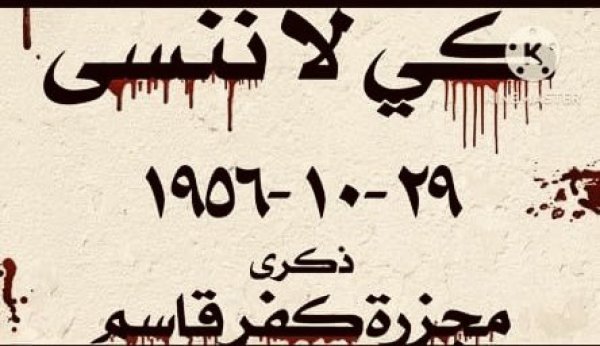
On the evening of 29 October 1956, Israeli Border Police soldiers opened fire on the people of Kafr Qasim as they returned home after a day's work, killing 49 Palestinians, among them women returning from the olive harvest, and children. None of them knew that a curfew had been imposed on their village while they were away.
The Kafr Qasim massacre took place on the eve of the Tripartite Aggression on Egypt, and it remains one of the most present events in the memory of Palestinians in the territories occupied in 1948.
Where Is Kafr Qasim?
Kafr Qasim is a Palestinian village in the Triangle region. At the time it lay close to the armistice line with Jordan, east of the city of Petah Tikva. After the Nakba its residents became holders of Israeli citizenship, but like all other Arab towns inside, it lived under military rule until 1966.
The Curfew Order
On 29 October 1956, a Border Police unit attached to the Israeli occupation army was tasked with imposing a curfew on the Triangle villages along the border with Jordan. The unit's commander, Major Shmuel Malinki, received an order to bring the curfew forward to 5:00 pm.
It was impossible for the villagers to learn of the new time, especially the labourers working outside the village in the fields and quarries. The village mukhtar was informed only at 4:30 pm, half an hour before the curfew, and he warned that hundreds of workers were still outside the village and the news would not reach them.
Malinki received clear instructions from the brigade commander, Colonel Issachar Shadmi, to open fire on anyone caught outside their home. When he asked what should be done with people returning from work without knowing about the curfew, Shadmi replied: "Allah yerhamo" (God have mercy on him). The order was explicit: "It is better that there be dead. We don't want arrests. Leave sentiment aside."
The Massacre
The soldiers deployed at the western entrance of the village. They stopped those returning on foot, on bicycles, on carts and in trucks, then opened fire on them.
- The first victims were four workers who greeted the soldiers with "shalom". The soldiers returned the greeting with gunfire. Three of them were killed, and the fourth survived because the soldiers thought he was dead.
- The soldiers stopped a truck carrying women returning from the olive harvest. Lieutenant Gabriel Dahan consulted his command by radio, and the women were then killed.
- The shooting went on for about an hour and a half.
By the end of the evening, 49 martyrs had fallen, among them a pregnant woman whose unborn child is counted as the 49th martyr, and 13 were wounded. The soldiers robbed the victims of their money and wristwatches.
Covering Up the Crime
The Israeli occupation authorities kept silent about the massacre for two full weeks, and military censorship banned the publication of any news about it. The Prime Minister's Office issued a statement only after the news leaked to the press.
The Trial and the Pardons
Two years after the massacre, the Border Police members involved were tried before a military court. In his 1958 verdict, Judge Benjamin Halevy wrote that the order to fire on civilians was "a blatantly illegal order" over which "a black flag flies", and that a soldier must refuse such an order. The phrase is still cited in Israeli law today.
- Major Shmuel Malinki: 17 years in prison.
- Lieutenant Gabriel Dahan and Shalom Ofer: 15 years in prison each.
- Five others were sentenced to up to seven years, and the rest were acquitted.
But the sentences were soon reduced by decision of the chief of staff, then by a pardon from the head of state, Yitzhak Ben-Zvi, and before 1960 all of the convicted men were free. Lieutenant Dahan left for France, declaring his anger at what he saw as discrimination between Mizrahi and Ashkenazi Jews in the sentences.
"Shadmi's Piastre"
Colonel Issachar Shadmi, who gave the order, was tried separately, and Moshe Dayan and Chaim Herzog testified in his favour. He was cleared of responsibility for the killings and convicted only of exceeding his authority. His punishment was a symbolic fine of one piastre. Ever since, "Shadmi's piastre" has been a symbol of how cheap Palestinian blood is in the eyes of the Israeli state.
Was the Massacre Part of a Larger Plan?
Of course, it was not the act of a single military unit. It was tied to a secret military plan known as "Operation Mole" (Hafarperet), which aimed to expel the Arab population of the Triangle to Jordan if war broke out. The documents of this plan remained classified for decades.
Remembrance and Recognition
Every year on 29 October, the people of Kafr Qasim and Palestinians inside the 1948 territories declare a general strike and march to the memorial to the martyrs of the massacre in the village, where the names of the 49 martyrs are engraved.
On 28 October 2021, the Knesset voted down a bill to formally recognise the massacre. The next day, 29 October 2021, Israeli President Isaac Herzog attended the commemoration in Kafr Qasim and apologised for the massacre. Yet the occupation state has to this day not officially recognised its responsibility, and has not compensated the martyrs' families.
Frequently Asked Questions About the Kafr Qasim Massacre
When did the Kafr Qasim massacre take place?
On 29 October 1956, between 5:00 and 6:30 pm, on the first day of the Tripartite Aggression on Egypt.
How many martyrs fell in the Kafr Qasim massacre?
49 martyrs, including women and children and a pregnant woman whose unborn child is counted among the martyrs, in addition to 13 wounded.
Who was responsible for the massacre?
A Border Police unit commanded by Major Shmuel Malinki, acting on orders from the brigade commander, Colonel Issachar Shadmi.
Were the killers punished?
Eight were convicted, but their sentences were reduced and they were pardoned, and all of them were free before 1960. Shadmi was fined one piastre.
What is "Shadmi's piastre"?
The symbolic fine imposed on Colonel Issachar Shadmi, who gave the order to shoot. It became a symbol of the occupation state's contempt for Palestinian blood.
Read more:
Video clips
Photo gallery


More from the archive
 Download Our Palestine App
The whole archive in the palm of your hand: depopulated villages, the Nakba, the massacres and Al-Aqsa — free, with no ads to erase the story.
Comments
No comments yet — be the first to write one.
Add your comment
Name and email are optional. Comments appear after review.