
The anniversary of the burning of the mosque Al-Aqsa by the Zionists
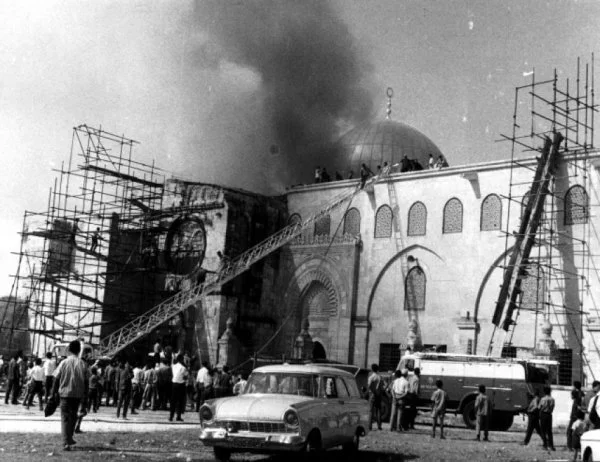
The 1969 Al-Aqsa Mosque Fire
On , the Australian extremist Denis Michael Rohan set fire to the Qibli Mosque within Al-Aqsa Mosque. The flames consumed large parts of the building and destroyed the historic minbar of Saladin, in a crime whose memory remains alive in Palestinian, Arab and Muslim consciousness.
Key Facts
- Date
- Location
- The south-eastern wing of the Qibli Mosque within Al-Aqsa Mosque, Jerusalem.
- Perpetrator
- Denis Michael Rohan, an Australian Christian extremist with Zionist beliefs.
- Main losses
- The historic minbar of Saladin, parts of the mosque's roof and dome, the mihrab, and the decorations, mosaics and carpets.
The Perpetrator and His Motives
Denis Michael Rohan was an Australian Christian and a follower of a fundamentalist evangelical church. He embraced Zionist ideas and believed that destroying Al-Aqsa Mosque would pave the way for building the so-called Temple in its place and hasten the return of the Messiah.
After the fire, the Israeli court claimed he was mentally ill and committed him to a psychiatric hospital instead of trying him for his crime. He was deported to Australia in 1974, where he died in 1995.
The Fire
Rohan poured petrol and kerosene onto a scarf he was carrying, then set fire to the eastern wing of the Qibli Mosque. The flames spread until they consumed Saladin's minbar, the mihrab and parts of the roof and dome, along with the historic mosaics and decorations, the carpets and the mosque's contents. The fire burned for more than 21 hours.
Fighting the Fire
The occupation authorities cut off the water supply to Al-Aqsa Mosque and its surroundings, and prevented fire engines from reaching it to put out the flames. The people of Jerusalem and other Palestinians rushed to the mosque and tried to extinguish the fire with simple tools, with their own clothes, and with water from the wells of Al-Aqsa Mosque. Fire engines later arrived from Hebron, Bethlehem, Ramallah and other Palestinian cities and helped put out the flames.
The Minbar of Saladin
Nur al-Din Zengi ordered the minbar to be made in Aleppo around 1168, intending it for Al-Aqsa Mosque once Jerusalem was liberated. When Saladin conquered Jerusalem in 1187, he had it brought to the mosque, and it became known as the minbar of Saladin. It was a masterpiece of interlocking woodwork inlaid with ivory and mother-of-pearl, assembled without nails or glue, and the fire destroyed it almost entirely.
Restoration
Restoration work began after the fire under the supervision of the Committee for the Reconstruction of Al-Aqsa Mosque established by Jordan. The minbar of Saladin was recreated in Jordan according to its original design and installed in the Qibli Mosque in 2007.
Reactions
The occupation's prime minister at the time, Golda Meir, said after the fire:
When Al-Aqsa was burned, I did not sleep that night. I thought (Israel) would be crushed. But when morning came, I realized that the Arabs were in a deep sleep.
Internationally, the UN Security Council adopted Resolution 271 in September 1969, condemning the fire and calling on Israel to refrain from any measure that would alter the status of Jerusalem. That same month, a summit was held in Rabat at which the Organisation of the Islamic Conference was founded in response to the crime; it is known today as the Organisation of Islamic Cooperation.
Conclusion
Golda Meir's words perhaps sum up the Arab impotence and international inaction that have followed the crime from the day it happened until today, as the response has not gone beyond denunciations, condemnations and statements that changed nothing on the ground. Although the Organisation of the Islamic Conference was born out of this crime and includes many Arab and Muslim countries, it has done nothing worth mentioning in support of Al-Aqsa Mosque, the first qibla, the third holiest site in Islam, and the destination of the Night Journey of the Prophet Muhammad, peace be upon him.
Photo gallery


More from the archive
 Download Our Palestine App
The whole archive in the palm of your hand: depopulated villages, the Nakba, the massacres and Al-Aqsa — free, with no ads to erase the story.
Download Our Palestine App
The whole archive in the palm of your hand: depopulated villages, the Nakba, the massacres and Al-Aqsa — free, with no ads to erase the story.



Comments
No comments yet — be the first to write one.
Add your comment
Name and email are optional. Comments appear after review.