St. Anthony's Church in Jaffa

St. Anthony's Church in Jaffa
St. Anthony's Church in Jaffa: The Arab Latin Parish of the "Bride of the Sea"
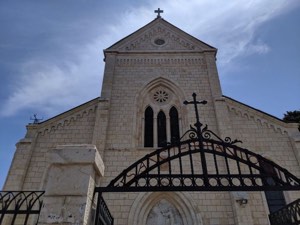
The Church of St. Anthony of Padua is a Latin Catholic church in Jaffa, standing on Yafeth Street at the heart of the city. It was built in 1932 in the neo-Gothic style and belongs to the Franciscan Custody of the Holy Land. It is the parish church of Jaffa's Arab Catholic community, which remained in its city after the Nakba of 1948. Over the decades it has also become home to migrant communities from the Philippines, India, Africa and Latin America. Every June its parishioners celebrate their patron's feast with a procession from the Church of St. Peter in the Old City. This guide covers the church's history, architecture and parish.
Quick facts
| Arabic name | كنيسة القديس أنطونيوس – يافا |
|---|---|
| Location | Yafeth Street, Jaffa |
| Denomination | Latin Catholic |
| Administration | Franciscan Custody of the Holy Land |
| Built | 1932 CE |
| Style | Neo-Gothic |
| Patron | St. Anthony of Padua, Franciscan friar |
| Feast | 13 June (celebrated on the nearest Saturday) |
| Parish | Jaffa's Arab Catholic community and migrant communities |
| Facilities | Friary, parish cemetery and chapel, school |
St. Anthony: the patron
The church is named after St. Anthony of Padua, the Portuguese Franciscan friar whom the Catholic Church venerates as a saint and Doctor of the Church. He is one of the most popular saints among Catholics in the Arab East, and his feast falls on 13 June.
Location
The church stands on Yafeth Street in Jaffa, south of the Old City, in the district where much of the city's Palestinian population still lives. It is close to the Church of St. Peter on the hill of old Jaffa, the Clock Tower and the Sea Mosque.
History
- The Franciscan presence: for centuries the Catholic presence in Jaffa was tied to the friars of the Franciscan Custody of the Holy Land, who received pilgrims arriving through Jaffa's port on their way to Jerusalem.
- 1932: St. Anthony's Church was built in the neo-Gothic style as the parish church of the city's Arab Catholic community, during Jaffa's heyday as a port and a commercial and cultural city.
- 1948: the church and its parish survived the fall of Jaffa and the expulsion of most of its people, becoming a centre for the few Arab Christians who remained in the city.
- Recent decades: the parish has grown to include many migrant communities alongside its Arab members.
Architecture and restoration
The church was built in the neo-Gothic style, with a stone façade and pointed arched windows. In recent years the Custody of the Holy Land launched a restoration project to return it to its original style. The work included reinforcing the load-bearing walls of the parish buildings and friary, replacing the windows, stopping water infiltration and improving the garden. The apse has been decorated with a blue sky of golden stars, each star bearing the name of a family that contributed to the restoration. The parish cemetery and its chapel were also restored. The parish's Arab faithful, many of them people of limited means, raised 18,000 shekels in a single week to support the work.
The parish: a Church within the Church
The local Arab Catholic community forms the core of St. Anthony's parish. Alongside it, the parish now includes communities from the Philippines, the largest group, as well as from Africa, India, Sri Lanka, Latin America and Poland, and Hebrew speakers. The Custody of the Holy Land describes it as "a Church within the Church". Children from these communities celebrate their First Holy Communion together during the patron's feast.
The Feast of St. Anthony
The parish celebrates its patron's feast on the Saturday nearest 13 June. A procession sets out from the Church of St. Peter in the Old City to the parish church, with each community announcing the feast with its own music and traditional dances. It is followed by a festive Mass and the First Communion of the children.
Jaffa's Christians and the Nakba
Before the Nakba some 120,000–130,000 Palestinians, Muslim and Christian, lived in Jaffa and its surroundings, and its churches and mosques stood side by side in a city known for its oranges, its port and its press. In May 1948 the city fell after siege and bombardment and most of its people were expelled. Only 3,000–4,000 remained, gathered in the Ajami neighbourhood and fenced in with barbed wire. In 1950 Jaffa was merged into the Tel Aviv municipality. Since then St. Anthony's, together with Jaffa's other churches, has remained a spiritual home for the Arab Christians who stayed in their city.
The church today (2026)
St. Anthony's Church remains alive with prayers and celebrations, and its Arab parishioners, despite hard circumstances, carry the responsibility of restoring and preserving it. Jaffa's Palestinians, some 20,000–25,000 today, live under the pressures of urban Judaisation, evictions and rising prices. Together with the city's mosques and other churches, St. Anthony's stands as a witness that Arab Jaffa, Muslim and Christian, is still present.
Frequently asked questions
Where is St. Anthony's Church in Jaffa?
On Yafeth Street in Jaffa, near the Old City and the Church of St. Peter.
When was the church built?
In 1932, in the neo-Gothic style.
Who runs St. Anthony's Church?
The Franciscan Custody of the Holy Land; it is a Latin Catholic church.
When is the Feast of St. Anthony celebrated in Jaffa?
On the Saturday nearest 13 June, with a procession from the Church of St. Peter to the parish church and a festive Mass.
Who are the church's parishioners?
Its core is Jaffa's Arab Catholic community, and it also includes communities from the Philippines, Africa, India, Latin America and elsewhere.
Conclusion
Since 1932 St. Anthony's Church has risen in neo-Gothic style at the heart of Jaffa, a witness to the heyday of the "Bride of the Sea", to its Nakba, and to the steadfastness of its Arab parishioners, who still give from their own means to restore its walls. Beneath its blue sky studded with their families' names, the church remains a home for Jaffa's Christians and part of the memory of their Palestinian city.
More from the archive
 Download Our Palestine App
The whole archive in the palm of your hand: depopulated villages, the Nakba, the massacres and Al-Aqsa — free, with no ads to erase the story.
Comments
No comments yet — be the first to write one.
Add your comment
Name and email are optional. Comments appear after review.