Mount Precipice (Jabal al-Qafza) in Nazareth
Mount Precipice (Jabal al-Qafza) in Nazareth: Where Jesus "Leapt" and Early Humans Were Buried
Mount Precipice, known in Arabic as Jabal al-Qafza ("the Mount of the Leap"), is a rocky cliff on the southern edge of Nazareth overlooking Marj Ibn Amer. It brings together two stories. The first is religious: Christian tradition places here the spot to which the people of Nazareth led Jesus to throw him off the cliff, as told in the Gospel of Luke, but he passed through their midst and went on his way, hence its popular name "the Leap". The second is archaeological: Qafzeh Cave on its slope holds the remains of at least 27 Homo sapiens who lived some 92,000 to 145,000 years ago, including what is considered one of the oldest intentional burials in human history. This guide covers the mountain, its story and its cave.
Quick facts
| Arabic name | جبل القفزة – الناصرة |
|---|---|
| Meaning of the name | "The Mount of the Leap" |
| Location | Southern edge of Nazareth, about 2 km south-west of its centre |
| View | Marj Ibn Amer |
| Christian tradition | Luke 4:29–30 |
| Cave | Qafzeh Cave on the slope |
| Cave discovered | 1933, by a French archaeologist |
| Human remains | At least 27 Homo sapiens |
| Age of remains | About 92,000 – 145,000 years |
| Papal Mass | 14 May 2009, about 40,000 worshippers |
The name and tradition
The Gospel of Luke (4:29–30) tells how, when Jesus taught in the synagogue of Nazareth, its people grew angry, "and they rose up and drove him out of the town and brought him to the brow of the hill on which their town was built, so that they could throw him down the cliff. But passing through their midst, he went away." Christian tradition places this event on this cliff south of Nazareth, while popular tradition says Jesus "leapt" from it and escaped, so the local people came to call it "Jabal al-Qafza", the Mount of the Leap.
Location
The mountain lies on the southern edge of Nazareth, about two kilometres south-west of its centre, part of the Nazareth range extending southwards, its sheer cliff overlooking the broad plain of Marj Ibn Amer. From its summit one can see the hills of Galilee, Mount Tabor and the plain stretching towards Jenin.
Qafzeh Cave
On the mountain's northern slope lies Qafzeh Cave, discovered by a French archaeologist in 1933 and excavated over the following decades. Excavations uncovered the remains of at least 27 Homo sapiens, dated to between 92,000 and 145,000 years ago, who may be among the earliest modern humans to live outside Africa. The cave also yielded perforated shells that may have been strung as jewellery, stones engraved with geometric patterns, and 71 pieces of red ochre and ochre-stained stone tools.
The oldest human burials
Qafzeh Cave is the site of what may be the oldest intentional burial known in human history: red ochre was found near the bones, suggesting rituals accompanied the burials. Among its most notable finds is the partial skeleton of a young man buried near several children, bearing on his face the mark of a deep wound from a sharp stone tool that healed, after which he lived for a long time. Researchers in a recent study describe it as the earliest documented case of sharp-force trauma in the archaeological record, and his survival suggests his community cared for him.
The 2009 papal Mass
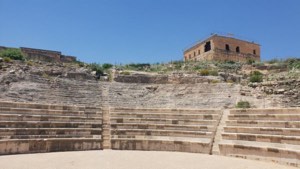
On 14 May 2009, during his visit to the Holy Land, Pope Benedict XVI celebrated Mass on Mount Precipice before some 40,000 worshippers, and a large amphitheatre was built on the mountainside for the occasion, still standing and overlooking Marj Ibn Amer.
Nazareth and its surroundings
The mountain overlooks the Arab city of Nazareth, which Zionist militias occupied on 16 July 1948 but where most of the people stayed, taking in thousands of refugees from nearby villages and becoming the main centre of the Palestinians inside the Green Line. On Marj Ibn Amer below stood Palestinian villages many of whose people were expelled in 1948, while settlements built to encircle the city surround it today.
The mountain today (2026)
Mount Precipice remains a destination for Christian pilgrims and visitors, who gaze out over Marj Ibn Amer from its summit and recall Luke's story, while its cave remains one of the world's most important sites for the study of human origins. The mountain combines a religious memory two thousand years old with a human memory more than a hundred thousand years old, on Palestinian land whose identity Nazareth's people still guard.
Frequently asked questions
Where is Mount Precipice?
On the southern edge of Nazareth, about two kilometres south-west of its centre, overlooking Marj Ibn Amer.
Why is it called Jabal al-Qafza?
Because popular tradition says Jesus "leapt" from it and escaped when the people of Nazareth tried to throw him off the cliff, as told in the Gospel of Luke.
What is Qafzeh Cave?
A cave on the mountain's slope where the remains of at least 27 Homo sapiens who lived some 92,000 to 145,000 years ago were found.
Why is Qafzeh Cave important?
Because it holds what may be the oldest intentional burial in human history, along with red ochre, perforated shells and engraved stones.
When did the Pope celebrate Mass on Mount Precipice?
On 14 May 2009, when Pope Benedict XVI celebrated Mass before some 40,000 worshippers.
Conclusion
On the edge of Mount Precipice, where tradition says Jesus escaped his people's anger, the earliest humans buried their dead with red ochre more than a hundred thousand years ago. Overlooking Marj Ibn Amer, the mountain remains a witness to the depth of the history of Nazareth and Palestine, from the dawn of humanity to today.
More from the archive
 Download Our Palestine App
The whole archive in the palm of your hand: depopulated villages, the Nakba, the massacres and Al-Aqsa — free, with no ads to erase the story.

Comments
No comments yet — be the first to write one.
Add your comment
Name and email are optional. Comments appear after review.