The Armenian Quarter of Jerusalem

The Armenian Quarter of Jerusalem: St James Convent and the Old City's Oldest Community
The Armenian Quarter (Harat al-Arman) lies in the south-western corner of the Old City of Jerusalem, on the hill of Nabi Dawud between Jaffa Gate (Bab al-Khalil) and Zion Gate (Bab al-Nabi Dawud), and covers about 300 dunams, roughly one-sixth of the Old City. Armenians have lived in Jerusalem since the early Christian centuries, and at the heart of their quarter stands the Cathedral and Convent of St James (Mar Ya'qub), seat of the Armenian Patriarchate, which holds one of the world's richest collections of Armenian manuscripts and the oldest printing press in Palestine. Armenians introduced photography, printing and painted ceramics to the country and are an integral part of Jerusalem's Palestinian fabric. A few thousand Armenians live in the quarter today, facing emigration and settlement pressure, most visibly in the 2023 "Cows' Garden" land deal. This guide covers the quarter's history, landmarks and present state.
Quick facts
| Arabic name | حارة الأرمن – القدس |
|---|---|
| Other names | Al-Hayy al-Armani |
| Location | South-west of the Old City, on the hill of Nabi Dawud |
| Area | About 300 dunams, roughly one-sixth of the Old City |
| Nearby gates | Jaffa Gate (Bab al-Khalil) and Zion Gate (Bab al-Nabi Dawud) |
| Armenian presence | Since the early Christian centuries |
| Main landmarks | Cathedral and Convent of St James, Armenian Patriarchate |
| Library | More than 3,000 manuscripts |
| Population today | About 3,000 to 5,000 |
| World Heritage | Part of the Old City and its Walls, inscribed 1981 on Jordan's nomination |
Location and gates
The Armenian Quarter occupies the south-western corner of the Old City of Jerusalem, on the hill of Nabi Dawud. It is bounded by the city wall to the west and south, the Christian Quarter to the north, and the Muslim Quarter and what became the Jewish Quarter to the east. It is entered from Jaffa Gate (Bab al-Khalil) in the west and Zion Gate (Bab al-Nabi Dawud) in the south. Most of the quarter is enclosed by the wall of the St James Convent, making it feel like a small city within the city.
The Armenians of Jerusalem: a history
- Early Christian centuries: the Armenian presence in Palestine dates to the 3rd or 4th century CE, when Armenia embraced Christianity; Armenians were among the first pilgrims to set up hospices and inns for visitors, since their tradition holds that every Christian should make the pilgrimage to Jerusalem at least once.
- 638 CE: according to Armenian tradition, the first Armenian Patriarch of Jerusalem received a covenant from Caliph Umar ibn al-Khattab recognising the rights of the Armenian Church, and the covenant was inscribed at the entrance of the convent.
- The Crusades and later centuries: the Armenian presence in Jerusalem grew, and the Armenian Patriarchate remained one of the oldest patriarchates in Palestine.
- First World War: survivors of the massacres of the Armenians took refuge in Jerusalem; the city's Armenians commemorate them every year on 24 April.
- Before 1967: some 25,000 Armenians lived in Palestine, many of whom emigrated after the occupation of Jerusalem in 1967.
The Cathedral and Convent of St James
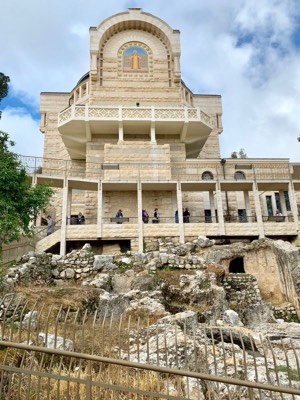
At the heart of the quarter stands the Convent of St James and its cathedral, among the oldest churches in Jerusalem. It houses the Armenian Patriarchate, a theological seminary, the Tarkmanchatz School, the Gulbenkian Library, the Mardigian Museum and a health clinic. The Patriarchate holds the second-largest library of Armenian manuscripts in the world, with more than 3,000 manuscripts, and the convent's press, founded in the 1830s, is the oldest in Jerusalem and Palestine.
Armenian contributions to Palestine
- Printing: Armenians founded the first printing press in Palestine, at the St James Convent, in the 1830s.
- Photography: Armenians introduced photography to Palestine in 1857.
- Ceramics: they founded the country's first decorated ceramics workshops during the British Mandate, and their craftsmen helped restore the ceramic tiles of the Dome of the Rock.
- Crafts: they excelled in tailoring and jewellery, and their shops remain part of Jerusalem's markets.
Part of Jerusalem's fabric
Jerusalem's Armenians see themselves as part of the city's social mosaic, with close ties to their Christian and Muslim neighbours. The Armenian Patriarchate has rejected placing the convent under Israeli sovereignty and confronted the occupation authorities in the 1990s over taxes and interference in its affairs, while Armenians stress that their presence in Jerusalem predates all of the successive occupations.
The "Cows' Garden" affair
In 2021 the Armenian Patriarchate signed an agreement leasing a plot in the quarter known locally as the "Cows' Garden", after its old use as grazing land, to a company owned by an Israeli businessman for 98 years, to build a luxury hotel. The deal would have cost the Armenians nearly a quarter of their quarter. When its terms came to light in 2023, young people from the quarter launched the "Save the Armenian Quarter" movement, staging a permanent sit-in on the land and weekly vigils, arguing that the deal breached Patriarchate rules requiring wider approval for any lease longer than 25 years. On 26 October 2023 the Patriarchate announced that the deal was cancelled under community pressure. But on 5 November 2023 company representatives stormed the land with armed men and dogs, and some 15 armed settlers demolished parts of a stone wall and the asphalt surface; residents confronted them and took turns guarding the land.
The quarter today (2026)
Between 3,000 and 5,000 Armenians live in the quarter today, their numbers shrinking through emigration for study and work. The St James Convent, its library and its cathedral remain the heart of the quarter, while residents face settlement pressure and attempts to seize their land, along with repeated attacks on clergy and church property in the Old City. With its walls, convents and crafts, the Armenian Quarter remains a witness to Jerusalem's diversity and to a community rooted there for more than sixteen centuries.
Frequently asked questions
Where is the Armenian Quarter in Jerusalem?
In the south-western corner of the Old City, on the hill of Nabi Dawud, between Jaffa Gate and Zion Gate.
How big is the Armenian Quarter?
About 300 dunams, roughly one-sixth of the Old City.
How long have Armenians lived in Jerusalem?
Since the 3rd or 4th century CE, when Armenian pilgrims began setting up hospices in the city.
What are the main landmarks of the Armenian Quarter?
The Cathedral and Convent of St James, the Armenian Patriarchate, its library of more than 3,000 manuscripts, and the Mardigian Museum.
What is the Cows' Garden affair?
A deal to lease nearly a quarter of the quarter to an Israeli company for 98 years to build a hotel; it was cancelled in October 2023 after Armenian protests.
Conclusion
Behind the walls of the St James Convent, Armenians have lived in Jerusalem for sixteen centuries, preserving their manuscripts, introducing printing and photography, and adorning the Dome of the Rock with their ceramics. Today, as they defend the Cows' Garden and the survival of their quarter, Jerusalem's Armenians affirm that they are an inseparable part of the city and its people, and that Jerusalem is only complete in its plurality.
More from the archive


 Download Our Palestine App
The whole archive in the palm of your hand: depopulated villages, the Nakba, the massacres and Al-Aqsa — free, with no ads to erase the story.
Comments
No comments yet — be the first to write one.
Add your comment
Name and email are optional. Comments appear after review.