The Mount of Olives (Jabal al-Tur) in Jerusalem

The Mount of Olives (Jabal al-Tur) in Jerusalem: The City's Highest Peak Overlooking al-Aqsa
The Mount of Olives, known in Arabic as Jabal al-Tur, is a ridge of hills running along the east of the Old City of Jerusalem and adjoining it. It is the highest peak in the city and looks directly over al-Aqsa Mosque and the Dome of the Rock. It takes its name from the olive trees that once covered its slopes, and the Jerusalem town of al-Tur stands on its summit. The mountain gathers Muslim and Christian holy places: the Dome of the Ascension, endowed as a waqf by Salah al-Din, a shrine attributed to Rabi'a al-Adawiyya, and dozens of churches and convents including Gethsemane, the Pater Noster, Dominus Flevit and the Russian Church of Mary Magdalene. Since the occupation of Jerusalem in 1967 the mountain and its people have faced multiple Judaisation projects, from the "national park" and the "Holy Basin" to a cable car and expanding cemeteries. This guide covers the mountain's history, landmarks and present state.
Quick facts
| Arabic name | جبل الطور (جبل الزيتون) – القدس |
|---|---|
| Other names | Jabal al-Zaytun, Tur Zayta |
| Location | East of the Old City of Jerusalem |
| Status | Highest peak in Jerusalem, overlooking al-Aqsa Mosque |
| Town | Al-Tur, on the summit |
| Main Islamic landmarks | Dome of the Ascension, shrine of Rabi'a al-Adawiyya |
| Main Christian landmarks | Gethsemane, Pater Noster, Dominus Flevit, Mary Magdalene, Russian Convent of the Ascension |
| Salah al-Din's waqf | 1188 CE |
| Highest building | Bell tower of the Russian Convent of the Ascension, 64 m |
| Main threats | National park, Holy Basin, cable car |
The name
Jerusalemites call it "Jabal al-Tur"; tur means "mountain" in Arabic, and the town on its summit takes its name from it. The name "Mount of Olives" (Jabal al-Zaytun) comes from the olive trees that once covered its slopes, and Arab geographers called it "Tur Zayta".
Location
The mountain stretches in a ridge of hills along the east of the Old City of Jerusalem, adjoining it and separated from its walls by the valley of Sitti Maryam. It is the highest peak in the city: from its western slope the whole of the Old City lies open, with al-Aqsa Mosque, the Dome of the Rock, the walls and the domes, while to the east it falls away towards the Jerusalem wilderness, Jericho and the Dead Sea.
Islamic landmarks
- The Dome of the Ascension: an octagonal building on the summit, where Christians believe Jesus ascended to heaven. After Salah al-Din liberated Jerusalem in 1187 he made the site an Islamic waqf, registered in a document dated 20 October 1188; a mihrab was added and a mosque built beside it. The site remains an Islamic waqf, which Muslims open to Christian pilgrims.
- Shrine of Rabi'a al-Adawiyya: a shrine on the summit that popular tradition attributes to the Sufi mystic Rabi'a al-Adawiyya, visited by Muslims for centuries.
- Islamic waqf land: large areas of the mountain east of al-Aqsa Mosque are considered Islamic waqf.
- The town of al-Tur: a long-established Jerusalem town on the summit, with mosques, cemeteries, schools and residential neighbourhoods.
Christian landmarks
- Gethsemane and the Church of All Nations: on the western foot, where Christians believe Jesus prayed his last prayer, with olive trees about 900 years old.
- The Pater Noster Church: where Christians believe Jesus taught his disciples the Lord's Prayer. Empress Helena founded a church here in the 4th century; the Crusaders destroyed it and partly rebuilt it, a French duchess bought the land in 1868, and the present convent was built in the early 20th century, with the prayer written in more than 140 languages.
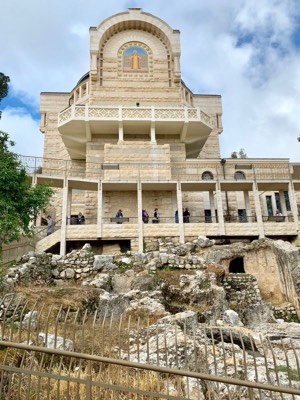
- Dominus Flevit ("The Lord Wept"): built in 1955 by the Italian architect Antonio Barluzzi in the shape of a teardrop, where Jesus is believed to have wept over the fate of Jerusalem; it looks out over al-Aqsa Mosque and the Dome of the Rock.
- The Church of Mary Magdalene: a Russian Orthodox convent founded in 1886 on the western slope, crowned with golden domes overlooking the Old City.
- The Russian Convent of the Ascension: built in 1870 on the summit near the Dome of the Ascension; its 64-metre bell tower is among the highest points in Jerusalem.
- The Monastery of Little Galilee: a Greek Orthodox Patriarchate monastery on the northern slope, dating to the 6th century and restored in the Crusader and Ottoman periods.
- The Church of the Tomb of the Virgin Mary: at the foot of the mountain near Gethsemane.
The mountain under occupation
- Expanding cemeteries: large areas of the mountain have been turned into a vast Jewish cemetery spreading over dozens of dunams, many of whose graves Jerusalemites describe as fictitious, intended to take control of the land.
- The "Holy Basin" project: the mountain is targeted by a plan that seeks to Judaise the area surrounding the Old City.
- The "national park": in March 2022 the Israel Nature and Parks Authority proposed expanding the "Jerusalem Walls National Park" by about 275 dunams, covering much of the mountain and church lands; it was frozen after a protest by the heads of the churches, who described it as the confiscation and nationalisation of one of the holiest sites.
- The cable car: a project crossing over Palestinian neighbourhoods to link a Jewish neighbourhood with the Old City.
- House demolitions: about 100 homes in the neighbourhood south of the Mount of Olives are at risk of demolition on the pretext of lacking permits.
The mountain today (2026)
Jabal al-Tur remains Jerusalem's balcony, from which visitors look out over al-Aqsa Mosque, where the Palm Sunday procession sets out towards the Old City, and where the people of al-Tur live on the summit. But it is under growing pressure: spreading cemeteries, "national park" projects hemming in churches and homes, a cable car meant to change the city's skyline, and houses threatened with demolition. With its mosques, churches and olive trees, the mountain remains a witness to Arab Jerusalem, Muslim and Christian, and to its steadfast people.
Frequently asked questions
Where is the Mount of Olives?
East of the Old City of Jerusalem, separated from its walls by the valley of Sitti Maryam; it is the highest peak in the city.
Why is it called the Mount of Olives?
After the olive trees that once covered its slopes; its Arabic name, al-Tur, simply means "the mountain".
What is the Dome of the Ascension?
An octagonal building on the summit where Christians believe Jesus ascended; Salah al-Din made it an Islamic waqf in 1188, and the waqf still welcomes Christian pilgrims.
What are the main churches on the Mount of Olives?
The Church of All Nations at Gethsemane, the Pater Noster, Dominus Flevit, the Church of Mary Magdalene and the Russian Convent of the Ascension.
What threatens the Mount of Olives today?
Expanding cemeteries, the "Holy Basin" and "national park" projects, the cable car, and the demolition of Palestinian homes.
Conclusion
From the summit of Jabal al-Tur the whole of Jerusalem appears: al-Aqsa, the Dome of the Rock, the walls and the churches. On its slopes the Dome of the Ascension, a waqf since Salah al-Din, stands beside the churches of Gethsemane, the Pater Noster and Mary Magdalene, an image of the Arab Jerusalem that embraced its Muslims and Christians. Despite the Judaisation projects closing in on it, the mountain and the people of al-Tur remain the guardians of that image.
More from the archive


 Download Our Palestine App
The whole archive in the palm of your hand: depopulated villages, the Nakba, the massacres and Al-Aqsa — free, with no ads to erase the story.
Comments
No comments yet — be the first to write one.
Add your comment
Name and email are optional. Comments appear after review.