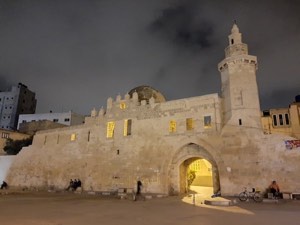
Ibn Uthman Mosque in Gaza

Ibn Uthman Mosque in Gaza: Gaza's Second-Largest Historic Mosque, Destroyed in the Genocide War
Ibn Uthman Mosque is a historic mosque in the al-Shuja'iyya neighbourhood of eastern Gaza City, on Market Street. It was the second-largest historic mosque in Gaza after the Great Omari Mosque and one of the finest examples of Mamluk architecture in Palestine. It bears the name of Sheikh Shihab al-Din Ahmad ibn Uthman, a Nablus-born scholar who settled in Gaza and died there in 805 AH (1402 CE). It was built in stages in the Mamluk period, its oldest part dating to July 1400, and it holds the tomb of Emir Sayf al-Din Yalkhuja, governor of Gaza. It held some 1,500 worshippers over an area of about 2,000 square metres. On 3 July 2024, during Israel's genocide war on Gaza, occupation aircraft struck it with several missiles and reduced it to rubble. This guide covers the mosque's history, architecture and fate.
Quick facts
| Arabic name | جامع ابن عثمان – غزة |
|---|---|
| Other names | "The Great Mosque" to the people of al-Shuja'iyya |
| Location | Market Street, al-Shuja'iyya, eastern Gaza City |
| Status | Second-largest historic mosque in Gaza after the Omari Mosque |
| Area | About 2,000 m², including a courtyard of about 400 m² |
| Oldest inscription | July 1400 CE, at the southern entrance |
| Qibla wall inscription | March 1431 CE, naming Alam al-Din Sanjar |
| Named after | Sheikh Shihab al-Din Ahmad ibn Uthman, died 805 AH (1402 CE) |
| Capacity | About 1,500 worshippers inside |
| Destroyed | 3 July 2024, by occupation aircraft missiles |
The name
The mosque bears the name of Sheikh Shihab al-Din Ahmad ibn Uthman, a righteous scholar born in Nablus who came to Gaza and settled there; people believed in his miracles, and he oversaw the building and care of the mosque until his death in 805 AH (1402 CE). The people of al-Shuja'iyya call it "the Great Mosque" because of its size and its place in the neighbourhood's main market.
Location
The mosque stands on Market Street in the al-Shuja'iyya neighbourhood of eastern Gaza City, its two western gates overlooking the Shuja'iyya market, at the heart of one of the city's largest and oldest neighbourhoods.
History
- Late 8th century AH: construction began in stages in the Mamluk period, overseen by sultans and emirs whose names were inscribed on its walls.
- July 1400 CE: an inscription at the southern entrance dates the mosque's oldest parts, including the western façade with its two entrances and the minaret.
- 805 AH (1402 CE): Sheikh Ahmad ibn Uthman died in Gaza, and the mosque took his name.
- March 1431 CE: an inscription on the qibla wall dates its construction and names Alam al-Din Sanjar, then head of Gaza's local administration.
- 850 AH (1446 CE): Emir Sayf al-Din Yalkhuja, governor of Gaza since 849 AH, died and was buried in the mosque.
- Earlier wars: the mosque was damaged in earlier wars and then restored; the mosque was restored around the mid-1990s and the prayer hall around the mid-2000s, funded by worshippers' donations.
- First Intifada (1987): the mosque was a centre of confrontations with occupation forces.
Architecture
The mosque was modelled on the Great Omari Mosque in the Mamluk style. It was entered through two western gates with pointed arches, flanking a minaret on a square base, leading into a wide courtyard surrounded by four arcades with Mamluk arches and walls nearly a metre thick. On the east side stood the prayer hall, crowned by a large dome, its four iwans separated by three massive square piers. The qibla wall bore Mamluk stone decoration with geometric and floral motifs, while the minbar was made of marble with traditional Arabic decoration and a small dome over the preacher's seat. The ablution area was known for its arches and white marble benches.
Yalkhuja's tomb and the fasqiyya
In the mosque's western arcade lay the tomb of Emir Sayf al-Din Yalkhuja, who became governor of Gaza in 849 AH (1445 CE) and asked to be buried in the mosque shortly before his death in 850 AH (1446 CE). In the south-western iwan of the courtyard was a burial place known locally as the "fasqiyya", holding the remains of about 40 fighters who came to resist invaders.
Destruction in the genocide war
Since Israel's genocide war on the Gaza Strip began in October 2023, al-Shuja'iyya has been one of the most heavily bombed and invaded neighbourhoods. On 3 July 2024, about a week after a new ground offensive on al-Shuja'iyya began, occupation aircraft fired several missiles at Ibn Uthman Mosque, destroying it and reducing it to rubble, so that the Gaza Strip lost its second-largest historic mosque after the Great Omari Mosque had been destroyed before it.
Across the Strip, the occupation had destroyed 208 of the 325 registered archaeological and heritage sites by October 2025, while 738 mosques out of about 1,244 had been razed by early 2025, a number that rose to 835 destroyed mosques by October 2025.
The mosque today (2026)
Nothing remains of Ibn Uthman Mosque today but rubble in the heart of a devastated al-Shuja'iyya, more than six centuries after it was built. With its wide courtyard, Mamluk arcades, minaret and Yalkhuja's tomb, the mosque was a witness to Mamluk Gaza as a city that welcomed scholars from Nablus and beyond. Documenting what remains of its stones and rebuilding it is part of the struggle to preserve the memory and identity of Gaza that the genocide war seeks to erase.
Frequently asked questions
Where is Ibn Uthman Mosque?
On Market Street in the al-Shuja'iyya neighbourhood of eastern Gaza City.
Who was Ibn Uthman?
Sheikh Shihab al-Din Ahmad ibn Uthman, a scholar born in Nablus who settled in Gaza and died there in 805 AH (1402 CE).
When was the mosque built?
In stages during the Mamluk period; its oldest inscription dates to July 1400 CE and its qibla wall inscription to March 1431 CE.
What made Ibn Uthman Mosque special?
It was Gaza's second-largest historic mosque, with a wide courtyard, four Mamluk arcades, a minaret between two entrances, and the tomb of Emir Yalkhuja, governor of Gaza.
What happened to the mosque in the genocide war?
Occupation aircraft destroyed it with several missiles on 3 July 2024, reducing it to rubble.
Conclusion
For more than six centuries Ibn Uthman Mosque stood in the Shuja'iyya market, welcoming worshippers and bearing witness to Gaza's history, until the genocide war's missiles turned it to rubble in a single day. Yet the mosque's memory lives on among the people of al-Shuja'iyya who called it "the Great Mosque", and in its stones, waiting to be raised again.
More from the archive

 Download Our Palestine App
The whole archive in the palm of your hand: depopulated villages, the Nakba, the massacres and Al-Aqsa — free, with no ads to erase the story.
Comments
No comments yet — be the first to write one.
Add your comment
Name and email are optional. Comments appear after review.