
Battle of Ras al-Ain 1948: The Battle for Water and the Martyrdom of Hasan Salama
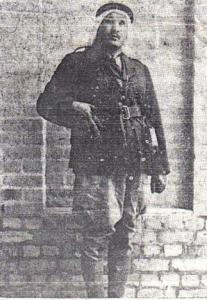
The battle of Ras al-Ain was a series of clashes between March and June 1948 over the spring of Ras al-Ain in central Palestine, whose water was pumped through pipelines to the Jewish neighbourhoods of Jerusalem. Arab fighters took control of it in March and blew up its pipelines as the Zionist offensive intensified; when Zionist forces seized it on 30 May, the fighters of the Central Sector under Sheikh Hasan Salama and the fighters of the nearby villages counter-attacked at dawn on 31 May and retook it within hours. [1][2][3]
In this attack the commander Hasan Salama was hit by shrapnel in his left lung, and he died of his wounds on 2 June 1948, a day after the Iraqi army took over the position. [3][4][5]
Contents
- At a glance
- The spring of thirst
- March: the fighters at the spring
- Blowing up the pipelines
- 30–31 May: loss and recapture
- The martyrdom of Hasan Salama
- The Iraqi army at Ras al-Ain
- Differences between the accounts
- Timeline
- Frequently asked questions about the Battle of Ras al-Ain
At a glance
| Item | Details |
|---|---|
| Date | 8 March – 1 June 1948, the fiercest fighting in the last three days of May |
| Place | The Ras al-Ain spring and water-pumping installations, central Palestine, about 60 kilometres from Jerusalem |
| Arab forces | About 500 of the Arab Liberation Army, the Central Sector fighters, and fighters from Deir Tarif, Beit Nabala and nearby villages |
| Commander | Sheikh Hasan Salama, commander of the Central Sector |
| Key moments | The pipelines blown up (April and May); Zionist seizure on 30 May; the position retaken on 31 May |
| Martyrs | Commander Hasan Salama, who died of his wounds on 2 June 1948 |
| Outcome | Ras al-Ain retaken; the Iraqi army held the position from 1 June until the fall of Lydda and Ramla |
The spring of thirst
Ras al-Ain was known for the sweetness of its water, which reached the Jewish neighbourhoods of Jerusalem through pipelines, making it a target for both sides. The historian Aref al-Aref describes it as a strategic spring during the siege of Jerusalem, which remained in Arab hands from the partition resolution until the battles of Lydda and Ramla. [1][3]
March: the fighters at the spring
On 8 March 1948 some 500 men of the Arab Liberation Army took up positions at Ras al-Ain, expelled the employees of the Zionist water company and replaced them with Arab staff. At first the fighters did not cut off Jerusalem’s water, so as not to harm the Arab residents of western Jerusalem. [1][2]
Blowing up the pipelines
After the Deir Yassin massacre and the fall of al-Qastal in April 1948, the fighters decided to blow up the pipelines carrying Ras al-Ain’s water to the Jewish neighbourhoods of Jerusalem, and on 10 April they did so at Bab al-Wad, with Holy Jihad fighters and Bedouin volunteers taking part. The Jewish neighbourhoods, government offices and British army units in Jerusalem were affected, and the Zionist bodies had to ration water to the settlers from wells and cisterns. [1][2]
After Jaffa fell in May, the fighters blew up the pipelines at four more points on 17 May, to deny the Zionist forces the use of the spring should they reach it. [1][2]
30–31 May: loss and recapture
The Zionist forces kept trying to seize Ras al-Ain, most fiercely in the last three days of May, until on 30 May they overcame its garrison and took it. [1][2]
At dawn on 31 May the fighters of the nearby villages, from Deir Tarif, Beit Nabala and elsewhere, rushed to the aid of Sheikh Hasan Salama and launched a sweeping counter-attack with him. In the bloody battle Hasan Salama was wounded, but his men fought on until they had driven the Zionist forces out of Ras al-Ain before noon, only hours after it had been taken. The Zionists regrouped and counter-attacked the same day, but failed and fell back. [1][2][3]
The martyrdom of Hasan Salama
Hasan Salama was born in 1912 in the village of Qula between Jaffa and Lydda. He joined the Great Palestinian Revolt when it broke out in 1936 and became one of its field commanders, leading groups of rebels around Jaffa, Lydda and Ramla, and one of the closest aides of the revolt’s general commander, Abd al-Rahim al-Hajj Muhammad. After the revolt he went abroad, then returned to Palestine to resist the partition plan and commanded the Central Sector. [5][1]
In the attack of 31 May he was hit by shrapnel in his left lung and taken at once to a field hospital. After the battle he bade his men farewell, and he died of his wounds on 2 June 1948. [4][3][5]
The Iraqi army at Ras al-Ain
On 1 June 1948 a company of the 1st Battalion of the Iraqi army’s 1st Brigade arrived under Lieutenant Colonel Ali Ghalib Aziz, took over the sector and fortified it; when the Zionists returned they fell back without engaging the Iraqi force. Lieutenant Colonel Aziz relates that a clash during his force’s presence left four Zionists dead and three Arabs wounded, one Iraqi and two Palestinians. [3][2]
Ras al-Ain stayed in Arab hands until the fall of Lydda and Ramla on 11–12 July 1948, when the Iraqi company withdrew for fear of having its line of retreat cut, leaving behind a platoon of 30 soldiers with three machine guns. [3]
Differences between the accounts
The available sources give no number of fighters martyred in the battle of 31 May, nor the Zionist forces’ losses in it; Aref al-Aref’s figures refer only to a clash during the Iraqi force’s presence. WAFA’s “Battles of the Nakba” describes Ras al-Ain as “a village north of Jerusalem,” whereas it lies in central Palestine west of Jerusalem, near Lydda. Al-Moubadara also says Hasan Salama was close to Sheikh Izz al-Din al-Qassam, which we found in no other source. [1][3][5]
Timeline
| Date | Event |
|---|---|
| 8 March 1948 | The Arab Liberation Army takes up positions at Ras al-Ain [1] |
| 10 April | The water pipelines to Jerusalem blown up at Bab al-Wad [2] |
| 17 May | The pipelines blown up at four more points [2] |
| 30 May | Zionist forces seize Ras al-Ain [1] |
| Dawn, 31 May | Hasan Salama and the village fighters counter-attack and retake the position [1] |
| 1 June | The Iraqi army takes over the sector [3] |
| 2 June | Hasan Salama dies of his wounds [4] |
| 11–12 July | Lydda and Ramla fall; the Iraqi company withdraws [3] |
Frequently asked questions about the Battle of Ras al-Ain
Where is Ras al-Ain?
In central Palestine near Lydda, about 60 kilometres from Jerusalem; its water was pumped to the Jewish neighbourhoods of Jerusalem. [1][3]
Why did Ras al-Ain matter?
Because it supplied the water piped to Jerusalem’s Jewish neighbourhoods; whoever held it controlled the city’s thirst. [1][3]
When was the battle of Ras al-Ain?
Between March and June 1948, most fiercely on 30–31 May, when the Zionists seized it and the fighters retook it. [1][2]
How was Hasan Salama killed?
He was hit by shrapnel in his left lung in the attack of 31 May 1948 and died of his wounds on 2 June. [4][3]
What role did the Iraqi army play?
An Iraqi company took over the sector on 1 June 1948 and held it until the fall of Lydda and Ramla in July. [3]
Read also on Palestinuna
Sources and references
- WAFA – Palestinian National Information Centre, “Battles of the Nakba”: “The Battle of Ras al-Ain” (in Arabic).
- “Battle of Ras al-Ain (Palestine),” after the Palestinian Encyclopedia, entry “Ras al-Ain (battle)” (in Arabic).
- Aref al-Aref, al-Nakba, vol. 3, p. 519, as reproduced on Palestine Remembered, 14 June 2008 (in Arabic).
- “The Martyred Commander Hasan Salama,” Natour Center for Studies and Research (in Arabic).
- “On the Anniversary of His Death: Milestones in the Life of the Palestinian Commander Hasan Salama,” al-Moubadara (in Arabic).
More from the archive
 Download Our Palestine App
The whole archive in the palm of your hand: depopulated villages, the Nakba, the massacres and Al-Aqsa — free, with no ads to erase the story.



Comments
No comments yet — be the first to write one.
Add your comment
Name and email are optional. Comments appear after review.