
The Battles of Latrun 1948: How the Fourth Battalion Held the Road to Jerusalem
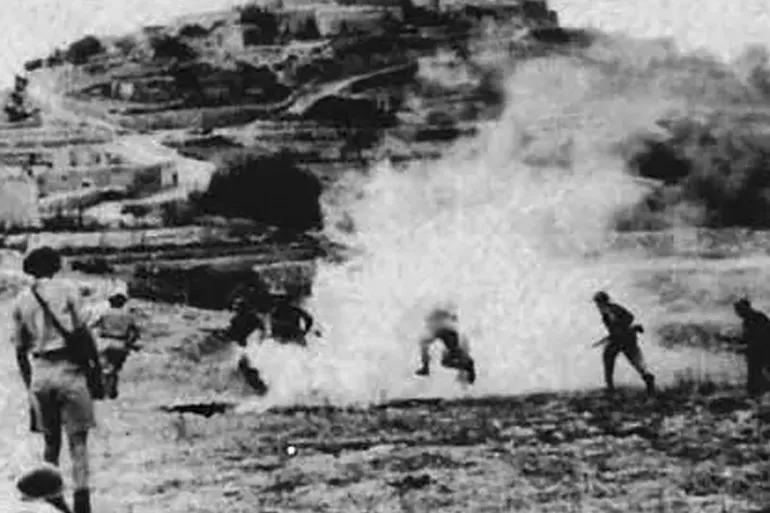
Latrun is a hill and crossroads at the western gateway to the Jerusalem mountains, crowned by a fortified police station and a monastery and surrounded by the villages of Imwas, Yalu and Beit Nuba. Whoever held it held the Jaffa–Jerusalem road, the artery on which the Zionist militias’ convoys depended to supply their settlements in Jerusalem. Between May and July 1948 the militias therefore launched a series of major attacks on it, and the Fourth Battalion of the Jordanian Arab Army under Habis al-Majali beat them back time after time, inflicting more than 1,300 dead according to the Jordanian account; Latrun remained Arab until 1967. [1][2]
Contents
- At a glance
- From Bab al-Wad to Latrun
- Phase one: the May attacks
- Phase two: the attack of 9 June
- Phase three: the July battles
- The men of Latrun
- Latrun after 1948
- Between the accounts
- Timeline
- Frequently asked questions about the battles of Latrun
At a glance
| Item | Details |
|---|---|
| Date | 23 May – 18 July 1948 |
| Place | Latrun and its police station, Bab al-Wad, Yalu, Imwas and Beit Nuba |
| Arab forces | The Fourth Battalion under Habis al-Majali, reinforced by the Second Battalion and later the 5th Company |
| Main attacks | 23, 25 and 30 May, 9 June, and 13–18 July 1948 |
| Enemy losses | More than 1,300 dead across all the Latrun battles, according to the Jordanian account |
| Martyrs | About 30 Jordanian soldiers, together with fighters and civilians from Imwas |
| Outcome | Latrun held and remained in Arab hands until 1967 |
From Bab al-Wad to Latrun
Before the Arab armies entered, fighters from the neighbouring villages, together with Sheikh Haroun bin Jazi’s volunteers and the Holy Jihad forces, cut the Jerusalem road at Bab al-Wad, attacking convoys and blowing up water pipes, and held the position until the Jordanian army took it over on 15 May 1948. [3][2]
On 22 May the Fourth Battalion occupied Latrun, and on 24 May the Second Battalion reinforced it at Bab al-Wad and Yalu. Latrun commanded the Tel Aviv–Jerusalem road, so breaking it became a precondition for getting supplies to the besieged settlements in Jerusalem. [1]
Phase one: the May attacks
23 May: a battalion of the Alexandroni Brigade tried to seize the Latrun police station and village; the Jordanian forces let it advance until, at about four in the morning, it came within their field of fire, and hundreds of its men fell. [1]
24 May: a 42-man patrol under First Lieutenant Qasim al-Ayed went out to gather intelligence near Artuf and blow a bridge; on its way back it clashed with a Zionist force, killing at least fifty, while four of its men were martyred and two wounded. [1]
25 May: at 3:30 in the morning the 7th Brigade attacked the Fourth Battalion’s positions and was forced to withdraw, leaving behind 800 dead and much equipment and weaponry; three Jordanian soldiers were martyred. The next day the Fourth Battalion attacked a position north of the Jerusalem road, expelled its garrison and seized Radar Hill in the Biddu area. [1]
30 May: at nine in the evening a new attack began with a Givati battalion and an armoured unit; it was repulsed, the attackers losing 161 dead besides their wounded, and Jordanian forces captured weapons and vehicles, while four men of the Fourth Battalion were martyred. [1]
On 1 June King Abdullah visited Latrun and praised the Fourth Battalion, telling its commander that “your Fourth Battalion is the winning battalion.” [1]
Phase two: the attack of 9 June
On 9 June 1948, two days before the truce, came the third major attack, by the Harel and Yiftah brigades, with one battalion heading for Yalu. Jordanian forces repulsed it, and the attackers left 97 bodies on the field besides those they carried off; among their dead was David Marcus, who had taken command of the front on 28 May. [1]
Jordanian forces captured 120 rifles, 5 machine guns, two wireless sets and large quantities of ammunition. Seven soldiers, a transport soldier, four fighters and a civilian from Imwas were martyred, and 16 were wounded, two of them fighters. On 10 June the 5th Company arrived to reinforce the Fourth Battalion; a shell killed four of its soldiers and wounded three. The first truce began on 11 June. [1]
Phase three: the July battles
When the first truce ended, the militias returned on 13 July to try to encircle Latrun as part of Operation Dani, having occupied Lydda and Ramla. The Jordanian defence line ran from Beit Nabala and Qula in the north to Salfit and Beit Nuba in the south. Battles were fought at Yalu on 15 July, at Qula and al-Burj on 16 July, then at Ras Karkar and al-Safa, and at Latrun on 18 July; eight Jordanian soldiers were martyred and five wounded. [1][2]
The operation failed to reach Latrun, and the militias resorted to cutting a mountain bypass around Bab al-Wad, known as the “Burma Road,” though its usefulness remained limited. [2]
The men of Latrun
The Jordanian army’s record names among those who distinguished themselves at Latrun: the Fourth Battalion’s commander Habis al-Majali; Lieutenant Hamdan al-Sabih, commander of the armoured platoon; Sergeant Yousef Jeries; Lieutenants Muhammad al-Mahasneh and Turki Yousef al-Hindawi; Captains Saleh al-Eid and Izzat Hassan; Sergeant Yousef Saab; and from the Second Battalion Captain Rafifan Khaled al-Harisha and Ali Mithqal al-Fayez. [1]
Among the martyrs were Lieutenant Abd al-Majid al-Ma’ayta, commander of the guard platoon at the Latrun police station, and Private First Class Mahmoud Ali al-Rousan, martyred inside the station while defending it. [1]
Latrun after 1948
Latrun and the villages of Imwas, Yalu and Beit Nuba remained in Arab hands after the Nakba, but the aggression returned in June 1967. On 6 June 1967 some ten thousand inhabitants of the three villages were driven out and the villages were bulldozed, and the so-called “Canada Park” was built on their land – the occupation took in 1967 what it had failed to take in 1948. [4]
Between the accounts
Enemy losses: the Jordanian army’s figures (hundreds on 23 May, 800 on 25 May, 161 on 30 May, 97 bodies on 9 June) add up to more than 1,300 dead, and the same source says more than 700 fell in the first battle. Its breakdown of the 30 May losses does not match the total it gives, so the figures remain estimates. [1]
Date of the Battle of Latrun: the Al Jazeera Encyclopedia dates the battle from 15 to 23 May 1948, while the Jordanian army’s record begins with the first major attack on 23 May and runs to 18 July. [2][1]
Timeline
| Date | Event |
|---|---|
| 15 May 1948 | The fighters hand Bab al-Wad over to the Jordanian army [3] |
| 22 May 1948 | The Fourth Battalion occupies Latrun [1] |
| 23 May 1948 | Alexandroni attack on the police station repulsed [1] |
| 25 May 1948 | 7th Brigade attack repulsed with 800 enemy dead [1] |
| 26 May 1948 | Radar Hill captured [1] |
| 30 May 1948 | Givati and armoured attack repulsed [1] |
| 9 June 1948 | Harel and Yiftah attack repulsed [1] |
| 11 June 1948 | The first truce begins [1] |
| 13–18 July 1948 | Battles of Yalu, Qula, al-Burj and Latrun during Operation Dani [1] |
| 6 June 1967 | Expulsion of the people of Imwas, Yalu and Beit Nuba [4] |
Frequently asked questions about the battles of Latrun
Why was Latrun important in 1948?
Because it commanded the Jaffa–Jerusalem road on which the militias’ convoys depended to supply their settlements in Jerusalem. [1][2]
Who defended Latrun?
The Fourth Battalion of the Jordanian Arab Army under Habis al-Majali, reinforced by the Second Battalion, alongside fighters from Imwas and neighbouring villages. [1]
How many attacks were repulsed at Latrun?
Four major attacks were repulsed on 23, 25 and 30 May and 9 June, followed by the Operation Dani attacks in July 1948. [1]
What was the “Burma Road”?
A mountain bypass the militias cut around Bab al-Wad after failing to break through at Latrun; its usefulness remained limited. [2]
When was Latrun occupied?
In the June 1967 war, when the people of Imwas, Yalu and Beit Nuba were expelled and their villages destroyed. [4]
Read also on Palestinuna
Sources and references
- General Command of the Jordanian Armed Forces, “The 1948 War” (in Arabic).
- Al Jazeera Encyclopedia, “The Battle of Bab al-Wad: the war that delayed Israel’s occupation of Jerusalem,” 12 September 2025 (in Arabic).
- WAFA – Palestinian National Information Centre, “Battles of the Nakba”: “The Battles of Bab al-Wad” (in Arabic).
- Al-Haq, “The Ghost of the Latroun Area,” 13 June 2013.
More from the archive
The Battles of Radar Hill 1948: The Yarmouk Battalion and Biddu's Fighters Retake the Hill
 Al-Quds (Jerusalem)
Battle of Shu'fat 1948: The Holy Jihad Destroys the Neve Yaakov Convoy North of Jerusalem
 Al-Quds (Jerusalem)
The Battles of Bab al-Wad 1948: Fighters Shut "the Key to Jerusalem" to Zionist Convoys
 Download Our Palestine App
The whole archive in the palm of your hand: depopulated villages, the Nakba, the massacres and Al-Aqsa — free, with no ads to erase the story.



Comments
No comments yet — be the first to write one.
Add your comment
Name and email are optional. Comments appear after review.