
The Battles of al-Shajara 1948: The Galilee Front Where Abd al-Rahim Mahmoud Fell
Al-Shajara was a Palestinian village in the Tiberias district, south-west of the town between Nazareth and Tiberias, and from the start of the war it was a vital crossroads for both sides. In 1948 it therefore became one of the longest and fiercest fronts in Lower Galilee: the Haganah attacked it in February and returned in June and July with heavy artillery and aircraft, while its people, fighters from Lubya and the neighbouring villages and the Arab Liberation Army fought for it. The poet Abd al-Rahim Mahmoud was martyred on its soil before it fell in mid-July, and Nazareth with it. [1][2][3]
Al-Shajara was also the birthplace of the cartoonist Naji al-Ali, who as a child drew rural scenes on the village’s gates in lime chalk, according to his childhood friend Hani Dhiyabat. [4][2]
Contents
- At a glance
- The February attack
- The June battles
- The July battles and the fall
- The martyr-poet Abd al-Rahim Mahmoud
- Al-Shajara after the Nakba
- Between the accounts
- Timeline
- Frequently asked questions about the battles of al-Shajara
At a glance
| Item | Details |
|---|---|
| Date | 17 February, 9–11 June and 8–18 July 1948 |
| Place | Al-Shajara and the neighbouring settlement of Sejera, Khirbat Ras Ali and Tall al-Tin, Tiberias district |
| Arab forces | The people of al-Shajara, fighters from Lubya and the neighbouring villages, and the “Hittin Army” of the Arab Liberation Army |
| Attackers | Haganah forces of more than 1,500 fighters, joined in July by aircraft and heavy artillery |
| Defenders’ arms | About a hundred rifles in the village |
| Notable martyr | The poet First Lieutenant Abd al-Rahim Mahmoud, on 13 July 1948 |
| Outcome | Al-Shajara fell on 15 July 1948 and Nazareth on 16 July |
The February attack
On 17 February 1948 the Haganah attacked al-Shajara as part of its attempt to take Lower Galilee, blowing up two houses to terrorise the villagers into leaving. But the villagers chose to fight: they sent out the women, children and elderly, and the men able to bear arms stayed behind, with some who prepared their food. [2]
The village had about a hundred rifles against more than 1,500 Zionist fighters; the villagers held out until their ammunition ran out and some of them were martyred. [2]
The June battles
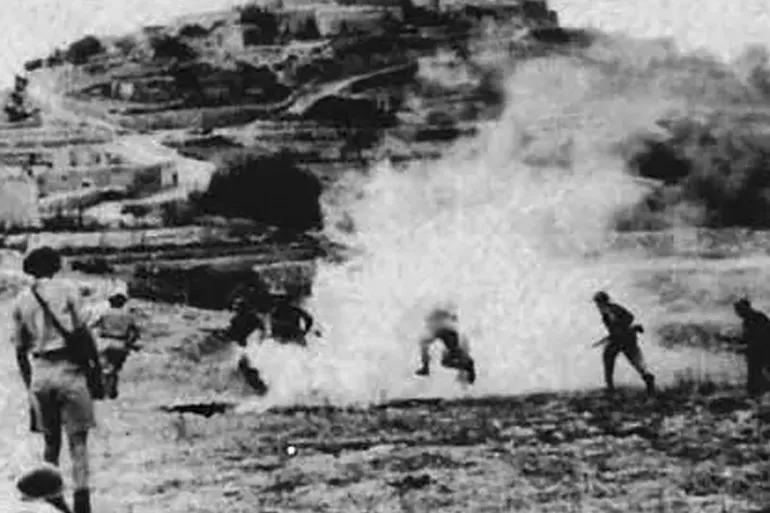
On 9 June 1948 the militias occupied several villages in the area, cutting off Nazareth, and attacked Lubya and the neighbouring villages. The commander of the Arab Liberation Army prepared the forces of the “Hittin Army” to destroy the Zionist forces in the al-Shajara area, and the attack began on 10 June, the infantry advancing with artillery and armoured-car support. [1][2]
The Arab attackers suffered heavy losses crossing open ground under fire, but the roar of the artillery drew fighters from the neighbouring villages, whose assault was fierce and swift; the Zionist forces began falling back towards al-Shajara, and the Arab forces pursued them and shelled the Sejera settlement. Fighting then stopped with the start of the first truce on 11 June. [1][2]
The militias did not respect the truce, attacking al-Shajara and other villages during it; the Arab Liberation Army thwarted the attack, and when on 20 June the militias seized Khirbat Ras Ali, it drove them out with a counter-attack. [1]
The July battles and the fall
On the morning of 8 July 1948, a day before the truce expired, the militias attacked first and the battle flared at al-Shajara; Zionist warplanes and heavy artillery appeared on this front for the first time, the aircraft bombing the neighbouring villages heavily. The fighting went on without pause, and the Arab forces’ ammunition began to run out fast. [1][2]
Withdrawal from al-Shajara meant the fall of Nazareth, so the Arab Liberation Army threw all its units into an attack on the Sejera base. On the night of 13 July the Arab forces advanced through heavy fire and took al-Shajara the same day after severe losses, inflicting heavy casualties on the militias and wounding some of their commanders. [1][2]
But the militias regrouped and attacked from the direction of Kafr Sabt, and on 14 July they shelled the positions of the fighters and the Arab Liberation Army with heavy artillery, killing many, while the Arabs retook Tall al-Tin on 15 July. The same day the fall of al-Shajara was announced; Nazareth fell on 16 July, along with Lubya, Nimrin and Tur‘an, and the Arab Liberation Army withdrew on 18 July under cover of a Yemeni unit and a Bedouin unit, before fighting stopped with the second truce. [1][2]
The martyr-poet Abd al-Rahim Mahmoud
Abd al-Rahim Mahmoud was born in Anabta, Tulkarm district, in 1913. He taught Arabic language and literature at the National Najah School in Nablus, joined the revolt from 1937, and later graduated from the Military College in Baghdad as a lieutenant. He joined the Arab Liberation Army in 1948, completed the officers’ course at Qatana camp near Damascus in mid-January, and returned to Palestine as commander of a company in the “Hittin Brigade,” being promoted to first lieutenant and adjutant to the brigade commander in May 1948. [3]
On 13 July 1948, during the Hittin Brigade’s attack on the Sejera settlement near al-Shajara, he was struck by a shell and martyred; he was buried in Nazareth. He lived on the battlefield what he had written in his poetry, where self-sacrifice was word and deed alike, and he became a symbol of Palestinian resistance poetry; in 1990 the PLO awarded him the Jerusalem Medal for Culture, Arts and Literature. [3]
Al-Shajara after the Nakba
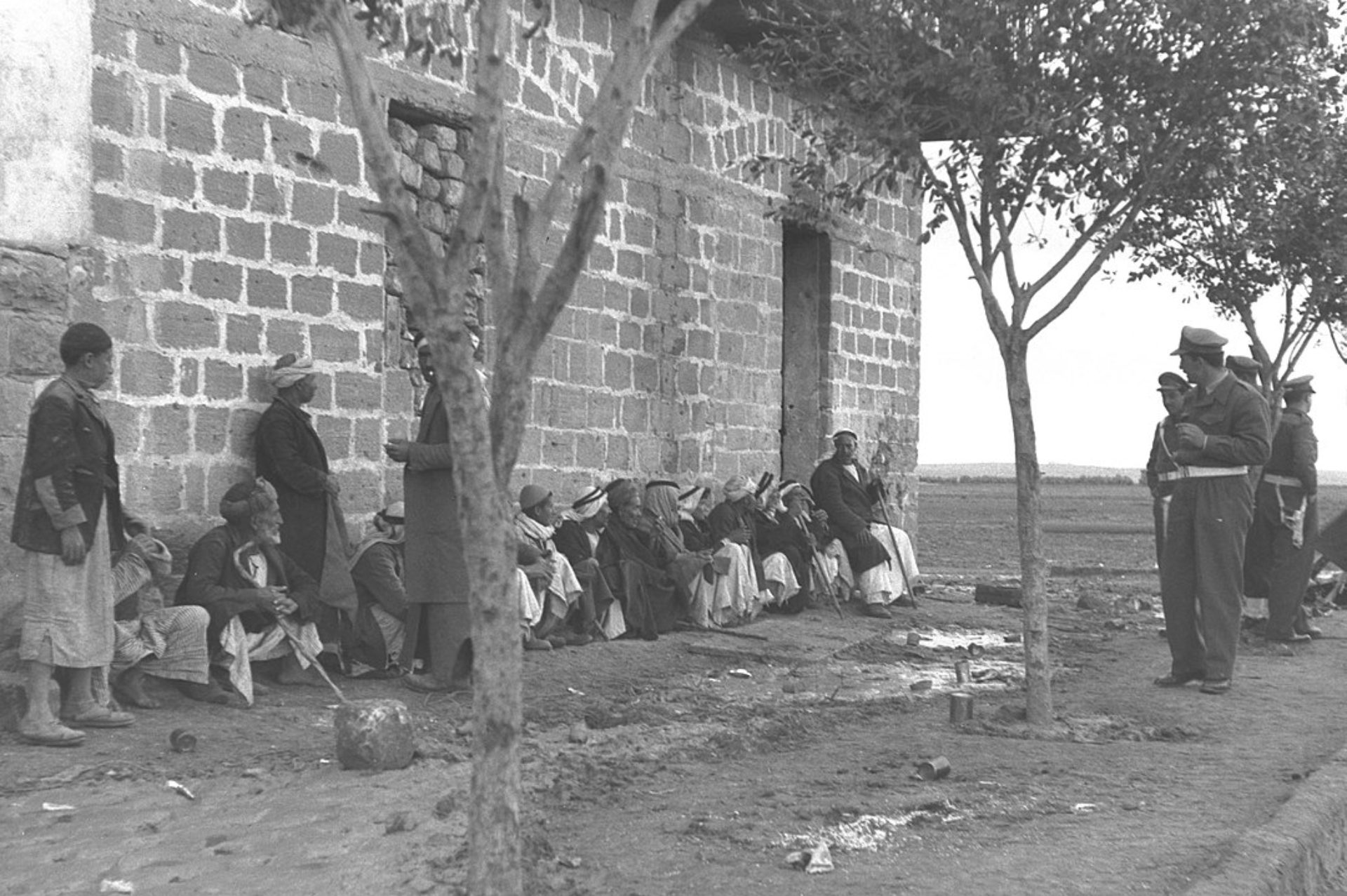
The people of al-Shajara were expelled, and the occupation authorities destroyed its houses and landmarks. Hani Musa Dhiyabat, a childhood friend of Naji al-Ali, recalls that occupation snipers killed his aunt and her fiancé as they fled with a column of the displaced, that his grandfather went back by night to carry their bodies home and bury them, and that twenty of the defenders were martyred on the last day of the village’s defence. [4]
Nothing remains of the village but the rubble of its houses, an olive press, the Ain al-Balad spring and a family cemetery surrounded by olive, fig and cactus trees; its primary school is now a heap of stones. [4]
Between the accounts
Number of martyrs: Arabi Post says 300 martyrs from the village and beyond fell in the second phase of the fighting, without naming its source; WAFA gives no figure. [2][1]
“Taking al-Shajara” on 13 July: WAFA says the Arab forces took al-Shajara on 13 July, while the biography of Abd al-Rahim Mahmoud says the attack that day was on the Sejera settlement next to the village. [1][3]
Timeline
| Date | Event |
|---|---|
| 17 February 1948 | Haganah attack on al-Shajara; two houses blown up [2] |
| 9 June 1948 | Villages around Nazareth occupied; attack on Lubya [1] |
| 10 June 1948 | Hittin Army attack; militias pursued to Sejera [1] |
| 11 June 1948 | First truce begins; an attack during it is thwarted [1] |
| 20 June 1948 | Militias driven out of Khirbat Ras Ali [1] |
| 8 July 1948 | Surprise attack before the truce ends; aircraft appear [1] |
| 13 July 1948 | Attack on Sejera; Abd al-Rahim Mahmoud martyred [3] |
| 15 July 1948 | Tall al-Tin retaken; fall of al-Shajara announced [2] |
| 16 July 1948 | Fall of Nazareth [1] |
| 18 July 1948 | Arab Liberation Army withdraws [1] |
Frequently asked questions about the battles of al-Shajara
Where is al-Shajara?
In the Tiberias district, south-west of the town, between Nazareth and Tiberias. [1]
When did al-Shajara fall?
Its fall was announced on 15 July 1948, after battles that began in February and resumed in June and July. [2]
Where was the poet Abd al-Rahim Mahmoud martyred?
On 13 July 1948 during the Hittin Brigade’s attack on the Sejera settlement near al-Shajara; he was buried in Nazareth. [3]
What is Naji al-Ali’s connection to al-Shajara?
He was born there, and as a child drew on the gates of its houses in lime chalk. [4]
Why were the al-Shajara battles decisive?
Because al-Shajara was a crossroads between Nazareth and Tiberias, and its fall meant the fall of Nazareth, which happened on 16 July 1948. [1]
Read also on Palestinuna
Sources and references
- WAFA – Palestinian National Information Centre, “Battles of the Nakba”: “The Battles of al-Shajara” (in Arabic).
- Arabi Post, “Twice the Palestinians nearly won it: the Battle of al-Shajara, won by the Haganah after it broke the truce,” 8 November 2023 (in Arabic).
- PalQuest, Interactive Encyclopedia of the Palestine Question, Institute for Palestine Studies: “Abd al-Rahim Mahmoud”.
- Al Jazeera Net, “Jews and Arabs meet in Naji al-Ali’s birthplace,” 27 November 2006 (in Arabic).
More from the archive
 Download Our Palestine App
The whole archive in the palm of your hand: depopulated villages, the Nakba, the massacres and Al-Aqsa — free, with no ads to erase the story.



Comments
No comments yet — be the first to write one.
Add your comment
Name and email are optional. Comments appear after review.