
Martyrdom Operations in Palestine 1993–2005: Context, Major Operations
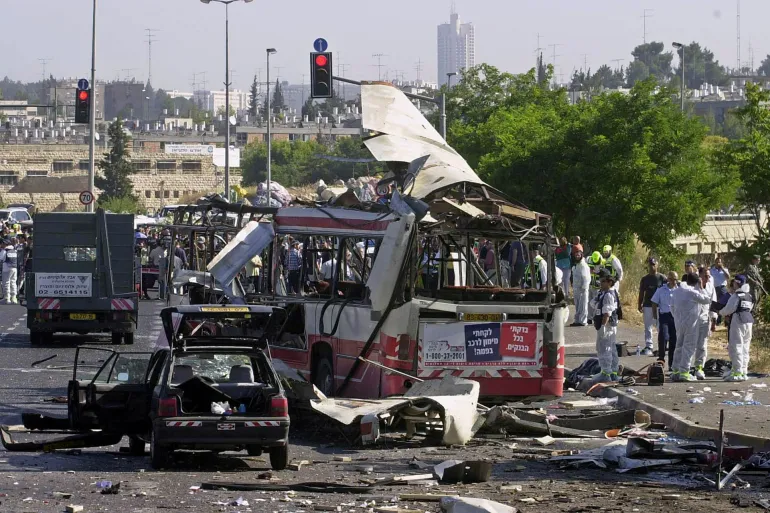
“Martyrdom operations” is the name Palestinian resistance factions gave to attacks in which the perpetrators blew themselves up with explosive belts or car bombs; the occupation and Western media call them “suicide attacks.” Palestine saw such operations from 1993; they peaked during the al-Aqsa Intifada between 2000 and 2004, and then declined. [1]
This article examines the phenomenon as it was: the context in which it arose, the crimes the factions presented it as answering, the most prominent operations, and the Palestinian, Arab and religious debate around it. Many of these operations were directed at civilian places such as buses, markets and restaurants, and civilians were killed in them – which made them among the most contested chapters of the Intifada. [2][3]
Contents
- At a glance
- Origins: from Mehola to Afula
- Between Oslo and the Intifada
- The peak in the al-Aqsa Intifada
- The most prominent operations
- The operations in detail
- Timeline
- Frequently asked questions about martyrdom operations
At a glance
| Item | Details |
|---|---|
| First attempt | 1986, an Islamic Jihad car bomb foiled before it was carried out |
| First successful operation | 16 April 1993, a car bomb near the Mehola settlement in the Baysan valley |
| Before the al-Aqsa Intifada | 30 attempts from 1993, 24 of them carried out |
| September 2000 – end of 2001 | 48 operations |
| By 1 April 2002 | 153 attempts: 102 carried out and 51 foiled |
| Main factions | The Qassam Brigades, the al-Quds Brigades and the al-Aqsa Martyrs’ Brigades |
| Name | “Martyrdom” for the factions, “suicide” for the occupation and Western media |
Origins: from Mehola to Afula
The Al Jazeera Encyclopedia says the first attempt came in 1986, when Islamic Jihad’s Saraya planned a car bomb that was foiled before it was carried out. It credits the first successful operation to Yahya Ayyash, the Qassam Brigades’ engineer, on 16 April 1993: a car bomb detonated between two military buses near the Mehola settlement in the Baysan valley, killing and wounding dozens of soldiers. [1][4]
Then came the Ibrahimi Mosque massacre in Hebron in February 1994, when a settler opened fire on worshippers at dawn prayer. The Qassam Brigades presented the Afula operation of 6 April 1994 as a response to the massacre; it struck the central bus station inside the Green Line, and 8 Israelis were killed. [4]
Between Oslo and the Intifada
On 5 January 1996 Israeli intelligence assassinated Yahya Ayyash by booby-trapping his mobile phone. The Qassam Brigades replied with a series of operations they called “Holy Revenge,” planned and directed by Hassan Salameh, now serving 48 life sentences, in Jerusalem, Ashkelon and Tel Aviv; about 60 Israelis were killed and 210 wounded, among them soldiers. [4][5]
The peak in the al-Aqsa Intifada
With the outbreak of the al-Aqsa Intifada in September 2000, in response to Ariel Sharon’s storming of al-Aqsa Mosque, and the killing of demonstrators, assassinations and incursions that followed, the operations returned with unprecedented intensity. From September 2000 to the end of 2001, 48 were carried out; by 1 April 2002 there had been 153 attempts, 102 carried out and 51 foiled. [1]
Women entered this path for the first time in January 2002 with Wafa Idris, followed by Darin Abu Aisheh, Ayat al-Akhras and others. The most violent operations coincided with the occupation’s invasion of West Bank cities in spring 2002, including Jenin and Nablus. [2]
The most prominent operations
The table sets out the most prominent operations as documented by Arab sources, with their dates, places, the groups that claimed them and their toll: [4][5][2][1][6][7]
| Date | Place | Perpetrator / group | Toll | Stated context |
|---|---|---|---|---|
| 16 April 1993 | Near Mehola, Baysan valley | Saher Hamdallah al-Tamam | Soldiers killed and wounded | First successful operation |
| 6 April 1994 | Afula central bus station | Raed Zakarneh | 8 killed | Response to the Ibrahimi Mosque massacre |
| 13 April 1994 | Hadera bus station | Ammar Amarneh | 7 killed, dozens wounded | – |
| 19 October 1994 | Dizengoff Street, Tel Aviv | Saleh Nazzal | 22 killed | – |
| 22 January 1995 | Beit Lid junction near Netanya | Anwar Sukkar and Salah Shaker | 23 soldiers killed, about 40 wounded | Military target: a soldiers’ stop |
| 24 July 1995 | Bus in Ramat Gan | Labib Saeed Azem | 6 killed, 33 wounded | – |
| February–March 1996 | Jerusalem, Ashkelon and Tel Aviv | Majdi Abu Warda, Ibrahim al-Sarahneh (disguised as an Israeli soldier), Raed al-Shaghnoubi | About 60 killed, 210 wounded | “Holy Revenge” for Ayyash’s assassination |
| 1 June 2001 | Dolphinarium nightclub, Tel Aviv | Saeed al-Hotari | 21 killed, 120+ wounded | – |
| 27 January 2002 | Jaffa Street shopping area, West Jerusalem | Wafa Idris | 1 killed, 100+ wounded | First woman to carry out such an operation |
| 27 March 2002 | Park Hotel, Netanya | Abdel-Basset Odeh | 29 killed, 100+ wounded | Eve of the Arab summit in Beirut |
| 29 March 2002 | Supermarket in Kiryat Yovel, West Jerusalem | Ayat al-Akhras | 2 killed, 20+ wounded | Day the “Defensive Shield” invasion began |
| April 2002 | Bus stop, West Jerusalem | Andaleeb Takatka | 6 killed, 60+ wounded | Coincided with the invasion of Jenin and Nablus |
| 5 June 2002 | Bus at Megiddo junction | Hamza Samoudi | 17 killed, 13 of them soldiers | Most of the dead were soldiers |
| 18 June 2002 | Bus from the Gilo settlement, Jerusalem | Muhammad al-Ghoul | 19 killed, about 50 wounded | – |
| 4 October 2003 | Maxim restaurant, Haifa | Hanadi Jaradat | 21 killed | After her brother and cousin were assassinated |
The operations in detail
Below are the details of each operation in the table, as reported in Arab sources and human-rights reports, with the context in which it came and the occupation’s measures that followed.
Mehola, 16 April 1993
The first successful operation of its kind, planned by Yahya Ayyash and carried out by Saher Tamam with a car bomb near the Mehola settlement in the Baysan valley. Sources describe it differently: the Al Jazeera Encyclopedia’s biography of Ayyash says it targeted a café in the settlement, killing two and wounding eight, while another of its entries says it was detonated between two military buses. [4][1]
Afula, 6 April 1994
About forty days after the Ibrahimi Mosque massacre, in which the settler Baruch Goldstein shot worshippers at dawn prayer, Raed Zakarneh of the Qassam Brigades set off a car bomb at Afula’s central bus station inside the Green Line, killing 8 Israelis. The Qassam Brigades presented it as a response to the massacre. [4]
Hadera, 13 April 1994
A week after Afula, Ammar Amarneh of the Qassam Brigades blew himself up at a bus station in Hadera, killing 7 and wounding dozens. [4][5]
Dizengoff Street, 19 October 1994
A year after the Oslo accords were signed, Saleh Nazzal of the Qassam Brigades blew himself up on bus No. 5 on Dizengoff Street in central Tel Aviv, with a device prepared by Yahya Ayyash; 22 Israelis were killed and 50 wounded. It was the first operation of its kind in Tel Aviv. [4][8]
Beit Lid, 22 January 1995
Two Islamic Jihad bombers carried out a double bombing at Beit Lid junction near Netanya, at a stop where soldiers gathered; 23 soldiers were killed and about 40 wounded.
Ramat Gan, 24 July 1995
One of Yahya Ayyash’s students in the Qassam Brigades blew himself up on a bus in Ramat Gan near Tel Aviv, killing 6 and wounding 33. [4]
“Holy Revenge,” February–March 1996
After Israeli intelligence assassinated Yahya Ayyash on 5 January 1996 by booby-trapping his phone, the Qassam Brigades launched the “Holy Revenge” series, planned by Hassan Salameh, who moved from Gaza to the West Bank on the orders of the commander-in-chief Mohammed Deif. Al Jazeera Net lists four operations in it: [4][5]
- Majdi Abu Warda on a bus in Jerusalem: 24 killed, 13 of them soldiers, and more than 50 wounded.
- Ibrahim al-Sarahneh at a junction in Ashkelon about half an hour later: 3 soldiers killed and 30 wounded.
- Raed al-Shaghnoubi on a bus in Jerusalem: 19 killed and 10 wounded.
- Ramez Obeid of Islamic Jihad at the entrance to the Dizengoff Center shopping mall in Tel Aviv, on 4 March 1996: 13 killed and about 130 wounded.
Hassan Salameh was sentenced to 48 life terms. Al Jazeera Net quotes Rabin as saying, “What can I do against a person who wants to die?” and cites a survey in which 42% of Israelis said they wished to emigrate. [5][8]
The Dolphinarium, 1 June 2001
In the ninth month of the al-Aqsa Intifada, Saeed Hassan Hussein al-Hotari, 22, from the city of Qalqilya, blew himself up amid a crowd of young people outside the Dolphinarium nightclub on the Tel Aviv seafront. The Qassam Brigades claimed it with a will signed in their name, after Islamic Jihad had first claimed it. 21 Israelis were killed, most of them teenagers, and more than 120 wounded. [10][6][7]
Jaffa Street, 27 January 2002
Wafa Ali Idris, from al-Am’ari camp near Ramallah and a volunteer with the Palestinian Red Crescent Society, was the first Palestinian woman to carry out such an operation, and it was the first martyrdom operation claimed by Fatah’s al-Aqsa Martyrs’ Brigades. The blast struck the Jaffa Street shopping area in West Jerusalem, killing an 81-year-old Israeli and wounding more than 100. [11][6]
Park Hotel, Netanya, 27 March 2002
Abdel-Basset Odeh, 25, from Tulkarm and a Hamas member, blew himself up in the dining hall of the Park Hotel in Netanya during a Passover dinner; 29 were killed and more than 100 wounded. Hamas said one of its aims was to thwart the diplomatic initiatives on the table at the Arab summit in Beirut. Two days later the occupation began its invasion of West Bank cities, which it called “Defensive Shield.” [6][12][8]
Kiryat Yovel, 29 March 2002
On the day the invasion of the West Bank began, Ayat al-Akhras, 18, from Dheisheh camp near Bethlehem, blew herself up in a supermarket in the Kiryat Yovel neighbourhood of West Jerusalem, killing two and wounding more than 20. The al-Aqsa Martyrs’ Brigades claimed the operation. [6][7]
Bus stop in West Jerusalem, 12 April 2002
While Jenin camp was under siege, Andaleeb Takatka of the al-Aqsa Martyrs’ Brigades blew herself up at a bus stop in West Jerusalem, killing 6 and wounding more than 60. [2]
Megiddo junction, 5 June 2002
An Islamic Jihad bomber detonated a car bomb next to a bus bound for Tiberias at Megiddo junction; 17 were killed, 13 of them soldiers, and about 38 wounded. Hours later about 30 Israeli tanks, backed by Apache helicopters, stormed the city of Jenin. [7][13]
The Gilo bus, 18 June 2002
Muhammad al-Ghoul, 23, from al-Far’a camp in the northern West Bank, blew himself up on a bus travelling from the Gilo settlement to Jerusalem; 19 were killed and about 50 wounded. The Qassam Brigades claimed the operation; occupation forces arrested his brother Iyad, and Sharon vowed to retaliate. [14][6]
Maxim restaurant, 4 October 2003
On 12 June 2003 an Israeli undercover unit assassinated Hanadi Jaradat’s brother and cousin, both Islamic Jihad members, outside the family home in Jenin and before her eyes. Months later, having just graduated from law school in Jordan, she blew herself up in the Maxim restaurant in Haifa; 21 were killed according to the Al Jazeera Encyclopedia, among them 5 Palestinian citizens of the occupied interior, and about 50 wounded. The occupation responded by shelling and demolishing an empty house in Gaza and storming Jenin and Tulkarm camp, where it killed an al-Aqsa Brigades fighter and a nine-year-old child. [15][1]
Timeline
| Date | Event |
|---|---|
| 1986 | First car-bomb attempt foiled before execution [1] |
| 16 April 1993 | First successful operation near Mehola [1] |
| February 1994 | The Ibrahimi Mosque massacre in Hebron [4] |
| 6 April 1994 | The Afula operation in response to the massacre [4] |
| 5 January 1996 | Yahya Ayyash assassinated [4] |
| February–March 1996 | The “Holy Revenge” operations [5] |
| September 2000 | The al-Aqsa Intifada erupts [1] |
| January 2002 | Wafa Idris becomes the first woman to carry out such an operation [2] |
| 4 October 2003 | The Maxim restaurant operation in Haifa [1] |
Frequently asked questions about martyrdom operations
What were martyrdom operations?
Attacks in which the perpetrators blew themselves up with explosive belts or car bombs; the factions call them “martyrdom” and the occupation “suicide” operations. [1]
When did they begin?
The first attempt was in 1986 and the first successful operation on 16 April 1993 near the Mehola settlement. [1]
Why did the factions resort to them?
They presented them as a response to the occupation’s massacres and assassinations, such as the Ibrahimi Mosque massacre and the killing of Yahya Ayyash, and to the repression of the al-Aqsa Intifada. [4][5]
Who was the first woman to carry out such an operation?
Wafa Idris, in West Jerusalem in January 2002. [2]
Read also on Palestinuna
Sources and references
- Al Jazeera Encyclopedia, “A history of fedayeen operations against Israel from the First Intifada to the Al-Aqsa Flood” (in Arabic).
- Al Jazeera Net, “The main events of the second year of the Intifada,” 3 October 2004 (in Arabic).
- Al Jazeera, “The Opposite Direction,” episode “Martyrdom operations,” 4 June 2004 (in Arabic).
- Al Jazeera Encyclopedia, “Yahya Ayyash: the engineer of martyrdom operations against Israel,” 25 September 2014 (in Arabic).
- Al Jazeera Net, “A quarter-century since the ‘Holy Revenge’ operations avenging Yahya Ayyash,” 30 March 2021 (in Arabic).
- Human Rights Watch, report on suicide bombing attacks against Israeli civilians, 2002 (Arabic edition).
- Human Rights Watch, appendix: chronology of suicide bombings, 2002 (Arabic edition).
- Al Jazeera Net, “The Dizengoff Street operation: Israelis recall major martyrdom operations in the heart of Tel Aviv,” 8 April 2022 (in Arabic).
- Al Jazeera Net, “Kill him outside Damascus: five bullets in Shaqaqi’s head,” 11 May 2020 (in Arabic).
- Al-Jazirah (Saudi Arabia), 8 June 2001 (in Arabic).
- Al-Jazirah (Saudi Arabia), 31 January 2002 (in Arabic).
- Institute for Palestine Studies, Palestine chronology, 27 March 2002.
- Gulf News, “June 5, 2002: Israel storms Jenin after bomb kills 16”.
- Arab News, “Bus blast kills 20 in Jerusalem,” 19 June 2002.
- Institute for Palestine Studies, Palestine chronology, 4 October 2003.
- Arabi21 (via Noon Post), “Scholars and preachers defend al-Qaradawi’s fatwa on martyrdom operations,” 8 July 2016 (in Arabic).
More from the archive
 Download Our Palestine App
The whole archive in the palm of your hand: depopulated villages, the Nakba, the massacres and Al-Aqsa — free, with no ads to erase the story.



Comments
No comments yet — be the first to write one.
Add your comment
Name and email are optional. Comments appear after review.