
Maqam al-Nabi Musa

Maqam al-Nabi Musa: The Shrine of Prophet Moses near Jericho
Maqam al-Nabi Musa (the Shrine of Prophet Moses) is one of the largest and best-known shrines in Palestine. It stands in the wilderness between Jerusalem and Jericho, where local Muslim tradition places the tomb of Moses. The Mamluk sultan al-Zahir Baybars built it in 1269–70, and later Mamluk and Ottoman rulers enlarged it into a domed complex of courtyards, a mosque and about a hundred rooms. For centuries it hosted the Nabi Musa festival, the largest popular gathering in Palestine, which turned into a national occasion under the British Mandate. This guide covers the shrine's history, architecture, the festival and its situation under occupation.
Quick facts
| Arabic name | مقام النبي موسى |
|---|---|
| Location | Jerusalem wilderness, south of Jericho, east of Jerusalem |
| Distance | 8–11 km from Jericho; 20–28 km from Jerusalem (sources differ) |
| Founder | Mamluk sultan al-Zahir Baybars, 668 AH / 1269–70 CE |
| Expansions | Mamluk hospice (1470–1480); Ottoman restorations in the 16th century and around 1820 |
| Area | About 5 dunums |
| Main elements | Mosque with five aisles, tomb chamber, minaret, courtyards, about 100 rooms |
| Festival | Annual week-long Nabi Musa season in spring |
| Administration | Palestinian Ministry of Awqaf; surroundings mostly in Area C |
| Nearby | Shrine cemetery; "Nabi Musa stones" (bituminous shale) |
Location
The shrine stands on a rise of sulphurous, sedimentary hills in the wilderness east of Jerusalem, south of Jericho, just off the old road between the two cities. It is about 8–11 km from Jericho and 20–28 km from Jerusalem, depending on the source. The surrounding land is isolated, with few trees or plants. From the top of its minaret one can see Jericho, the Dead Sea, the open desert and the mountains east of the Jordan.
The region, which extends towards the Dead Sea, was known for its Christian monasteries and hermits' cells. According to historians, one purpose of building such a large shrine here was to assert the Islamic character of the Jerusalem wilderness.
Moses' tomb in tradition
Local Muslim tradition holds that Moses is buried here, although Islamic scholarship generally holds that the exact place of his grave is unknown. A hadith in Sahih al-Bukhari relates that Moses asked God to bring him close to the Holy Land "a stone's throw away", and that the Prophet Muhammad said that if he were there, he would show his companions Moses' grave "by the side of the road, below the red sand hill". The Hebrew Bible says Moses died in the land of Moab, east of the Jordan, and that "no one knows his burial place to this day" (Deuteronomy 34:6). Early pilgrims are said to have used this spot to look across the Jordan Valley towards Mount Nebo.
History through the ages
- Ayyubid period: tradition links the site and its festival to Saladin after he liberated Jerusalem in 1187, but historians generally credit the building to Baybars.
- Mamluk period: Sultan al-Zahir Baybars built the domed tomb and mosque in 668 AH (1269–70 CE), as recorded in an inscription still visible at the shrine. A hospice for pilgrims was completed between 1470 and 1480.
- Ottoman period: the complex was restored in the mid-16th century and almost entirely rebuilt around 1820, taking the form it has today. The Husseini family of Jerusalem served as its custodians.
- British Mandate: the festival became a mass national gathering. The authorities sought to restrict it, especially after the April 1920 events in Jerusalem. After the 1936–39 Revolt and the exile of the Mufti of Jerusalem, it declined.
- 1948–1967: after the occupation of Palestine in 1948 the festival stopped for a time. According to the Palestinian narrative, it resumed in the 1950s. Other sources say large gatherings in Jerusalem were suspended from 1951.
- Since 1967: under occupation the festival was banned. It was permitted in 1987 and then banned again with the First Intifada. It resumed under the Palestinian Authority in 1997, stopped in 2000 with the Second Intifada, and was renewed in 2007.
Architecture
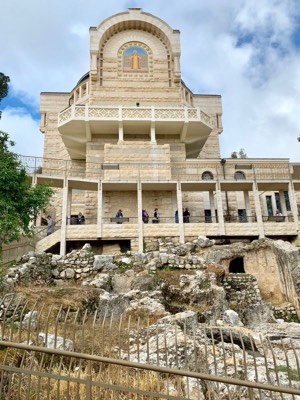
The shrine covers about five dunums. It is a compound of linked buildings crowned with white domes, on three storeys plus a ground-level basement. At its centre is a large mosque of five aisles, with a spacious tomb chamber holding the cenotaph attributed to Moses. Around the mosque and tomb chamber are large central courtyards that can hold great crowds. The complex has about a hundred rooms, some open and some closed, once used to lodge pilgrims during the festival. A medium-height minaret overlooks the area.

A cemetery lies around the shrine, where people from the region were brought for burial near the prophet. Bedouin collected the nearby bituminous shale, known as "Nabi Musa stones", which burns when lit. They used it as fuel and wore it as an amulet.
The Nabi Musa festival
The festival lasted about a week each spring. It began on the Friday before Good Friday in the Orthodox Christian calendar, usually in April, and was partly meant as a Muslim presence in Jerusalem during the Easter pilgrimage.
- The Friday of the Call: a week before the festival, after Friday prayers, the call was proclaimed from the Sharia court hall at Bab al-Silsila, in the presence of the qadi, the Awqaf official, scholars and notables. Jerusalem's families then prepared to receive guests and readied their drums, brass cymbals (kasat) and banners.
- The banners: leading families such as the Husseinis, the Alamis and the Qazzaz each had a banner of its own colour, inscribed with Quranic verses, for example a green banner bearing "There is no god but God". Players struck the cymbals together in rhythm with the drums, and the procession swayed behind the banner, singing religious and patriotic songs on its way to the "House of the Banner" in the Old City.
- The House of the Banner: the house of Hajj Amin al-Husseini served as the House of the Banner until he left Palestine in 1937. From there the procession went to the courtyards of al-Haram al-Sharif, while women greeted it with ululations, rosewater and sugared almonds.
- The villages and cities: delegations from the villages around Jerusalem brought their own banners. These included Lifta, al-Maliha and Qalunya, villages emptied in 1948, as well as Anata, Hizma, Jaba', al-Ram, Silwan, Abu Dis and al-Eizariya.

Dabke dancing, dal'ona and sahjeh songs filled the courtyards. The Hebron delegation entered singing "We the people of Hebron have just arrived; at God's Rock and the Haram we have prayed". The Nablus delegation was greeted by crowds at the edge of Jerusalem and chanted "We are the sons of Jabal al-Nar, a thorn in the throat of colonialism".

After the Nablus and Hebron delegations arrived, on two different days, the celebrations began. Families spent whole days in the courtyards of al-Aqsa with kibbeh, falafel and cheese, and bought liver and fat-tail from butchers and street sellers. On Friday, with all delegations present, the procession left through Bab al-Asbat (Lions' Gate) and went down to the shrine, where pilgrims stayed for several days before returning to Jerusalem.

From festival to national occasion
Under the British Mandate the festival became a platform for Palestinian national demands against the Mandate and the Zionist project. In April 1920 the festival coincided with clashes in Jerusalem, after which the British authorities tightened their control over the processions. The Mufti of Jerusalem, Hajj Amin al-Husseini, gave the season a pronounced national character, and its chants about Jabal al-Nar and colonialism reflect that era. With the 1936–39 Revolt and the Mufti's exile in 1937, the festival lost much of its scale.
Under occupation since 1967
Israeli forces occupied the area in 1967 and banned the festival. Settlements were later built near the shrine on land belonging to its waqf. After the Oslo Accords, the shrine came under the Palestinian Authority in 1995, but about 98% of the surrounding land was classified as Area C, under full Israeli control. Access to the shrine therefore depends on roads controlled by the occupation. In December 2020 a music event held in the shrine's hostel wing caused widespread public anger, and the Palestinian government opened an investigation and pledged to safeguard the site's religious character.

The shrine today (2026)
The shrine is surrounded by accelerating settlement expansion in the area between Jerusalem and the Jordan Valley. On 27 July 2026 settlers set up a new outpost near the shrine. According to the Jerusalem Governorate, the aim is to create "new facts on the ground" and extend control over Palestinian land. Nearby Bedouin communities, such as those around al-Mu'arrajat north-west of Jericho, have faced a wave of new outposts and attacks since 2025, as the genocide war on Gaza has been accompanied by an escalation of settler violence across the West Bank.
Legal protection
As a religious and historic site in occupied territory, the shrine is protected by the 1954 Hague Convention for the Protection of Cultural Property and the Fourth Geneva Convention, which forbids the occupying power from transferring its population into occupied land. UN Security Council Resolution 2334 (2016) confirms that settlements have no legal validity.
Frequently asked questions
Where is Maqam al-Nabi Musa?
In the wilderness between Jerusalem and Jericho, about 8–11 km south of Jericho and 20–28 km east of Jerusalem.
Who built the Nabi Musa shrine?
The Mamluk sultan al-Zahir Baybars built it in 668 AH (1269–70 CE). It was expanded under the Mamluks and largely rebuilt by the Ottomans around 1820.
Is Moses really buried at Nabi Musa?
Local Muslim tradition places his tomb here, but Islamic scholarship holds that the exact place is unknown, and the Bible places his death in Moab, east of the Jordan.
What is the Nabi Musa festival?
A week-long spring season in which processions with banners, drums and songs gathered in al-Aqsa and then went down to the shrine. It became a national occasion under the British Mandate.
What threatens the shrine today?
The surrounding land is mostly in Area C under Israeli control, and settlers set up a new outpost near the shrine in July 2026.
Conclusion
For more than seven centuries the white domes of Nabi Musa have stood in the desert between Jerusalem and Jericho, a shrine that gathered Palestinians from the cities and villages in a season of faith, song and national pride. Today, surrounded by settlement outposts, it remains a witness to the Islamic and Palestinian identity of the Jerusalem wilderness.
Photo gallery


More from the archive


 Download Our Palestine App
The whole archive in the palm of your hand: depopulated villages, the Nakba, the massacres and Al-Aqsa — free, with no ads to erase the story.



Comments
No comments yet — be the first to write one.
Add your comment
Name and email are optional. Comments appear after review.