
The Bahá'í Gardens

The Bahá'í Gardens
The Bahá'í Gardens in Haifa: Terraces of Mount Carmel and the Shrine of the Báb
The Bahá'í Gardens (the Terraces of the Bahá'í Faith) climb the northern slope of Mount Carmel in the Palestinian city of Haifa, occupied in 1948. Nineteen garden terraces run about one kilometre from the foot of the mountain to its summit around the golden-domed Shrine of the Báb, one of the holiest sites of the Bahá'í Faith. The site's history goes back to 1868, when the Ottomans exiled Bahá'u'lláh, the founder of the faith, to Acre. The terraces opened in 2001, and in 2008 UNESCO inscribed them, with the Shrine of Bahá'u'lláh near Acre, on the World Heritage List. This guide covers the gardens' history, design and holy places, and the story of the Palestinian city in which they stand.
Quick facts
| Arabic name | حدائق البهائيين / الحدائق البهائية في حيفا |
|---|---|
| Location | Northern slope of Mount Carmel, Haifa |
| Terraces | 19 terraces, about 1 km long, from the foot to the summit of the mountain |
| Centrepiece | Shrine of the Báb, golden dome with about 12,000 tiles |
| Shrine | Báb's remains interred 21 March 1909; superstructure built 1949–1953 |
| Terraces built | About 1987–2001; opened to the public in May 2001 |
| Cost | About US$250 million (according to press reports) |
| UNESCO | World Heritage since 8 July 2008, with the Bahá'í holy places near Acre |
| Managed by | Bahá'í World Centre, with volunteers from many countries |
| Entry | Outer gardens open daily; guided tours by reservation |
Location
The gardens descend the northern face of Mount Carmel in Haifa, from Yefe Nof Street at the top to the German Colony at the bottom, where they line up with the colony's main avenue (Carmel Avenue) running down towards the port and Haifa Bay. From the upper terraces the view takes in the whole bay as far as Acre, where the other Bahá'í holy places stand.
Why the Bahá'í centre is in Haifa and Acre
- The Báb (1819–1850): the Bahá'í Faith grew out of the movement of the Báb, Ali Muhammad of Shiraz, who announced his mission in Iran in 1844 and was executed in Tabriz in 1850.
- Bahá'u'lláh in Acre: Bahá'u'lláh, the founder of the Bahá'í Faith, was banished from Iran in 1853. At the request of the Persian Shah, the Ottoman authorities exiled him to the prison city of Acre in 1868. He spent the rest of his life in the Acre area, and he died at Bahjí, north of Acre, in 1892.
- Mount Carmel: during his visits to Haifa, Bahá'u'lláh pointed out to his son and successor, Abdu'l-Bahá, the spot on Mount Carmel where the Báb's remains were to be buried.
- Abdu'l-Bahá (1844–1921): he settled in Haifa, and on 21 March 1909 he laid the Báb's remains, brought secretly from Iran, in a mausoleum of local stone. He was himself buried in a room of the shrine in 1921.
The Bahá'í presence in Haifa and Acre thus began in the Ottoman period, decades before 1948, as a result of exile. Today the Bahá'í World Centre is based there, staffed by Bahá'ís from abroad. The Bahá'ís follow a long-standing policy of not seeking converts in the country, and there is no local Bahá'í community.
The Shrine of the Báb
The original shrine, built by Abdu'l-Bahá, was a simple six-room stone building. Under Shoghi Effendi, the head of the faith after Abdu'l-Bahá, a superstructure was added between 1949 and 1953, designed by the Canadian architect William Sutherland Maxwell. It combines a colonnaded arcade of Italian granite and marble, an octagonal drum and a dome covered with about 12,000 gilded fish-scale tiles. A major restoration between 2008 and 2011 renewed the dome and stonework. The shrine, glowing gold on the mountainside, has become one of the best-known landmarks of Haifa.
The nineteen terraces
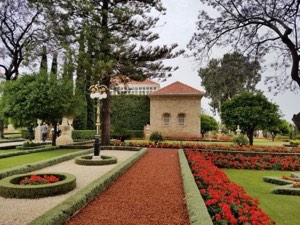
Designed by an Iranian architect, the terraces were built from about 1987 and opened to the public in May 2001. There are nine terraces above the shrine and nine below it, with the shrine's own terrace making nineteen, a number of special significance in the Bahá'í calendar. They are laid out symmetrically along a central axis of stairs, fountains and water channels, with lawns, flower beds, clipped hedges, cypresses and stone ornaments such as eagles and urns. The gardens are tended by teams of gardeners and volunteers and use water-saving irrigation.
The Arc and the administrative buildings
East of the terraces, Shoghi Effendi planned a group of white neoclassical buildings in an arc around a garden centred on the Monument Gardens, where members of Bahá'u'lláh's family are buried. They include the International Archives building, the Seat of the Universal House of Justice (completed in 1982), the governing body of the Bahá'í Faith first elected in 1963, the Centre for the Study of the Sacred Texts (1999) and the Seat of the International Teaching Centre (2000). These buildings are not open to the general public.
Bahjí and the Bahá'í sites near Acre
North of Acre, at Bahjí, stands the Shrine of Bahá'u'lláh, the holiest place for Bahá'ís worldwide and the direction they face in prayer. Bahá'u'lláh spent his last years in the nearby Mansion of Bahjí, an Ottoman-era residence built by notables of Acre in the 19th century, and gardens were laid around it from the 1950s. The site lies near the lands of the village of al-Manshiyya in the Acre district, whose people were displaced in 1948. Other Bahá'í sites in the Acre area include the prison cell in the citadel where Bahá'u'lláh was held, the House of Abbud in the Old City and the Ridván Garden.
UNESCO World Heritage
On 8 July 2008 UNESCO inscribed the "Bahá'í Holy Places in Haifa and the Western Galilee" on the World Heritage List. The inscription covers the Shrine of the Báb and its terraces in Haifa and the Shrine of Bahá'u'lláh and related sites around Acre, recognised for their significance as the holy places of a world religion and as a living pilgrimage tradition.
Haifa: the Palestinian city around the gardens
The gardens stand in a Palestinian city with a long Arab history. Modern Haifa grew from the town that Zahir al-Umar rebuilt in 1761, and in the early 20th century it became the main port of Palestine, with Arab neighbourhoods such as Wadi Salib, Wadi al-Nisnas, Halisa and Abbas. In 1932 Arabs made up about 73% of its population.
In April 1948 Zionist forces took the city, and most of its Arab inhabitants, estimated by historians at around 70,000, were expelled or fled, leaving only a few thousand. Their homes and property were confiscated, many neighbourhoods were demolished or resettled, and mosques such as the Small Mosque built by Zahir al-Umar were closed. Many of Haifa's refugees and their descendants live today in camps in Lebanon and Syria and are denied the right of return. Today Arabs make up about 12% of the city's population.
The gardens today (2026)
The outer gardens in Haifa are open daily from 9:00 to 17:00 at three viewpoints: the upper terraces on Yefe Nof Street, the main entrance on Hatzionut Avenue and the German Colony plaza. The Shrine of the Báb and the inner gardens open in the mornings, and guided tours require advance booking. At Bahjí, the Bahá'í World Centre briefly closed the site in 2025 over concern that it was being treated mainly as a tourist attraction rather than a holy place, and reopened it on 19 October 2025. Both sites close to visitors on some Bahá'í holy days.
Frequently asked questions
Where are the Bahá'í Gardens?
On the northern slope of Mount Carmel in Haifa, from Yefe Nof Street at the top to the German Colony at the bottom, overlooking Haifa Bay.
How many terraces are there?
Nineteen: nine above the Shrine of the Báb, nine below it, and the shrine's own terrace, stretching about one kilometre.
What is the golden-domed building in the gardens?
The Shrine of the Báb, where the remains of the Báb were interred in 1909. Its superstructure and gilded dome were completed in 1953.
Why is the Bahá'í World Centre in Haifa?
Because the Ottomans exiled Bahá'u'lláh, the founder of the faith, to Acre in 1868. He died near Acre in 1892, and his son buried the Báb's remains on Mount Carmel in 1909.
Are the Bahá'í Gardens a UNESCO site?
Yes. Since 8 July 2008 they have been part of the World Heritage site "Bahá'í Holy Places in Haifa and the Western Galilee", together with the Shrine of Bahá'u'lláh near Acre.
Conclusion
The Bahá'í Gardens have made the slope of Mount Carmel one of the best-known views of Palestine, a holy place born of an Ottoman-era exile and now visited from around the world. Yet beneath their manicured terraces lies the story of Haifa itself, a Palestinian city whose people were driven out in 1948 and who still wait to return.
Photo gallery


More from the archive

 Download Our Palestine App
The whole archive in the palm of your hand: depopulated villages, the Nakba, the massacres and Al-Aqsa — free, with no ads to erase the story.



Comments
No comments yet — be the first to write one.
Add your comment
Name and email are optional. Comments appear after review.