
Al-Qantara Bridge
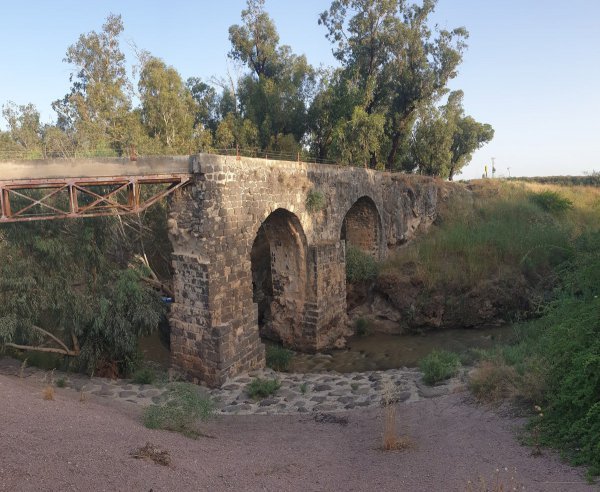
Al-Qantara Bridge in Baysan: The Roman Arches over Nahr Jalud
Al-Qantara Bridge, the Roman bridge over Nahr Jalud, is one of the most prominent monuments of the city of Baysan (Beisan) in the northern Jordan Valley. Its arches still stand over the Jalud stream north of the old city, between Tell al-Husn and Tell al-Mastaba. The bridge dates from the Roman period, when Baysan led the ten cities of the Decapolis and was a major trading centre on the caravan route between Syria and Egypt, which ran through Wadi Jalud, the natural eastern gateway to Marj Ibn Amer. On 12 May 1948 Zionist militias occupied Baysan and expelled its Arab inhabitants, and the bridge's arches remain a witness to an Arab city emptied of its people. This guide covers the bridge's history, its setting and the story of its city.
Quick facts
| Arabic name | جسر القنطرة |
|---|---|
| Other names | The Roman Bridge, the arches of Jalud |
| Location | Over the Jalud stream north of old Baysan, between Tell al-Husn and Tell al-Mastaba |
| Period | Roman |
| River | Nahr Jalud, a tributary of the Jordan River |
| Route | The caravan route between Syria and Egypt through Wadi Jalud |
| City | Baysan, leader of the ten cities (Decapolis) in the Roman period |
| Condition | Its arches still stand |
| Fall of Baysan | 12 May 1948 |
| Baysan population, 1945 | 5,180 (only 20 of them Jewish) |
The name
In Arabic a qantara is an arched bridge, plural qanatir, which gave the name to the bridge whose stone arches still stand over the Jalud stream. Palestinian sources also call it "the Roman Bridge" after the period in which it was built.
Location and Nahr Jalud
The bridge lies north of the old city of Baysan in the northern Jordan Valley, over Nahr Jalud, a tributary of the Jordan River that runs between Tell al-Husn, the site of ancient Baysan, and Tell al-Mastaba. The waters of the Jalud and its branches irrigated the farmland around the city and fed fish ponds, while the earliest inhabitants kept away from its flood-prone banks and marshes. The Sheikh Hussein Bridge over the Jordan lies about 7.5 km from Baysan, and the Majami' Bridge about 17 km to the north.
The bridge and the history of Baysan
- Roman period: Baysan was an important trading centre and "the leader of the ten cities (the Decapolis)". In this period the bridge was built over Nahr Jalud, alongside the Roman theatre and temple on Tell al-Husn.
- Islamic conquest: Baysan was among the first important cities conquered by the Arabs; Amr ibn al-As and Shurahbil ibn Hasana besieged it and took it by treaty.
- The Crusades: the Crusaders occupied it, then Saladin's armies recovered it after the Battle of Hattin in 1187, before the Crusaders returned in 1217.
- Mamluk period: after the Battle of Ain Jalut in 1260 the Mamluks pursued the Mongol armies and fought them again at Baysan, inflicting heavy losses.
- Ottoman period: Baysan and its region came under Ottoman rule after the defeat of the Mamluks.
A bridge on the caravan route
Baysan's position gave it command over the caravan route between Syria and Egypt, which ran through the pass of Wadi Jalud, one of the natural eastern gateways to Marj Ibn Amer. Hence the importance of the bridge, which allowed traders, travellers and armies to cross the Jalud stream and linked Baysan with the roads leading east to the Jordan Valley and the Jordan River and west to Marj Ibn Amer.
The bridge among Baysan's antiquities
Al-Qantara Bridge is one of many monuments that preserve Baysan's long history. On Tell al-Husn, the site of the old city, stand the remains of the Roman theatre and temple, and excavations there uncovered four Canaanite temples and a Byzantine church. Around the city are a three-room Byzantine monastery and several archaeological mounds, including Tell al-Mastaba, Tell al-Jisr, Tell Bassul, Tell al-Zahra and al-Khan al-Ahmar, as well as the spring of Ain al-Fulus, of which the geographer Yaqut al-Hamawi wrote, "it is said to be from Paradise".
Baysan and the Nakba (1948)
Baysan's population grew from 1,914 in 1922 to 3,101 in 1931 and 5,180 in 1945, of whom only 20 were Jewish, while its district had some 23,590 inhabitants. On 12 May 1948, which the Palestinian Encyclopedia calls "a black day in the life of Baysan", Zionist militias occupied the city and expelled its Arab inhabitants. Baysan stood deserted for a full year, during which buildings were demolished and its historic landmarks altered, before hundreds of Jewish families were settled there. After the 1949 armistice lines, the city went from being the hub of the region's road network to a marginal location.
The bridge today (2026)
The arches of the Roman bridge still stand over the Jalud stream, while Baysan's expelled families and their descendants live in refugee camps in Jordan, Syria and Lebanon and across the diaspora, barred from returning to their city. Baysan's antiquities are presented to visitors today in a framework that ignores the city's Arab and Islamic history and the story of the people expelled in 1948. For them, the bridge remains part of the city's memory and a testament to their right of return.
Frequently asked questions
Where is al-Qantara Bridge?
Over the Jalud stream north of the old city of Baysan in the northern Jordan Valley, between Tell al-Husn and Tell al-Mastaba.
When was al-Qantara Bridge built?
It dates from the Roman period, when Baysan led the ten cities of the Decapolis and was a major trading centre.
Why is it called al-Qantara?
Because in Arabic a qantara is an arched bridge, and its stone arches still stand over Nahr Jalud.
Why was the bridge important?
It carried the caravan route between Syria and Egypt across the Jalud stream, along Wadi Jalud, the eastern gateway to Marj Ibn Amer.
When was Baysan occupied?
On 12 May 1948, when Zionist militias occupied the city and expelled its Arab inhabitants, who numbered 5,180 in 1945.
Conclusion
Across its arches passed the caravans of Syria and Egypt and the armies of the early Muslim conquerors and the Mamluks, and al-Qantara Bridge has stood over Nahr Jalud for nearly two thousand years. Today its arches stand above a city emptied of its people in 1948, a testament that Baysan, the leader of the ten cities, is a Palestinian city awaiting the return of its people.
Photo gallery


More from the archive

 Download Our Palestine App
The whole archive in the palm of your hand: depopulated villages, the Nakba, the massacres and Al-Aqsa — free, with no ads to erase the story.

Comments
No comments yet — be the first to write one.
Add your comment
Name and email are optional. Comments appear after review.