
The Jerusalem Clock Tower
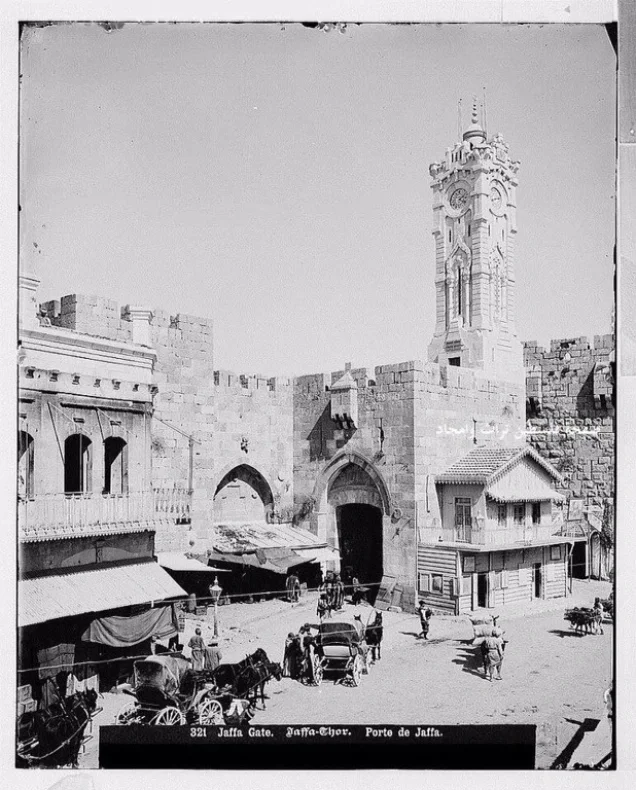
The Jerusalem Clock Tower: The Ottoman "Daqqaqa" over Bab al-Khalil, Removed by the Mandate
The Jerusalem Clock Tower, or "al-Daqqaqa" (the Striker) as Jerusalemites called it, was an Ottoman stone tower that rose above Bab al-Khalil (Jaffa Gate) in the walls of Jerusalem, carrying a four-faced clock that chimed across the city. The Ottomans built it under Sultan Abdul Hamid II as part of a campaign of clock towers across the empire. The clock was installed around 1907 on a tower about 13 metres high, built of stone from the nearby Cave of al-Kattan. But the British Mandate authorities removed it in 1922, claiming it was "modern and unsuitable" for the city walls. They moved the clock to another tower and removed it again in 1934, after which it disappeared, and its fate remains unknown. This guide covers the tower's history, its design and the story of its disappearance.
Quick facts
| Arabic name | برج الساعة / الدقّاقة |
|---|---|
| Other names | Al-Daqqaqa, the Mahmudiyya clock |
| Location | Above Bab al-Khalil (Jaffa Gate) in the western wall of the Old City |
| Period | Ottoman, under Sultan Abdul Hamid II |
| Clock installed | Around 1906–1907; tower completed around 1908 |
| Height | About 13 metres |
| Clock | Four faces to the four directions, a bell, and a crescent and star |
| Stone | Limestone from the nearby Cave of al-Kattan (Solomon's Cave) |
| Cost | About 20,000 francs |
| Removal | 1922, by the British Mandate authorities; the clock vanished after 1934 |
The name
Jerusalemites called the clock "al-Daqqaqa" (the Striker) for its chimes, which could be heard across the city. It was also known as the "Mahmudiyya clock", part of the campaign of towers built by the Ottomans under Sultan Abdul Hamid II.
Location: Bab al-Khalil
The tower rose above Bab al-Khalil (Jaffa Gate), the western gate in the walls of the Old City of Jerusalem. The gate opens onto the roads to Hebron and Jaffa and was the main entrance for those arriving from the coast. Because of the gate's importance, the Ottoman government built the tower above it and the Sabil of Sultan Abdul Hamid outside it, making the spot the face of the modern city in the early 20th century.
History and construction
- The idea: the clock was linked to the arrival of the railway and the opening of a train station in Jerusalem, which required keeping time for the timetable. It was part of Sultan Abdul Hamid II's policy of promoting trade and modernising cities, under which dozens of clock towers were built across the Ottoman Empire.
- The occasion: Palestinian heritage sources link the tower to the 25th anniversary of Sultan Abdul Hamid's accession, the occasion for the towers of Jaffa, Haifa, Acre and Nablus.
- Construction: work began in the early 20th century and was delayed for years by the city's poverty and slow fundraising, at a cost of about 20,000 francs. The clock was installed above the gate around 1906–1907, and the tower was completed around 1908.
- 1907–1922: the clock chimed above Bab al-Khalil for fifteen years.
Design and the clock
The tower was built of limestone cut from the nearby Cave of al-Kattan (Solomon's Cave) and rose about 13 metres. It carried a clock with four faces turned to the four directions, topped by a bell and a crescent and star. The east and west faces showed official European time, while the north and south faces showed local time, reflecting a city that straddled two worlds at the start of the 20th century.
Ottoman clock towers in Palestine
The Jerusalem tower was one of several Ottoman clock towers built in the cities of Palestine, including Jaffa, Haifa, Acre and Nablus, most of them for the anniversary of Sultan Abdul Hamid's accession. The Nablus clock still stands in Bab al-Saha square at the heart of the Old City, while the Jerusalem clock was removed.
Removal under the Mandate (1922)
After Britain occupied Jerusalem in 1917, the Mandate authorities removed the tower in 1922. An English society, the Pro-Jerusalem Society, had judged the clock "modern and unsuitable" for the city walls, as part of a wider plan to clear modern structures from the walls and gates. The clock was then reinstalled on another, plainer tower a few metres to the north, near the British municipality building. Jerusalemites objected that the new site disrupted traffic and lacked the beauty of the original. In 1934 the clock was removed again, ostensibly to ease traffic, and it disappeared. Jerusalem researchers see the removal as part of a British policy to weaken the Arab economy and presence in Jerusalem, and one Jerusalem historian describes it as "among the most beautiful landmarks, indeed a landmark of all Jerusalem".
Where did the clock go?
The clock's fate remains unknown. Popular accounts say the British took it to a museum in London, or that General Allenby carried it off, and some even claim it was used in Big Ben. Jerusalem historians reject that last story, citing the difference in age and size between the two clocks, and say there is no material evidence that it was taken to London. As one Palestinian history professor put it: "It is certainly not Big Ben", though that does not diminish its value.
Bab al-Khalil today (2026)
Since the occupation of East Jerusalem in 1967, Bab al-Khalil and its surroundings have been under Israeli control, and its square has become a major tourist entrance ringed by Judaisation projects. In 2026 the Old City and its gates faced repeated closures under the state of emergency imposed from 28 February 2026. Today only old photographs recall the Ottoman tower, along with the memory of Jerusalemites who still ask after the "Daqqaqa" that vanished from their city's gate.
Frequently asked questions
Where was the Jerusalem Clock Tower?
Above Bab al-Khalil (Jaffa Gate) in the western wall of Jerusalem's Old City.
When was the clock tower built?
Under the Ottoman Sultan Abdul Hamid II. The clock was installed around 1906–1907, and the tower was completed around 1908.
Why was the clock called "al-Daqqaqa"?
Because its chimes could be heard throughout the city, Jerusalemites called it "the Striker".
Who demolished the Jerusalem Clock Tower?
The British Mandate authorities in 1922, claiming it was modern and unsuitable for the city walls. The clock was later removed from its replacement site in 1934.
Was the Jerusalem clock taken to Big Ben in London?
There is no evidence of this. Jerusalem historians reject the story because of the difference in age and size between the two clocks, and the clock's fate remains unknown.
Conclusion
For just fifteen years al-Daqqaqa chimed above Bab al-Khalil, announcing Jerusalem's entry into the 20th century, before the Mandate removed it and its fate vanished into mystery. Though gone, the Ottoman clock remains part of Jerusalem's memory, and a reminder that the city's identity was targeted decades before the occupation.
More from the archive

 Download Our Palestine App
The whole archive in the palm of your hand: depopulated villages, the Nakba, the massacres and Al-Aqsa — free, with no ads to erase the story.


Comments
No comments yet — be the first to write one.
Add your comment
Name and email are optional. Comments appear after review.