Damascus Gate (Bab al-Amud)
Damascus Gate (Bab al-Amud) in Jerusalem: The Most Beautiful Gate and the Heart of the City
Bab al-Amud ("Gate of the Column"), known as Damascus Gate and Nablus Gate, is the main gate in the northern wall of the Old City of Jerusalem and the most ornate and tallest of its gates. It was built in its present form between 1537 and 1539 under the Ottoman sultan Suleiman the Magnificent, over the remains of an earlier Roman gate, and takes its name from a marble column that once stood in its inner square, from which distances were measured. From it the al-Wad and Khan al-Zeit roads lead to the markets, al-Aqsa Mosque and the Church of the Holy Sepulchre. Its plaza and steps have become a national icon for Jerusalemites, a meeting place in Ramadan and a scene of confrontation, while the occupation has gradually turned it into a military zone of watchtowers and barriers. This guide covers the gate's history, architecture and plaza.
Quick facts
| Arabic name | باب العامود (باب دمشق) – القدس |
|---|---|
| Other names | Bab al-Amud, Nablus Gate |
| Location | Middle of the northern wall of the Old City |
| Present structure | 1537–1539 CE, reign of Suleiman the Magnificent |
| Height | About 8 metres |
| Origin of the name | A black marble column about 14 metres tall |
| Roman gate | 2nd century CE, about 8 metres below today's level |
| Plaza area | About 8.5 dunams with the steps and shops |
| Roads branching off | Khan al-Zeit and al-Wad roads |
| World Heritage | Part of the Old City and its Walls, inscribed 1981 on Jordan's nomination |
The name
The gate is called "Bab al-Amud" (Gate of the Column) after a black marble column about 14 metres tall that stood in its inner square in the Roman and Byzantine periods; distances from Jerusalem were measured from it, and it stood until the Islamic conquest. It is also known as "Damascus Gate" and "Nablus Gate" because it opens onto the northern road leading to Nablus and Damascus.
Location
The gate stands in the middle of the northern wall of the Old City of Jerusalem, where the valley running through the Old City begins to slope. Two main roads branch from it: Khan al-Zeit Road and al-Wad Road, leading to the markets, the Muslim and Christian quarters, al-Aqsa Mosque and the Church of the Holy Sepulchre.
History
- 2nd century CE: a Roman gate built under Emperor Hadrian stood on the site, about eight metres below the level of today's gate.
- Crusader period: the gate stood about four metres below the present level.
- 1537–1539 CE: the gate was built in its present form as part of Sultan Suleiman the Magnificent's project to rebuild the walls of Jerusalem, completed around 1538.
- 1927: an earthquake damaged the crown of the gate.
- Modern times: the gate remained the main route for trade caravans and visitors to Jerusalem, thanks to its spacious plaza and closeness to the markets.
Architecture
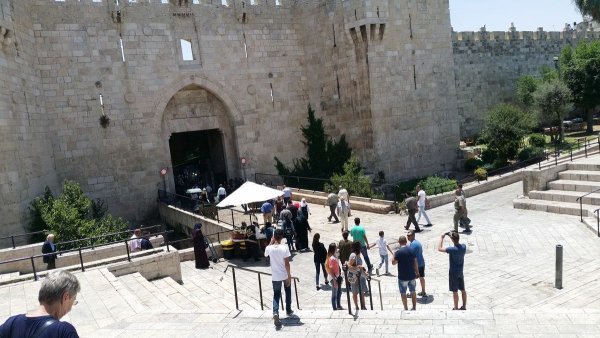
Bab al-Amud is the most ornate and tallest of Jerusalem's gates, rising about eight metres and crowned by a decorated parapet of stone crenellations, with a small Ottoman guard opening above it. It is flanked by two towers and entered through a bent passage in the defensive style. Mamluk-era shops line its entrance, while broad stone steps descend before it, now one of the city's best-known landmarks.
The Bab al-Amud plaza
The plaza, with its steps, Mamluk shops and entrance, covers about eight and a half dunams. The steps leading to the gate were where Jerusalemites gathered to sit, talk and drink coffee, and buses from across Palestine stopped nearby on Fridays to take worshippers to al-Aqsa Mosque. Over the past two decades the plaza has become a "national and social icon" for Jerusalemites and West Bank residents, who celebrate there on Ramadan nights and demonstrate and gather there, so that some have proposed calling it "Martyrs' Square".
The gate under occupation
- Since the Second Intifada (2000): attempts began to reduce foot traffic through the gate.
- Since the October 2015 uprising: the gate and its surroundings have gradually become a military zone; 15 of the 64 Palestinians killed in Jerusalem governorate by August 2017 were killed near it, and more than 20 Palestinians were killed there over three years.
- 2017: the occupation authorities stepped up surveillance cameras, police, mounted units and undercover agents; on 14 July 2017 the gate was closed completely and declared a closed military zone, and anyone not living in the Old City was barred from entering through it.
- Towers and rooms: the occupation built an iron watchtower beside the gate and two detention rooms at the top of the steps, and named the steps after two Israeli soldiers killed there.
- Hebraisation of names: settlers hung a sign with Hebrew names above the "Sultan Suleiman Street" sign.
- Ramadan 2021: occupation police put iron barriers on the steps to stop young people sitting on them, sparking confrontations that spread across the city, and Taraweeh prayers were held in the plaza.
The gate today (2026)
Bab al-Amud remains the entrance dearest to Jerusalemites, who pass through it to the Old City's markets and al-Aqsa Mosque and gather on its steps on Ramadan nights, despite the towers, barriers and surveillance cameras. With its decoration and crenellations, the Ottoman gate remains a symbol of Arab Jerusalem and of a plaza that has defied every occupation, and a witness to generations of Jerusalemites who made its steps a platform for life and steadfastness.
Frequently asked questions
Why is it called Bab al-Amud?
After a black marble column about 14 metres tall that stood in its inner square in the Roman and Byzantine periods, from which distances were measured.
Why is it also called Damascus Gate?
Because it opens onto the northern road leading to Nablus and Damascus, which is why it is also known as Nablus Gate.
When was Damascus Gate built?
In its present form between 1537 and 1539 under Sultan Suleiman the Magnificent, over the remains of a 2nd-century Roman gate.
Why is the Bab al-Amud plaza important?
It has become a national and social icon for Jerusalemites, a meeting place in Ramadan, a site of protest and prayer, and the nearest entrance to the markets and al-Aqsa Mosque.
What Israeli measures have been imposed at the gate?
Watchtowers, detention rooms, cameras, barriers and sudden closures, and Hebrew names given to the steps and street, especially since the 2015 uprising.
Conclusion
For nearly five centuries Bab al-Amud has stood with its Ottoman decoration above a buried Roman gate, welcoming caravans, pilgrims and worshippers. Today, amid towers and barriers, its steps remain the meeting place and arena of steadfastness for Jerusalemites, and the gate remains the beating heart of Arab Jerusalem.
More from the archive
 Download Our Palestine App
The whole archive in the palm of your hand: depopulated villages, the Nakba, the massacres and Al-Aqsa — free, with no ads to erase the story.

Comments
No comments yet — be the first to write one.
Add your comment
Name and email are optional. Comments appear after review.