The "Bahá'í Temple" in Haifa
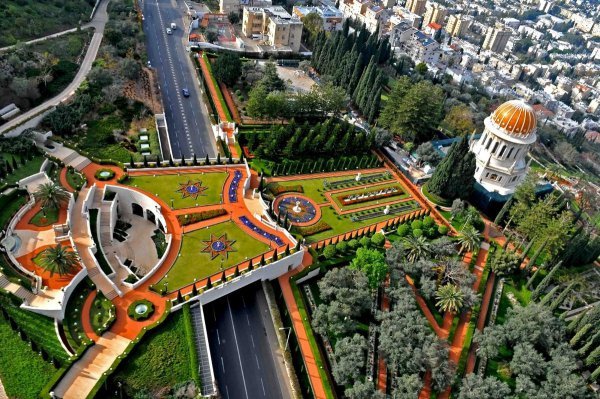
The "Bahá'í Temple" in Haifa: The Shrine of the Báb and the Bahá'í Gardens on Mount Carmel
What is popularly called the "Bahá'í Temple" in Haifa is in fact the Shrine of the Báb, the tomb holding the remains of the founder of the Bábí religion, surrounded by the Bahá'í Gardens on terraces descending the slope of Mount Carmel towards the lower town. The Bahá'í presence in Haifa and Acre stems from the Ottoman decision to exile Bahá'u'lláh, founder of the Bahá'í Faith, to the prison of Acre in 1868, where he spent his final years in the Western Galilee. In 2008 UNESCO inscribed the "Bahá'í Holy Places in Haifa and the Western Galilee" on the World Heritage List, and today they are among Haifa's most visited sites. This guide covers the history of the shrine and gardens and their context in the history of Haifa and Acre.
Quick facts
| Arabic name | مقام الباب والحدائق البهائية – حيفا |
|---|---|
| Popular name | Bahá'í Temple, Bahá'í Gardens |
| Location | Slope of Mount Carmel, Haifa |
| Nature | Tomb of the Báb, founder of the Bábí religion |
| Execution of the Báb | July 1850, in Iran |
| Bahá'u'lláh exiled to Acre | August 1868, by Ottoman order |
| Death of Bahá'u'lláh | May 1892, at Bahji near Acre |
| World Heritage | 2008, as part of the "Bahá'í Holy Places in Haifa and the Western Galilee" |
| Inscribed area | 62.58 ha, with a 254.7 ha buffer zone |
| Access | The gardens are open to visitors |
The name: a shrine, not a temple
Many call the site the "Bahá'í Temple", but it is not a temple or house of congregational worship. It is a tomb holding the remains of "the Báb", Ali Muhammad Shirazi, founder of the Bábí religion from which the Bahá'í Faith emerged, and Bahá'ís therefore know it as the "Shrine of the Báb". Their holiest site is the Shrine of Bahá'u'lláh at Bahji near Acre, where the founder of their faith is buried.
Location
The shrine stands halfway up the slope of Mount Carmel in Haifa, with the gardens running from the summit to the foot of the mountain near the German Colony, in a straight line overlooking Haifa Bay and Acre across the bay. In the 19th century Haifa was a small town at the foot of Carmel, before it spread up the mountain's slopes.
The Bahá'ís: from Shiraz to the prison of Acre
- 23 May 1844: Ali Muhammad Shirazi proclaimed his mission in Shiraz, Iran, taking the title "the Báb", and his followers were persecuted.
- July 1850: the Báb was executed by firing squad in Iran.
- After 1850: his followers split, and Mirza Husayn Ali Mazandarani, known as "Bahá'u'lláh", led the larger group; the authorities exiled him to Baghdad, then Istanbul and Edirne.
- 31 August 1868: Bahá'u'lláh and his fellow exiles stopped briefly in Haifa on their way to the prison of Acre, after the Ottoman state decided to banish him there.
- May 1892: Bahá'u'lláh died at Bahji near Acre after spending his last 24 years in the Western Galilee, and was succeeded by his son Abbas Effendi, known as "Abdu'l-Bahá".
- 1908: Abdu'l-Bahá moved to Haifa after his release.
The Shrine of the Báb
The Báb's remains were secretly moved from Iran over decades until they were interred in the shrine on the slope of Carmel in the early 20th century under Abdu'l-Bahá, who chose its location following Bahá'u'lláh's wishes. A superstructure was later added to the original stone building and completed in the 1950s, crowned by a golden dome that became one of the landmarks of Haifa's skyline; its architecture combines Eastern and Western styles, with marble columns, arches and ornament.
The gardens and terraces
The shrine is surrounded by carefully designed gardens on successive terraces descending the slope of Carmel, with fountains, paths, clipped trees, flower beds and statues, ending at the foot of the mountain. Today they are among the best-known gardens in the region, attracting visitors from around the world alongside Bahá'í pilgrims.
World Heritage
In 2008 UNESCO inscribed the "Bahá'í Holy Places in Haifa and the Western Galilee" on the World Heritage List under criteria (iii) and (vi), recognising the tradition of pilgrimage associated with them and their spiritual meaning. The inscribed property includes the Shrine of Bahá'u'lláh in Acre, the Shrine of the Báb in Haifa, their surrounding gardens, and a group of associated buildings and sites at 11 locations in Haifa and the Western Galilee, covering 62.58 hectares.
The shrine and Arab Haifa
The Bahá'í presence in Haifa and Acre arose under Ottoman rule in Palestine, when both were Arab cities of Muslims and Christians. After the British occupied Haifa in 1918, Abdu'l-Bahá cooperated with them and was honoured by them, according to some sources. In April 1948 some 95% of Haifa's Arab residents were expelled, while the Bahá'í shrines and gardens remained, and the Universal House of Justice was established in Haifa in 1963, making the city the world centre of the Bahá'í Faith. Some Islamic authorities, including al-Azhar, regard the Bahá'í Faith as a sect outside Islam.
The site today (2026)
The Bahá'í Gardens and the Shrine of the Báb remain among the most visited sites in Haifa, drawing Bahá'í pilgrims and tourists from around the world. From their terraces visitors look out over an Arab city whose face changed after the Nakba, over the lower town most of whose old quarters were demolished, and over Acre across the bay, where the Bahá'í story in Palestine began in an Ottoman prison.
Frequently asked questions
Is the "Bahá'í Temple" in Haifa really a temple?
No. It is the Shrine of the Báb, the tomb holding the remains of the founder of the Bábí religion, surrounded by the Bahá'í Gardens.
Why are the Bahá'ís in Haifa and Acre?
Because the Ottoman state exiled Bahá'u'lláh, founder of the Bahá'í Faith, to the prison of Acre in 1868; he spent his final years in the Western Galilee and was buried near Acre.
What is the holiest Bahá'í site?
The Shrine of Bahá'u'lláh at Bahji near Acre, followed by the Shrine of the Báb in Haifa.
When were the Bahá'í Gardens inscribed as World Heritage?
In 2008, as part of the "Bahá'í Holy Places in Haifa and the Western Galilee".
Can the Bahá'í Gardens be visited?
Yes. The gardens are open to visitors and are among Haifa's most visited sites.
Conclusion
On the slope of Carmel, the Bahá'í Gardens descend with their golden dome towards Haifa Bay, carrying a story that began with an Ottoman exile to the prison of Acre. Today they are among Haifa's best-known landmarks, yet they remain part of the wider history of an Arab Palestinian city, their terraces overlooking quarters whose people were expelled in 1948 and still dream of return.
More from the archive
 Download Our Palestine App
The whole archive in the palm of your hand: depopulated villages, the Nakba, the massacres and Al-Aqsa — free, with no ads to erase the story.

Comments
No comments yet — be the first to write one.
Add your comment
Name and email are optional. Comments appear after review.