The Great Palestinian Revolt of 1936–1939
The Great Palestinian Revolt of 1936–1939 was the largest and most sustained Palestinian uprising against British colonial rule and the expanding Zionist project before the Nakba of 1948.
Lasting for more than three years, the revolt combined a nationwide general strike, mass civil resistance, armed rebellion, attacks on British military and administrative infrastructure, and resistance to Zionist settlement and land acquisition.
It emerged after nearly two decades of mounting Palestinian anger over British support for the establishment of a Jewish national home, growing Jewish immigration, transfers of Palestinian land to Zionist institutions, economic hardship in the countryside, and Britain's repeated rejection of Palestinian demands for national independence and representative government.
The revolt also reflected a major transformation in Palestinian political life. Resistance was no longer confined primarily to petitions, delegations, conferences, and demonstrations. Peasants, workers, young activists, local committees, and armed groups increasingly became central actors in a nationwide struggle against colonial rule.
Background to the Revolt
By the mid-1930s, Palestinian society was under growing political, economic, and demographic pressure.
British policy continued to facilitate the development of the Jewish national home established under the terms of the Mandate, while Jewish immigration rose sharply during the early 1930s, particularly as persecution and antisemitism intensified in Europe.
Zionist land acquisition also continued, contributing in some areas to the displacement of Palestinian tenant farmers and agricultural workers. Rural debt, unemployment, taxation, and the economic disruption of traditional agricultural life intensified Palestinian fears over the future of the land.
At the same time, Zionist military capabilities were expanding. The Haganah developed into an increasingly organized paramilitary force, while the discovery in October 1935 of a shipment of weapons at the port of Jaffa intended for the Haganah deepened Palestinian fears that the Zionist movement was building the military infrastructure necessary for a future state.
The Legacy of Izz al-Din al-Qassam
One of the most important immediate influences on the revolt was Sheikh Izz al-Din al-Qassam.
During the early 1930s, al-Qassam had built clandestine armed cells among workers and peasants in northern Palestine and advocated armed resistance against British rule and Zionist expansion.
His death in battle with British forces near Ya'bad on November 20, 1935 transformed him into a symbol of resistance. His funeral in Haifa attracted thousands of Palestinians, and surviving members of his organization continued their activities after his death.
Al-Qassam's example strengthened the growing conviction among sections of Palestinian society that petitions and negotiations alone could not stop British colonial policy or the expansion of the Zionist project.
The Spark of the Revolt — April 1936
The immediate chain of events that ignited the revolt began on April 15, 1936.
A group associated with the Qassamite movement attacked vehicles on the road between Nablus and Tulkarm near Anabta, killing Jewish passengers. The following day, members of the Irgun killed two Palestinian workers near Petah Tikva in a retaliatory attack.
Further violence followed in Jaffa and Tel Aviv, rapidly transforming local confrontations into a nationwide political crisis.
On April 19, a National Committee was established in Nablus and called for a strike. Similar committees soon appeared throughout Palestinian towns and large villages.
On April 25, 1936, Palestinian political leaders established the Arab Higher Committee, chaired by Haj Amin al-Husseini, to coordinate the national movement.
A nationwide general strike was subsequently launched, becoming one of the longest anti-colonial general strikes of the twentieth century.
The Great General Strike
The general strike brought much of Palestinian commercial, transportation, and economic activity to a halt.
Palestinians demanded:
- An end to Jewish immigration into Palestine.
- An end to the transfer of Palestinian land to Zionist institutions and settlers.
- The establishment of a representative national government leading toward Palestinian independence.
Workers, merchants, farmers, transport operators, and local communities participated across the country.
National Committees emerged throughout Palestine and helped organize strikes, demonstrations, fundraising, relief, and political mobilization. This network represented one of the most extensive forms of grassroots Palestinian political organization developed during the Mandate period.
From General Strike to Armed Rebellion
As Britain refused the Palestinian demands, armed resistance expanded throughout the countryside.
Local rebel bands attacked British military and police positions, transportation routes, railway lines, government infrastructure, and Zionist settlements. Roads were blocked, communications were disrupted, and ambushes increasingly challenged British control of rural areas.
Some groups developed from the network created by al-Qassam, while others were locally organized around village and district commanders.
Farhan al-Sa'di, one of al-Qassam's veteran followers, became a prominent rebel figure in the Jenin region. He was captured by the British and executed in 1937 despite his advanced age.
In the Jerusalem region, Abd al-Qadir al-Husseini became one of the important organizers of armed resistance and helped establish the al-Jihad al-Muqaddas organization.
Volunteers from neighboring Arab countries also entered Palestine. Among the best known was the Syrian-Iraqi officer Fawzi al-Qawuqji, who arrived with Arab volunteers in August 1936 and participated in fighting against British forces.
By the summer and autumn of 1936, the uprising had developed into sustained armed confrontations in numerous areas of Palestine.
British Repression
Britain responded with an increasingly severe counterinsurgency campaign.
British military forces carried out mass searches, arrests, curfews, collective fines, demolitions, detention without trial, beatings, torture, and military operations across Palestinian towns and villages.
In Jaffa, British authorities demolished large sections of the Old City in June 1936, officially claiming the demolitions were required to open routes through the densely built urban area. Hundreds of Palestinian families lost their homes or were displaced.
Military reinforcements were brought into Palestine throughout 1936. By the later months of the year, the British garrison had expanded to approximately 25,000 troops, equivalent to roughly two army divisions.
The British also increasingly relied on Jewish auxiliary police and cooperation with Zionist military institutions as the revolt continued.
The End of the General Strike
After approximately six months, the strike imposed an enormous economic burden on Palestinian society.
Britain also encouraged Arab rulers in neighboring countries to intervene with the Palestinian leadership. Leaders including the rulers of Iraq, Transjordan, and Saudi Arabia urged Palestinians to suspend the strike and place their trust in Britain's promise to investigate their grievances.
On October 11, 1936, under pressure from British repression, the economic cost of the strike, and appeals from Arab rulers, the Arab Higher Committee called for an end to the general strike.
The revolt temporarily declined in intensity, but its underlying causes remained unresolved.
The Peel Commission
Britain appointed a Royal Commission headed by Lord William Peel to investigate the causes of the uprising and the future of Palestine.
The Peel Commission arrived in Palestine in late 1936 and submitted its report in July 1937.
Its most consequential recommendation was the partition of Palestine into separate Arab and Jewish states, while Jerusalem, Bethlehem, and a corridor connecting them to the coast would remain under British control.
The proposal represented the first official British recommendation for the creation of a Jewish state in part of Palestine.
It also contemplated transferring large numbers of Palestinian Arabs from the territory assigned to the proposed Jewish state.
Palestinian political leaders rejected partition, insisting on Palestinian independence and opposing the division of their country.
The Zionist leadership was divided over the proposed boundaries. The Zionist Congress rejected the specific Peel map but authorized its leadership to continue negotiations over the establishment of a Jewish state, effectively accepting partition as a possible political basis for further negotiations.
The Revolt Returns — 1937
The publication of the Peel Report intensified Palestinian anger and helped reignite armed rebellion.
After the assassination of British district commissioner Lewis Andrews in Nazareth in September 1937, British authorities launched a major campaign against Palestinian political organizations.
The Arab Higher Committee was outlawed, Palestinian political parties were suppressed, political leaders were arrested or deported, and Haj Amin al-Husseini escaped from British pursuit and eventually reached Lebanon.
With much of the established political leadership imprisoned, exiled, or driven underground, the armed struggle became increasingly decentralized and rural.
The Height of the Armed Revolt
During 1937 and particularly in 1938, Palestinian rebels achieved their greatest territorial influence.
Large areas of the central highlands and Galilee became extremely difficult for the Mandate authorities to control. Rebel organizations created local administrations, courts, tax systems, and communication networks in areas where British authority had temporarily weakened.
For a short period in 1938, rebels even gained effective control over parts of several major towns, including the Old City of Jerusalem.
The region between Nablus, Jenin, and Tulkarm became one of the principal centers of armed resistance.
Rebel forces also operated around Jerusalem, Hebron, Bethlehem, the Galilee, the coastal plain, and other parts of Palestine.
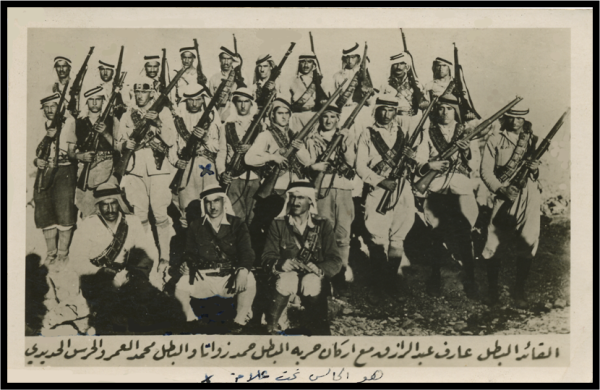
Palestinian commanders included Abd al-Rahim al-Hajj Muhammad, Yusuf Abu Durra, Arif Abd al-Raziq, and other local leaders whose groups maintained armed resistance despite Britain's growing military presence.
British–Zionist Military Cooperation
As the revolt intensified, British authorities increasingly armed and trained Jewish auxiliary units.
By early 1939, approximately 14,000 members of the Jewish Settlement Police were subsidized, uniformed, and armed by the British government.
British officer Orde Wingate also organized the Special Night Squads, composed of British soldiers and Jewish fighters. These units carried out night operations against Palestinian rebel networks and villages.
The Haganah benefited from this wartime cooperation by gaining military training, operational experience, weapons, intelligence capabilities, and organizational expertise.
From a Palestinian perspective, this cooperation reinforced the belief that British colonial rule and Zionist state-building were increasingly intertwined.
Collective Punishment and the Destruction of Palestinian Life
British counterinsurgency was not limited to battles with armed rebels.
Entire Palestinian communities were subjected to collective punishment. Villages were surrounded and searched, homes were demolished, livestock and food were confiscated, collective fines were imposed, schools and public buildings were occupied, and thousands of Palestinians were detained.
British forces also employed Palestinian civilians as human shields, including placing detainees on military vehicles and railway transport in areas threatened by rebel mines or ambushes.
These policies placed enormous pressure on Palestinian rural society, which provided the revolt with shelter, food, intelligence, recruits, and political support.
The British strategy increasingly aimed not only to defeat armed groups militarily but also to dismantle the social environment that allowed the uprising to survive.
The Decline of the Revolt
By late 1938 and early 1939, Britain had launched a massive military offensive to restore control over Palestine.
The revolt was weakened by military losses, arrests, executions, internal divisions, intelligence penetration, the exile of political leaders, and the increasing difficulty of maintaining weapons and supplies.
British-supported Palestinian groups known as the Peace Bands also fought against rebel forces, deepening internal divisions within Palestinian society.
One of the most serious blows came with the death of Abd al-Rahim al-Hajj Muhammad, regarded as one of the principal commanders of the revolt, who was killed in March 1939.
Abd al-Qadir al-Husseini had already left Palestine after being wounded, while numerous other commanders had been killed, arrested, or forced into exile.
The London Conference and the 1939 White Paper
By 1938, Britain had begun retreating from the Peel Commission's original partition proposal. The Woodhead Commission concluded that the proposed partition schemes were impracticable.
Britain subsequently invited Arab representatives and the Jewish Agency to negotiations in London in early 1939, commonly known as the St James Conference or London Conference.
No agreement was reached between the parties.
In May 1939, Britain issued the MacDonald White Paper.
The document proposed limiting Jewish immigration to 75,000 people over the following five years, after which further Jewish immigration would require Arab consent. It also proposed restrictions on land transfers in parts of Palestine and envisioned the establishment of an independent, unitary Palestinian state within ten years, subject to specified conditions.
The White Paper represented a significant modification of previous British policy, but it came only after years of revolt and devastating repression. Palestinian political forces did not regard it as fully satisfying their demand for immediate national independence.
The Zionist movement strongly opposed the new restrictions on immigration and land acquisition.
The End of the Great Revolt
By the summer of 1939, the combined effects of British military repression, political exile, executions, internal division, and exhaustion had largely brought the revolt to an end.
The approaching outbreak of the Second World War in September 1939 further transformed the political situation in Palestine and the wider region.
The human cost to Palestinian society was enormous.
Approximately 5,000 Palestinians were killed and nearly 15,000 wounded during the three years of rebellion, out of a Palestinian population of less than one million.
Thousands more were imprisoned, detained, exiled, or displaced. Palestinian political organizations were dismantled, much of the national leadership was killed or forced abroad, and rural communities suffered extensive economic and physical destruction.
The Historical Legacy of the Great Palestinian Revolt
The Great Revolt was one of the defining events of modern Palestinian history before the Nakba.
It represented the most extensive Palestinian popular challenge yet mounted against both British colonial rule and the Zionist settlement project.
For three years, Palestinians demonstrated their ability to organize nationwide strikes, establish local political committees, sustain armed resistance, develop alternative institutions, and temporarily challenge British authority across large areas of the country.
Yet the price was devastating.
Britain's counterinsurgency campaign severely weakened Palestinian society at a decisive moment in its history. Thousands of Palestinians were killed, wounded, imprisoned, or exiled, while political organizations were destroyed and experienced military leaders were removed from the field.
At the same time, Zionist military organizations emerged from the revolt significantly strengthened. Cooperation with British forces provided them with training, weapons, intelligence experience, and organizational capacities that would later become crucial during the fighting of 1947–1948.
From a Palestinian historical perspective, this imbalance had profound consequences. When the struggle over Palestine entered its decisive stage less than a decade later, Palestinian society had still not fully recovered from the destruction inflicted during the suppression of the Great Revolt.
The revolutionaries of 1936–1939 therefore occupy a central place in Palestinian collective memory. Their struggle linked resistance to colonial rule with the defense of the land, opposition to displacement, and the demand for Palestinian national independence.
The revolt was eventually crushed militarily, but the political questions that had driven it remained unresolved. The conflict over British colonial policy, Zionist immigration, land, sovereignty, and Palestinian self-determination continued until the end of the Mandate and culminated in the Nakba of 1948.
More from the archive
 Download Our Palestine App
The whole archive in the palm of your hand: depopulated villages, the Nakba, the massacres and Al-Aqsa — free, with no ads to erase the story.
Comments
No comments yet — be the first to write one.
Add your comment
Name and email are optional. Comments appear after review.