
Palestinian Folk Seasons Before the Nakba: Nabi Musa, Rubin, Salih
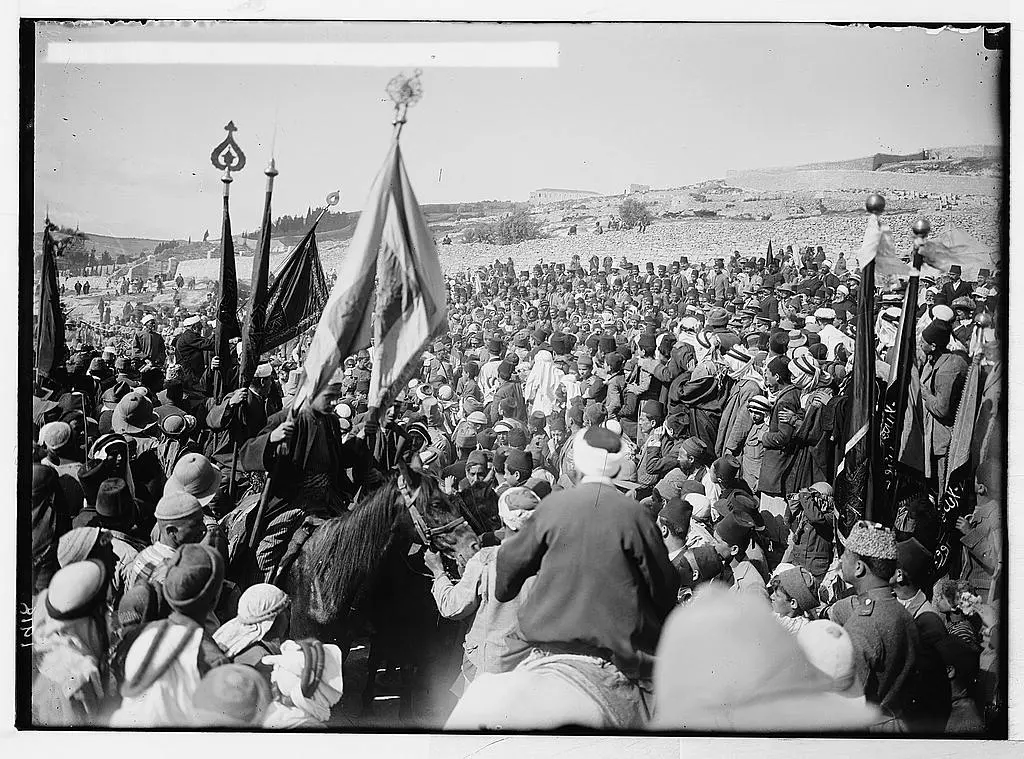
Palestinian folk seasons (mawasim) were annual mass pilgrimages to the shrines of prophets and saints that, over the centuries, became festivals combining worship, celebration and trade. The best known were the Nabi Musa season near Jericho in spring, the Nabi Rubin season south of Jaffa in summer, and the Nabi Salih season near Ramla. Alongside them, Palestinians celebrated the Nabi Yusha season in Galilee, the feast of al-Khader near Bethlehem, Arba'at Ayyub (the Wednesday of Job), and dozens of mawalid for village saints. [1] [2]
These seasons began in the Mamluk era and lived on for centuries, until the 1948 Nakba drove out the people who celebrated some of them and cut off others, and the 1967 occupation completed what the Nakba had begun. This article presents the Palestinian seasons one by one: where they were held, when, how people celebrated them, and what became of them.
The Palestinian Seasons at a Glance
| Season | Location | Timing | Duration | What happened to it |
|---|---|---|---|---|
| Nabi Musa | Near Jericho, on the road from Jerusalem | Spring, on the Friday before Orthodox Good Friday | About a week | Banned for a long time after 1967, then permitted on a limited scale [2] |
| Nabi Rubin | South of Jaffa, Ramla district | Mid-August to mid-September | About a month | Ended with the Nakba; the village was depopulated in 1948 [1] |
| Nabi Salih | Near Ramla | April | 3 to 5 days | Ended when the people of Ramla were driven out in 1948 [1] |
| Nabi Yusha | Upper Galilee, Safad district | 15 Sha'ban | Not specified | Taken over by Zionist forces in 1948 [3] |
| Al-Khader | The Monastery of al-Khader near Bethlehem | May | Not specified | Declined after having been a regional occasion [4] |
| Arba'at Ayyub | Local springs | Just before the Nabi Rubin season | One day | Ended along with Nabi Rubin [4] |
| Sidna Ali | Al-Haram village, north of Jaffa | Summer | Not specified | The village was occupied in 1948 [5] |
What Is a Mawsim?
In Palestinian tradition, a mawsim (season) is an annual mass pilgrimage to the shrine of a prophet or saint, held on a fixed date, to which people from towns and villages set out in processions carrying banners. During the season, dhikr circles and prayers were held alongside markets, cafés, dabke, horse races and folk performances, bringing faith and celebration together. [2]
The season was also a major social occasion: vows were fulfilled, animals were slaughtered to feed visitors, boys were circumcised near the shrines, and families met and got to know one another. [2]
How Did the Seasons Begin?
Palestinian historian Mahmoud Yazbak traces the great seasons to the late thirteenth century, when the Mamluks began organizing mass pilgrimages on fixed dates at Muslim shrines, with the authorities organizing and fully funding them. [1]
Yazbak cites several motives: [1]
- Asserting a Muslim presence in Jerusalem: Easter processions drew large crowds of Christian pilgrims, so the seasons were held at the same time of year to affirm the city's Islamic character.
- Mobilizing against the Crusaders: rallying popular support for the war and affirming the rulers' legitimacy as defenders of the faith.
- Protecting the coast: shrines near the sea, such as Nabi Rubin and Ali ibn 'Ulaym, provided a local presence that could raise the alarm against any seaborne invasion.
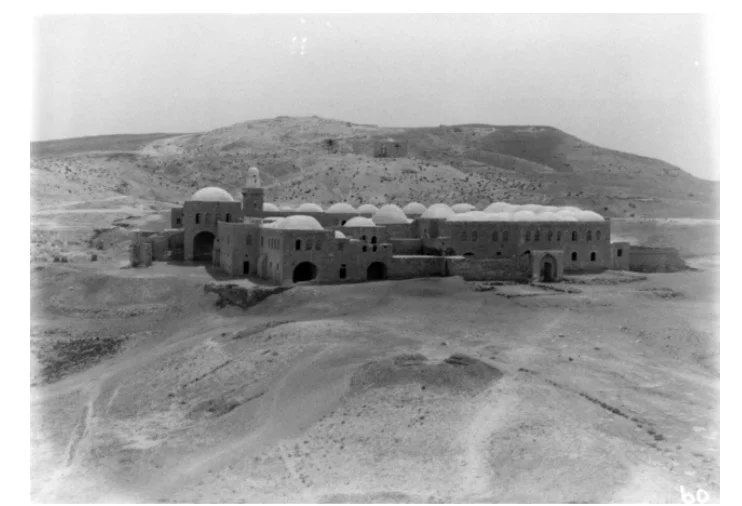
In this context, Sultan al-Zahir Baybars built the shrine of Nabi Musa in the 1260s, and raised a shrine over the tomb of Ali ibn 'Ulaym at Arsuf. [1]
Shared Features: Banners, Music and Vows
The Palestinian seasons shared common features: [2]
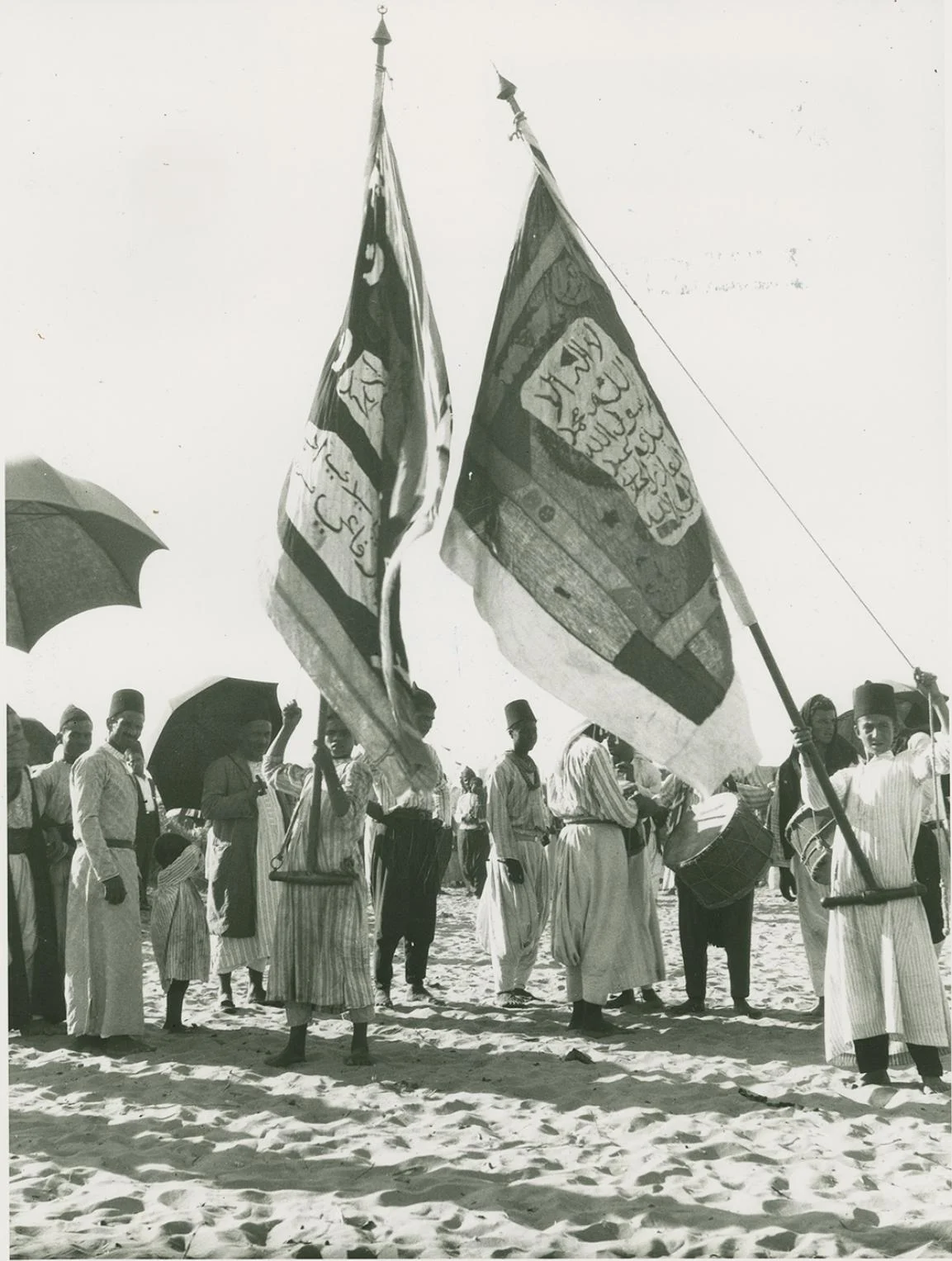
- Banners: each prophet or saint had a banner carried by followers of the Sufi orders. Well-known banners included those of Sheikh Atif, Sheikh al-Qazzaz, Sheikh Ali al-Sharif and Sheikh Jarrah.
- The herald and the kettledrum: a herald (najjab) announced a sheikh's arrival by beating the naqqara, and dervishes and Sufis greeted him with drums and chanting while shots were fired into the air.
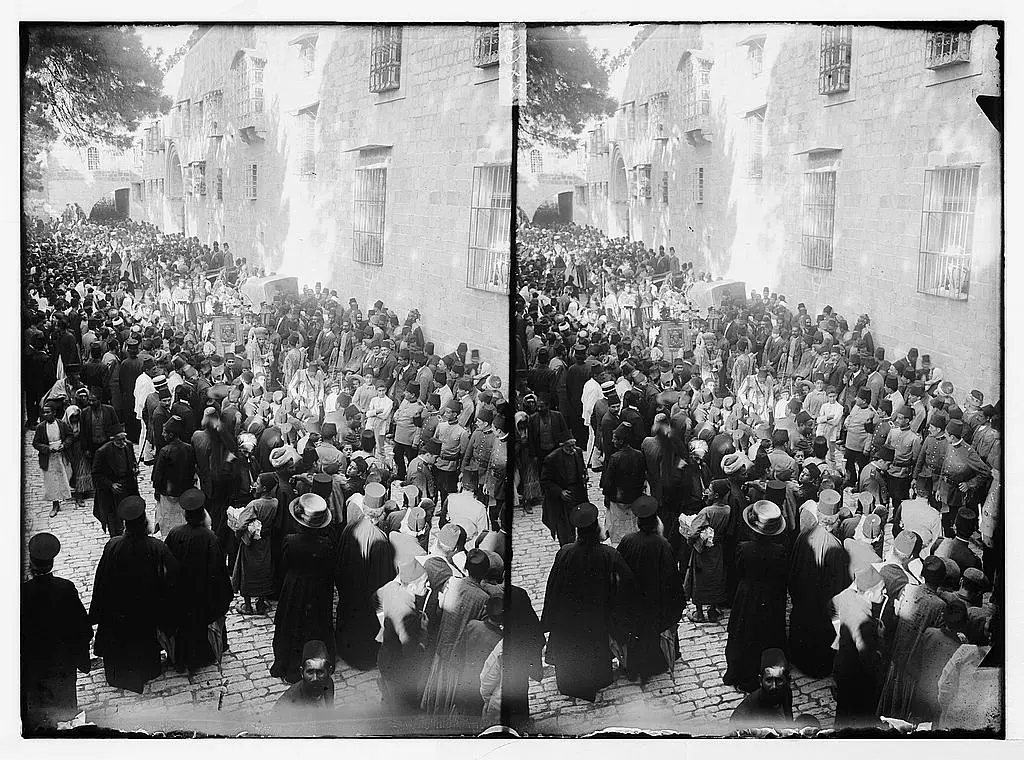
- Processions: they moved to drums, music and dabke, with people lining the roads and rooftops. Because the procession set out at midday, people carried parasols, which earned the Nabi Musa procession the popular name "Eid al-Shamasi" (the Feast of Parasols).
- Food and vows: feasts were cooked in large quantities, and animals were slaughtered in fulfillment of vows to feed the visitors.
- Women: they watched the processions from balconies or joined the celebrations in the shrine courtyards, usually accompanied by a relative.
- Circumcision: boys' circumcision ceremonies were held near the shrines for blessing.
The Nabi Musa Season
The Nabi Musa season was the largest and best-known Palestinian season. The shrine stands in the wilderness about 8 kilometers south of Jericho and 28 kilometers from Jerusalem. The season began on the Friday before Greek Orthodox Good Friday, usually in April, and lasted about a week. [2]
The Procession From Jerusalem
The procession set out from Jerusalem, with the al-Husseini family carrying the "Banner of Nabi Musa," made of green velvet embroidered with gold thread and bordered with black silk. The Mufti of Jerusalem and the city's notables took part, and the mayor and members of the municipal council bid the procession farewell at Ras al-Amud. [2]
Delegations and Visitors
Delegations arrived at the shrine in waves: the people of Hebron and the young men of Nablus, Jerusalem's notables and Sufis, the Adwan tribe, the Bedouin of al-Dawayek, and the people of Jericho. Visitors could number up to about 150,000. [2]
Food and Festivities
The al-Husseini family provided about 300 kilograms of meat a day, and the al-Yunis family a similar amount, with two meals served daily to visitors. The season's activities included sword-and-shield displays, dancing and dabke, puppet shows and shadow theater, horse racing and stick throwing, markets, cafés and dhikr circles. [2]
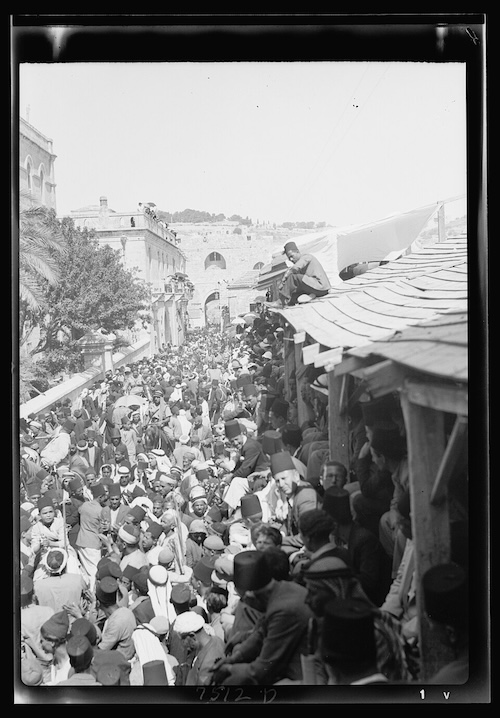
For the full story of the shrine's history and architecture, the season's rituals and the threats it faces today, read our article The Shrine of Nabi Musa.
The Nabi Rubin Season
The Nabi Rubin season was the second of the great seasons and the longest of them all. It was held every summer at the shrine of Nabi Rubin on the south bank of the Rubin River, south of Jaffa, and lasted about a month. Its procession set out from Jaffa carrying banners, and its visitors stayed in a tent city on the sand, numbering 40,000 to 50,000 after World War I. [1]
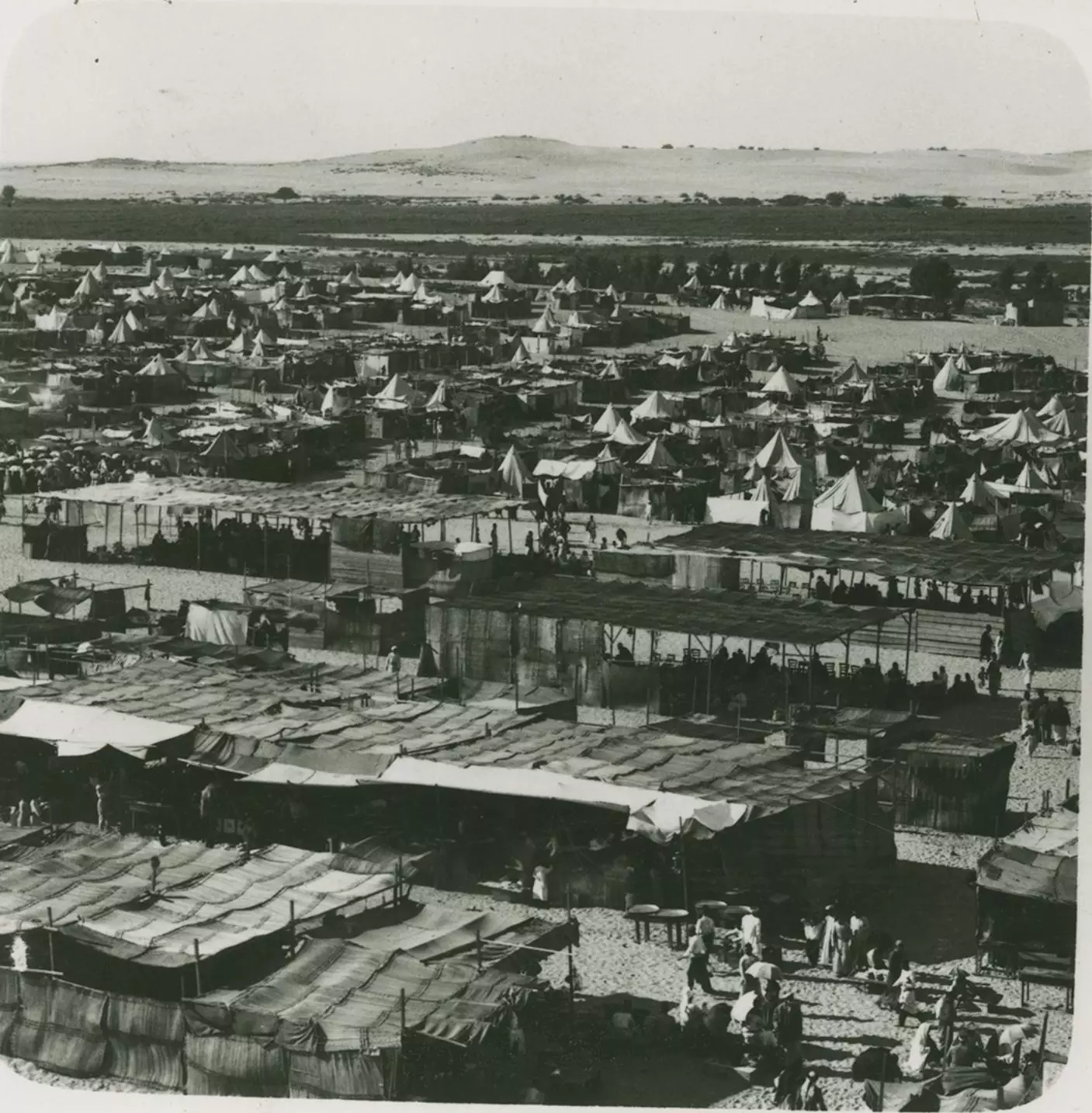
Over time the season became more of a summer resort than a religious pilgrimage, with theater, cinema, music, swimming, horse racing and wrestling. [1] [4] Accounts describe the women of Jaffa running into the sea in search of blessing, and the season also drew visitors from outside the Muslim community. [4]
For the full story, read our article on the Nabi Rubin season.
The Nabi Salih Season in Ramla
The Nabi Salih season near Ramla was the third of the great seasons in Palestine, after Nabi Musa and Nabi Rubin, and somewhat smaller than both. It was held in April and lasted three to five days, and the roads to and from the shrine were crowded with pilgrims. [1]
It was held in the same month as the Nabi Musa season, within the same Mamluk rationale: affirming a Muslim presence in spring, when Easter drew Christian pilgrims to the country. [1]
The Nabi Yusha Season in Galilee
In the far reaches of Upper Galilee, about 17 kilometers from Safad, the village of al-Nabi Yusha grew up around a shrine believed to be the tomb of the Prophet Joshua (Yusha). It was founded in the late eighteenth century by the al-Ghul family, the shrine's custodians, who built a mosque and a guesthouse for visitors. [3]
The villagers held an annual season on the 15th of Sha'ban, similar to the Nabi Rubin season. The village was small, with 70 residents in 1944–1945. [3]
The Feast of al-Khader: A Season Shared by Muslims and Christians
In the village of al-Khader near Bethlehem, the Monastery of Saint George (al-Khader) hosted a celebration every May attended by Palestinians, Muslims and Christians alike. The saint's mother is said to have come from Lydda, which gave the pilgrimage special standing among Palestinians. Before 1948 it was a regional occasion that drew thousands from near and far. [4]
Al-Khader is an example of what researchers call Palestine's "shared worlds": holy places visited by followers of different faiths who share their symbols and rituals. [4]
Arba'at Ayyub (the Wednesday of Job)
Just before the Nabi Rubin season, Palestinians celebrated Arba'at Ayyub, the Wednesday of Job, going out to local springs to perform songs and dances associated with fertility and blessing. [4]
The Shrine of Sidna Ali at al-Haram
On the coast north of Jaffa, the village of al-Haram grew up around a large shrine that people from across Palestine visited every summer to pray, perform rituals and collect souvenirs. [5] The Interactive Encyclopedia of the Palestine Question attributes the shrine to al-Hasan ibn Ali, a descendant of the Caliph Umar ibn al-Khattab, who died in 1081 CE. [5] The place is popularly known as "Sidna Ali," and Yazbak notes that Baybars built a shrine over the tomb of Ali ibn 'Ulaym at Arsuf. [1]
The shrine still stands, with its arched porticos and minaret, but the village cemetery overlooking the sea has become a parking lot. [5]
Nabi Yusuf, Nabi Samwil and the Saints' Mawalid
Besides the great seasons, Palestinians held smaller seasons at other shrines: [2]
- Nabi Yusuf: in Balata, east of Nablus.
- Nabi Samwil: in the village next to Jerusalem.
Villages also held mawalid for their saints. Among the shrines that were visited: [2]
- Sheikh al-Qatrawani, between Birzeit and Atara.
- Abu Hurayra, in Wadi al-Shari'a.
- Ahmad al-Karaki al-Tayyar, in al-Qastal.
- Sheikh Yasin, in Deir Yassin.
- Sheikh Abd al-Aziz, near Beit Surik.
- Sheikh al-Nuran, between al-Shallala and Khan Younis.
- Sheikh Jarrah and Sheikh Saad, in Jerusalem.
From Religious Season to National Occasion
Under the British Mandate, the seasons changed. In the 1930s and 1940s, the Nabi Rubin processions took on a nationalist character, with political slogans and Palestinian flags. [1] The Nabi Musa season likewise became a national occasion through which Palestinians expressed their identity. [6]
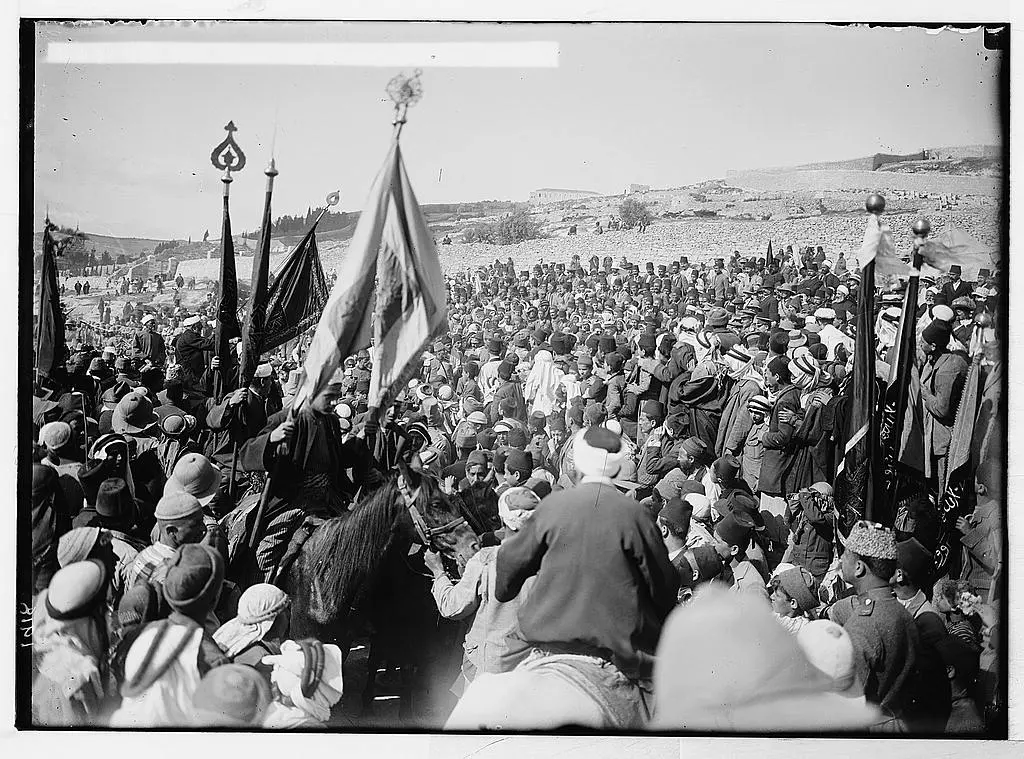
At the same time, the Mandate authorities began barring followers of each faith from attending the others' feasts in the name of "public order." Researcher Alex Shams argues that this bureaucratic management of religion gradually weakened the shared feasts that had brought Palestinians together. [4]
The Nakba and the Occupation: The End of the Seasons
The 1948 Nakba cut off the coastal and northern seasons: [1] [2] [3] [5]
- Nabi Rubin: last held in 1946; the people of Jaffa, Ramla and Lydda were driven out, the village's residents were expelled on June 1, 1948, and the shrine was turned into an exclusively Jewish site.
- Nabi Salih: ended when the people of Ramla were driven out in 1948.
- Nabi Yusha: the Haganah captured the village police station in May 1948, Israeli forces reached the village in October during Operation Hiram, and the shrine was left neglected behind barbed wire.
- Sidna Ali: the village of al-Haram was occupied before May 15, 1948.
Then came the 1967 occupation: [2]
- Nabi Musa: the season was banned for a long time, then permitted on a much smaller scale.
- Nabi Yusuf: Balata was occupied, and the shrine became a settler site.
- Nabi Samwil: the village was occupied and later confiscated.
Read more on our site: The Shrine of Nabi Musa, our article on the Nabi Rubin season, and our article on Jaffa before the Nakba.
Conclusion
The folk seasons were another calendar of Palestinian life: Nabi Musa and Nabi Salih in spring, Nabi Rubin in summer, al-Khader in May, and the saints' mawalid throughout the year. In them, faith met joy, city met village, and Muslim met Christian. When the Nakba came, it was not only the rituals that ended; the society that kept them alive was scattered, and the shrines remained as witnesses to a time when Palestine celebrated.
Frequently Asked Questions About Palestinian Folk Seasons
What are the Palestinian folk seasons (mawasim)?
They are annual mass pilgrimages to the shrines of prophets and saints, held on fixed dates, combining prayers and dhikr circles with processions, markets, dabke and horse racing. The best known are the seasons of Nabi Musa, Nabi Rubin and Nabi Salih.
What were the best-known Palestinian seasons before the Nakba?
The best known were the Nabi Musa season near Jericho in spring, the Nabi Rubin season south of Jaffa in summer, and the Nabi Salih season near Ramla in April. Others included Nabi Yusha in Galilee, the feast of al-Khader near Bethlehem, and Arba'at Ayyub.
When did the seasons begin in Palestine?
The great seasons began in the late thirteenth century, when the Mamluks organized mass pilgrimages on fixed dates at Muslim shrines. Sultan Baybars built the shrine of Nabi Musa in the 1260s.
Why is the Nabi Musa season held in spring?
It is held on the Friday before Greek Orthodox Good Friday. Historian Mahmoud Yazbak argues that the Mamluks tied it to the Easter season to assert a Muslim presence in Jerusalem when Christian processions drew large crowds.
What is the feast of al-Khader?
It is an annual celebration in May at the Monastery of Saint George (al-Khader) in the village of al-Khader near Bethlehem, attended by Palestinians, Muslims and Christians alike. Before 1948 it was a regional occasion that drew thousands.
What happened to the Palestinian seasons after the Nakba?
The seasons of Nabi Rubin, Nabi Salih, Nabi Yusha and Sidna Ali ended when their people were driven out in 1948. After the 1967 occupation, the Nabi Musa season was banned for a long time and then permitted on a limited scale, and the shrines of Nabi Yusuf and Nabi Samwil were seized.
Sources and References
Arabic-language sources are listed with translated titles.
- Mahmoud Yazbak, "The Muslim Festival of Nabi Rubin in Palestine: From Religious Festival to Summer Resort," Holy Land Studies 10, no. 2 (2011).
- Muhammad Hussein al-Sheikh, "Nabi Musa and the Pilgrimage Seasons: Palestinian Rituals of Joy Before the Occupation," Noon Post, April 16, 2025 (Arabic), drawing on Tawfiq Canaan, Kamil Jamil al-Asali and Walid Khalidi.
- Interactive Encyclopedia of the Palestine Question: al-Nabi Yusha' (Safad district).
- Alex Shams, "Between al-Khader and Nabi Rubeen: Religious Pilgrimage and Palestinian Shared Worlds of Meanings," Jerusalem Quarterly, no. 63–64.
- Interactive Encyclopedia of the Palestine Question: al-Haram (Jaffa district).
- Palestinina: The Shrine of Nabi Musa (Arabic).
More from the archive
 Download Our Palestine App
The whole archive in the palm of your hand: depopulated villages, the Nakba, the massacres and Al-Aqsa — free, with no ads to erase the story.



Comments
No comments yet — be the first to write one.
Add your comment
Name and email are optional. Comments appear after review.