
Olive Harvest in Palestine: Traditions, Al-Ouneh and Settler Attacks in 2026
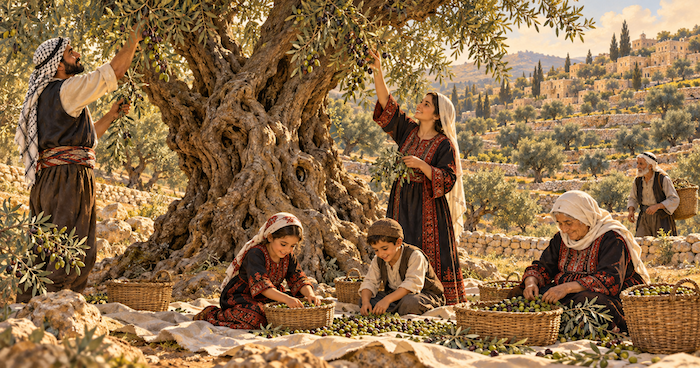
The olive harvest in Palestine is more than farm work. It is a family festival that brings relatives and neighbours together under the trees from dawn until sunset. In October and November, homes empty out, fields fill up, and the smell of fresh oil becomes the smell of the whole village.
This article covers the Palestinian olive harvest season: when it starts, how olives are picked, what the tradition of al-Ouneh means, how olives become oil in the old stone press and the modern mill, and the food, proverbs and songs tied to the season. It also documents how Israeli settlers are stealing the harvest and uprooting trees in 2026.
When Does the Olive Harvest Start in Palestine?
The olive harvest usually starts in mid-October and runs until late November, with small differences between regions depending on altitude and weather. Many farmers wait for the first autumn rain before picking, because it washes the dust off the fruit and increases its oil content.
Yields change from year to year. Olive trees bear heavily one year and lightly the next, a pattern known as alternate bearing.
Al-Ouneh: When the Whole Village Harvests Together
Al-Ouneh (العونة) is an old Palestinian tradition of mutual help. Relatives and neighbours pick one family's olives together, then move on to the next family's land. Nobody is paid. The help is a debt of goodwill, returned in the same season.
Everyone takes part:
- Men and young people climb the trees and pick the high branches.
- Women pick the lower branches, gather the olives from the ground sheets, and prepare food.
- Children collect the olives scattered on the ground, a task called al-talqeet.
In many villages, schools used to close for several days during the season so students could help their families.
How Are Olives Harvested?
- Spreading the sheets: Large cloths or tarps are laid under the tree to catch the falling olives.
- Picking by hand: Pickers strip each branch from top to bottom with their hands. This is the best method because it does not harm the tree.
- Ladders and sticks: Ladders reach the high branches. Some farmers beat the branches with sticks, although this breaks the buds that would bear fruit the following year.
- Cleaning: Leaves and small twigs are separated from the fruit.
- Bagging: The olives go into burlap sacks and are taken to the mill within a few days, before they spoil and the oil's acidity rises.
From the Stone Press to the Modern Mill
Before modern mills, olives were crushed in the bad (البدّ): a huge round millstone turning on a flat stone base, pulled by a horse, mule or camel. The resulting paste was packed into straw baskets and pressed until the oil ran out. Remains of old stone presses still stand in many Palestinian villages.
Today, modern mills press olives in a few hours. Families still wait their turn at the mill for hours, tasting the new oil there with hot bread.
The oil is stored in metal tins or in clay jars called khawabi. It lasts the household a full year, and part of it is sent as gifts to relatives in the cities and abroad.
What Palestinians Make from Olives
- Olive oil: The base of Palestinian cooking, eaten every morning with bread and za'atar.
- Cracked green olives (marsous): Green olives cracked with a stone, then pickled in water, salt, lemon and chili.
- Slit olives (mjarrah): Cut with a knife instead of cracked, and pickled the same way.
- Black olives: Picked fully ripe and cured in salt.
- Soap: Nablus has been famous for olive oil soap for hundreds of years.
- Jift: The pressed pulp left after milling, compacted and used as fuel for heating and for the taboon oven.
- Olive wood: Carved in Bethlehem into ornaments, prayer beads and crosses.
Food of the Harvest Season
Harvest food is simple and eaten under the trees. Families carry a packed meal called al-zuwwadeh to the fields: taboon bread, oil and za'atar, tomatoes and cucumbers, cheese and labneh, and a kettle of sage tea boiled over a fire of olive twigs.
When the new oil arrives from the mill, families celebrate with musakhan: taboon bread soaked in fresh oil and topped with onions, sumac and chicken. For many Palestinians, musakhan is the taste of the olive season.
Proverbs and Songs About Olives
Olives hold a large place in Palestinian folk proverbs:
- "Al-zeit imad al-beit" (Oil is the pillar of the home): a house with oil never goes hungry.
- "Al-qamh wal-zeit sab'een fil-beit" (Wheat and oil are seventy in the house): whoever has wheat and oil has everything.
- "Kul zeit w'intah il-heit" (Eat oil and butt the wall): olive oil gives the body strength.
Women sang dal'ouna and ataba songs while picking. One of the best known lines is:
Ala dal'ouna, ala dal'ouna
Zaytoun bladi ajmal ma yakouna
(The olives of my homeland are the most beautiful there can be)
Palestinian Olive Varieties
- Nabali: The most widespread variety in Palestine. Its oil is rich, and it is also good for pickling.
- Souri: Named after the city of Tyre (Sour). Its oil has a strong flavour, and it is common in northern Palestine.
- Roumi: The name farmers give to very old trees, which they say date back to Roman times.
Ancient Olive Trees
Palestine has olive trees estimated to be hundreds or even thousands of years old, still bearing fruit today. One of the most famous is the al-Badawi tree in the village of al-Walaja near Bethlehem. Some researchers estimate its age at several thousand years, which would make it one of the oldest olive trees in the world.
For Palestinians, the olive tree is not only a source of income. It is a witness to their presence on the land, generation after generation.
The Olive Harvest Under Occupation
In many villages the season has turned from a festival into a confrontation. The Israeli occupation bars farmers from reaching land near settlements and behind the separation wall except with permits for a limited number of days. Farmers face attacks by Israeli settlers, from beatings to crop theft and the burning of trees. Palestinian sources estimate that hundreds of thousands of olive trees have been uprooted since 1967.
The 2026 Season: Stolen Harvests and Uprooted Trees
Settler attacks peaked at the start of the 2026 harvest. The figures below come from Palestinian and UN reports up to 10 October 2026:
- About 28,000 trees and seedlings, mostly olive, were uprooted by settlers between October 2025 and September 2026, according to UN OCHA figures cited by the National Office for Defending Land and Resisting Settlement.
- 647 settler attacks were recorded in September 2026 alone, affecting 14,600 trees, including 9,334 olive trees, according to the Colonization and Wall Resistance Commission.
- Between 220,000 and 230,000 dunams of olive land are cut off behind the wall or near settlements, reachable by their owners only with permits, according to Palestinian Ministry of Agriculture data cited by the Settlement Observatory.
In the first weeks of the season, settlers stole olives in Deir Ibzi' west of Ramallah, in Jenin-area villages including Kafr Ra'i, Faqqu'a, Deir Abu Da'if and Ya'bad, and in Abu Injim near Bethlehem. They burned about 55 old olive trees in Abu Dis and set trees on fire in Wadi al-Sha'er near Salfit. Farmers and international solidarity activists were beaten, shot at and pepper-sprayed, and several Palestinians were killed by settler gunfire, according to the National Office's weekly report.
In Gaza, the genocide has put about 90% of olive land out of use, and olive oil production has fallen from about 5,000 tons to roughly 700 tons, according to the National Office.
Still, every autumn farmers return to their land, and where a tree is uprooted, they plant a new one.
To understand the place of land in Palestinian life before 1948, read Palestinian Agriculture Before the Nakba.
Frequently Asked Questions
When is the olive harvest in Palestine?
From mid-October to late November, starting slightly earlier or later depending on the region and the weather.
What is al-Ouneh?
A Palestinian tradition in which relatives and neighbours help each family pick its olives in turn, without pay, returning the favour within the same season.
What is a "bad"?
The traditional olive press: a large round millstone pulled by an animal to crush the olives, after which the paste is pressed to release the oil.
What is the most famous dish of the olive season?
Musakhan, because it is made with the fresh oil as soon as it comes from the mill.
Why do settlers attack the olive harvest?
The olive tree ties Palestinian families to their land. Attacks on the harvest, together with access restrictions, push farmers off land near settlements, which can then be seized.
Read more:
Share your story: How did your family spend the olive season? Is there a song or proverb you still remember from harvest days? Write it in the comments with the name of your village.
More from the archive
 Download Our Palestine App
The whole archive in the palm of your hand: depopulated villages, the Nakba, the massacres and Al-Aqsa — free, with no ads to erase the story.
Download Our Palestine App
The whole archive in the palm of your hand: depopulated villages, the Nakba, the massacres and Al-Aqsa — free, with no ads to erase the story.



Comments
No comments yet — be the first to write one.
Add your comment
Name and email are optional. Comments appear after review.