
Jerusalem before the Nakba: Markets, Schools and City Life
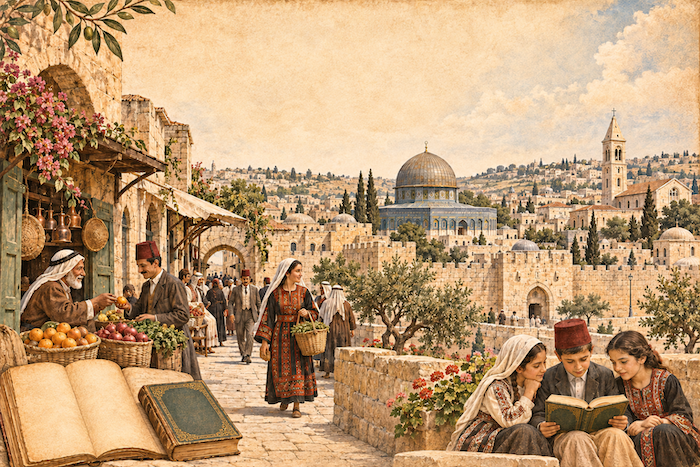
In Jerusalem before the Nakba, the road to market passed a school, a bakery, a monastery and a mosque. From the Old City gates, people moved out to the new neighbourhoods beyond the walls and to the villages that supplied the city with food, labour and kinship. Jerusalem was a holy city, but it was also a city where its people lived, learned and traded. [1][2]
Then came the Nakba. Zionist forces attacked the Arab neighbourhoods of western Jerusalem and the surrounding villages; some 60,000 Palestinians were driven from the city, Jerusalem was divided, and nineteen years later Israel occupied its eastern half as well. [3]
Contents
- Jerusalem before the Nakba at a glance
- One city before “East” and “West”
- The Old City: homes and markets around the holy sites
- Markets: from village to shop
- Roads and the railway
- Schools: a city where Palestine studied
- The Khalidi Library
- Press and photography
- “This Is Jerusalem”: Palestine Radio
- Women: education and national organizing
- Health
- The municipality and the Mandate
- The Nakba: uprooting the people and dividing the city
- From the Nakba to occupation: Jerusalem after 1967
- Timeline
- Frequently asked questions about Jerusalem before the Nakba
Jerusalem before the Nakba at a glance
| Item | Details |
|---|---|
| Location | The central Palestinian highlands, at roads linking it to Jaffa, Nablus, Hebron and Transjordan |
| Administrative status | Centre of a district reporting directly to Istanbul in the late Ottoman period, then seat of the British Mandate administration |
| Urban fabric | The Old City and growing Arab neighbourhoods outside the walls, including Talbiyeh, Qatamon, Baq‘a and Musrara |
| Institutions | The Arab College (1918), the Khalidi Library (1900), Palestine Radio (1936) |
| In the Nakba | Some 60,000 Palestinians expelled, the western neighbourhoods seized, 38 villages in the Jerusalem district destroyed |
| Occupation of the east | 7 June 1967, annexed on 28 June 1967 |
One city before “East” and “West”
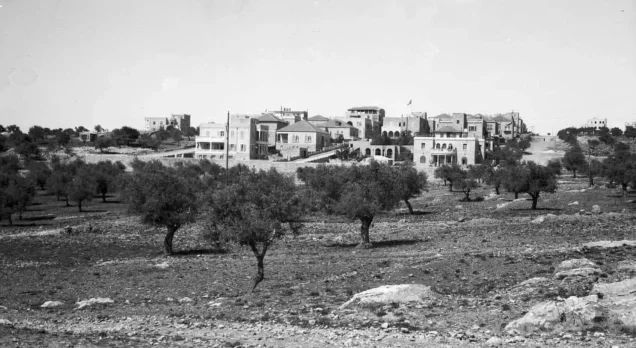
The division of Jerusalem into east and west, imposed by the 1948 war, was not the map its people lived by. The Old City and the neighbourhoods beyond its walls were bound together by work, markets, institutions and family visits. [1]
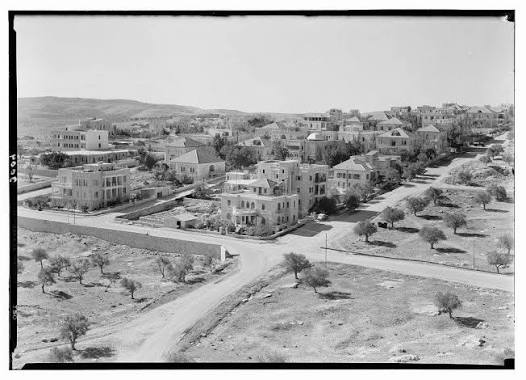
In the nineteenth and early twentieth centuries the city spread beyond its walls, and Palestinians built neighbourhoods such as Talbiyeh, Qatamon, Baq‘a and Musrara. This was the growth of a single city, not the start of two separate ones. [1]
Read also: West Jerusalem before the Nakba: Qatamon, Talbiyeh and Baq‘a.
The Old City: homes and markets around the holy sites
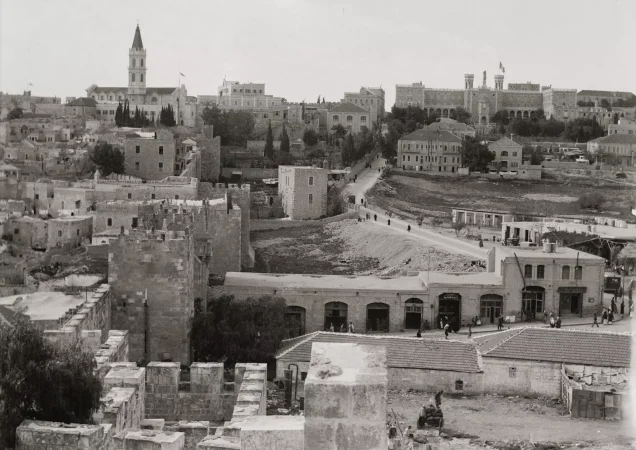
Al-Aqsa Mosque, the Dome of the Rock, the Church of the Holy Sepulchre, churches, monasteries and synagogues stand side by side in Jerusalem, surrounded by homes, shops, libraries, endowments and cemeteries; religious life was part of an inhabited city and everyday relationships. [3][8]
Historical photographs preserve the roads out of Damascus Gate, the Cotton Merchants’ Market and the shops near Jaffa Gate, restoring the city’s people and goods. Historian Falestin Naïli notes that the early-twentieth-century Ottoman census recorded mixed quarters in the Old City, and that its later division into “religious quarters” obscured this intermingling. [9][10][2]
Markets: from village to shop

Photographs of Jerusalem’s markets show stalls of grapes, pomegranates, dates and watermelons; produce came into the city from its villages, and the market brought farmer, trader and buyer together. [11]
A photograph in the Library of Congress records the shops of David Street inside Jaffa Gate between about 1920 and 1933, with their fronts, signs and customers. [10]
Read also: Markets and trade in Palestine before 1948.
Roads and the railway

Roads linked Jerusalem to the towns of Palestine and to Transjordan, and the opening of the Jaffa–Jerusalem railway in 1892 gave travellers a new route between coast and highlands. The National Army Museum in London holds a 1920 photograph of Jerusalem station. [12]
Schools: a city where Palestine studied

Jerusalem had community, government and religious schools. Among its leading institutions was the Arab College, founded in 1918 as a teacher-training college; it drew students from towns and villages across Palestine, and its graduates shaped education, literature and public life. [4]
A graduate’s recollections describe life there: classes, a library and a laboratory, boarding, shared meals and sport. In 1934 the college moved from rented buildings near Herod’s Gate to its own campus on Jabal al-Mukabbir. [4]
Read also: Palestinian education before 1948.
The Khalidi Library
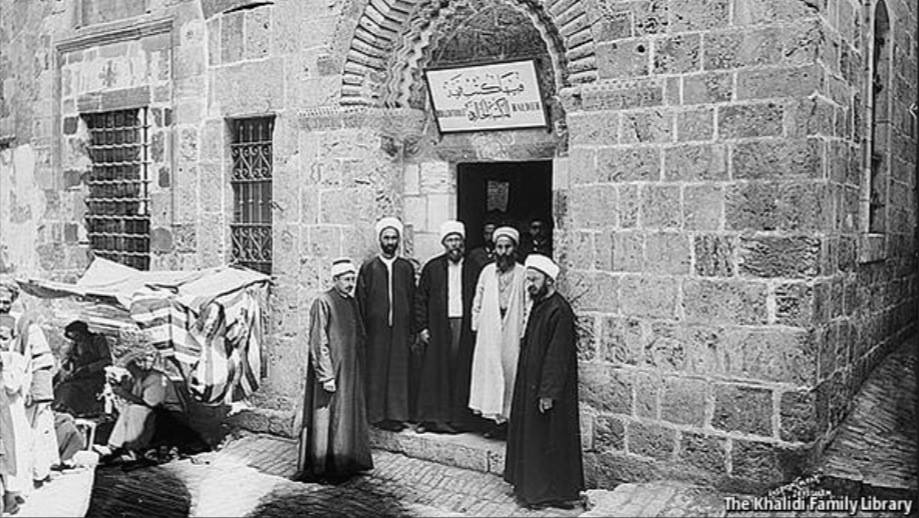
On Bab al-Silsila Street, the Khalidi Library was founded in 1900 on the initiative of Hajj Raghib al-Khalidi; its published history describes it as the first Arab public library in Palestine founded by private initiative. It held manuscripts, books and family papers in historic endowment buildings. [5]
Press and photography

The magazine Dar al-Mu‘allimin first appeared in 1920, later took the name al-Kulliyya al-‘Arabiyya, and continued until 1948, a sign of the link between education and publishing. [13]
The American Colony collection at the Library of Congress holds photographs of the city and of Palestinians, their work and dress, taken by photographers including the Palestinian Hanna Safieh. [9]
“This Is Jerusalem”: Palestine Radio

Palestine Radio began broadcasting from Jerusalem in 1936, a Mandate institution broadcasting in Arabic, English and Hebrew, so the city’s name became a voice heard far beyond it. [6]
Its Arabic section employed the poet Ibrahim Tuqan, Ajaj Nuwayhid and others, offering literature, music and talks under Mandate censorship, and people listened in cafés, homes and guest houses. [6]
Women: education and national organizing
On 26 October 1929 the first Palestinian Arab Women’s Congress met in Jerusalem, bringing together women from across the country; it demanded the repeal of the Balfour Declaration and a national government, linking women’s activism to resistance against British policy and the Zionist project. Matiel Mogannam helped organize it and served as its English-language secretary. [14][15]
Read also: Palestinian women before the Nakba.
Health
Among the medical institutions before the Nakba was St John Eye Hospital, established in its modern form in 1882 when eye disease was widespread in Jerusalem; it expanded its services in the early twentieth century despite a pause during the First World War. [16]
Read also: Medicine and health in Palestine before the Nakba.
The municipality and the Mandate

Jerusalem had a municipal council from the 1860s, and in the late Ottoman period its work expanded to lighting, sanitation and public facilities beyond the walls. [2]
Under the Mandate, the British administration took planning powers away from the municipality and drew its boundaries in a way that boosted the number of Jews inside them; within those boundaries the city had about 97,000 Jews and 61,000 Palestinians in the late 1940s, while most surrounding Arab neighbourhoods and villages were left outside. [2][3]
The Nakba: uprooting the people and dividing the city
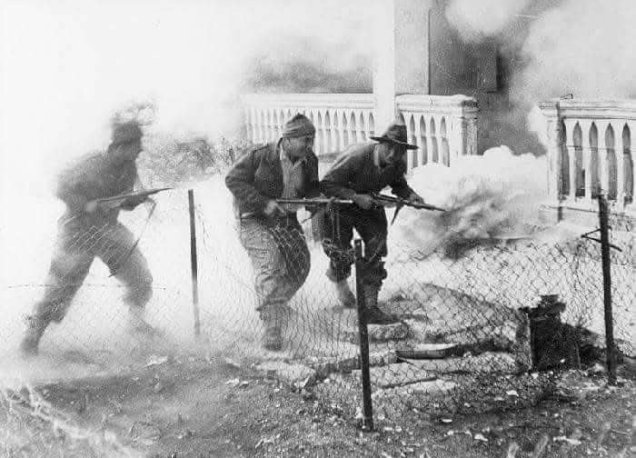
Partition Resolution 181 of 1947 recommended a special international regime for Jerusalem, but Zionist forces moved quickly to seize the city and its surroundings. At dawn on 9 April 1948 the Irgun and Stern gangs, backed by the Palmach and Haganah, carried out the Deir Yassin massacre about a kilometre from Jerusalem’s western neighbourhoods, killing some 254 Palestinians according to Palestinian sources. [17][18]
Some 60,000 Palestinians were driven from Jerusalem; the neighbourhoods of Baq‘a, Talbiyeh, Musrara, Abu Tor, the German Colony and Qatamon were emptied of their people, and 38 villages in the Jerusalem district were destroyed. Israel occupied the western part of the city, while the Old City and the east remained under Jordanian administration. [3][7]
The loss went beyond homes: the links between home, work, school and market were severed, and a military line divided places that had been a few steps apart. [3]
Read also: West Jerusalem before the Nakba; Massacres archive; Depopulated villages.
From the Nakba to occupation: Jerusalem after 1967
On 7 June 1967 Israel occupied the Old City and East Jerusalem; on 28 June it annexed them to the West Jerusalem municipality, and in August 1980 the Knesset passed a law declaring “complete and united” Jerusalem its capital. [3][19]
The Security Council rejected the annexation in Resolutions 252 (1968) and 478 (1980), and in 2024 the International Court of Justice affirmed that Israel’s continued presence in the occupied Palestinian territory, including East Jerusalem, is unlawful. [19][20]
Today some 333,600 settlers live in Jerusalem’s settlements, while al-Aqsa Mosque faces repeated raids and violations of international law. [21][22]
Jerusalem thus carries two memories: that of a city its people lived in, with its markets, schools and libraries, and that of the uprooted who still keep the keys to their homes in Qatamon, Talbiyeh and Baq‘a.
Timeline
| Year | Event |
|---|---|
| 1860s | A municipal council established [2] |
| 1882 | St John Eye Hospital founded in its modern form [16] |
| 1892 | Jaffa–Jerusalem railway opens [12] |
| 1900 | Khalidi Library founded [5] |
| 1918 | Arab College founded [4] |
| 26 October 1929 | First Palestinian Arab Women’s Congress [14] |
| 1936 | Palestine Radio begins broadcasting from Jerusalem [6] |
| 9 April 1948 | Deir Yassin massacre [18] |
| 1948 | Some 60,000 Palestinians expelled, western neighbourhoods seized, city divided [3] |
| 7 June 1967 | Occupation of the Old City and East Jerusalem [3] |
| August 1980 | Knesset annexation law; rejected by Security Council Resolution 478 [19] |
Frequently asked questions about Jerusalem before the Nakba
Was Jerusalem divided into east and west before 1948?
No. Its neighbourhoods inside and outside the walls were parts of one city; the 1948 war imposed the division. [1]
Who built West Jerusalem’s neighbourhoods?
Palestinians built neighbourhoods such as Talbiyeh, Qatamon, Baq‘a and Musrara beyond the walls in the nineteenth and early twentieth centuries. [1]
How many Palestinians were expelled from Jerusalem in 1948?
About 60,000, and the neighbourhoods of Baq‘a, Talbiyeh, Musrara, Abu Tor and Qatamon were emptied of their people. [3]
When was the Deir Yassin massacre?
On 9 April 1948, by the Irgun and Stern gangs with Palmach and Haganah support; some 254 Palestinians were killed. [18]
What is Jerusalem’s oldest Arab public library?
The Khalidi Library, founded in 1900 by Hajj Raghib al-Khalidi. [5]
When did Palestine Radio start broadcasting from Jerusalem?
In 1936; its Arabic section employed Ibrahim Tuqan and Ajaj Nuwayhid. [6]
When did Israel occupy East Jerusalem?
On 7 June 1967; it annexed it on 28 June 1967, an annexation rejected by the Security Council and international law. [3][19]
Read also on Palestinuna
- West Jerusalem before the Nakba
- The Palestinian Nakba
- Massacres archive
- Depopulated villages
- Palestine before the Nakba
Sources and references
- Jerusalem Story, “West Side Story, Part 1: Jerusalem East and West”.
- Falestin Naïli, “Jerusalem under the British Mandate: Confessionalisation and Division,” Middle East Institute, National University of Singapore.
- Institute for Palestine Studies – Interactive Encyclopedia, “Jerusalem”.
- Jerusalem Story, “The Arab College of Jerusalem, 1918–48: Recollections”.
- The Khalidi Library, “About the Khalidi Library”.
- Institute for Palestine Studies – Interactive Encyclopedia, “Palestine Radio, 1936–1948”.
- “69 Years since the Nakba of Jerusalem,” Al Jazeera Net, 15 May 2017 (in Arabic).
- UNESCO, “Old City of Jerusalem and its Walls”.
- Library of Congress, American Colony and Matson photograph collection.
- Library of Congress, “Stores inside Jaffa Gate,” c. 1920–1933.
- Jerusalem Story, “A Land in Bloom” photo album.
- National Army Museum, London, “Jerusalem Railway Station,” 1920.
- Jrayed Archive, “Dar al-Mu‘allimin / Arab College Magazine” (in Arabic).
- Institute for Palestine Studies – Interactive Encyclopedia, “Resolutions of the First Arab Women’s Congress of Palestine, 26 October 1929” (in Arabic).
- Institute for Palestine Studies – Interactive Encyclopedia, “Matiel Mogannam”.
- St John Eye Hospital, “Our Heritage”.
- United Nations, Resolution 303 on the international regime for Jerusalem.
- “The Deir Yassin Massacre,” Al Jazeera Encyclopedia (in Arabic).
- “Jerusalem According to International Resolutions,” Al Jazeera Net, 16 July 2016 (in Arabic).
- UN News, “ICJ: Israel’s Continued Presence in the Occupied Palestinian Territory Is Unlawful,” 19 July 2024 (in Arabic).
- Mais Abu Ghosh, “76 Martyrs since 2023: Where Are Settler Attacks Concentrated?” Al Jazeera Net, 15 September 2026 (in Arabic).
- “Legal Expert: How Israel Violates International Law at al-Aqsa,” Al Jazeera Net, 4 October 2023 (in Arabic).
More from the archive
 Download Our Palestine App
The whole archive in the palm of your hand: depopulated villages, the Nakba, the massacres and Al-Aqsa — free, with no ads to erase the story.



Comments
No comments yet — be the first to write one.
Add your comment
Name and email are optional. Comments appear after review.